


How an Electric Field Travels at 300,000 km/s with Almost Stationary Electrons
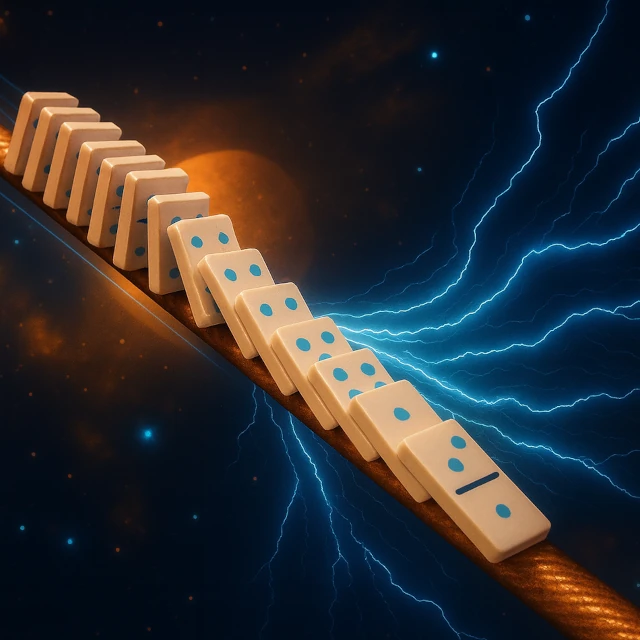
Illustration of the almost instantaneous propagation of an electric field in a copper wire, despite the slow drift velocity of electrons represented by dominoes knocking each other over.
Image source: astronoo.com (new window)
Scientific Summary
This article explains the difference between the drift velocity of electrons and the propagation speed of the electric field in a conductor. The drift velocity of electrons is very low (approximately 0.07 mm/s) because they are constantly slowed by collisions with the crystal lattice. In contrast, the electric field (or electrical signal) propagates as a collective wave at nearly 300,000 km/s (the speed of light). The domino analogy illustrates this phenomenon: the wave travels very fast while each domino (electron) moves only a little. Electricity therefore does not transport electrons from one end of the wire to the other; it is the field disturbances that are transmitted almost instantaneously.
How can an electric field travel at 300,000 km/s while electrons move so slowly?
In a conductor, the electron drift velocity is very low (about 0.07 mm/s) because they are constantly slowed down by collisions. In contrast, the electric field (or electrical signal) propagates as a collective wave at nearly 300,000 km/s (the speed of light). The domino analogy illustrates this: the wave moves very fast while each domino (electron) moves only a very short distance. Electricity does not transport electrons from one end of the wire to the other; it is the field disturbances that are transmitted almost instantaneously.
Also worth exploring
Continue your exploration of the Universe with these topics:
Propagation of the Collective Wave of the Field vs. the Slowness of Electrons
The Drift Velocity: Electrons in Slow Motion
In a conductor like copper, the free electrons of the metal move very slowly under the effect of an electric field, as they are constantly slowed down by Brownian collisions with the ions of the crystal lattice and the impurities of the metal. Their average drift velocity is about 0.07 mm/s, comparable to that of a snail. Yet, when an electric field is applied to the end of the wire, the electromagnetic disturbance propagates almost at the speed of light, about 300,000 km/s.
The Electric Signal Does Not Transport Electrons
Electricity does not consist of making electrons travel from one end of the wire to the other. When an electric field is applied, all the electrons in the conductor react at the speed of light, transmitting the disturbance instantaneously on a macroscopic scale.
The Domino Analogy: A Fast Wave, Slow Movements
One can imagine the electrons as reacting locally and almost instantaneously to the applied field, somewhat like a row of dominoes where the wave propagates very quickly, while each domino only moves a very short distance. In this way, the collective wave travels through the conductor almost at the speed of light from one end to the other, while the electrons themselves drift extremely slowly, at a speed comparable to that of a snail, traveling only a few millimeters per second.
Comparison of Speeds in a Conductor
| Phenomenon | Typical value | Comment |
|---|---|---|
| Drift velocity of electrons | ~ 0.07 mm/s | Extremely slow, due to frequent and disordered collisions in the crystal lattice |
| Propagation of the electric field | ~ 3 × 10⁸ m/s | Almost instantaneous, like an electromagnetic wave that propagates rapidly through the wire, long before the electrons themselves move |
| Average thermal velocity of electrons | ~ 105 m/s | Brownian motion, does not contribute to the net current |
FAQ: Everything about the speed of the electric field versus that of electrons
What is the difference between electron drift velocity and electric field propagation speed?
Electron drift velocity is the average speed at which electrons move through the conductor under the influence of the field. It is extremely slow (about 0.07 mm/s) due to collisions with crystal lattice ions. Electric field propagation is the speed at which the electromagnetic disturbance travels from one end of the wire to the other: about 300,000 km/s (speed of light).
Why do electrons move so slowly in a conductor?
Free electrons in a metal are constantly slowed down by Brownian collisions with crystal lattice ions, impurities, and material defects. These incessant collisions prevent them from accelerating linearly under the electric field. Their overall motion is therefore a slow drift, comparable to a snail's pace, even though their random thermal speed is very high (about 10⁵ m/s).
What is the domino analogy to understand this phenomenon?
The domino analogy is simple: line up dominoes. If you push the first one, the falling wave propagates very quickly along the row, but each domino only falls over a very short distance. Similarly, in an electrical wire, the electric field (the wave) propagates almost instantaneously (at 300,000 km/s) while each electron only moves very slowly (0.07 mm/s) over a short distance before transmitting the disturbance to its neighbor.
 Does the electron have a shape? The surprising answer of quantum physics
  String Theory: When Physics Breaks the Boundaries of Four-Dimensional Spacetime
  At the Heart of Matter: The Proton's Well-Kept Secrets
  How an Electric Field Travels at 300,000 km/s with Almost Stationary Electrons
  Why Doesn't Matter Pass Through Matter?
  Magnets: From the Small Fridge Magnet to Levitation Trains
  From Electron Spin to Magnetism: Emergence of Mini-Magnets
  Free electrons: from colliding balls to dancing waves
  Water Anomalies: A Common and Abundant Molecule in the Universe
  Heat and Temperature: Two Often Confused Thermal Notions
 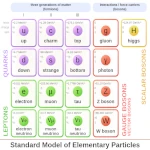 Electroweak Force: The Unification of Electromagnetism and the Weak Interaction
  Special Relativity: The Beginning of a New Physics
  The Higgs Boson: The Unification of Fundamental Forces
 Quantum Entanglement: When Two Particles Become One!
 The Pentaquark: A New Piece of the Cosmic Puzzle!
 Why are Rare Gases rare?
 Brownian Motion: A Link Between Two Worlds
 The 4 Articles of Albert Einstein from 1905
  Why does nuclear fusion require so much energy?
  Stars cannot create elements heavier than iron because of the nuclear instability barrier
  Alpha, Beta, and Gamma Radiation: Understanding Their Differences
  Planck wall theory
  Is Absolute Vacuum a Utopia?
  Giant Colliders: Why the LHC is Unique in the World
  The World of Hadrons: From the LHC to Neutron Stars
  Radioactivity, natural and artificial
  The World of Nanoparticles: An Invisible Revolution
  Schrödinger's Cat: An Exploration of Quantum Mechanics
  Eternal inflation
  What is a wave?
  Quantum Field Theory: Everything is Fields
  Quantum Computers: Between Scientific Revolution and Technological Challenges
  Bose-Einstein Condensate: When Matter Becomes a Single Quantum State
  From Probability Cloud to Particle: The Electron in Quantum Mechanics
  What is Entropy? A Journey into Disorder and Information
  Beta Radioactivity and Neutrino: A Story of Mass and Spin
  Spacetime: Space and Time United, understand this concept
  Time Measurement: Scientific and Technological Challenge
  Spectroscopy, an inexhaustible source of information
  The Chemical Code of the Universe: Abundance and Origin of the Elements
  The size of atoms
  Magnetism and Magnetization: Why Are Some Materials Magnetic?
  Quarks and Gluons: A Story of Confinement
  Superpositions of quantum states
  Alpha decay (α)
  Electromagnetic induction equation
  Fusion and Fission: Two Nuclear Reactions, Two Energy Paths
  From the Ancient Atom to the Modern Atom: An Exploration of Atomic Models
  The Origins of Mass: Between Inertia and Gravitation
  From the Nucleus to Electricity: Anatomy of a Nuclear Power Plant
  How many photons to heat a coffee?
  How Do We See the Hidden Structure of Atoms?
  Quantum tunnelling: exploring the invisible atom by atom
  The 12 Particles of Matter: Understanding the Universe at the Subatomic Scale
  Atomic orbitals: from the probabilistic cloud to images of the infinitely small
  Antimatter: The Enigmas of Antiparticles and Their Energy
  What is an electric charge?
  Our matter is not quantum!
  Why use hydrogen in the fuel cell?
  Newton and Einstein: Two Visions for the Same Mystery
  Where does the proton's mass come from?
  Einstein's Universe: Physical Foundations of the Theory of Relativistic Gravitation
  Einstein's Annus Mirabilis : 1905, the year that revolutionized physics
  What does the equation E=mc2 really mean?
  Between
Waves and Particles: The Mystery of Duality
Between
Waves and Particles: The Mystery of Duality  The supercritical state of water: between liquid and gas, a fourth phase?
  Quantum Mechanics and Spirituality: Another Way to See the World