


Magnets: From Fridge Magnets to Levitating Trains
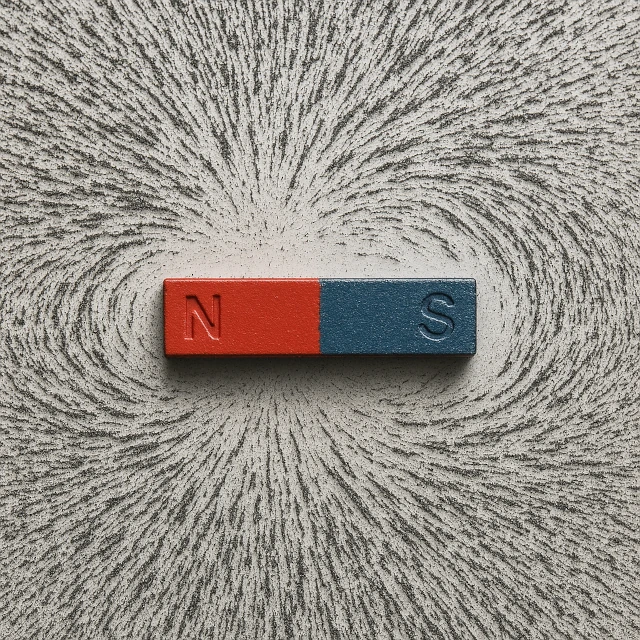
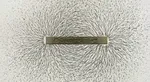
Magnetic field lines around a permanent magnet.
Image source: astronoo.com (new window) — AI-generated image, public domain.
Scientific summary
Astronoo's article explains how magnetism, a force born from the spin of electrons in ferromagnetic materials (iron, cobalt, nickel), makes it possible to go from a small fridge magnet to a levitating train. In these materials, spins spontaneously align to form Weiss domains. When these domains predominantly add up in the same direction, the material becomes a permanent magnet. The scale difference between a small magnet (weak force) and a Maglev train (colossal force) comes down to three factors: the volume of magnetic material (kilometers of rails), the field intensity (superconducting electromagnets or neodymium magnets, several teslas) and the channeling of magnetic flux via soft iron circuits. The same physical force, accumulated on a large scale, makes it possible to make entire trains levitate at over 600 km/h.
How do we go from a small fridge magnet to a levitating train?
Magnetism originates from the spin of electrons, an intrinsic quantum property. In ferromagnetic materials (iron, cobalt, nickel), spins spontaneously align to form Weiss domains. When these domains predominantly add up in the same direction, the material becomes a permanent magnet. The scale difference between a small magnet (weak force) and a Maglev train (colossal force) comes down to three factors: the volume of magnetic material (kilometers of rails), the field intensity (superconducting electromagnets or neodymium magnets, several teslas) and the channeling of magnetic flux via soft iron circuits. The same physical force, accumulated on a large scale, makes it possible to make entire trains levitate at over 600 km/h.
Also worth exploring
Continue your exploration of the Universe with these topics:
Magnetism: a minor force capable of lifting trains
A fundamental interaction
Magnetism is a manifestation of electromagnetism, one of the four fundamental interactions of nature. It originates from the movement of electric charges and more specifically from the spin of electrons, an intrinsic quantum property, on par with mass or charge.
From small magnets to Maglev trains
At first glance, magnetism seems to be a minor force: a small fridge magnet struggles to hold a few sheets of paper. Yet this same physical force is harnessed by Maglev trains to levitate and guide themselves without contact. An active control system keeps them at an extremely precise distance from the rails (between 10 and 15 mm) without being able to move away or closer. The train is literally "glued" at this height by an intense magnetic field. However, the absence of mechanical friction allows an independent electromagnetic motor to accelerate them to over 600 km/h.
How to go from a negligible force to phenomenal power?
The microscopic origin of magnetism: electron spin
At the most fundamental level, magnetism originates from the spin and electrostatic repulsion of electrons. Each electron behaves like a microscopic bipolar magnet (with a North and South pole). In most materials, these micromagnets (spins) are randomly oriented. Their magnetic effects cancel each other out, so that the material exhibits no net magnetic field at the macroscopic scale.
Ferromagnetic materials and Weiss domains
In ferromagnetic materials (such as iron, cobalt or nickel), electrostatic interactions favor a parallel alignment of electron spins. This alignment of billions of electronic "little compasses" forms microscopic magnetic islands (Weiss domains). Each island is like a large boat with thousands of oarsmen rowing perfectly in the same direction (the spins are aligned). When all the islands predominantly add up in the same direction, the material becomes a very strong permanent magnet.
N.B. :
Weiss domains, named after the French physicist Pierre-Ernest Weiss (1865-1940), are microscopic regions (typically 10 to 100 micrometers) inside a ferromagnetic material where all electron spins are naturally aligned in the same direction, even in the absence of an external field.
The most powerful permanent magnets in the world
This phenomenon of spontaneous alignment is pushed to its peak in certain modern alloys. Rare-earth magnets, such as those composed of neodymium, iron and boron (NdFeB), exploit a particular crystalline structure. This structure strengthens the exchange interaction and "freezes" the alignment of spins, creating materials with extreme properties: record saturation magnetization and resistance to demagnetization. This is what makes NdFeB the most powerful permanent magnet.
Why this scale difference between a fridge magnet and a Maglev train?
The key lies in the difference between spontaneous magnetization and produced magnetic field. In a small fridge magnet, the magnetization (alignment of electron spins) is already strong at the microscopic scale, but the volume of magnetic material is very small and the poles are close, which limits the range and intensity of the field felt at a distance.
In a Maglev train, one does not use a simple permanent magnet of the same size: one uses either superconducting electromagnets (in the electrodynamic system) or a succession of very high-performance permanent magnets (neodymium) associated with active coils. The trick is on the one hand to multiply the active volume (kilometers of rails and entire trains of magnets), and on the other hand to channel and amplify the flux via soft iron magnetic circuits. Above all, in the case of superconducting electromagnets, phenomenal current densities (over 100 A/mm²) are achieved without Joule effect losses, producing magnetic fields of several teslas, thousands of times more intense than that of a small fridge magnet.
Thus, the "minor" force at the gram scale becomes colossal at the ton scale, through accumulation of magnetization, current, and interaction surface.
N.B. :
The first observations of magnetism date back to ancient China, where magnetite was used as early as the 4th century BCE for orientation.
In the 19th century, the work of Hans Christian Ørsted (1777-1851) revealed the link between electric current and magnetic field.
This discovery was formalized by James Clerk Maxwell (1831-1879), whose equations unify electricity and magnetism.
Magnetism at the heart of 21st century innovations
The table below presents some of the most spectacular applications of modern magnetism, illustrating how this fundamental force is harnessed in fields as varied as transport, medicine, energy or space exploration.
| Application field | Technology / Key principle | Impact / Performance | Concrete example |
|---|---|---|---|
| Very high-speed transport | Magnetic levitation (Maglev) & linear motors | Speeds >600 km/h, silence, no mechanical friction | SCMaglev line in Japan (Tokyo-Nagoya), Shanghai Transrapid train |
| Medical imaging | Magnetic Resonance Imaging (MRI) - Superconducting electromagnets | Magnetic fields of 1.5 to 7 Tesla for non-invasive imaging of soft tissues | Diagnosis of tumors, brain lesions, and muscle pathologies |
| Nuclear fusion energy | Magnetic confinement of plasma (Tokamak/Stellarator) | Magnetic fields of several Tesla to confine plasma at >100 million °C | International ITER project (France), aiming to demonstrate the feasibility of fusion |
| Energy storage | Magnetic flywheels on magnetic bearings | Frictionless suspension in vacuum, efficiency >90 %, millisecond response | Stabilization of electrical grids, backup power for data centers |
| Particle accelerators | Superconducting electromagnets for focusing and deflecting beams | Intense magnetic fields to guide particles at speeds close to that of light | Large Hadron Collider (LHC) at CERN, for fundamental physics research |
| Environment | High Gradient Magnetic Separation (HGMS) | Extraction of fine metal pollutants or minerals from water and industrial waste | Water treatment, recycling of rare metals, ore purification |
| Aeronautics & Space | Magneto-plasmadynamic propulsion (MPD) and space protection magnets | High-impulse electric propulsion for long-duration travel; radiation shield | Satellite thrusters; magnetic shield concept for crewed missions to Mars |
Historical references of magnetism
The first observations
The first observations of magnetism date back to ancient China, where magnetite was used as early as the 4th century BCE for orientation. The ancient Greeks also knew the properties of the lodestone (magnetite) and its power to attract iron.
The founding discoveries
In the 19th century, the work of Hans Christian Ørsted (1777-1851) revealed the link between electric current and magnetic field. This discovery was formalized by James Clerk Maxwell (1831-1879), whose equations unify electricity and magnetism into a single theory: electromagnetism.
Modern magnetism
The advances of the 20th century have made it possible to understand the microscopic origin of magnetism with quantum mechanics, and to develop materials with extreme magnetic properties, paving the way for the spectacular applications we know today.
References
- Encyclopædia Britannica - Magnetism (new window)
- Nature - Magnetism (new window)
- APS News - August 2002: Hans Christian Ørsted and the discovery of electromagnetism (new window)
- Encyclopædia Britannica - James Clerk Maxwell (new window)
- Encyclopædia Britannica - Ferromagnetism (new window)
- Nature Materials - The physics of exchange coupling (new window)
- BBC Future - Maglev: The story of the fastest trains (new window)
- ITER - The ITER magnets (new window)
- CERN - The magnets of the Large Hadron Collider (new window)
FAQ: Everything you need to know about magnetization and magnetism
What is the microscopic origin of magnetism?
At the most fundamental level, magnetism originates from the spin of electrons, an intrinsic quantum property on par with mass or charge. Each electron behaves like a bipolar micromagnet with a North and South pole. In most materials, these spins are randomly oriented and their effects cancel out. In ferromagnetic materials (iron, cobalt, nickel), electrostatic interactions favor a parallel alignment of spins, forming microscopic magnetic islands called Weiss domains.
What are Weiss domains?
Named after the French physicist Pierre-Ernest Weiss (1865-1940), Weiss domains are microscopic regions (typically 10 to 100 micrometers) inside a ferromagnetic material where all electron spins are naturally aligned in the same direction, even in the absence of an external field. Each domain is like a magnetic "island" whose spins are perfectly oriented. When these domains predominantly add up in the same direction, the material becomes a permanent magnet.
What are the most powerful permanent magnets and why?
The most powerful permanent magnets are made from rare-earth alloys, such as neodymium-iron-boron (NdFeB). Their particular crystalline structure strengthens the exchange interaction that aligns electron spins and "freezes" this alignment. This gives them record saturation magnetization and resistance to demagnetization. A neodymium magnet can lift several hundred times its own weight. These magnets are used in Maglev trains, electric vehicle motors, wind turbines and computer hard drives.
How does a Maglev train work?
A Maglev train (for Magnetic Levitation) uses magnetism to levitate above the rails, eliminating all mechanical friction. Two main technologies exist: the electrodynamic system (EDS), which uses superconducting electromagnets to produce levitation by magnetic repulsion, and the electromagnetic system (EMS), which uses permanent magnets and coils to keep the train at a constant height by attraction. An active control system keeps the train at a precise distance from the rails (10 to 15 mm), and a linear motor provides propulsion at over 600 km/h.
What is a superconducting electromagnet?
A superconducting electromagnet is an electrical coil made from materials that become superconducting at very low temperatures (generally close to absolute zero, -273.15 °C). In this state, electrical resistance vanishes, allowing very intense currents to circulate without Joule effect losses. This produces extremely powerful magnetic fields, of several teslas, used in Maglev trains, MRIs and particle accelerators.
What are the main applications of magnetism?
Magnetism is used in many fields: magnetic levitation trains (Maglev), magnetic resonance imaging (MRI), plasma confinement in nuclear fusion reactors (tokamaks), energy storage in magnetic flywheels, particle accelerators (such as the LHC at CERN), magnetic separation for depollution and recycling, as well as space propulsion and radiation protection.
 Does the electron have a shape? The surprising answer of quantum physics
  String Theory: When Physics Breaks the Boundaries of Four-Dimensional Spacetime
  At the Heart of Matter: The Proton's Well-Kept Secrets
  How an Electric Field Travels at 300,000 km/s with Almost Stationary Electrons
  Why Doesn't Matter Pass Through Matter?
  Magnets: From the Small Fridge Magnet to Levitation Trains
  From Electron Spin to Magnetism: Emergence of Mini-Magnets
  Free electrons: from colliding balls to dancing waves
  Water Anomalies: A Common and Abundant Molecule in the Universe
  Heat and Temperature: Two Often Confused Thermal Notions
  Electroweak Force: The Unification of Electromagnetism and the Weak Interaction
  Special Relativity: The Beginning of a New Physics
  The Higgs Boson: The Unification of Fundamental Forces
 Quantum Entanglement: When Two Particles Become One!
 The Pentaquark: A New Piece of the Cosmic Puzzle!
 Why are Rare Gases rare?
 Brownian Motion: A Link Between Two Worlds
 The 4 Articles of Albert Einstein from 1905
  Why does nuclear fusion require so much energy?
  Stars cannot create elements heavier than iron because of the nuclear instability barrier
  Alpha, Beta, and Gamma Radiation: Understanding Their Differences
  Planck wall theory
  Is Absolute Vacuum a Utopia?
  Giant Colliders: Why the LHC is Unique in the World
  The World of Hadrons: From the LHC to Neutron Stars
  Radioactivity, natural and artificial
  The World of Nanoparticles: An Invisible Revolution
  Schrödinger's Cat: An Exploration of Quantum Mechanics
  Eternal inflation
  What is a wave?
  Quantum Field Theory: Everything is Fields
  Quantum Computers: Between Scientific Revolution and Technological Challenges
  Bose-Einstein Condensate: When Matter Becomes a Single Quantum State
  From Probability Cloud to Particle: The Electron in Quantum Mechanics
  What is Entropy? A Journey into Disorder and Information
 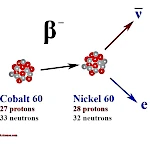 Beta Radioactivity and Neutrino: A Story of Mass and Spin
  Spacetime: Space and Time United, understand this concept
  Time Measurement: Scientific and Technological Challenge
  Spectroscopy, an inexhaustible source of information
  The Chemical Code of the Universe: Abundance and Origin of the Elements
  The size of atoms
  Magnetism and Magnetization: Why Are Some Materials Magnetic?
  Quarks and Gluons: A Story of Confinement
  Superpositions of quantum states
  Alpha decay (α)
  Electromagnetic induction equation
  Fusion and Fission: Two Nuclear Reactions, Two Energy Paths
  From the Ancient Atom to the Modern Atom: An Exploration of Atomic Models
  The Origins of Mass: Between Inertia and Gravitation
  From the Nucleus to Electricity: Anatomy of a Nuclear Power Plant
  How many photons to heat a coffee?
  How Do We See the Hidden Structure of Atoms?
  Quantum tunnelling: exploring the invisible atom by atom
  The 12 Particles of Matter: Understanding the Universe at the Subatomic Scale
  Atomic orbitals: from the probabilistic cloud to images of the infinitely small
  Antimatter: The Enigmas of Antiparticles and Their Energy
  What is an electric charge?
  Our matter is not quantum!
  Why use hydrogen in the fuel cell?
  Newton and Einstein: Two Visions for the Same Mystery
  Where does the proton's mass come from?
  Einstein's Universe: Physical Foundations of the Theory of Relativistic Gravitation
  Einstein's Annus Mirabilis : 1905, the year that revolutionized physics
  What does the equation E=mc2 really mean?
  Between
Waves and Particles: The Mystery of Duality
Between
Waves and Particles: The Mystery of Duality  The supercritical state of water: between liquid and gas, a fourth phase?
  Quantum Mechanics and Spirituality: Another Way to See the World