


At the Heart of Matter: The Proton's Well-Kept Secrets
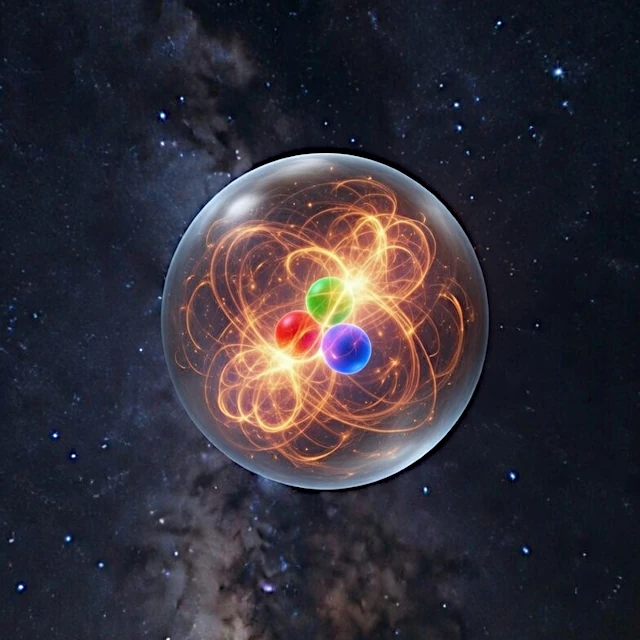
Representation of quarks and gluons at the heart of the proton.
This teeming structure resembles a bubbling plasma of virtual quark-antiquark pairs and gluons, whose violent interactions generate most of its mass.
Image source: astronoo.com (new window)
Scientific Summary
This article explores three fundamental mysteries of the proton, discovered in 1919. Despite its apparent familiarity, the proton defies modern physics. The first mystery is the origin of its mass (~938 MeV/c²): less than 1% comes from its constituent quarks, the rest emerging from the energy of gluons and quantum fluctuations (E=mc²). The second is its spin, as quarks only provide ~30% of it, with the remainder coming from gluons and orbital motions. The third is quark confinement, as quarks are never observed in isolation because the force binding them increases with distance.
What Are the Proton's Well-Kept Secrets?
Despite its discovery in 1919, the proton still holds three fundamental mysteries: the origin of its mass (since 99% comes from the energy of quarks and gluons, not the quarks themselves), the enigma of its spin (quarks only account for ~30%, with the rest coming from gluons and orbital motions), and quark confinement (never observed alone, as the force binding them increases with distance). These mysteries are governed by quantum chromodynamics (QCD).
Also worth exploring
Continue your exploration of the Universe with these topics:
The Proton: A Particle We Thought We Understood
A Familiar Yet Mysterious Particle
Since its discovery in 1919 by Ernest Rutherford (1871-1937), the proton seems familiar to us. Along with the neutron, it forms the nucleus of atoms, and thus 99.9% of visible matter. Yet, more than a century later, this particle continues to defy physicists' understanding. Its exact size, the origin of its mass, and the stability of its internal composition: so many mysteries that remain unsolved. Since then, generations of physicists have probed this particle with increasingly powerful instruments. Despite this, the proton jealously guards several of its fundamental secrets.
Quantum Chromodynamics: The Key to the Proton's Mysteries
The answer lies in two words: quantum chromodynamics (quantum theory describing the strong interaction, which binds quarks together) (QCD).
The Mental Challenge of the Quantum World
If quantum physics is so counterintuitive, it's because our brain, shaped by millions of years of evolution in a world of stones and trees, is not equipped to visualize the quantum world. We instinctively seek an image: a small hard ball, a compact nucleus surrounded by orbiting electron(s), like a miniature solar system. This image, popularized by school textbooks, is fundamentally wrong.
A Probabilistic Reality
At the heart of matter, reality does not exist. A particle in the quantum world (electron, quarks, etc.) is an entity governed by probabilities. Visualizing an atom means "seeing" a probability map, a fuzzy cloud where the density of the cloud represents the chance of finding the particle. For the proton, one must imagine a trembling ball of energy, where pairs of virtual particles burst forth and annihilate endlessly, an ordered chaos governed by the laws of quantum chromodynamics.
1st Mystery: The Mass of the Proton
An Unexpected Mass
The proton has a mass of approximately \(938.3\) MeV/c². Yet, if we add up the masses of the three constituent quarks, we only get a few MeV, which is less than 1% of the total mass. Where does the rest come from? The answer lies in one word: energy.
Energy as the Origin of Mass
By virtue of Albert Einstein's (1879-1955) famous equivalence, \(E = mc^2\), mass is merely a condensed form of energy. Inside the proton, the quarks are in perpetual motion, and the gluon fields that connect them constantly interact, endlessly generating virtual quark-antiquark pairs. This quantum bubbling, this energy confined in an infinitesimal volume, constitutes most of the proton's mass. Therefore, it is not an intrinsic property of the quarks that compose it, but of the pure energy trapped by the strong nuclear force.
A Persistent Mystery
The mystery is that gluons are massless particles. How does the strong interaction manage to trap such colossal energy in such a tiny volume? And above all, why do direct calculations from QCD remain so difficult, to the point that supercomputers still struggle to reproduce the exact value of this mass?
A Manifestation of Hidden Physics
The mass of the proton is the visible manifestation of hidden physics, that of the quantum vacuum and the most powerful force in the Universe. Understanding its origin means understanding how the invisible becomes matter.
2nd Mystery: The Enigma of the Proton's Spin
Spin: A Complex Quantum Property
Spin is a quantum property of particles, often (incorrectly) compared to a rotation on themselves. In the 1980s, deep inelastic scattering experiments revealed an anomaly. The sum of the spins of the valence quarks represented only a small fraction of the proton's total spin.
Where Has the Missing Spin Gone?
Where has the spin gone? The answer likely lies in two contributions: the spin of the gluons, which can contribute via their own angular momentum, and the orbital motion of quarks and gluons inside the proton.
Experiments to Solve the Enigma
Experiments such as those at the RHIC (relativistic Heavy Ion Collider, an accelerator dedicated to the study of spin and the quark-gluon plasma) attempt to unravel these contributions, but the puzzle remains unsolved.
3rd Mystery: Quark Confinement
A Puzzling Phenomenon: Confinement
Quarks have never been observed in a free state. They are always imprisoned inside hadrons (composite particles subject to the strong interaction, such as protons, neutrons, and pions), bound together by gluons (bosons that mediate the strong interaction, carriers of the color charge that binds quarks together). This phenomenon, called confinement (property of QCD according to which quarks and gluons can never be observed in isolation), is one of the most puzzling features of QCD.
A Counterintuitive Mechanism
Its mechanism is counterintuitive: the more one tries to separate two quarks, the more the force that binds them increases, unlike what is observed in electromagnetism. The energy stored in the gluon field tube grows linearly with distance. When this energy exceeds the threshold for creating a quark-antiquark pair, the string breaks and gives rise to new hadrons. A free quark never appears: nature seems to forbid any isolated color charge.
Lattice QCD: A Numerical Approach
Simulations of lattice QCD (numerical approach to QCD on a discrete space-time lattice, allowing non-perturbative calculations of the strong interaction), whose foundations were laid by Kenneth Wilson (1936-2013), make it possible to numerically reproduce confinement with good precision. But a simulation is not a proof. Understanding why nature confines quarks remains one of the deepest questions in all of theoretical physics.
Summary Table of the Proton's Mysteries
| Mystery | Observation | What Theory Predicts | What Remains Unexplained |
|---|---|---|---|
| Origin of Mass | The proton weighs \(938.3\) MeV/c², about 100 times the combined mass of its quarks | QCD attributes mass to the kinetic energy of quarks and gluon fields (\(E = mc^2\)) | No rigorous analytical calculation from first principles; only lattice QCD simulations approach the result |
| Origin of Spin | The proton has a spin of \(\frac{1}{2}\) (in units of \(\hbar\)) | The three valence quarks should be the main source | Quarks contribute only ~30% of the total spin; gluons and orbital moments fill the rest in a still imprecise way |
| Quark Confinement | No free quark has ever been observed in nature | QCD predicts that the force between quarks increases with distance, making their separation impossible | No formal mathematical demonstration of confinement |
N.B.: These three mysteries are intimately linked: confinement conditions the internal structure of the proton, which determines both the mass distribution and the spin distribution. The future EIC (electron-Ion Collider, an accelerator under construction at Brookhaven National Laboratory, scheduled to start around 2030-2035 CE) (Electron-Ion Collider), scheduled to start around 2030-2035, is specifically designed to provide quantitative answers to these open questions.
FAQ: Everything You Need to Know About the Proton's Mysteries
Why Doesn't the Proton's Mass Come from Its Quarks?
The proton's mass is approximately 938.3 MeV/c², but the sum of the masses of its three valence quarks represents only less than 1% of this value. The rest comes from the enormous energy confined within, in accordance with Einstein's equivalence \(E=mc^2\). This energy comes from the perpetual motion of quarks and the gluon fields that bind them, creating a bubbling of virtual quark-antiquark pairs.
What Is the Proton's "Spin" and Why Is It a Mystery?
Spin is an intrinsic quantum property, often imagined as a rotation on itself. The mystery, discovered in the 1980s, is that the three valence quarks contribute only about 30% of the proton's total spin. The rest must come from the spin of gluons and the orbital motion of quarks and gluons, but these contributions remain difficult to measure and untangle precisely.
Why Can't We Observe a Free Quark?
This phenomenon is called confinement. Unlike electromagnetism, the force between two quarks increases with the distance separating them. If we try to separate them, the energy stored in the gluon "tube" becomes so great that it spontaneously creates new quark-antiquark pairs, forming new hadrons. An isolated quark therefore never appears in nature.
 Does the electron have a shape? The surprising answer of quantum physics
  String Theory: When Physics Breaks the Boundaries of Four-Dimensional Spacetime
  At the Heart of Matter: The Proton's Well-Kept Secrets
  How an Electric Field Travels at 300,000 km/s with Almost Stationary Electrons
  Why Doesn't Matter Pass Through Matter?
  Magnets: From the Small Fridge Magnet to Levitation Trains
  From Electron Spin to Magnetism: Emergence of Mini-Magnets
  Free electrons: from colliding balls to dancing waves
  Water Anomalies: A Common and Abundant Molecule in the Universe
  Heat and Temperature: Two Often Confused Thermal Notions
  Electroweak Force: The Unification of Electromagnetism and the Weak Interaction
  Special Relativity: The Beginning of a New Physics
  The Higgs Boson: The Unification of Fundamental Forces
 Quantum Entanglement: When Two Particles Become One!
 The Pentaquark: A New Piece of the Cosmic Puzzle!
 Why are Rare Gases rare?
 Brownian Motion: A Link Between Two Worlds
 The 4 Articles of Albert Einstein from 1905
  Why does nuclear fusion require so much energy?
  Stars cannot create elements heavier than iron because of the nuclear instability barrier
  Alpha, Beta, and Gamma Radiation: Understanding Their Differences
  Planck wall theory
  Is Absolute Vacuum a Utopia?
  Giant Colliders: Why the LHC is Unique in the World
  The World of Hadrons: From the LHC to Neutron Stars
  Radioactivity, natural and artificial
  The World of Nanoparticles: An Invisible Revolution
  Schrödinger's Cat: An Exploration of Quantum Mechanics
  Eternal inflation
  What is a wave?
  Quantum Field Theory: Everything is Fields
  Quantum Computers: Between Scientific Revolution and Technological Challenges
  Bose-Einstein Condensate: When Matter Becomes a Single Quantum State
  From Probability Cloud to Particle: The Electron in Quantum Mechanics
  What is Entropy? A Journey into Disorder and Information
  Beta Radioactivity and Neutrino: A Story of Mass and Spin
  Spacetime: Space and Time United, understand this concept
  Time Measurement: Scientific and Technological Challenge
  Spectroscopy, an inexhaustible source of information
  The Chemical Code of the Universe: Abundance and Origin of the Elements
  The size of atoms
  Magnetism and Magnetization: Why Are Some Materials Magnetic?
  Quarks and Gluons: A Story of Confinement
  Superpositions of quantum states
  Alpha decay (α)
  Electromagnetic induction equation
  Fusion and Fission: Two Nuclear Reactions, Two Energy Paths
  From the Ancient Atom to the Modern Atom: An Exploration of Atomic Models
  The Origins of Mass: Between Inertia and Gravitation
  From the Nucleus to Electricity: Anatomy of a Nuclear Power Plant
  How many photons to heat a coffee?
  How Do We See the Hidden Structure of Atoms?
  Quantum tunnelling: exploring the invisible atom by atom
  The 12 Particles of Matter: Understanding the Universe at the Subatomic Scale
  Atomic orbitals: from the probabilistic cloud to images of the infinitely small
  Antimatter: The Enigmas of Antiparticles and Their Energy
  What is an electric charge?
  Our matter is not quantum!
  Why use hydrogen in the fuel cell?
  Newton and Einstein: Two Visions for the Same Mystery
  Where does the proton's mass come from?
  Einstein's Universe: Physical Foundations of the Theory of Relativistic Gravitation
  Einstein's Annus Mirabilis : 1905, the year that revolutionized physics
  What does the equation E=mc2 really mean?
  Between
Waves and Particles: The Mystery of Duality
Between
Waves and Particles: The Mystery of Duality  The supercritical state of water: between liquid and gas, a fourth phase?
  Quantum Mechanics and Spirituality: Another Way to See the World