


Quarks and gluons: a story of confinement
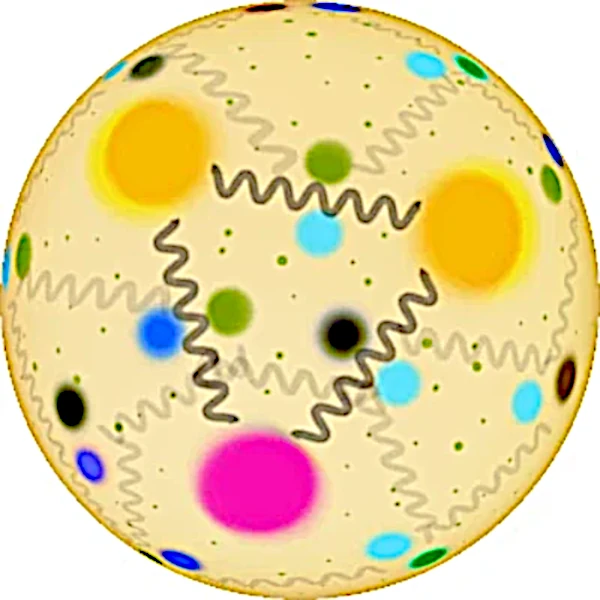
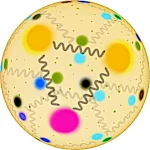
Simplified model of a proton or neutron (hadron): the main quarks are connected by gluon flux tubes through a bubbling sea of gluons. If a tube is stretched and breaks, the accumulated energy materializes a new quark-antiquark pair by drawing from the gluon sea, and new flux tubes immediately form with these new particles.
Scientific summary
The Astronoo article presents quark confinement, a fundamental phenomenon of quantum chromodynamics (QCD). It explains why quarks can never be observed in isolation: the strong interaction, transmitted by gluons, increases with distance, forming flux tubes that break by creating new quark-antiquark pairs. The article details the composition of hadrons (protons and neutrons), the missing mass of nucleons, and the stability and instability of particles. It also covers exotic hadrons, proton decay, and the technological applications of particle instability.
Why are quarks never free?
This article is devoted to quark confinement, one of the most fascinating phenomena in particle physics. Why can a quark never be observed in a free state? The answer lies in quantum chromodynamics (QCD), the theory that describes the strong interaction. Unlike gravity or electromagnetism, whose strength decreases with distance, the strong interaction increases as quarks move apart. Gluons, the mediating particles of this force, form flux tubes that act like elastic springs: the more one tries to separate the quarks, the more enormous the accumulated energy becomes. When this energy becomes sufficient, the tube breaks and creates a new quark-antiquark pair, so that no isolated quark ever emerges. This mechanism, called color confinement, is at the heart of the stability of protons and neutrons. The article also explores the mass of nucleons, the sea of quarks and gluons, particle stability, and the frontiers of research in quantum physics.
Also worth exploring
Continue your exploration of the Universe with these topics:
Quantum chromodynamics: the theory that binds quarks
The elementary constituents of matter
Quarks, leptons and bosons are the elementary particles that make up all known matter. These quantum entities are described by the Standard Model, experimentally validated by the discovery of quarks (1995), the tau neutrino (2000) and the Higgs boson (2012).
Protons, neutrons and hadrons: assemblies of quarks
Protons and neutrons, the constituents of atomic nuclei, are composite particles (non-elementary). They belong to the family of hadrons, alongside a hundred or so other ephemeral particles such as mesons (pion, kaon, eta, rho, etc.). All mesons are unstable, with lifetimes ranging from 10-8 to 10-23 second. Only the proton is stable, with an estimated lifetime of 1036 years. Neutrons, stable inside a nucleus, decay in about 880.3 seconds (≈ 15 minutes) when free.
Quantum chromodynamics (QCD) and the missing mass
The theory describing the strong interaction, responsible for the cohesion of nuclei and the mass of quarks and gluons, is quantum chromodynamics (QCD), proposed in 1973 by David Gross, Frank Wilczek and Hugh David Politzer (Nobel Prize 2004).
The mass of a proton (2 up quarks + 1 down quark) or a neutron (1 up quark + 2 down quarks) does not correspond to the sum of the masses of its constituents:
- Proton mass: 1.673 × 10⁻²⁴ g (1.673 yg),
- Neutron mass: 1.675 × 10⁻²⁴ g,
- Mass of an up quark: ~0.002 to 0.005 yg,
- Mass of a down quark: ~0.004 to 0.008 yg.
N.B.:
Quarks represent only about 1% of the mass of nucleons. All the rest of the mass comes from the kinetic energy of the quarks and the binding energy of the gluons (according to the formula $E=mc^2$).
Energy and confinement: the origin of mass
The missing mass is explained by:
- the kinetic energy of the moving quarks,
- the binding energy of the strong interaction (via E=mc²), which largely dominates the mass of nucleons.
Quark confinement prevents their isolation: they are bound by gluons, particles that are electrically neutral but carry a color charge.
Quark confinement: why are they prisoners?
The paradox of confinement
Unlike the other fundamental forces (electromagnetic, weak, gravitational), the strong interaction increases with distance between quarks. This phenomenon, called asymptotic freedom, implies that:
- the closer the quarks are, the less they interact,
- the more one tries to separate them, the more intense the force becomes, like an elastic spring.
The sea of quarks and gluons
Inside hadrons, quark-antiquark pairs appear and disappear constantly, forming a dynamic sea. If a quark is ejected during a collision, the released energy immediately creates new particles (pions, kaons, etc.), never leaving an isolated quark.
Example: During an energetic collision, a quark torn from a proton generates a new hadron (such as a pion), but the initial quarks remain confined in the original nucleon.
Mechanism of confinement
QCD describes this mechanism by:
- the creation of quark-antiquark pairs from the energy of the gluon (via E=mc²),
- the annihilation of these pairs, returning energy to the gluons.
Thus, a proton or neutron is not a static set of 3 quarks, but a quantum soup where quarks, antiquarks and gluons interact continuously. The net balance remains constant, however: 2 up quarks + 1 down for a proton, and 2 down + 1 up for a neutron.
Why is confinement crucial?
This complex structure enables:
- the stability of atomic nuclei,
- the diversity of chemical elements, via optimal bonding configurations.
N.B.:
Confinement applies to particles that carry a color charge, which can never be isolated. They are only observed as white combinations with zero charge, such as hadrons, a principle that is at the origin of all visible matter.
Stability and instability of particles
Why do some live forever and others vanish in the blink of an eye?
In the world of particles, some are of unshakeable stability, like immutable rocks, while others vanish in an instant, as fleeting as lightning. For example, a proton can persist for billions upon billions of years, whereas a rho meson survives only for an infinitely brief time — so short that a light ray would travel less than the thickness of a hair during its entire lifetime. Where does this radical difference come from? It is explained by the fundamental laws of quantum physics and by the specific interactions that determine the behavior of each particle.
In brief: The longevity of a particle is mainly dictated by:
- Its mass and energy (the heavier it is, the more possible decay channels there are)
- The conservation laws it must obey
- The fundamental interactions that govern its behavior
- The presence of lighter particles into which it can convert
Stable particles: the pillars of matter
Only three particles of the Standard Model are considered absolutely stable (or at least, with a lifetime so long that it exceeds the age of the universe).
| Particle | Type | Estimated lifetime | Role in the universe |
|---|---|---|---|
| Electron | Lepton | >1020 years* | Constituent of atoms, charge carrier |
| Proton | Baryon | >1036 years | Nucleus of atoms (with neutrons) |
| Photon | Boson | ∞ (stable) | Transport of light and electromagnetic interactions |
| Neutrino | Lepton | ∞ (stable for the 3 types)** | Produced by nuclear reactions (Sun, supernovas) |
| * Experimental limit in 2025. No decay of the electron has been observed. ** Neutrinos are stable in the Standard Model, but theories beyond it predict an extremely slow decay. | |||
N.B.:
Theoretically, the electron could decay into a neutrino and a photon, but this has never been observed. Experimental limits (2025) place its lifetime well beyond 1020 years.
Neutrinos are stable in the Standard Model, but theories beyond it (such as Grand Unification) predict an extremely slow decay.
Why are only 3 particles stable?
If the vast majority of elementary particles eventually decay, a few escape this rule for fundamental reasons of physics:
- Principle of charge conservation: The electron cannot simply vanish, since its electric charge of -1 must be conserved. Since no lighter particle with a non-zero charge exists to receive it, it remains unalterable.
- Stability linked to baryon number: As the lightest baryon, the proton cannot decay without violating current conservation laws. Only bold theories predict the existence of such proton decay, actively hunted by cutting-edge facilities such as Super-Kamiokande in Japan and DUNE in the United States.
- Energy lock and absence of channel: Lacking energetically viable options to transform into, the photon and neutrinos have no possible decay path.
Unstable particles: quantum fireworks
The majority of particles are ephemeral, with lifetimes ranging from the nanosecond to the second. Their instability comes from two factors:
- Violation of symmetries: Certain interactions (such as the weak force) allow a particle to transform into a lighter one, while respecting conservation laws (energy, charge, etc.).
- High mass: The heavier a particle is, the more "room" it has to decay into lighter particles (via E=mc²).
| Particle | Type | Average lifetime | Typical decay | Analogy |
|---|---|---|---|---|
| Free neutron | Baryon | 880 seconds | → Proton + electron + antineutrino | A tightrope walker who falls after 15 minutes |
| π⁰ meson | Meson | 8.5 × 10⁻¹⁷ s | → 2 photons (γ) | A soap bubble that bursts |
| K⁺ kaon | Meson | 1.2 × 10⁻⁸ s | → Muon + neutrino (63%) or pion (21%) | A spark in the night |
| Z boson | Boson | 3 × 10-25 s | → Electron + positron (or quarks) | A flash of lightning during a storm |
| Top quark | Quark | 5 × 10-25 s | → Bottom quark + W boson | A shooting star |
Why some particles are unstable: the case of the neutron
While it remains stable at the heart of atomic nuclei thanks to the cohesion of the strong interaction, a free neutron eventually decays in about a quarter of an hour under the action of the weak force: n → p⁺ + e⁻ + ν̅e (neutron → proton + electron + electron antineutrino). This fundamental mechanism is directly at the origin of beta radioactivity, a phenomenon with major applications both in medicine (notably in PET imaging) and in archaeology (with the famous carbon-14 dating).
Exotic hadrons: a veritable zoo of ephemeral particles
Beyond the traditional protons and neutrons, large particle accelerators such as the CERN's LHC have revealed much more complex structures, called exotic hadrons:
- Tetraquarks: Composed of 2 quarks and 2 antiquarks (such as X(4140), identified in 2020), with a lightning-fast lifetime of the order of ~10-23 s.
- Pentaquarks: Made of 4 quarks and 1 antiquark (such as Pc(4312), confirmed in 2019), with an ephemeral existence of about ~10-20 s.
- Glueballs: Theoretical configurations made exclusively of gluons, actively hunted by physicists although their formal observation remains to be confirmed.
What explains their extreme instability?
These entities resemble highly excited states of matter. Overloaded with energy, they decay almost instantaneously into lighter, more stable hadrons (such as pions or kaons), thus obeying the universal tendency toward a state of minimum energy.
Proton decay: the Holy Grail of physics
Is the proton absolutely eternal? While the Standard Model asserts so, bold theories such as Grand Unification or supersymmetry suggest that it could eventually decay into a neutral pion and a positron according to the reaction: p⁺ → π⁰ + e⁺. Its hypothetical lifetime exceeds comprehension: it is estimated at more than 1036 years, or about 1026 times the current age of the universe!
How do physicists hunt for this phenomenon?
Giant observatories buried underground, such as Super-Kamiokande and its successor Hyper-Kamiokande (designed to offer tenfold sensitivity), keep watch over millions of tons of pure water to catch this improbable decay. To date, no observation has validated this hypothesis, but these colossal research efforts continue to push back the frontiers of knowledge.
What is the major issue?
Detecting proton decay would be a scientific shockwave comparable to the discovery of the Higgs boson, validating the idea that the fundamental forces — strong nuclear, weak and electromagnetism — were one at the very beginning of the universe.
Instability and technology: unsuspected applications
Far from being limited to theoretical physics, particle instability irrigates many technological and scientific fields of everyday life:
- Nuclear medicine and imaging: Short-lived radioactive isotopes, such as technetium-99m (whose lifetime is about 6 hours), are invaluable for performing precise scintigraphy.
- Archaeology and dating: The measured decay of carbon-14 (with a half-life of 5,730 years) makes it possible to date organic artifacts nearly 50,000 years old.
- Energy production: The intrinsic instability of uranium-235 (with a half-life of 700 million years) is the energy source of civilian nuclear reactors.
- Astrophysics and cosmology: The balance of neutron instability dictated primordial nucleosynthesis, enabling the emergence of the very first atomic nuclei in the aftermath of the Big Bang.
N.B.:
If the neutron decays rapidly when free, its stability is miraculously ensured within nuclei thanks to the strong interaction. It is precisely this phenomenon that allows the existence of neutron stars: in the aftermath of a supernova collapse, these particles, compressed under colossal pressures, form a stable quantum fluid capable of crossing the eons!
Frontiers of knowledge: what if stability were only an illusion?
At the dawn of this decade, several areas of shadow continue to stimulate fundamental research:
- The enigmatic nature of dark matter: If it turns out to be corpuscular (carried by hypothetical candidates such as WIMPs), the longevity of these particles would justify its domination of the universe without dissipating.
- Evaporation of quantum black holes: Predicted by Stephen Hawking through a specific radiation, this disintegration of black holes remains to this day a purely theoretical object of study, for lack of experimental validation.
- The asymmetry of antimatter: How to explain that our universe is exclusively shaped of matter rather than a parity equilibrium with antimatter? A tiny nuance of stability between particles and antiparticles could well hold the answer.
To watch closely
The giant collider project, the Future Circular Collider (FCC), whose commissioning at CERN is envisaged for the 2040s, aims to reach energies of the order of 100 TeV (eclipsing the 13 TeV of the LHC). Enough to hunt highly unstable entities and probe physics beyond the Standard Model.
In conclusion, the balance between stability and disintegration is not the fruit of chance, but the expression of fundamental laws harmonizing energy, symmetries and interactions. Penetrating these intimate workings amounts to deciphering the greatest secrets of the universe, from the infinitely small to the infinitely large.
References
FAQ: Everything you need to know about quarks and confinement
What is a quark?
A quark is an elementary particle of matter, a fundamental component of protons and neutrons. There are six types (or "flavors"): up, down, charm, strange, top and bottom. Quarks are never observed alone; they are always confined within hadrons.
Why are quarks never observed in isolation?
Because of color confinement, the strong interaction that binds quarks increases with distance. When one tries to separate two quarks, the energy accumulated in the gluon field becomes so great that it creates new quark-antiquark pairs, preventing any quark from escaping in a free state.
What is quantum chromodynamics (QCD)?
QCD is the theory that describes the strong interaction, one of the four fundamental forces. It explains how quarks and gluons interact via color charge, and why quarks are confined inside hadrons.
What is the difference between a quark and a gluon?
The quark is a particle of matter that carries a color charge and a fractional electric charge. The gluon is the mediator boson of the strong interaction: it also carries a color charge, but has neither mass nor electric charge. Gluons are responsible for the cohesion of quarks.
Can quarks transform into other particles?
Yes, via the weak interaction, a quark can change flavor (for example, a down quark can transform into an up quark). This phenomenon is at the origin of beta radioactivity and particle decays.
What is the role of quarks in ordinary matter?
The up and down quarks constitute protons (2 up + 1 down) and neutrons (1 up + 2 down), which form atomic nuclei. All visible matter in the Universe is thus built from these two types of quarks, bound by the strong interaction.
 Does the electron have a shape? The surprising answer of quantum physics
  String Theory: When Physics Breaks the Boundaries of Four-Dimensional Spacetime
  At the Heart of Matter: The Proton's Well-Kept Secrets
  How an Electric Field Travels at 300,000 km/s with Almost Stationary Electrons
  Why Doesn't Matter Pass Through Matter?
  Magnets: From the Small Fridge Magnet to Levitation Trains
  From Electron Spin to Magnetism: Emergence of Mini-Magnets
  Free electrons: from colliding balls to dancing waves
  Water Anomalies: A Common and Abundant Molecule in the Universe
  Heat and Temperature: Two Often Confused Thermal Notions
  Electroweak Force: The Unification of Electromagnetism and the Weak Interaction
  Special Relativity: The Beginning of a New Physics
  The Higgs Boson: The Unification of Fundamental Forces
 Quantum Entanglement: When Two Particles Become One!
 The Pentaquark: A New Piece of the Cosmic Puzzle!
 Why are Rare Gases rare?
 Brownian Motion: A Link Between Two Worlds
 The 4 Articles of Albert Einstein from 1905
  Why does nuclear fusion require so much energy?
  Stars cannot create elements heavier than iron because of the nuclear instability barrier
  Alpha, Beta, and Gamma Radiation: Understanding Their Differences
  Planck wall theory
  Is Absolute Vacuum a Utopia?
  Giant Colliders: Why the LHC is Unique in the World
  The World of Hadrons: From the LHC to Neutron Stars
  Radioactivity, natural and artificial
  The World of Nanoparticles: An Invisible Revolution
  Schrödinger's Cat: An Exploration of Quantum Mechanics
  Eternal inflation
  What is a wave?
  Quantum Field Theory: Everything is Fields
  Quantum Computers: Between Scientific Revolution and Technological Challenges
  Bose-Einstein Condensate: When Matter Becomes a Single Quantum State
  From Probability Cloud to Particle: The Electron in Quantum Mechanics
  What is Entropy? A Journey into Disorder and Information
  Beta Radioactivity and Neutrino: A Story of Mass and Spin
  Spacetime: Space and Time United, understand this concept
  Time Measurement: Scientific and Technological Challenge
  Spectroscopy, an inexhaustible source of information
  The Chemical Code of the Universe: Abundance and Origin of the Elements
  The size of atoms
  Magnetism and Magnetization: Why Are Some Materials Magnetic?
  Quarks and Gluons: A Story of Confinement
  Superpositions of quantum states
  Alpha decay (α)
  Electromagnetic induction equation
  Fusion and Fission: Two Nuclear Reactions, Two Energy Paths
  From the Ancient Atom to the Modern Atom: An Exploration of Atomic Models
  The Origins of Mass: Between Inertia and Gravitation
  From the Nucleus to Electricity: Anatomy of a Nuclear Power Plant
  How many photons to heat a coffee?
  How Do We See the Hidden Structure of Atoms?
  Quantum tunnelling: exploring the invisible atom by atom
  The 12 Particles of Matter: Understanding the Universe at the Subatomic Scale
  Atomic orbitals: from the probabilistic cloud to images of the infinitely small
  Antimatter: The Enigmas of Antiparticles and Their Energy
  What is an electric charge?
  Our matter is not quantum!
  Why use hydrogen in the fuel cell?
  Newton and Einstein: Two Visions for the Same Mystery
  Where does the proton's mass come from?
  Einstein's Universe: Physical Foundations of the Theory of Relativistic Gravitation
  Einstein's Annus Mirabilis : 1905, the year that revolutionized physics
  What does the equation E=mc2 really mean?
  Between
Waves and Particles: The Mystery of Duality
Between
Waves and Particles: The Mystery of Duality  The supercritical state of water: between liquid and gas, a fourth phase?
  Quantum Mechanics and Spirituality: Another Way to See the World