


Does the electron have a shape? The surprising answer of quantum physics

Artistic visualization of an electron cloud around an atomic nucleus, illustrating the probabilistic shape of the electron enriched with virtual particles from quantum vacuum fluctuations, with ephemeral electron-positron pairs and photons emerging around the probabilistic field.
Image source: astronoo.com (new window) : AI-generated image, public domain.
Scientific summary
The Astronoo article explores the question of the shape of the electron through the prism of modern physics. In the Standard Model, the electron is a point particle, with no measurable spatial extension. Yet quantum mechanics assigns it a wave function whose square describes a probability density of presence: this is its probabilistic shape. In an atom, this shape manifests through atomic orbitals, three-dimensional patterns that depend on quantum numbers. The eEDM experiments search for an infinitesimal deformation of the charge distribution, which would reveal physics beyond the Standard Model. To date, the electron appears remarkably spherical, with an upper limit of the order of \(10^{-30} \, e\cdot\text{cm}\).
Does the electron have a shape?
A simple question, a quantum answer
Asking "what is the shape of the electron?" amounts to questioning the very nature of matter. In our classical intuition, an object has a shape: a marble is spherical, a cube has six faces. But the electron is not a classical object. It is an elementary particle described by quantum mechanics, and its "shape" depends on the theoretical framework and the type of observation.
In the Standard Model, the electron is a mathematical point, with no spatial extension. No experiment has ever measured a size for the electron: current limits are below \(10^{-18}\) meters. Yet the electron possesses a wave function that unfolds in space, and it is this function that gives it a probabilistic shape. In an atom, it adopts well-defined configurations called atomic orbitals. Finally, its charge distribution could be slightly deformed, a question at the heart of current research on the eEDM.
Also worth exploring
Continue your exploration of the Universe with these topics:
The point-like electron of the Standard Model
A particle with no spatial extension
In the Standard Model, the electron is described as a point particle. This means it has no intrinsic size: its charge and mass are concentrated at a mathematical point. This description is extraordinarily effective: it allows calculating with spectacular precision quantities such as the magnetic moment of the electron, whose value predicted by quantum electrodynamics (QED) coincides with experiment to more than ten decimal places.
But be careful: "point-like" does not mean "without structure." In QED, the electron is surrounded by a cloud of virtual particles (photons, electron-positron pairs) that screen its charge. This screening structure is responsible for measurable effects, such as the Lamb shift or the anomalous magnetic moment. The "shape" of the electron, in this framework, is therefore that of a point surrounded by a cloud of virtual particles from quantum vacuum fluctuations.
Experimental limits on the size of the electron
Physicists have attempted to measure the size of the electron by studying its scattering on other particles. If the electron had a spatial extension, the scattering results would deviate from point-like predictions. To date, no deviation has been observed. The strictest constraints give an upper limit of the order of \(10^{-18}\) meters, or one thousandth of the size of a proton. The electron is therefore, to our knowledge, truly point-like.
The wave function: the probabilistic shape of the electron
A haze of probability
If the electron is point-like, how can it have a "shape"? The answer lies in the wave function \(\psi(r,t)\), introduced by Erwin Schrödinger (1887-1961). This function does not describe a physical material wave, but a probability amplitude. Its square \(|\psi|^2\) gives the probability density of finding the electron at a given position during a measurement.
It is this probability distribution that constitutes the "shape" of the electron in quantum mechanics. Around an atomic nucleus, for example, the electron forms an electron cloud whose geometry depends on its quantum state. This shape is not fixed: it evolves according to the Schrödinger equation and deforms under the effect of external fields.
Wave function collapse
When the electron's position is measured, the wave function collapses to a precise point: this is wave function collapse. Before measurement, the electron has no defined position; its "shape" is a cloud of possibilities. After measurement, it appears locally as a particle. This duality between extended shape and point-like appearance is at the heart of the Copenhagen interpretation, defended by Niels Bohr (1885-1962).
Atomic orbitals: the shape of the electron in the atom
Well-defined three-dimensional patterns
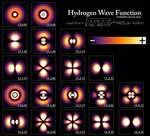
In an atom, electrons occupy quantum states called atomic orbitals. Each orbital is characterized by three quantum numbers (n, l, m) and has a precise geometric shape. The s orbital (l = 0) is spherical. The p orbitals (l = 1) have a dumbbell shape, with two lobes oriented along the x, y or z axes. The d orbitals (l = 2) have four-lobed shapes, and so on.
These shapes are not mere mathematical curiosities: they determine the geometry of chemical bonds and therefore the structure of molecules. The shape of the electron in an atom is thus directly responsible for the shape of matter at our scale.
Table of orbitals
The table below summarizes the main shapes of atomic orbitals and their characteristics.
| Orbital | Quantum number l | Geometric shape | Example atom |
|---|---|---|---|
| s | 0 | Spherical, perfect symmetry | Hydrogen (1s) |
| p | 1 | Dumbbell with two oriented lobes | Carbon (2p) |
| d | 2 | Four lobes in clover shape | Iron (3d) |
| f | 3 | Complex shapes with six or more lobes | Uranium (5f) |
The sphericity of the electron: what do experiments say?
An almost perfect charge distribution
If the electron is point-like, how can we speak of its "shape"? In reality, even a point particle can have an effective charge distribution due to quantum fluctuations. Physicists seek to know whether this distribution is perfectly spherical or slightly deformed. A deformation would reveal the existence of an electric dipole moment (eEDM), a property that would violate certain fundamental symmetries.
The most sensitive experiments use polar molecules (such as thorium fluoride, ThF) trapped in intense electric fields. If the electron had an eEDM, its spin would align slightly with the electric field, producing a measurable shift. To date, no signal has been detected, which imposes an extremely strict upper limit.
Current limits on the eEDM
In 2018, the ACME collaboration established a limit of \(|d_e| < 1.1 \times 10^{-29} \, e\cdot\text{cm}\). In 2023, a new measurement further improved this constraint. Future experiments aim for a sensitivity of \(10^{-30} \, e\cdot\text{cm}\), which would probe energies well beyond those accessible at the LHC. The electron thus becomes a miniature laboratory for testing the limits of the Standard Model.
N.B.:
If the eEDM exists, it is aligned with the electron's spin. Its discovery would require a new source of CP violation, beyond the Standard Model, and could explain the matter-antimatter asymmetry of the Universe.
The form factor: how do we measure the shape of the electron?
Electron scattering
To probe the shape of a particle, physicists use scattering. By projecting electrons onto a target (protons, nuclei, other electrons), one measures how they are deflected. If the target particle is point-like, the cross section follows a simple law (Rutherford formula). If it has a spatial extension, the scattering is modulated by a form factor \(F(q^2)\), where \(q\) is the momentum transfer.
Applied to the electron itself, this reasoning gives a limit on its size. Electron-electron and electron-positron scattering experiments at LEP and SLAC have shown that the electron behaves as a point particle down to scales of \(10^{-18}\) meters. No non-trivial form factor has been observed.
Radiative corrections
Even point-like, the electron acquires an effective structure through its interactions with the quantum vacuum. The radiative corrections of QED modify its charge and magnetic moment. The magnetic moment of the electron is given by \(g/2 = 1 + a_e\), where \(a_e\) is the magnetic anomaly. The measured value of \(a_e\) is one of the most precise in all of physics: \(a_e = 0.001\,159\,652\,180\,73(28)\). This agreement between theory and experiment is a spectacular proof of the validity of QED, but it reveals no deformation of shape.
Synthesis: the multiple faces of the electron's shape
The table below summarizes the different ways of describing the "shape" of the electron according to the theoretical framework and the experimental viewpoint.
| Framework | Described shape | Characteristic dimension | Experimental status |
|---|---|---|---|
| Standard Model | Mathematical point with no extension | 0 (point-like) | Compatible with all measurements |
| Quantum mechanics | Probability cloud \(|\psi|^2\) | Variable depending on state | Confirmed by countless experiments |
| Atomic physics | Atomic orbitals (s, p, d, f) | On the order of the Ångström | Confirmed by spectroscopy and diffraction |
| Particle physics | Effective charge distribution | Less than \(10^{-18}\) m | No deviation observed |
| eEDM research | Possible deformation of sphericity | Less than \(10^{-30}\) e·cm | No signal detected to date |
New frontiers: the shape of the electron tested by recent experiments
The "recoil slit" experiment and complementarity
In 2025, a Chinese team carried out for the first time the "recoil slit" thought experiment imagined by Einstein and Bohr in 1927. By trapping a single atom, it observed the continuous transition between wave-like and particle-like behavior. This experiment confirms that the "shape" of the electron depends on the measurement device: it is not an intrinsic property, but a relational one.
Positronium diffraction: a new confirmation of duality
In 2026, an international team observed for the first time the diffraction of a positronium beam, an exotic atom formed by an electron and a positron. This experiment extends wave-particle duality to a bound system and opens the way to tests of quantum gravity with antiatoms. The "shape" of the electron there appears as a diffracted matter wave.
Radiative decoherence of free electrons
A 2024 study showed that free electrons can lose their quantum coherence over long distances simply by interacting with vacuum radiation. This effect, called "radiative decoherence," shows that decoherence can occur at a distance, with consequences for electron microscopy and interferometers. The quantum shape of the electron gradually degrades under the effect of the environment.
References
- Wikipedia — Electron (new window)
- Wikipedia — Wave function (new window)
- Wikipedia — Atomic orbital (new window)
- Wikipedia — Electron electric dipole moment (new window)
- Nobel Prize in Physics 1933 — Erwin Schrödinger and Paul Dirac (new window)
- Andreev, V. et al. — "Improved limit on the electric dipole moment of the electron", Nature, vol. 562, 2018 (new window)
- Roussy, T. S. et al. — "An improved bound on the electron's electric dipole moment", Science, vol. 381, 2023 (new window)
- Official website of the ACME collaboration (Advanced Cold Molecule Electron EDM search) (new window)
- arXiv — Associated preprint (EFT approach for ACME II) (new window)
- Alfred P. Sloan Foundation — eEDM Initiative (JILA) (new window)
- Physics Today — Review article on the electron electric dipole moment (new window)
FAQ: Everything you need to know about the shape of the electron
Does the electron have a shape?
In the Standard Model, the electron is a point particle with no spatial extension: it therefore has no shape in the classical sense. However, in quantum mechanics, its wave function describes a probability distribution that gives it a probabilistic shape. In an atom, this shape manifests through atomic orbitals. Finally, its effective charge distribution could be slightly deformed, a question studied by experiments on the electric dipole moment.
What is the sphericity of the electron?
The sphericity of the electron refers to the degree of symmetry of its charge distribution. If the electron were perfectly spherical, its electric dipole moment would be zero. Current experiments show that the electron is spherical to an extraordinary level of precision: the upper limit on its eEDM is of the order of \(10^{-30} \, e\cdot\text{cm}\). A deformation, however tiny, would be the sign of new physics beyond the Standard Model.
Is the electron really point-like?
Yes, all experiments indicate that the electron behaves as a point particle down to scales of \(10^{-18}\) meters, or one thousandth of the size of a proton. No internal structure has ever been detected. However, in QED, the electron is surrounded by a cloud of virtual particles that gives it an effective structure, without giving it a measurable size.
What is the electron electric dipole moment?
The electron electric dipole moment (eEDM) is a quantity that, if non-zero, would signal a violation of T and CP symmetries beyond the Standard Model. Its detection would potentially explain the matter-antimatter asymmetry of the Universe. Current experiments have established an upper limit of the order of \(10^{-30} \, e\cdot\text{cm}\).
How do we measure the shape of the electron?
We use scattering experiments: by projecting electrons onto a target, we measure how they are deflected. If the target particle is point-like, the cross section follows a simple law. If it has a spatial extension, the scattering is modulated by a form factor. For the eEDM, we use polar molecules trapped in intense electric fields: an eEDM would produce a measurable shift in the energy of quantum levels.
Are atomic orbitals the shape of the electron?
Atomic orbitals describe the spatial distribution of the probability of finding the electron in an atom. They are therefore probabilistic shapes, not trajectories. The s orbital is spherical, the p orbitals have a dumbbell shape, the d orbitals have four lobes, etc. These shapes determine the geometry of chemical bonds and therefore the structure of matter.
Why is the shape of the electron important?
The shape of the electron is important for several reasons. In chemistry, it determines the geometry of molecules and therefore the properties of matter. In particle physics, it allows testing the limits of the Standard Model: a deformation of its charge distribution would reveal new physics. In cosmology, it could explain why the Universe contains more matter than antimatter. Finally, in the philosophy of science, it illustrates the break between classical intuition and quantum reality.
 Does the electron have a shape? The surprising answer of quantum physics
  String Theory: When Physics Breaks the Boundaries of Four-Dimensional Spacetime
  At the Heart of Matter: The Proton's Well-Kept Secrets
  How an Electric Field Travels at 300,000 km/s with Almost Stationary Electrons
  Why Doesn't Matter Pass Through Matter?
  Magnets: From the Small Fridge Magnet to Levitation Trains
  From Electron Spin to Magnetism: Emergence of Mini-Magnets
  Free electrons: from colliding balls to dancing waves
  Water Anomalies: A Common and Abundant Molecule in the Universe
  Heat and Temperature: Two Often Confused Thermal Notions
  Electroweak Force: The Unification of Electromagnetism and the Weak Interaction
  Special Relativity: The Beginning of a New Physics
  The Higgs Boson: The Unification of Fundamental Forces
 Quantum Entanglement: When Two Particles Become One!
 The Pentaquark: A New Piece of the Cosmic Puzzle!
 Why are Rare Gases rare?
 Brownian Motion: A Link Between Two Worlds
 The 4 Articles of Albert Einstein from 1905
  Why does nuclear fusion require so much energy?
  Stars cannot create elements heavier than iron because of the nuclear instability barrier
  Alpha, Beta, and Gamma Radiation: Understanding Their Differences
  Planck wall theory
  Is Absolute Vacuum a Utopia?
  Giant Colliders: Why the LHC is Unique in the World
  The World of Hadrons: From the LHC to Neutron Stars
  Radioactivity, natural and artificial
  The World of Nanoparticles: An Invisible Revolution
  Schrödinger's Cat: An Exploration of Quantum Mechanics
  Eternal inflation
  What is a wave?
  Quantum Field Theory: Everything is Fields
  Quantum Computers: Between Scientific Revolution and Technological Challenges
  Bose-Einstein Condensate: When Matter Becomes a Single Quantum State
  From Probability Cloud to Particle: The Electron in Quantum Mechanics
  What is Entropy? A Journey into Disorder and Information
  Beta Radioactivity and Neutrino: A Story of Mass and Spin
  Spacetime: Space and Time United, understand this concept
  Time Measurement: Scientific and Technological Challenge
  Spectroscopy, an inexhaustible source of information
  The Chemical Code of the Universe: Abundance and Origin of the Elements
  The size of atoms
  Magnetism and Magnetization: Why Are Some Materials Magnetic?
  Quarks and Gluons: A Story of Confinement
  Superpositions of quantum states
  Alpha decay (α)
  Electromagnetic induction equation
  Fusion and Fission: Two Nuclear Reactions, Two Energy Paths
  From the Ancient Atom to the Modern Atom: An Exploration of Atomic Models
  The Origins of Mass: Between Inertia and Gravitation
  From the Nucleus to Electricity: Anatomy of a Nuclear Power Plant
  How many photons to heat a coffee?
  How Do We See the Hidden Structure of Atoms?
  Quantum tunnelling: exploring the invisible atom by atom
  The 12 Particles of Matter: Understanding the Universe at the Subatomic Scale
  Atomic orbitals: from the probabilistic cloud to images of the infinitely small
  Antimatter: The Enigmas of Antiparticles and Their Energy
  What is an electric charge?
  Our matter is not quantum!
  Why use hydrogen in the fuel cell?
  Newton and Einstein: Two Visions for the Same Mystery
  Where does the proton's mass come from?
  Einstein's Universe: Physical Foundations of the Theory of Relativistic Gravitation
  Einstein's Annus Mirabilis : 1905, the year that revolutionized physics
  What does the equation E=mc2 really mean?
  Between
Waves and Particles: The Mystery of Duality
Between
Waves and Particles: The Mystery of Duality  The supercritical state of water: between liquid and gas, a fourth phase?
  Quantum Mechanics and Spirituality: Another Way to See the World