


The Brain vs. AI: Chronicle of an Organ Overwhelmed by the Data Deluge
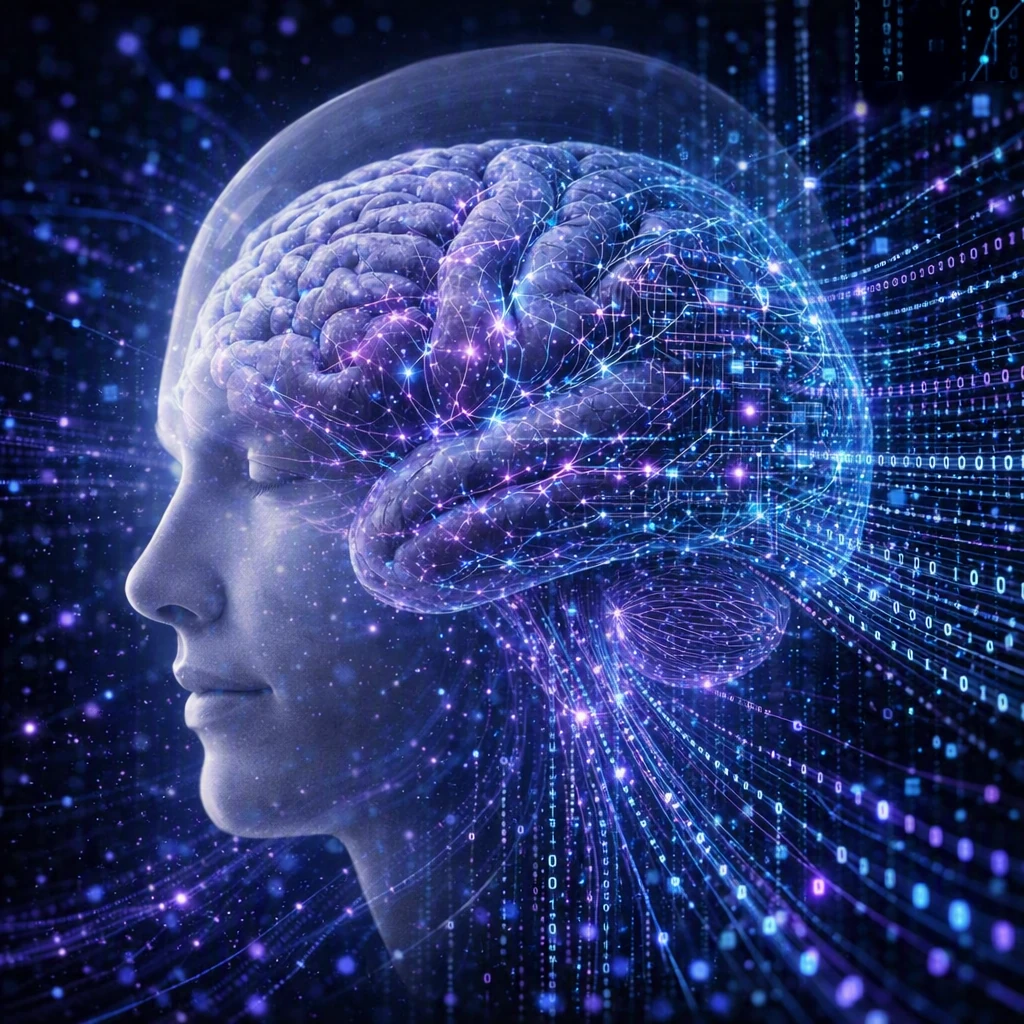
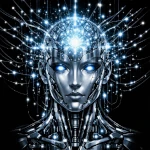
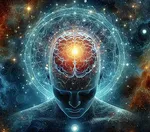
Artistic visualization of a human brain whose neural connections blend with a network of digital data, illustrating the encounter between biological cognition and the information flows generated by AI, with luminous particles evoking the billions of bits processed every second.
Image source: astronoo.com (new window) : AI-generated image, public domain.
Scientific abstract
The Astronoo article explores the encounter between the human brain, a biological organ hungry for data, and the information deluge amplified by artificial intelligence. The brain, the product of millions of years of evolution, has built itself as a predictive machine seeking to reduce uncertainty. But the scale, speed, and nature of the flows produced by generative AI exceed the absorption capacities of human attention. Neuroscience studies document a fragmentation of sustained attention, a saturation of working memory, and a modification of dopaminergic circuits (reward circuits using dopamine). This article examines the neural mechanisms at play, the available experimental data, and the possible scenarios: cognitive submersion, plastic adaptation, or augmented symbiosis. The central question is not whether the brain will change, but at what cost and in what ways.
Can the brain absorb the AI data tsunami?
A question of neuroscience, not science fiction
The human brain weighs about 1.4 kilograms, or 2% of body mass, but consumes nearly 20% of the body's total energy. It contains approximately 86 billion neurons and several hundred trillion synaptic connections. This architecture, shaped by evolution, is optimized for a precise task: extracting useful information from an uncertain environment, then anticipating, deciding, and acting.
For millennia, the information flow accessible to an individual remained limited. Generative AI, algorithmic social networks, and continuous data streams have changed scale in less than twenty years. The question is therefore no longer rhetorical: is the brain, an organ hungry for data, undergoing a cognitive tsunami or a simple adaptive transition?
Also worth exploring
Continue your exploration of the Universe with these topics:
The brain, a predictive machine hungry for data
An organ selected to reduce uncertainty
Contemporary neuroscience describes the brain as a predictive machine. According to the free energy principle formalized by Karl Friston (1959–), the brain constantly seeks to minimize surprise, that is, the gap between its internal predictions and the sensory signals it receives. This theory, called the FEP, unifies perception, action, and learning under a single mathematical framework.
In this model, the hunger for data is not a defect: it is an evolutionary strategy. Each new piece of information makes it possible to refine internal models, improve predictions, and thus better survive. The brain is therefore wired to actively seek information, especially that which reduces uncertainty or signals a reward.
The work of Donald Hebb (1904–1985) on synaptic plasticity showed that this hunger leaves a physical trace: neural connections strengthen or weaken according to their use. The brain is therefore not a passive receptacle, but an organ that constantly reconfigures itself, based on the data it processes. It is this plasticity that makes adaptation possible, but also vulnerability.
The reward circuit and dopamine
Seeking information activates the brain's reward circuit. A small deep area, the ventral tegmental area, sends dopamine to another area, the nucleus accumbens. Result: the brain wants to keep searching. Dopamine does not encode pleasure itself, but the reward prediction error: it signals that something unexpected and positive has just occurred. However, modern digital platforms exploit precisely this mechanism by delivering new, unpredictable, and personalized content.
The result is a feedback loop: each notification, each scroll, each AI-generated response produces a small positive prediction error, which reinforces the search behavior. The brain, designed to economize on information, finds itself exposed to a nearly unlimited flow of stimuli calibrated for its own reward system.
The three cases of reward prediction error
| Case | Gap | Dopamine | Brain message |
|---|---|---|---|
| Positive error | Reward better than expected | Spike | "It was better than expected, remember it" |
| Negative error | Reward worse than expected | Drop | "It was worse, don't repeat the mistake" |
| Zero error | Reward exactly as expected | Stable | "Nothing new" |
The information deluge: a rupture of scale
Unprecedented volumes
To measure the magnitude of the phenomenon, a few orders of magnitude suffice. In 2024, humanity produced more than 400 exabytes of data, or about 400 billion billion bytes. This volume roughly doubles every two to three years. A growing share of this data is generated by AI, whether text, images, videos, or code.
The human brain, however, has not evolved at this speed. Its conscious processing capacity is estimated at about 50 bits per second, while its sensory systems capture several million bits per second. Most of this flow is filtered, but the filtering itself consumes attentional resources. The gap between the information supply and the cognitive absorption capacity is at the heart of the problem.
The notion of information overload
The concept is not new. As early as 1970, Alvin Toffler (1928–2016) described in Future Shock the psychological shock linked to the acceleration of change. In 1971, Herbert Simon (1916–2001), Nobel laureate in economics, formulated the fundamental idea: in a world rich in information, the scarce resource becomes attention. Information overload therefore does not come from a lack of data, but from an excess of data relative to available attention capacity.
With generative AI, this overload changes in nature. It is no longer only a quantitative excess, but a qualitative excess: content produced on demand, personalized, plausible, and impossible to distinguish from the real without effort. The brain must not only sort, but also understand and verify, which mobilizes costly prefrontal resources.
Documented cognitive impacts
Fragmentation of attention
Numerous studies in cognitive psychology have measured the effects of digital multitasking on attention. The results converge: repeated solicitation by notifications and continuous streams reduces the duration of sustained attention, increases the number of errors, and lengthens the time to resume after an interruption. A phenomenon known as the switch cost.
fMRI shows that digital multitasking excessively solicits the dorsolateral prefrontal cortex, a key region of executive control. In the long term, this overuse could promote decision fatigue and lower tolerance for boredom, a state nevertheless necessary for memory consolidation and creativity.
Saturation of working memory
Working memory, a capacity limited to about four to seven simultaneous elements, is the bottleneck of human cognition. Continuous information flows saturate it permanently, preventing deep encoding into long-term memory. The result is a more superficial memory, more dependent on external supports, and more vulnerable to distractions.
Modification of the reward circuit
The work of Daniel Kahneman (1934–2024) showed the coexistence of two systems of thought: a fast, intuitive system and a slow, analytical one. The information deluge favors the former at the expense of the latter, because it rewards immediate reaction rather than reflection. This shift has consequences for the quality of reasoning, resistance to cognitive biases, and the ability to sustain long intellectual effort.
Effects on sleep and emotional regulation
Prolonged exposure to screens and information flows, especially in the evening, delays falling asleep and fragments sleep. However, sleep is essential for consolidating learning and eliminating cerebral metabolic waste. Chronic sleep deprivation in turn aggravates irritability, anxiety, and difficulty regulating emotions, creating a vicious circle.
Table of documented impacts
The table below summarizes the main observed effects of the information deluge on cognitive functions, as well as the neural mechanisms probably involved.
| Cognitive function | Observed effect | Probable mechanism | Main source |
|---|---|---|---|
| Sustained attention | Fragmentation, reduced duration | Repeated dopaminergic solicitation, switch cost | Studies in cognitive psychology |
| Working memory | Saturation, frequent forgetting | Excessive cognitive load, interference | Cognitive neuroscience |
| Long-term memory | Superficial encoding | Lack of deep consolidation | Learning research |
| Sleep | Reduction, fragmentation | Screen exposure, hyperstimulation | Sleep medicine |
| Emotional regulation | Anxiety, irritability | Prefrontal cortex overload | Psychiatry and brain imaging |
| Creativity | Reduced tolerance for boredom | Lack of cognitive rest time | Psychology of creativity |
Neuroplasticity: adaptation or damage?
A double-edged plasticity
The brain is plastic: it reorganizes itself according to use. This property, essential to learning, also means that prolonged exposure to a saturated information environment leaves lasting traces. Imaging studies show modifications of functional connectivity in intensive users of digital platforms, particularly in the circuits of attention and cognitive control.
Should this be seen as damage or adaptation? The answer is nuanced. The brain adapts to its environment: if this environment is saturated and fragmented, it develops fast, superficial processing strategies, but efficient for navigating this flow. The cost appears when these strategies become dominant, at the expense of deep reflection and sustained attention.
The role of cognitive rest
The brain does not only need stimulation: it needs cognitive rest. Moments of mind-wandering, breaks without solicitation, walks without screens activate the default mode network (DMN), involved in memory consolidation, projection into the future, and the construction of the self. The systematic suppression of these moments by a continuous information flow could be one of the deepest effects of the current deluge.
AI and brain: symbiosis, dependence, or submersion?
Cognitive prostheses
AI can also act as cognitive prostheses: they externalize memory, assist reasoning, filter information, translate, summarize. Used as tools, they free attentional resources for higher-value tasks. This is the scenario of augmented symbiosis, in which human and machine complement each other.
But this symbiosis has a condition: the user must retain control of the process. If AI decides what is relevant, summarizes, guides, and personalizes, the user risks gradually losing the skills of sorting, analysis, and memorization. This is the scenario of cognitive dependence, where the tool replaces the function instead of assisting it.
The risk of functional atrophy
In neuroscience, the rule is simple: a function that is little used degrades. Studies on London taxi drivers showed that the posterior hippocampus develops in those who memorize the city map, and regresses after retirement. By analogy, if AI takes charge of memory, orientation, mental calculation, or writing, the corresponding circuits could weaken from lack of training.
This phenomenon, sometimes called cognitive offloading, is not inevitable. It depends on use: an AI that explains, guides, and makes the user work strengthens the circuits; an AI that answers in their place weakens them. The distinction is crucial for education and training.
New scientific frontiers
Brain-machine interfaces and augmented cognition
Brain-machine interfaces (BMIs) are progressing rapidly. They already allow paralyzed patients to control a robotic arm or a cursor by thought. Ultimately, they could offer a direct channel between the brain and AI, bypassing sensorimotor bottlenecks. But they raise major ethical questions: who controls the flow? Who guarantees the integrity of thought?
fMRI studies on the use of generative AI
Since 2023, several teams have been using fMRI to compare brain activity during tasks performed with or without generative AI. The first results suggest reduced activation of working memory and executive control regions when AI provides the answer, and increased activation of verification and vigilance regions. These works, still preliminary, open an essential field of research.
Toward information hygiene
Faced with the deluge, a new discipline is emerging: information hygiene. It consists of actively managing one's exposure to flows, preserving periods of cognitive rest, prioritizing depth over quantity, and regularly training the threatened functions (attention, memory, reasoning). Neuroscience can guide these practices, as it already guides sleep hygiene or physical activity.
Key takeaways
The brain is not a passive machine. Its plasticity allows it to adapt to very different environments, including informationally saturated ones. The question is therefore not whether it will survive the deluge of artificial intelligences, but in what ways and at what functional cost. The challenge is as much scientific as it is cultural and educational.
Natural selection, meanwhile, acts on very long timescales, on the order of several tens of generations. It therefore cannot respond in a few decades to such a rapid technological change. If there is selective pressure, it will probably bear on traits favoring resistance to information overload: better attention regulation, less dependence on immediate dopaminergic rewards, greater tolerance for boredom and slowness. But these traits are polygenic, difficult to measure, and subject to many cultural influences. Biological evolution will therefore be neither the only nor the main mechanism of adaptation.
What evolves fastest is culture: usage norms, digital education, information hygiene, collective regulations. Natural selection could eventually favor certain cognitive profiles, but it will not erase the need for immediate cultural and educational adaptation. The human brain will not be replaced: it will be reconfigured, partly by plasticity, partly by the collective choices we will make.
References
- Wikipedia: Information overload (new window)
- Friston, K.: "The free-energy principle: a unified brain theory?", Nature Reviews Neuroscience, vol. 11, 2010 (new window)
- Maguire, E. A. et al.: "Navigation-related structural change in the hippocampi of taxi drivers", PNAS, vol. 97, 2000 (new window)
- Schultz, W.: "Dopamine reward prediction-error signalling: a two-component response", Nature Reviews Neuroscience, vol. 17, 2016 (new window)
- Ince, M. S. et al.: "The neurocognitive cost of media multitasking: fragmented screens, fragmented minds!", BMC Neuroscience, 2026 (new window)
- 1978 Nobel Prize in Economics: Herbert Simon (new window)
- WHO: "Addressing the digital determinants of youth mental health and well-being: policy brief", 2025 (new window)
FAQ: The brain facing the data deluge
Is the brain really overwhelmed by data?
The brain is not overwhelmed in the sense of absolute saturation: it constantly filters information. However, its capacities for conscious attention are limited to about 50 bits per second, while current digital flows exceed several million bits per second. The gap creates an attentional overload, not a saturation of global brain processing.
Do AI make the brain more intelligent or more dependent?
Both scenarios are possible and depend on usage. Used as cognitive prostheses that explain, guide, and make the user work, AI strengthens skills. Used as substitutes that answer in the user's place, they promote cognitive dependence and atrophy of unsolicited functions.
What is information overload?
Information overload refers to the state in which the volume of information to be processed exceeds the individual's attention and processing capacity. The concept was introduced by Alvin Toffler (1928–2016) in 1970 and formalized by Herbert Simon (1916–2001) in 1971, who showed that in a world rich in information, attention becomes the scarce resource.
What are the effects of the data deluge on memory?
Working memory becomes saturated, encoding into long-term memory becomes more superficial, and dependence on external supports increases. The brain retains its memorization capacity, but its use of it changes: it memorizes less content and more the access paths to information.
Can the brain adapt to this deluge?
Yes, thanks to neuroplasticity. The brain reorganizes itself according to use. But this adaptation has a cost: it can favor fast and superficial strategies at the expense of sustained attention and deep reflection. The quality of adaptation depends on the information environment and individual practices.
What is information hygiene?
Information hygiene refers to the set of practices aimed at actively managing one's exposure to information flows: disconnection periods, preservation of cognitive rest, priority to depth over quantity, regular training of threatened functions (attention, memory, reasoning). It is inspired by the principles of sleep hygiene and physical activity.
Are brain-machine interfaces a solution?
Brain-machine interfaces (BMIs) open perspectives for direct communication between the brain and AI. They could one day bypass sensorimotor bottlenecks, but they raise major ethical questions: control of the flow, integrity of thought, equity of access. They are not an immediate solution to the information deluge.
Should we fear the announced cognitive tsunami?
Above all, it must be scientifically documented. Available data show measurable effects on attention, memory, and sleep, but also remarkable adaptive capacities. Fear is not a research program: the challenge is to understand the mechanisms, measure the thresholds, and propose informed practices.
 From the Zeroth Law to Generative AI: Asimov's Laws in Question
  How do complex societies emerge and disappear?
  The Brain vs. AI: Chronicle of an Organ Overwhelmed by the Data Deluge
  AI has learned to think: will artificial consciousness learn to be?
  The Future Obsession: When prediction shapes the living
  Which Regions of the World Will Remain Habitable During the Next Ice Age?
  Rapid Evolution: Darwin’s Thunderbolt in the 21st Century
  Fatal Imbalance: The Unsuspected Power of the Infinitely Small
  The Great Filter of Evolution: The Key to the Fermi Paradox
  The Last Glacial Shock: The Younger Dryas and Its Impact on Prehistoric Societies
  Why Does the Sunflower Turn Toward the Sun? An Answer Through the Lagrangian
  World Population 2026: Demographic Trends by Continent
 Why Life Emerges from Imbalance and Dies at Thermodynamic Equilibrium
  The Electromagnetic Spectrum and Vision: What Our Eyes Perceive of Our Planet
  Self and Non-Self: A Simplified Physical Reading of Identity
  The Molecular Clock: From Random Mutations to Measuring Time
  The Minimal Cell: The Inevitable Emergence
  White Sands Footprints: America's First Steps
  Hominins: Appearance, Expansion, and Extinctions
  Declining Births: Demographic Catastrophe or Natural Evolution?
  Natural Selection vs. Chance: Why Evolution is Not a Lottery?
  What if Life Originated from Earth? A Revolution in the Theory of Panspermia
  The Great Bifurcation that will Disrupt Our World: Survival or Collapse?
  Primordial Chemistry: Where Do the First Organic Molecules Originate?
  CO and CO₂: Two Gases, Two Risks, Two Biological Mechanisms
  Spontaneous Synchronization: A Universal Phenomenon, from Physics to Life
  Time Challenge: How to Illustrate a Billion Years?
  The Three Essential Components for the Emergence of Life
  Why Did the Genus Homo Nearly Go Extinct 900,000 Years Ago?
  The First Step Towards the Emergence of Life
  The shadow biosphere
  Decline of anthropocentrism: when the cosmos relativizes our importance
  The horseshoe
crab, a living fossil!
The horseshoe
crab, a living fossil!  Origin of life
on Earth: Panspermia theory
Origin of life
on Earth: Panspermia theory  Origin of life on Earth: White smoker theory
  Why 37 degrees Celsius?
  Are We Alone in the Cosmos? Between Science and Speculation
  Traces
of Life in the Ice: The Emergence of Prehistoric Mammoths
Traces
of Life in the Ice: The Emergence of Prehistoric Mammoths  The Younger Dryas: The Mini Ice Age That Wiped Out the Megafauna
  The Two Great Ice Ages: Surviving in the Oceans of a Frozen Earth
  Regeneration in Animals Following Amputation: Organic Regrowth
  At the Limits
of Life: Mephisto, Worm of the Infernal Depths
At the Limits
of Life: Mephisto, Worm of the Infernal Depths  Discovery
of solid buckyballs in space
Discovery
of solid buckyballs in space  Human Walking:
The Origins of Bipedalism in Hominids
Human Walking:
The Origins of Bipedalism in Hominids  Karabo: A Window into Human Evolution
  Entropy: What
is Time?
Entropy: What
is Time?  The
passage between the inert and the living
The
passage between the inert and the living  The
Great Story of Complexity: From Elementary Particles to the First Organisms
The
Great Story of Complexity: From Elementary Particles to the First Organisms  Megapod uses
volcanic heat
Megapod uses
volcanic heat  Ardipithecus:
The 4.4-Million-Year-Old Ethiopian Hominid
Ardipithecus:
The 4.4-Million-Year-Old Ethiopian Hominid  Natural Selection: The Peppered Moth
  The Ordovician:
The Era of Corals, Trilobites, and Graptolites
The Ordovician:
The Era of Corals, Trilobites, and Graptolites  Liquid
Water, Much More Than a Solvent: A Catalyst for Chemical Reactions
Liquid
Water, Much More Than a Solvent: A Catalyst for Chemical Reactions  Neanderthal:
Humanity's Lost Cousin
Neanderthal:
Humanity's Lost Cousin  ASIMO: The First
Humanoid
ASIMO: The First
Humanoid  What conditions allowed the emergence of life?
  Fermi Paradox and Plato's Cave: Are We Alone or Blind?
  Tardigrades:
Indestructible Creatures That Defy the Laws of Biology
Tardigrades:
Indestructible Creatures That Defy the Laws of Biology  Toumaï: One
of the Oldest Known Hominins
Toumaï: One
of the Oldest Known Hominins  The
Tree of Life: Billions of Extinct Species and a Single Ancestral Community
The
Tree of Life: Billions of Extinct Species and a Single Ancestral Community  Life
in the Abyss: The Extreme Adaptation of Creatures
Life
in the Abyss: The Extreme Adaptation of Creatures  Cyanobacteria
and the Oxygen Crisis: A Primordial Ecological Catastrophe
Cyanobacteria
and the Oxygen Crisis: A Primordial Ecological Catastrophe  From
Matter to Life: The Blurred Frontier of Biological Emergence
From
Matter to Life: The Blurred Frontier of Biological Emergence  The Smallest Frog in the World: Physiological Secrets of a Microvertebrate
  The explanation of the Little Ice Age
  The Light of Life: A Biosignature Revealed by the Moon
  Living
Light: The Dazzling Secrets of Bioluminescence
Living
Light: The Dazzling Secrets of Bioluminescence  Beyond our senses, the great scientific revolutions
  The
Primordial Soup: Chemical Cradle of Terrestrial Life
The
Primordial Soup: Chemical Cradle of Terrestrial Life  World Population: From One Billion Humans to Demographic Saturation
  Ecology
and Collapse: The Case of Easter Island
Ecology
and Collapse: The Case of Easter Island  Fractals: Universally Self-Organized
Structures
Fractals: Universally Self-Organized
Structures