


Why Life Emerges from Imbalance and Dies at Thermodynamic Equilibrium
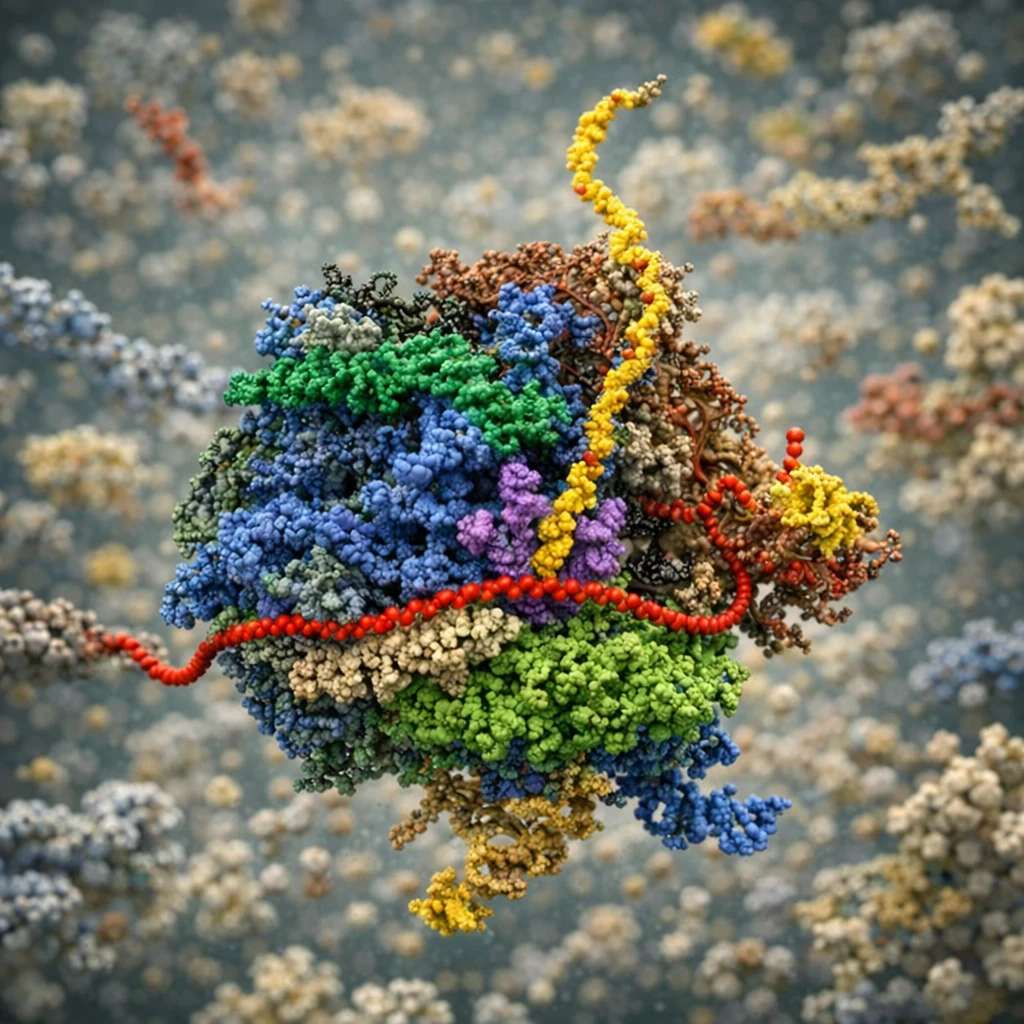
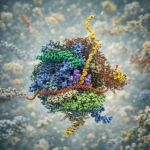
Visualization of a molecular machine at work inside a cell.
Macromolecules agitate and collide, translating the order arising from imbalance.
This imbalance fuels the relentless dynamics by which living matter transforms information into organized matter under the effect of electromagnetic forces.
Image source: astronoo.com (new window)
Scientific Summary
This article explains that life is a process far from thermodynamic equilibrium, dependent on gradients of energy and matter. A system at equilibrium is a dead state, without flow or transformation. Life, on the other hand, is a dissipative structure (Prigogine) that locally creates order by exporting entropy to its environment, thanks to a continuous input of energy (sun, food). This permanent disequilibrium, maintained by processes like ion pumps, enables metabolism and information transmission. Equilibrium would mean the end of all vital activity, illustrating that life is a fight against entropy.
Why Does Life Depend on Thermodynamic Imbalance?
Because life can only exist far from equilibrium: a living organism must maintain energy, temperature, or concentration gradients to produce movement, order, and information. At thermodynamic equilibrium, all flows cease, gradients disappear, and no further transformations can occur—this is a state of death. Life, on the other hand, is a dissipative structure: it creates local organization by exporting entropy to its surroundings. This permanent imbalance, sustained by a continuous flow of energy, allows cells to function, organisms to maintain themselves, and life to exist.
Also worth exploring
Continue your exploration of the Universe with these topics:
Why is thermodynamic equilibrium incompatible with life?
A system at thermodynamic equilibrium is a dead system: no temperature, pressure, or concentration gradients persist, and no spontaneous transformations can occur.
Life requires a permanent flow of energy to maintain its internal order, unlike thermodynamic equilibrium, which is a state of maximum disorder and absence of flow.
It is precisely this permanent flow that allows life to fight against entropy and build the complex structures that are cells, organisms, or ecosystems. Equilibrium would mean the end of all exchange, and thus the end of all dynamic processes characteristic of life.
Imbalance: The Engine of Life
Life relies on gradients—progressive variations in temperature, concentration, pressure, etc. These gradients are forms of imbalance that allow living systems to work: transport nutrients, build or repair molecules, or transmit information.
All cells permanently maintain an imbalance between their interior and their external environment, which contains ions, nutrients, waste, and various macromolecules.
Inside a neuron, potassium (K⁺) is more concentrated than outside, while the opposite is true for sodium (Na⁺). Nature tends to equalize concentrations: potassium ions want to leave, and sodium ions want to enter. Without intervention, equilibrium would reign, and the neuron would be unable to transmit any message. But ion pumps constantly retrieve the ions that have moved and reposition them where they need to be. Like a child (ion pump) constantly scattering toys around their room, while the mother (nature) tirelessly tidies up. A perfectly tidy room is a lifeless room. Thanks to the child, the imbalance is maintained, and the room stays alive.
Without this imbalance, the cell could neither generate action potentials (essential for neuronal communication) nor prevent swelling or shrinking, nor maintain its metabolism. Equilibrium would mean cellular death.
Entropy and the Order of Life
The second law of thermodynamics states that entropy (a measure of disorder) in an isolated system can only increase over time. Yet, living beings seem to defy this law: they maintain, or even increase, their internal level of organization.
The resolution to this paradox lies in the fact that living systems are not isolated. They constantly exchange energy and matter with their environment. By consuming energy (in the form of food, light, etc.), living organisms export entropy to their surroundings, allowing them to maintain or increase their internal order locally.
For example, a plant uses light energy to convert CO2 and water into carbohydrates (photosynthesis), while releasing oxygen. This process creates order in the plant (in the form of complex organic molecules), but it also generates heat and other forms of disorder in the environment. Thus, local order (life) is compensated by global disorder (increased entropy in the environment).
Thermodynamic Equilibrium: The End of Movement
At thermodynamic equilibrium, all forces are balanced, all temperatures are uniform, and all concentrations are homogeneous. There are no more gradients, no more flows, no more spontaneous transformations. It is a state where nothing changes, where nothing lives.
A living organism that reached thermodynamic equilibrium would cease all metabolic activity. Without energy flow, without gradients, it could no longer repair, reproduce, or adapt. Life, by definition, is a process out of equilibrium.
Life as a Dissipative Process
Physicist Ilya Prigogine (Nobel Prize in Chemistry, 1977) theorized that living systems are dissipative structures. These structures form and maintain themselves thanks to a continuous energy input, which they dissipate in the form of heat or other forms of disorder.
For example, eddies in a river, the flames of a fire, or even human economies are dissipative structures. They only exist because a flow of energy constantly passes through them. As soon as this flow stops, the structure disappears. Life, too, is a dissipative structure: it emerges from imbalance and returns to it as soon as energy runs out.
Key Takeaways
Life is a dissipative structure: it emerges from imbalance, but as soon as energy runs out, it disappears and returns to equilibrium. Far from seeking equilibrium, life actively exploits ambient imbalance (solar flux, hydrothermal vents). Thermodynamic equilibrium is a state that life constantly flees. It is in contrast to this equilibrium that life defines itself. This is why death is a process of relaxation toward equilibrium. When there is no more energy input, there are no more gradients. The system disorganizes.
FAQ – Why is thermodynamic equilibrium fatal to life?
What is thermodynamic equilibrium in biology?
It is an ideal state where a system no longer exchanges anything with its environment, and all its variables (temperature, pressure, chemical potentials) are uniform. In this state, no reaction or macroscopic transformation can occur spontaneously.
How does life violate the second law of thermodynamics?
Life does not violate it. It creates local order (reducing internal entropy), but this is always offset by a greater increase in the entropy of the environment. The overall balance complies with the second law; life is an "entropy-producing machine."
What is a dissipative structure?
A dissipative structure is an ordered pattern that spontaneously appears in a system kept far from thermodynamic equilibrium by an energy flow. Convection cells (like in a heated pot of water) or oscillating chemical structures are simple examples. Life is the most complex example.
Why does a dead organism return to equilibrium with its environment?
Because it can no longer maintain its gradients (acidity, concentration, membrane potential) or prevent diffusion and degradation processes. Enzymes stop working, barriers become permeable, and the system passively evolves toward chemical and thermal homogeneity with its surroundings.
Do ecosystems seek equilibrium?
Ecosystems may evolve toward a "dynamic equilibrium" or "climax" where energy and matter flows organize in a stable manner, but this is never thermodynamic equilibrium. Solar, chemical, or biological gradients persist, and total entropy continues to increase. It is a state of steady flow, not static equilibrium.
Is there a connection to the "heat death of the universe"?
Yes. Heat death predicts a distant future where the universe reaches a state of maximum entropy and uniform temperature. In this state, no work or life (as we know it) will be possible, as there will be no more imbalance to exploit. It is the ultimate outcome of the tendency toward equilibrium.
 From the Zeroth Law to Generative AI: Asimov's Laws in Question
  How do complex societies emerge and disappear?
  The Brain vs. AI: Chronicle of an Organ Overwhelmed by the Data Deluge
  AI has learned to think: will artificial consciousness learn to be?
  The Future Obsession: When prediction shapes the living
  Which Regions of the World Will Remain Habitable During the Next Ice Age?
 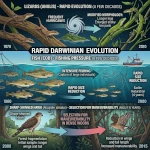 Rapid Evolution: Darwin’s Thunderbolt in the 21st Century
  Fatal Imbalance: The Unsuspected Power of the Infinitely Small
 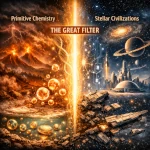 The Great Filter of Evolution: The Key to the Fermi Paradox
  The Last Glacial Shock: The Younger Dryas and Its Impact on Prehistoric Societies
  Why Does the Sunflower Turn Toward the Sun? An Answer Through the Lagrangian
  World Population 2026: Demographic Trends by Continent
 Why Life Emerges from Imbalance and Dies at Thermodynamic Equilibrium
  The Electromagnetic Spectrum and Vision: What Our Eyes Perceive of Our Planet
  Self and Non-Self: A Simplified Physical Reading of Identity
  The Molecular Clock: From Random Mutations to Measuring Time
  The Minimal Cell: The Inevitable Emergence
  White Sands Footprints: America's First Steps
  Hominins: Appearance, Expansion, and Extinctions
  Declining Births: Demographic Catastrophe or Natural Evolution?
  Natural Selection vs. Chance: Why Evolution is Not a Lottery?
  What if Life Originated from Earth? A Revolution in the Theory of Panspermia
  The Great Bifurcation that will Disrupt Our World: Survival or Collapse?
  Primordial Chemistry: Where Do the First Organic Molecules Originate?
 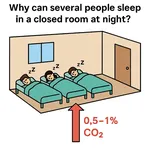 CO and CO₂: Two Gases, Two Risks, Two Biological Mechanisms
  Spontaneous Synchronization: A Universal Phenomenon, from Physics to Life
  Time Challenge: How to Illustrate a Billion Years?
  The Three Essential Components for the Emergence of Life
  Why Did the Genus Homo Nearly Go Extinct 900,000 Years Ago?
  The First Step Towards the Emergence of Life
  The shadow biosphere
  Decline of anthropocentrism: when the cosmos relativizes our importance
  The horseshoe
crab, a living fossil!
The horseshoe
crab, a living fossil!  Origin of life
on Earth: Panspermia theory
Origin of life
on Earth: Panspermia theory  Origin of life on Earth: White smoker theory
  Why 37 degrees Celsius?
  Are We Alone in the Cosmos? Between Science and Speculation
  Traces
of Life in the Ice: The Emergence of Prehistoric Mammoths
Traces
of Life in the Ice: The Emergence of Prehistoric Mammoths  The Younger Dryas: The Mini Ice Age That Wiped Out the Megafauna
  The Two Great Ice Ages: Surviving in the Oceans of a Frozen Earth
  Regeneration in Animals Following Amputation: Organic Regrowth
  At the Limits
of Life: Mephisto, Worm of the Infernal Depths
At the Limits
of Life: Mephisto, Worm of the Infernal Depths  Discovery
of solid buckyballs in space
Discovery
of solid buckyballs in space  Human Walking:
The Origins of Bipedalism in Hominids
Human Walking:
The Origins of Bipedalism in Hominids  Karabo: A Window into Human Evolution
  Entropy: What
is Time?
Entropy: What
is Time?  The
passage between the inert and the living
The
passage between the inert and the living  The
Great Story of Complexity: From Elementary Particles to the First Organisms
The
Great Story of Complexity: From Elementary Particles to the First Organisms  Megapod uses
volcanic heat
Megapod uses
volcanic heat  Ardipithecus:
The 4.4-Million-Year-Old Ethiopian Hominid
Ardipithecus:
The 4.4-Million-Year-Old Ethiopian Hominid  Natural Selection: The Peppered Moth
  The Ordovician:
The Era of Corals, Trilobites, and Graptolites
The Ordovician:
The Era of Corals, Trilobites, and Graptolites  Liquid
Water, Much More Than a Solvent: A Catalyst for Chemical Reactions
Liquid
Water, Much More Than a Solvent: A Catalyst for Chemical Reactions  Neanderthal:
Humanity's Lost Cousin
Neanderthal:
Humanity's Lost Cousin  ASIMO: The First
Humanoid
ASIMO: The First
Humanoid  What conditions allowed the emergence of life?
  Fermi Paradox and Plato's Cave: Are We Alone or Blind?
  Tardigrades:
Indestructible Creatures That Defy the Laws of Biology
Tardigrades:
Indestructible Creatures That Defy the Laws of Biology  Toumaï: One
of the Oldest Known Hominins
Toumaï: One
of the Oldest Known Hominins  The
Tree of Life: Billions of Extinct Species and a Single Ancestral Community
The
Tree of Life: Billions of Extinct Species and a Single Ancestral Community  Life
in the Abyss: The Extreme Adaptation of Creatures
Life
in the Abyss: The Extreme Adaptation of Creatures  Cyanobacteria
and the Oxygen Crisis: A Primordial Ecological Catastrophe
Cyanobacteria
and the Oxygen Crisis: A Primordial Ecological Catastrophe  From
Matter to Life: The Blurred Frontier of Biological Emergence
From
Matter to Life: The Blurred Frontier of Biological Emergence  The Smallest Frog in the World: Physiological Secrets of a Microvertebrate
  The explanation of the Little Ice Age
  The Light of Life: A Biosignature Revealed by the Moon
  Living
Light: The Dazzling Secrets of Bioluminescence
Living
Light: The Dazzling Secrets of Bioluminescence  Beyond our senses, the great scientific revolutions
  The
Primordial Soup: Chemical Cradle of Terrestrial Life
The
Primordial Soup: Chemical Cradle of Terrestrial Life  World Population: From One Billion Humans to Demographic Saturation
  Ecology
and Collapse: The Case of Easter Island
Ecology
and Collapse: The Case of Easter Island  Fractals: Universally Self-Organized
Structures
Fractals: Universally Self-Organized
Structures