


Major natural disasters: what are the most likely threats?
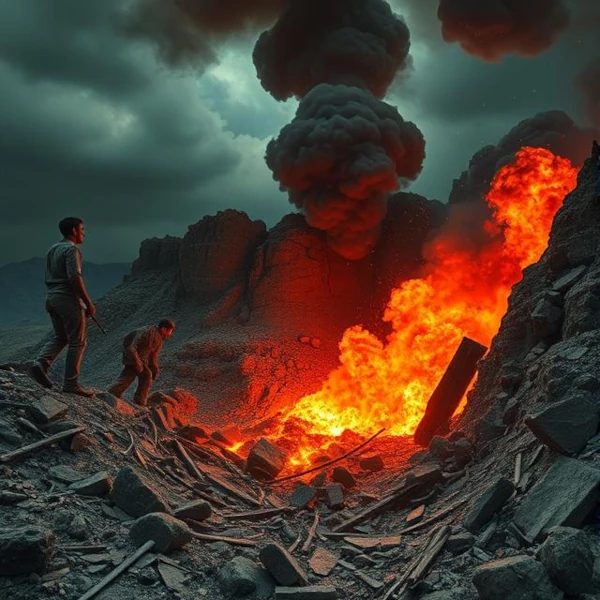
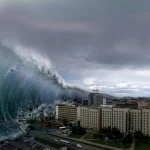
Natural disasters: The aftermath of a devastating tsunami on an inhabited coast.
Image source: astronoo.com (new window) — AI-generated image, public domain.
Scientific summary
This article examines major natural disasters according to their probability and potential impact. Threats are classified into regular events such as super hurricanes (5–10% per decade) and mega-fires, and into extremely rare but devastating phenomena: supervolcanic eruptions (<0.001% per century), asteroid impacts (<0.0001% per century) or nearby gamma-ray bursts. Intermediate risks include pandemics (0.1–1% per century), mega-earthquakes (0.1–0.2% per century) and abrupt climate collapses. Probabilistic analysis shows that high-frequency threats have a regional impact, while rare events can affect the entire biosphere, with human losses ranging from a few thousand to several billion.
What are the most likely and most devastating natural disasters?
The article draws up an inventory of natural threats by cross-referencing their frequency and their impact. The most likely events on a human scale are super hurricanes (5–10% per decade), mega-fires and major floods, whose damage is regional but significant (10,000 to 100,000 deaths). On a centennial scale, extreme pandemics (0.1–1% per century) and mega-earthquakes (0.1–0.2% per century) represent major risks, with potential losses reaching several million lives. Finally, cataclysmic phenomena such as supervolcanic eruptions (<0.001%), asteroid impacts larger than one kilometer (<0.0001%) or nearby gamma-ray bursts are extremely rare but capable of mass extinctions (several billion deaths). Between these extremes, abrupt climate collapse and the "Hothouse Earth" scenario present uncertain probabilities but potentially irreversible consequences for human societies.
Also worth exploring
Continue your exploration of the Universe with these topics:
Also discover
Continue your exploration of the Universe with these topics:
- Astronomy and time: How ancient civilizations measured time
- The Footprint of Life: From the Moon to Distant Worlds
- The Toba Super-Eruption: Decades of Climatic Chaos
- The Witch Head Nebula: Scientific Exploration
Natural disasters: between regularity and extreme rarity
Major natural disasters are high-impact events that can radically transform the environment and human societies. Some, such as earthquakes or floods, occur regularly and are relatively well quantified. Others, such as supervolcanic eruptions or asteroid impacts, are extremely rare but potentially devastating on a planetary scale.
Table of the worst potential natural disasters
| Phenomenon | Estimated frequency | Physical impact | Estimated number of deaths |
|---|---|---|---|
| Super hurricane | A few decades (5–10% per decade) | Winds >250 km/h, massive coastal destruction | 10,000 – 100,000 |
| Mega-fire | Decades to centuries (variable depending on climatic conditions) | Extreme forest fires destroying millions of hectares, massive pollution | Thousands to tens of thousands |
| Extreme global pandemic | A few centuries (0.1–1% per century) | Rapid spread of a highly lethal and contagious pathogen | Hundreds of thousands to several billion |
| Abrupt climate collapse | A few centuries to millennia (uncertain, potentially 0.1% per century) | Rapid modification of the global climate, impact on agriculture, water resources, migrations | Millions to hundreds of millions (indirect) |
| Hothouse Earth | Probably millennial (very uncertain) | Cascading climate feedbacks, ecosystem transformation, high CO₂ emissions | Hundreds of millions to billions (indirect) |
| Major solar storm | ~Every 150 years (~0.7% per century) | Global electromagnetic disturbances, power grid failures | Indirect, potentially millions through infrastructure collapse |
| Mega-earthquake | ~Every 500 to 1,000 years (0.1–0.2% per century) | Magnitude >9, extensive regional destruction | Hundreds of thousands |
| Mega-tsunami | A few thousand years (~0.01% per century) | Waves >30 m, massive coastal destruction | Millions |
| Detachment of an Antarctic block | Unknown, probably millennial (≤ 0.01% per century) | Rapid sea-level rise, submersion of coastal areas | Millions |
| Supervolcano | ~Every 100,000 years (<0.001% per century) | Massive eruption causing a global volcanic winter | Millions |
| Asteroid impact (>1 km) | ~Every 500,000 years (<0.0001% per century) | Intense impact energy causing mass extinction | Billions |
| Nearby gamma-ray burst | Very rare event (<0.0001% per century) | Intense cosmic explosion in gamma rays, partial sterilization of the biosphere | Millions to billions (depending on proximity) |
Main categories of threats and their probabilities
- Super hurricanes: These extreme tropical cyclones have winds exceeding 250 km/h, generating destructive storm surges and torrential rainfall. Their formation depends on warm ocean conditions (>28°C) and complex atmospheric dynamics. The kinetic power dissipated reaches several terajoules, causing massive destruction in coastal areas. Their frequency is on the order of a few decades, with a probability of 5 to 10% per decade.
- Mega-fire: These large-scale fires result from the convergence of prolonged droughts, strong winds and vast flammable biomass. They can engulf several million hectares, temporarily modifying the atmospheric composition through significant emissions of fine particles and CO₂, affecting air quality on a continental scale. Their occurrence is variable but can be expected on timescales of decades to centuries depending on climate change and ecosystem management.
- Extreme global pandemic: The emergence or rapid mutation of a highly contagious and lethal pathogen can cause a global pandemic. Transmission is facilitated by population density, human mobility, and interactions with animal reservoirs. These biological events represent a threat with potentially massive human losses, ranging from hundreds of thousands to several billion. Their probability over a few centuries is estimated at between 0.1 and 1% per century.
- Abrupt climate collapse: Abrupt climate collapse refers to a rapid and irreversible change in global climate regimes, often linked to disruption of water and carbon cycles and accelerated melting of polar ice. These modifications severely impact agricultural resources, water systems and cause massive human migrations. The probability remains uncertain but is estimated at around 0.1% per century, with indirect impacts on several hundred million individuals.
- Hothouse Earth: This extreme scenario involves a cascading climate runaway where natural carbon sinks, such as the Amazon rainforest and permafrost, cease to store CO₂ or even become sources. This leads to an uncontrolled increase in global temperatures, transforming terrestrial and marine ecosystems, and destabilizing the biosphere. The probability is highly uncertain but is probably on a millennial scale, with a potential indirect impact on several hundred million to billion people.
- Major solar storm: Intense solar flares release flows of energetic particles and electromagnetic pulses that can damage electrical and satellite infrastructure. The Carrington Event of 1859 is a reference, but more powerful storms are possible. These phenomena have a probability of about 0.7% per century and could indirectly affect millions of people by causing widespread blackouts.
- Mega-earthquake: Earthquakes of magnitude greater than 9 result from the rupture of a very long portion of a major tectonic fault. The energy released is measured in hundreds of megatons of TNT. These events cause extensive regional destruction and massive human losses. Their frequency is about one per 500 to 1,000 years, i.e., 0.1–0.2% per century.
- Mega-tsunami: Generated by very powerful earthquakes, underwater landslides or the detachment of immense glacial masses, these tsunamis reach heights exceeding 30 meters, flooding coastal areas over hundreds of kilometers. Their occurrence is on the order of a few thousand years. Human losses can reach several million.
- Mega-floods: Mega-floods are extreme events resulting from the rapid rupture of natural or artificial dams, massive rapid melting of glaciers, or the sudden obstruction of river basins. These phenomena can generate colossal volumes of water submerging vast regions within hours to days, causing extensive destruction and very significant human losses. Their frequency is difficult to quantify but may be on the order of a few centuries to millennia depending on the geological and climatic context.
- Detachment of an Antarctic block: The rupture and drift of a massive Antarctic ice block accelerate sea-level rise on centennial to millennial scales. This phenomenon leads to the submersion of large coastal areas, affecting millions of people. The probability is difficult to estimate precisely, but it remains low to very low.
- Supervolcanic eruptions: Supervolcanic eruptions eject thousands of cubic kilometers of pyroclastic materials and volcanic gases, causing a global volcanic winter with a drastic reduction in solar luminosity. These events are extremely rare, about one every 100,000 years, but their consequences are catastrophic, with several million deaths and global environmental disruptions.
- Asteroid impacts: An asteroid impact larger than one kilometer in diameter releases colossal energy, comparable to several million megatons of TNT, causing global fires, giant tsunamis, atmospheric disturbances and mass extinctions. The probability of this event is very low, about one every 500,000 years, but the consequences are planetary with several billion deaths possible.
- Nearby gamma-ray burst: Gamma-ray bursts are extremely energetic cosmic explosions, producing an intense beam of gamma rays. A burst located less than 6,000 light-years away could expose Earth to lethal radiation, causing partial destruction of the ozone layer and sterilizing a significant part of the biosphere. These events are extremely rare, with an infinitesimal probability on human timescales, but their effects would be cataclysmic.
References
- UNDRR (United Nations Office for Disaster Risk Reduction) - Global Assessment Report on Disaster Risk Reduction (GAR) (new window)
- IPCC - Assessment Reports on climate, extreme events and climate tipping points (new window)
- NOAA - National Centers for Environmental Information: Global database of major natural hazards (earthquakes, tsunamis, volcanoes) (new window)
- Global Priorities Institute (University of Oxford) - Scientific research on existential risks and extreme global catastrophes (new window)
- WHO (World Health Organization) - Surveillance of health emergencies, alerts and epidemic preparedness (new window)
FAQ: Everything you need to know about Major Natural Disasters
What is the most likely natural disaster in the coming decades?
According to the article, super hurricanes (winds >250 km/h) are the most frequent major threats, with a probability of 5 to 10% per decade. Mega-fires and extreme floods are also regular risks, whose probability increases with climate change. These events can cause massive destruction and human losses ranging from 10,000 to 100,000 people.
Which disasters are capable of affecting humanity on a planetary scale?
Several phenomena can have a global impact:
• Supervolcanic eruptions (every 100,000 years) cause a volcanic winter by projecting aerosols into the stratosphere, reducing solar luminosity.
• The impact of an asteroid larger than one kilometer (every 500,000 years) releases energy equivalent to several million megatons of TNT.
• Nearby gamma-ray bursts could partially destroy the ozone layer.
These events are extremely rare (probability <0.001% per century) but could lead to mass extinctions affecting several billion human beings.
What is the risk associated with abrupt climate change?
Abrupt climate collapse and the "Hothouse Earth" scenario represent long-term threats whose probabilities are uncertain (estimated at around 0.1% per century). These phenomena would involve cascading feedbacks: melting ice, release of permafrost methane, transformation of the Amazon rainforest into a CO₂ source. The impacts would be indirect but massive, affecting agriculture, water resources and forcing large-scale human migrations, with losses potentially reaching hundreds of millions to one billion people.
How are probabilities estimated for these rare events?
The probabilities presented in the article are derived from statistical models based on geological records (for eruptions and impacts), historical records (for hurricanes and earthquakes) and numerical simulations for future scenarios. For very rare events, uncertainties are large: a probability range is often indicated. For example, extreme pandemics are estimated at between 0.1 and 1% per century, while major impacts are described as "very low" due to the lack of historical data.
Which disasters are the deadliest in terms of potential victims?
The article's table ranks events according to their estimated human impact:
• Asteroid impact (>1 km): up to several billion deaths (mass extinction).
• Nearby gamma-ray burst: several million to billion (depending on distance).
• Extreme pandemic: from hundreds of thousands to several billion.
• Climate collapse / Hothouse Earth: hundreds of millions to billion (indirect impacts).
• Supervolcanic eruption: several million.
• Mega-tsunami or mega-earthquake: hundreds of thousands to millions.
Are there measures to prevent or mitigate these risks?
The article does not detail prevention measures, but it suggests that risk management relies on:
• Monitoring (seismic, meteorological, space networks).
• Early warning systems (for hurricanes, tsunamis, eruptions).
• Reducing vulnerabilities (earthquake-resistant construction, forest management).
• International cooperation for global threats (pandemics, climate).
Rare but cataclysmic events (asteroids, supervolcanoes) are the subject of detection programs and deflection strategies (for asteroids), although their implementation remains complex.
 From Black Basalt to Blue Oceans: Earth's Changing Palette
  Plate Tectonics: The Invisible Engine Moving the Continents
  The Number 360: The Mathematical Key to the Babylonian Sky
  Wet-Bulb Temperature: Humanity's Climate Time Bomb
  Why Doesn't Earth's Atmosphere Escape into Space?
  Origins of Earth: Magmatic Chaos and the Birth of the Solid World
  Earth's Atmosphere: The Invisible Shield Protecting Life
  The 5 Cosmic "End of the World" Scenarios (and Why They Won't Happen)
  Where does the water in the oceans come from? Three key stages
  From Carbon 14 to Uranium-Lead: The Science of Dating
  Major Natural Disasters: What Are the Most Likely Threats?
  The Boundary of Space: Where Does It Really Begin?
  536: The Year Without a Summer and the Beginning of the Late Antique Little Ice Age
  The leap second: scheduled end in 2035
  Planetary Alignments: A Fascinating but Relative Phenomenon
  All Deserts of the World
  Earth's Paleoclimates and Carbon Dioxide
  What is the effect of large lakes and water reservoirs on Earth's rotation?
  International Date Line
  Start Date of the Seasons: A Complex Celestial Mechanism
  Paleomagnetism: the magnetic memory of rocks
  3D Simulator: Revolutions of the Planets
  Geological Time and Mass Extinctions: From the Ordovician to the Cretaceous
  Earth History: Timeline Compressed into 24 Hours
  Earth's Water: An Extraterrestrial Origin?
  Reading the Sky: Understanding Declination and Right Ascension
  How is Earth's magnetic field born and why does it reverse?
  Earth's Magnetosphere: The Invisible Shield
  Fujita Scale: Classifying the Fury of Tornadoes
  Earth's Radioactivity: The Internal Energy of Our Planet
  The Deep Sea: Exploring the Deepest Ocean Trenches
  Why Are Days Getting Longer?
  The Depths of the Earth: From the Lithosphere to the Core
  Earth's Movements: How Earth Traces Its Spiral Through the Universe?
  How much is the sea level rising?
  The Life of Earth: Structure and Layers of the Earth
  The Eccentricity of Earth's Orbit: An Ellipse That Changes Everything
  Little Ice Age: The History of a Natural Climatic Cooling
  The Quest for Time: How Ancient Civilizations Used Astronomy?
  Van Allen Belt: A Rampart Against Cosmic Particles
  The Cosmos in Our Measure: When Man Invents the Universe
  What is the pendulum fixed relative to?
  Problem of longitude at sea
  World population, still gallopingin 2008
  The Oldest Image of Earth from Space
  Earth's Obliquity and Variations in Its Axis of Rotation
  The Astronomical Unit Fixed: A Length, No Longer an Orbit
  Water: one molecule, three states on Earth
  Simulator, the round of near-Earth cruisers
  Satellites that measure underwater relief
  Hadean's Hell
  The First Free Flight of an Astronaut in Space
  The first measurement of the Earth-Sun distance
  La The Announced End of the World on December 21, 2012: A Millennial Prophecy
 The Equinoxes: An Astronomical Event
 Milankovitch Cycles: The Astronomical Rhythm of Earth's Climate
 Why Is Earth So Often Cloudy?