


Why Does the Sunflower Turn Toward the Sun?
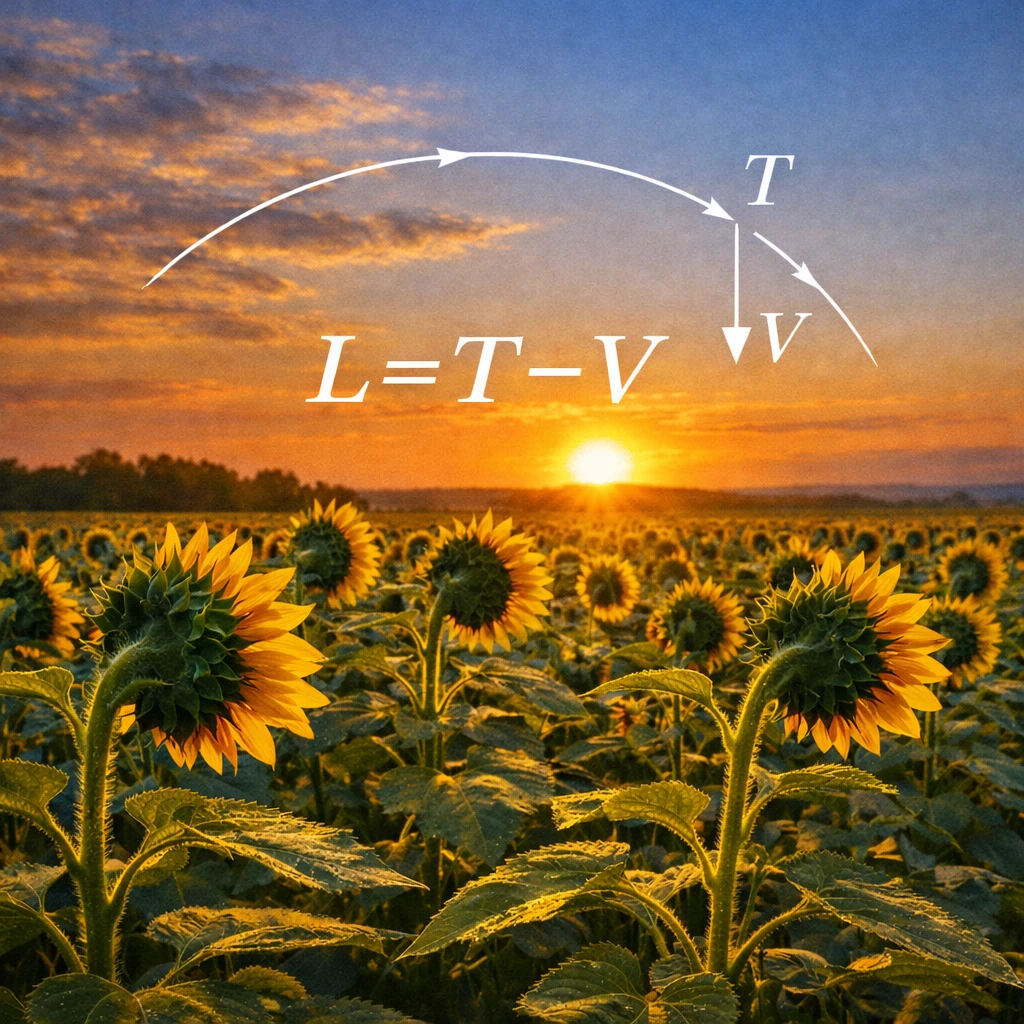
The sunflower is a physical system like any other, subject to gravity and energy exchanges with its environment.
Light does not "push" the plant: it gradually modifies the internal growth conditions, creating differences in pressure and rigidity in the tissues.
These asymmetries are enough to bend the stem toward the light source. No external or intentional mechanism is needed: the movement simply emerges from the physical laws applied to living matter.
Image source:
astronoo.com (new window)
Scientific Summary
This article explains the sunflower's movement (heliotropism) through the laws of physics, without invoking a vital force or intention. It uses the Lagrangian concept (L = T - V) to describe the balance between gravitational potential energy pulling the plant down and electrostatic energy from light, which creates a growth gradient via the hormone auxin. This gradient causes asymmetric cell elongation, bending the stem towards the light. The sunflower's behavior illustrates that living organisms, however complex, are governed by the same physical laws as inert matter.
Why Does the Sunflower Turn Toward the Sun? A Lagrangian Perspective
The sunflower turns toward the Sun because it is a physical system like any other, subject to the same laws as inert matter. No vital force or external intention is required: ordinary mechanical and biological constraints are sufficient.
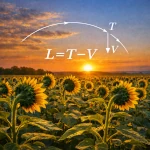
The Lagrangian \( L = T - V \) describes the evolution of a physical system using two terms: kinetic energy \(T\) and potential energy \(V\). Applied to the sunflower, it balances gravity, which pulls the stem downward, against the growth gradients induced by light, which bend it upward. Physics alone is enough to explain the rest.
Also worth exploring
Continue your exploration of the Universe with these topics:
Why Talk About a Lagrangian for a Sunflower?
The sunflower seems to simply follow the Sun, but its movement results from a subtle energetic balance. Invented by Joseph-Louis Lagrange (1736-1813) at the end of the 18th century, the Lagrangian is a mathematical function that summarizes the dynamic state of a system. Concretely, for any object, the Lagrangian is the difference between its kinetic energy (energy of motion) and its potential energy (stored energy, such as gravity). But beware: in the case of the sunflower, the energy from light is not directly kinetic energy. It is electrostatic energy: photons strike the cells, activate proton pumps, alter the electrical charges on either side of the membranes, and create water pressure that deforms the stem.
The Lagrangian of the sunflower can thus be understood as follows: it compares what pulls the flower downward (gravity, potential energy) and what pushes it upward or toward the light (electrostatic energy from photons). When electrostatic energy dominates, the flower straightens and turns toward the Sun. When gravity takes over (at night or as the flower ages), the plant droops. The Lagrangian is neither one nor the other of these energies: it is their difference. And it is this difference that dictates the movement.
Gravity: The Potential Energy That Always Pulls Downward
Gravity is a force that acts on all mass. The taller and heavier a plant is, the greater its gravitational potential energy. In the sunflower, the capitulum (the flower head) can weigh over a kilogram and be two meters above the ground. The amount of potential energy accumulated is considerable. This energy is stored in the plant and is mechanically released as soon as the stem bends. Without any other force, the flower would inevitably collapse. Gravity constantly pulls downward, as if it wants to return the sunflower to a horizontal position, lying on the ground.
Light Converted into a Growth Gradient: The Upright Movement Toward the Sky
The plant receives a daily flow of energy in the form of light. This light is not directly a mechanical force—it is photons carrying radiative energy. But inside plant cells, this energy triggers a precise cascade of biological reactions.
The photons first activate proteins called phototropins, located on the illuminated side of the stem. These proteins redistribute a growth hormone, auxin, to the shaded side. Auxin then acidifies the cell walls it reaches, which loosens the cellulose fibers and allows these cells to elongate further. The shaded side thus elongates faster than the illuminated side: the stem mechanically bends toward the light.
No intention is involved in this process. A local chemical difference is enough to produce directed movement, solely through the application of the laws of chemistry and material mechanics.
Why the Illuminated Side and the Shaded Side Create a Curve
The sunflower's movement does not come from a global electrostatic energy, but from an internal pressure imbalance in the plant tissues induced by light. This phenomenon, called phototropism (progressive orientation of the plant toward the light), relies on ionic gradients (\(K^+\), \(Ca^{2+}\), \(H^+\)) that modify the local potentials of the cells. These gradients cause a redistribution of water in the tissues and alter the internal pressure of the cells, called turgor (internal water pressure in plant cells that maintains their rigidity). The less turgid side elongates more, as its cells offer less mechanical resistance to expansion.
This difference in elongation between the two sides of the stem creates a gradual curve, orienting the plant toward the more rigid side, and thus generally toward the light.
From a mechanical perspective, this deformation results from a balance between the elastic potential energy linked to the stem's curvature and the pressure energy associated with turgor. The viscous dissipation of the tissues makes the evolution slow, damped, and almost inertia-free.
The stem thus behaves like a viscoelastic (material exhibiting both elasticity and viscous dissipation) structure, whose overall shape emerges from a continuous readjustment of internal constraints.
The Principle of Least Action in a Living Plant
The biological system "sunflower" does not perform any calculations or conscious optimization. Its behavior results solely from the laws of physics applied to a living system continuously traversed by solar energy.
The principle of least action describes, in mechanics, how a system evolves globally by balancing energy of motion and energy of position, not by minimizing a simple energy, but by following a global constraint imposed by physics.
In a living plant, the tissues are constantly supplied with water and energy, while dissipating some of this energy in the form of heat and internal resistance. These exchanges continuously modify the rigidity and shape of the stem.
The growth and orientation of the sunflower then appear as a progressive adjustment toward mechanically more stable and better light-adapted configurations. This behavior is not a voluntary strategy, but the direct consequence of physical laws and evolution.
Key Takeaways
The sunflower's movement is nothing miraculous. It results solely from ordinary physical constraints that constantly act on a material structure:
- gravity constantly pulls the stem downward;
- the elasticity of the tissues resists this deformation and pulls the stem back toward its equilibrium position;
- internal friction dissipates energy, making the movement slow and continuous;
- sunlight unbalances the pressure between the two sides of the stem, mechanically causing the curvature.
These four effects, all known and measurable, are sufficient to fully explain the sunflower's behavior. No vital force, no intention, no designer is needed to account for this movement.
What the sunflower illustrates applies to all living systems: the complexity of a behavior is not proof of a mystery, but the predictable result of simple physical laws applied to organized matter. Life does not escape physics—it is one of its expressions.
FAQ: The Sunflower Lagrangian
Why does a sunflower follow the Sun?
The sunflower follows the Sun thanks to phototropism. Plant hormones cause asymmetric growth of the stem, which gradually orients the flower toward the light.
What is a Lagrangian in physics?
The Lagrangian is a mathematical function defined as the difference between kinetic energy and potential energy: \( L = T - V \) It allows determining the optimal dynamic evolution of a physical system.
Does life obey the same physical laws as inert matter?
Yes, without exception. A living organism is made of atoms and molecules subject to the same laws as any physical system: gravity, thermodynamics, electromagnetism, fluid mechanics. Life is not an exception to physics—it is a particularly complex organization of it.
Does the complexity of life prove the existence of a designer?
No. The complexity of a behavior or structure is not proof of external intention: it is the result of simple physical and chemical laws applied to organized matter over long periods. The sunflower is one example among countless others.
What is phototropism?
Phototropism is a plant's ability to orient its growth in response to light. It relies on the redistribution of a hormone, auxin, which causes asymmetric elongation of the stem cells. It is a purely chemical and mechanical mechanism, selected by evolution because it improves light capture—without any intention involved.
Why use a mechanical model for a plant?
A plant has a material structure subject to physical forces: gravity, elasticity, hydraulic pressure, and energy dissipation. The tools of mechanics can therefore model certain aspects of its behavior.
Does the sunflower really minimize a physical action?
No, not in the strict sense. The sunflower does not minimize anything and does not seek any optimum: it follows local physical constraints, moment by moment. If the result sometimes resembles a variational solution, it is only because the same physical laws apply everywhere—not because the plant is pursuing a goal or an external intention is guiding its growth.
Is the Lagrangian used in modern biology?
Yes. Variational and Lagrangian methods are used in biomechanics, cellular modeling, biological fluid dynamics, and theoretical neuroscience.
 From the Zeroth Law to Generative AI: Asimov's Laws in Question
  How do complex societies emerge and disappear?
  The Brain vs. AI: Chronicle of an Organ Overwhelmed by the Data Deluge
  AI has learned to think: will artificial consciousness learn to be?
  The Future Obsession: When prediction shapes the living
  Which Regions of the World Will Remain Habitable During the Next Ice Age?
  Rapid Evolution: Darwin’s Thunderbolt in the 21st Century
  Fatal Imbalance: The Unsuspected Power of the Infinitely Small
  The Great Filter of Evolution: The Key to the Fermi Paradox
  The Last Glacial Shock: The Younger Dryas and Its Impact on Prehistoric Societies
  Why Does the Sunflower Turn Toward the Sun? An Answer Through the Lagrangian
  World Population 2026: Demographic Trends by Continent
 Why Life Emerges from Imbalance and Dies at Thermodynamic Equilibrium
  The Electromagnetic Spectrum and Vision: What Our Eyes Perceive of Our Planet
  Self and Non-Self: A Simplified Physical Reading of Identity
  The Molecular Clock: From Random Mutations to Measuring Time
  The Minimal Cell: The Inevitable Emergence
  White Sands Footprints: America's First Steps
  Hominins: Appearance, Expansion, and Extinctions
  Declining Births: Demographic Catastrophe or Natural Evolution?
  Natural Selection vs. Chance: Why Evolution is Not a Lottery?
  What if Life Originated from Earth? A Revolution in the Theory of Panspermia
  The Great Bifurcation that will Disrupt Our World: Survival or Collapse?
  Primordial Chemistry: Where Do the First Organic Molecules Originate?
 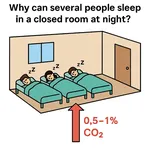 CO and CO₂: Two Gases, Two Risks, Two Biological Mechanisms
  Spontaneous Synchronization: A Universal Phenomenon, from Physics to Life
  Time Challenge: How to Illustrate a Billion Years?
 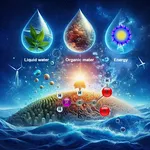 The Three Essential Components for the Emergence of Life
  Why Did the Genus Homo Nearly Go Extinct 900,000 Years Ago?
  The First Step Towards the Emergence of Life
  The shadow biosphere
  Decline of anthropocentrism: when the cosmos relativizes our importance
  The horseshoe
crab, a living fossil!
The horseshoe
crab, a living fossil!  Origin of life
on Earth: Panspermia theory
Origin of life
on Earth: Panspermia theory  Origin of life on Earth: White smoker theory
  Why 37 degrees Celsius?
  Are We Alone in the Cosmos? Between Science and Speculation
  Traces
of Life in the Ice: The Emergence of Prehistoric Mammoths
Traces
of Life in the Ice: The Emergence of Prehistoric Mammoths  The Younger Dryas: The Mini Ice Age That Wiped Out the Megafauna
  The Two Great Ice Ages: Surviving in the Oceans of a Frozen Earth
  Regeneration in Animals Following Amputation: Organic Regrowth
  At the Limits
of Life: Mephisto, Worm of the Infernal Depths
At the Limits
of Life: Mephisto, Worm of the Infernal Depths  Discovery
of solid buckyballs in space
Discovery
of solid buckyballs in space  Human Walking:
The Origins of Bipedalism in Hominids
Human Walking:
The Origins of Bipedalism in Hominids  Karabo: A Window into Human Evolution
  Entropy: What
is Time?
Entropy: What
is Time?  The
passage between the inert and the living
The
passage between the inert and the living  The
Great Story of Complexity: From Elementary Particles to the First Organisms
The
Great Story of Complexity: From Elementary Particles to the First Organisms  Megapod uses
volcanic heat
Megapod uses
volcanic heat  Ardipithecus:
The 4.4-Million-Year-Old Ethiopian Hominid
Ardipithecus:
The 4.4-Million-Year-Old Ethiopian Hominid  Natural Selection: The Peppered Moth
  The Ordovician:
The Era of Corals, Trilobites, and Graptolites
The Ordovician:
The Era of Corals, Trilobites, and Graptolites  Liquid
Water, Much More Than a Solvent: A Catalyst for Chemical Reactions
Liquid
Water, Much More Than a Solvent: A Catalyst for Chemical Reactions  Neanderthal:
Humanity's Lost Cousin
Neanderthal:
Humanity's Lost Cousin  ASIMO: The First
Humanoid
ASIMO: The First
Humanoid  What conditions allowed the emergence of life?
  Fermi Paradox and Plato's Cave: Are We Alone or Blind?
  Tardigrades:
Indestructible Creatures That Defy the Laws of Biology
Tardigrades:
Indestructible Creatures That Defy the Laws of Biology  Toumaï: One
of the Oldest Known Hominins
Toumaï: One
of the Oldest Known Hominins  The
Tree of Life: Billions of Extinct Species and a Single Ancestral Community
The
Tree of Life: Billions of Extinct Species and a Single Ancestral Community  Life
in the Abyss: The Extreme Adaptation of Creatures
Life
in the Abyss: The Extreme Adaptation of Creatures  Cyanobacteria
and the Oxygen Crisis: A Primordial Ecological Catastrophe
Cyanobacteria
and the Oxygen Crisis: A Primordial Ecological Catastrophe  From
Matter to Life: The Blurred Frontier of Biological Emergence
From
Matter to Life: The Blurred Frontier of Biological Emergence  The Smallest Frog in the World: Physiological Secrets of a Microvertebrate
  The explanation of the Little Ice Age
  The Light of Life: A Biosignature Revealed by the Moon
  Living
Light: The Dazzling Secrets of Bioluminescence
Living
Light: The Dazzling Secrets of Bioluminescence  Beyond our senses, the great scientific revolutions
  The
Primordial Soup: Chemical Cradle of Terrestrial Life
The
Primordial Soup: Chemical Cradle of Terrestrial Life  World Population: From One Billion Humans to Demographic Saturation
  Ecology
and Collapse: The Case of Easter Island
Ecology
and Collapse: The Case of Easter Island  Fractals: Universally Self-Organized
Structures
Fractals: Universally Self-Organized
Structures