


The Great Filter of Evolution: The Key to the Fermi Paradox
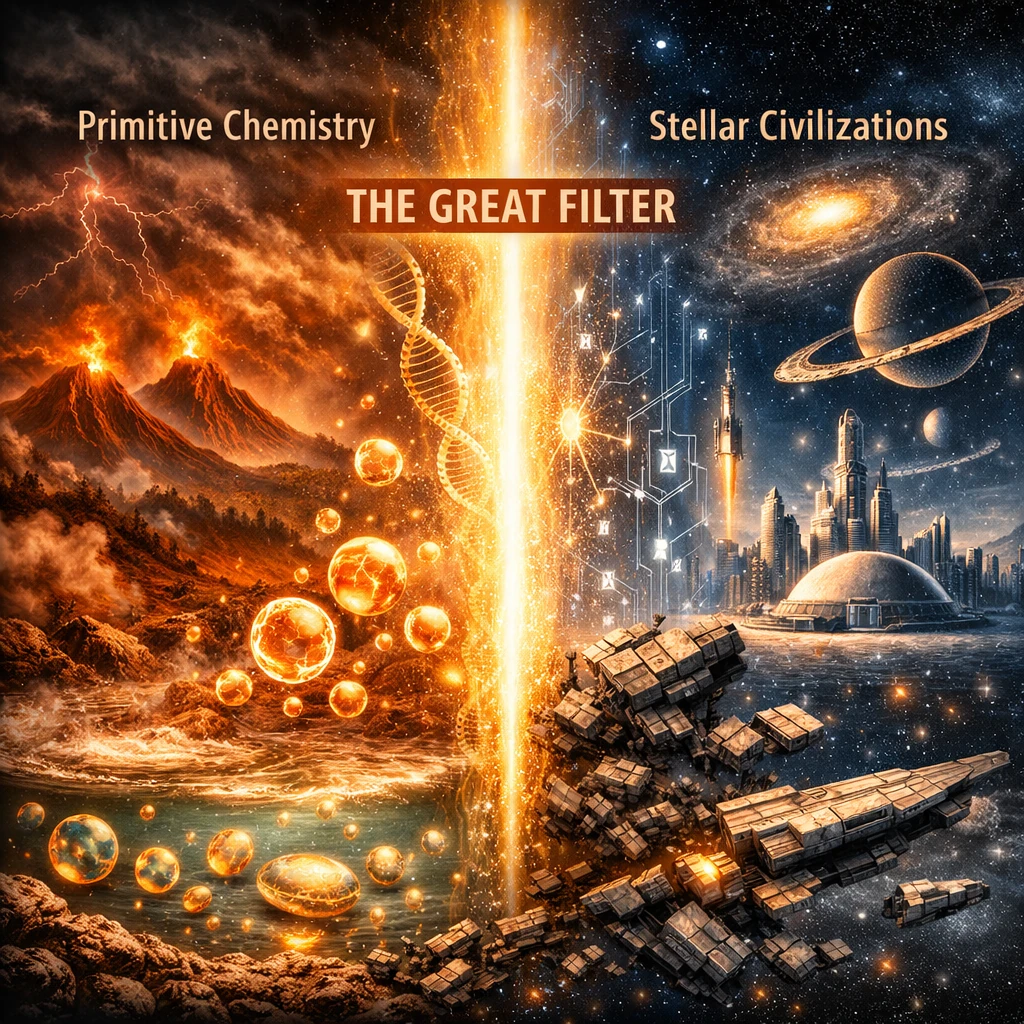
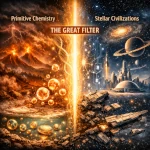
The Great Filter: this invisible barrier separates inert matter from civilizations capable of colonizing the stars.
Behind the glow of galaxies, perhaps intelligent life is systematically stopped by an obstacle that humanity has not yet overcome—or has miraculously avoided.
Image source: astronoo.com (new window)
Scientific Summary
The Great Filter is a proposed hypothesis to resolve the Fermi paradox: despite billions of potential planets, the cosmos appears silent. It postulates the existence of a nearly insurmountable evolutionary barrier that very few civilizations overcome. This filter would either be in our past (the emergence of life or intelligence being an extremely rare event) or, more worryingly, in our future (technological civilizations collapsing before reaching the interstellar stage). Humanity, having passed eight key stages, must still overcome the ninth: sustainable interstellar colonization.
Why does the cosmos remain silent? Does the Great Filter provide the answer?
Billions of stars, billions of planets, an overwhelming mathematical probability... and yet, the sidereal void remains desperately silent. No clearly artificial signal has ever been detected since 1960. Not a single modulation, not a single repeated noise that would betray intelligence. Faced with this Fermi Paradox, a hypothesis emerges, as logical as it is unsettling: the Great Filter. This hypothesis proposes that there exists an almost insurmountable evolutionary barrier that prevents the vast majority of potential civilizations from reaching a detectable interstellar stage. Either this filter lies in our past (the emergence of life or intelligence would be a statistical miracle), or it looms in our future (technological civilizations disappear before conquering the stars). In both cases, cosmic silence ceases to be a paradox: it becomes the predictable consequence of a universe where intelligent life is either extraordinarily rare or doomed to a short existence.
Also worth exploring
Continue your exploration of the Universe with these topics:
The Great Filter: Genesis of a Radical Idea
In 1950, physicist Enrico Fermi (1901-1954), during an informal lunch at Los Alamos Laboratory, asked a question that would become famous: "But where are they?" Behind this seemingly innocuous phrase lies the Fermi Paradox: if the Universe is teeming with potentially habitable worlds, why do we observe no traces, no signals, no extraterrestrial probes? Decades later, it was economist Robin Dale Hanson (1959-) who, in 1996, gave structured form to one of the most troubling answers: the theory of the Great Filter.
Hanson reasoned as follows: to go from a sterile planet to a technological civilization capable of harnessing energy on a stellar scale (Type II or III on the Kardashev scale), a series of critical steps must be overcome. If one of these steps is extremely improbable, then cosmic silence is explained: most stellar systems fail to pass this bottleneck. Humanity itself may have passed—or will have to pass—this barrier. This is where the vertiginous aspect of the theory lies: if the filter is behind us, we would be a miraculous exception, likely alone in the galaxy; if it is ahead of us, our future as an interstellar species is certainly compromised.
The notion of the Great Filter transforms our quest for extraterrestrial signals into a silent exploration of our own destiny.
Where is the Bottleneck Hiding? The Nine Steps
Robin Hanson identified nine major transitions that any form of living matter must go through to reach the stage of interstellar colonizing explosion. The Great Filter is located at one of these steps—the one where the failure rate is so high that almost no planetary system can overcome it.
- 1. Habitable star system (rocky planet in the habitable zone, stable for billions of years).
- 2. Self-replicating molecules (prebiotic chemistry → RNA, DNA).
- 3. Prokaryotic life (simple cells, bacteria).
- 4. Eukaryotic life (complex cells with nuclei—a leap that took over 2 billion years on Earth).
- 5. Sexual reproduction (dramatically accelerates evolution).
- 6. Complex multicellular organisms (animals, plants).
- 7. Brains and tools (development of high intelligence and dexterity).
- 8. Technological civilization (mastery of fossil energy, electricity, radio).
- 9. Interstellar colonizing explosion (expansion to other star systems).
Humanity has passed the first eight steps. The ninth remains, the most decisive: no known species has ever accomplished it. The Great Filter could be ahead of us—and perhaps insurmountable.
Two Scenarios: Triumphant Past or Doomed Future
Scenario A: The Filter is Behind Us—We Are a Statistical Miracle
If one of the transitions among steps 1 to 8 is extremely improbable, then intelligent life is an anomaly in the Universe. This would mean that billions of habitable planets never developed life, or that life never progressed beyond the microbial stage, or that technological intelligence is an evolutionary accident that never repeats.
Consequences: Cosmic silence would be total, as no other civilization would exist in the Milky Way—or even in neighboring galaxies of the Local Group, located millions of light-years away. This scenario, while vertiginous in its rarity, is optimistic for our future: once the filter is behind us, interstellar expansion becomes possible without additional barriers.
Scenario B: The Filter is Ahead of Us—the Great Barrier of Collapse
Steps 1 to 8 are relatively common in the galaxy, but almost no technological civilization passes step 9. In other words, as soon as a species reaches a certain technological level, it collapses before being able to colonize other stars.
If the Great Filter lies ahead of us, it could reside in a structural inability of civilizations to sustainably manage their own environment. When technological complexity grows faster than the collective ability to control its effects, societies become vulnerable to their own creations: irreversible climate disruption, ecosystem destabilization, resource depletion, social disorganization, or loss of control over technical systems that have become too powerful.
Astronomer Michael H. Hart (1932-) was one of the first to formalize this idea in the 1970s: the visibility window of a civilization would be extremely brief, as most would fail to maintain a stable balance between technological growth and environmental sustainability. Their detectability window would then last only a few millennia before collapse.
The Drake Equation Revisited by the Great Filter
The classic equation of Frank Drake (1930-2022) is often used to estimate the number of communicating civilizations: \(N = R^* \times f_p \times n_e \times f_l \times f_i \times f_c \times L\). In this framework, the Great Filter corresponds to one or more factors whose value is extremely low (close to \(10^{-6}\) or less), making \(N\) close to 1 or 0.
The natural candidates for the filter are:
- \(f_l\): the probability that life appears on a habitable planet—if abiogenesis is an ultra-rare event.
- \(f_i\): the probability that life evolves toward technological intelligence—if the human brain is an improbable contingency.
- \(L\): the lifespan of the technological civilization—if collapse occurs within a few centuries or millennia.
| Parameter | Definition | Scenario "Filter Behind" (Rare Life) | Scenario "Filter Ahead" (collapse) |
|---|---|---|---|
| \(R^*\) | Star formation rate (per year in the Milky Way) | \(\approx 3\) | \(\approx 3\) |
| \(f_p\) | Fraction of stars with planets | \(\approx 1\) | \(\approx 1\) |
| \(n_e\) | Habitable planets per system | 0.1 – 0.2 | 0.1 – 0.2 |
| \(f_l\) | Fraction where life appears | \(\mathbf{10^{-6}}\) (extremely rare event) | \(\approx 0.5\) (frequent life) |
| \(f_i\) | Fraction with intelligent life | \(\mathbf{10^{-3}}\) (rare evolution) | \(\approx 0.2\) (relatively probable) |
| \(f_c\) | Communicating fraction (technology) | \(\approx 1\) | \(\approx 1\) |
| \(L\) | Lifespan (years) | \(10^4\) to \(10^6\) (long) | \(\mathbf{200}\) to \(10^3\) (very brief) |
| Estimated \(N\) | Detectable civilizations in the Milky Way | 0.001 to 1 (we are alone or almost) | 0.01 to 1 (but very ephemeral) |
The Great Filter: Clues That Guide the Debate
- The early appearance of life on Earth (~3.7 billion years ago) argues for a high \(f_l\). Conversely, the late appearance of complex multicellular life (only 600 million years ago) could indicate a filter at step 4 or 5.
- The total absence of megastructures in astronomical surveys (Dyson spheres, stellar swarms) suggests that no civilization has reached Type II status on the Kardashev scale in our galaxy. If the filter were behind us, such structures might be visible elsewhere—but they are not.
- The time argument: some stars in the Milky Way are billions of years older than the Sun. If technological intelligence were common, there would be civilizations that have had plenty of time to colonize the entire galaxy. The fact that Earth has never been colonized strengthens the filter hypothesis.
The Great Filter: Why the Absence of Traces Is Not Proof of an Absence of History
Cosmic silence does not mean the Universe is empty, but that the traces left by potential civilizations do not survive long enough to reach us. On a cosmic scale, information is fragile: signals dissipate, artifacts erode, structures degrade or disappear in geological and stellar cycles. Even an advanced civilization cannot guarantee that its messages or objects will remain readable for millions of years.
Thus, the absence of remnants does not prove the absence of history. It merely reveals that civilizations, if they exist, leave footprints too brief to cross the immensities of time and space. The Great Filter could then reside not in the rarity of life, but in the difficulty for a civilization to produce traces capable of defying cosmic entropy.
The Great Silence does not prove the absence of vanished civilizations; it only proves the absence of currently noisy and durably visible civilizations in our immediate galactic neighborhood.
The Great Filter: An Oversimplified Concept
The appearance of life and intelligence does not depend on a single obstacle, but on a succession of billions of contingent conditions. Each step is a potential filter, and the Universe literally contains an infinity of them.
The concept of the Great Filter does not claim to describe a unique event in nature. It rather serves as a conceptual tool to summarize all these contingencies into a statistical bottleneck: the most improbable step, the one that dominates the total probability and could explain cosmic silence. In other words, among the multitude of possible filters, there may be one that crushes all others in terms of rarity.
The Great Filter does not erase the complexity of reality: it condenses it. It designates not a single obstacle, but the most improbable step among a chain of highly contingent events. It is this dominant step, not the totality of contingencies, that could explain why the cosmos seems silent despite its billions of potentially habitable worlds.
FAQ: Understanding the Great Filter and Its Implications
What is the Great Filter?
The Great Filter is a hypothesis proposed by Robin Hanson to explain the Fermi Paradox. It is an almost insurmountable evolutionary barrier that very few civilizations (perhaps none) overcome, thus explaining cosmic silence.
Where is the Great Filter located?
Two possibilities: either it is in our past (the emergence of life or intelligence is a near-miraculous event), or it is in our future (technological civilizations self-destruct before reaching the interstellar stage).
What is the difference with the Fermi Paradox?
The Fermi Paradox is the simple observation of cosmic silence despite the probabilities. The Great Filter is a potential answer to this paradox: silence exists because a near-universal obstacle prevents civilizations from becoming visible on a large scale.
What does the "filter ahead of us" scenario mean for humanity?
This is the most pessimistic scenario: it suggests that our technological civilization is doomed to collapse or collapse in the near future (a few centuries or millennia) before being able to colonize space. Nuclear bombs, climate disruption, pandemics, or uncontrolled AI could be the concrete manifestations of this filter.
Is the Great Filter scientifically proven?
No, it is a philosophical and mathematical hypothesis. No observation yet allows us to decide between the scenarios. This is precisely why the Fermi Paradox remains an open mystery.
Why is it such a dizzying enigma?
Because the answer radically changes our perception of our place in the Universe. Being alone in the galaxy is dizzying, but discovering that all civilizations die young is just as much. In both cases, humanity finds itself facing an overwhelming cosmic solitude or fragility.
Could the Great Filter be avoided?
If the filter is ahead of us, avoiding it is our existential challenge. This would require global cooperation, management of technological risks, and perhaps a form of collective wisdom that previous (hypothetical) civilizations did not have. This is the meaning of the phrase: "The Great Filter is either the best argument for space exploration, or the worst."
 From the Zeroth Law to Generative AI: Asimov's Laws in Question
  How do complex societies emerge and disappear?
  The Brain vs. AI: Chronicle of an Organ Overwhelmed by the Data Deluge
  AI has learned to think: will artificial consciousness learn to be?
  The Future Obsession: When prediction shapes the living
  Which Regions of the World Will Remain Habitable During the Next Ice Age?
  Rapid Evolution: Darwin’s Thunderbolt in the 21st Century
  Fatal Imbalance: The Unsuspected Power of the Infinitely Small
  The Great Filter of Evolution: The Key to the Fermi Paradox
  The Last Glacial Shock: The Younger Dryas and Its Impact on Prehistoric Societies
  Why Does the Sunflower Turn Toward the Sun? An Answer Through the Lagrangian
  World Population 2026: Demographic Trends by Continent
 Why Life Emerges from Imbalance and Dies at Thermodynamic Equilibrium
  The Electromagnetic Spectrum and Vision: What Our Eyes Perceive of Our Planet
  Self and Non-Self: A Simplified Physical Reading of Identity
  The Molecular Clock: From Random Mutations to Measuring Time
  The Minimal Cell: The Inevitable Emergence
  White Sands Footprints: America's First Steps
  Hominins: Appearance, Expansion, and Extinctions
  Declining Births: Demographic Catastrophe or Natural Evolution?
  Natural Selection vs. Chance: Why Evolution is Not a Lottery?
  What if Life Originated from Earth? A Revolution in the Theory of Panspermia
 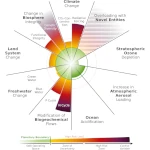 The Great Bifurcation that will Disrupt Our World: Survival or Collapse?
  Primordial Chemistry: Where Do the First Organic Molecules Originate?
  CO and CO₂: Two Gases, Two Risks, Two Biological Mechanisms
  Spontaneous Synchronization: A Universal Phenomenon, from Physics to Life
  Time Challenge: How to Illustrate a Billion Years?
  The Three Essential Components for the Emergence of Life
  Why Did the Genus Homo Nearly Go Extinct 900,000 Years Ago?
  The First Step Towards the Emergence of Life
  The shadow biosphere
  Decline of anthropocentrism: when the cosmos relativizes our importance
  The horseshoe
crab, a living fossil!
The horseshoe
crab, a living fossil!  Origin of life
on Earth: Panspermia theory
Origin of life
on Earth: Panspermia theory  Origin of life on Earth: White smoker theory
  Why 37 degrees Celsius?
  Are We Alone in the Cosmos? Between Science and Speculation
  Traces
of Life in the Ice: The Emergence of Prehistoric Mammoths
Traces
of Life in the Ice: The Emergence of Prehistoric Mammoths  The Younger Dryas: The Mini Ice Age That Wiped Out the Megafauna
  The Two Great Ice Ages: Surviving in the Oceans of a Frozen Earth
  Regeneration in Animals Following Amputation: Organic Regrowth
  At the Limits
of Life: Mephisto, Worm of the Infernal Depths
At the Limits
of Life: Mephisto, Worm of the Infernal Depths  Discovery
of solid buckyballs in space
Discovery
of solid buckyballs in space  Human Walking:
The Origins of Bipedalism in Hominids
Human Walking:
The Origins of Bipedalism in Hominids  Karabo: A Window into Human Evolution
  Entropy: What
is Time?
Entropy: What
is Time?  The
passage between the inert and the living
The
passage between the inert and the living  The
Great Story of Complexity: From Elementary Particles to the First Organisms
The
Great Story of Complexity: From Elementary Particles to the First Organisms  Megapod uses
volcanic heat
Megapod uses
volcanic heat  Ardipithecus:
The 4.4-Million-Year-Old Ethiopian Hominid
Ardipithecus:
The 4.4-Million-Year-Old Ethiopian Hominid  Natural Selection: The Peppered Moth
  The Ordovician:
The Era of Corals, Trilobites, and Graptolites
The Ordovician:
The Era of Corals, Trilobites, and Graptolites  Liquid
Water, Much More Than a Solvent: A Catalyst for Chemical Reactions
Liquid
Water, Much More Than a Solvent: A Catalyst for Chemical Reactions  Neanderthal:
Humanity's Lost Cousin
Neanderthal:
Humanity's Lost Cousin  ASIMO: The First
Humanoid
ASIMO: The First
Humanoid  What conditions allowed the emergence of life?
  Fermi Paradox and Plato's Cave: Are We Alone or Blind?
  Tardigrades:
Indestructible Creatures That Defy the Laws of Biology
Tardigrades:
Indestructible Creatures That Defy the Laws of Biology  Toumaï: One
of the Oldest Known Hominins
Toumaï: One
of the Oldest Known Hominins  The
Tree of Life: Billions of Extinct Species and a Single Ancestral Community
The
Tree of Life: Billions of Extinct Species and a Single Ancestral Community  Life
in the Abyss: The Extreme Adaptation of Creatures
Life
in the Abyss: The Extreme Adaptation of Creatures  Cyanobacteria
and the Oxygen Crisis: A Primordial Ecological Catastrophe
Cyanobacteria
and the Oxygen Crisis: A Primordial Ecological Catastrophe  From
Matter to Life: The Blurred Frontier of Biological Emergence
From
Matter to Life: The Blurred Frontier of Biological Emergence  The Smallest Frog in the World: Physiological Secrets of a Microvertebrate
  The explanation of the Little Ice Age
  The Light of Life: A Biosignature Revealed by the Moon
  Living
Light: The Dazzling Secrets of Bioluminescence
Living
Light: The Dazzling Secrets of Bioluminescence  Beyond our senses, the great scientific revolutions
  The
Primordial Soup: Chemical Cradle of Terrestrial Life
The
Primordial Soup: Chemical Cradle of Terrestrial Life  World Population: From One Billion Humans to Demographic Saturation
  Ecology
and Collapse: The Case of Easter Island
Ecology
and Collapse: The Case of Easter Island  Fractals: Universally Self-Organized
Structures
Fractals: Universally Self-Organized
Structures