


The three essential elements for the birth of life
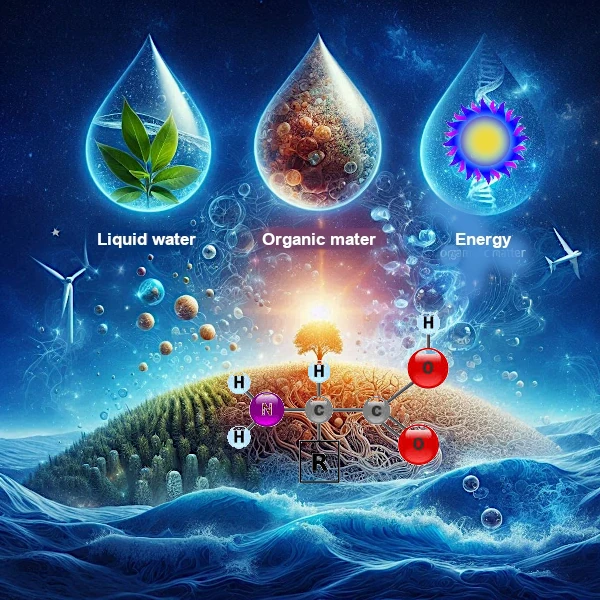
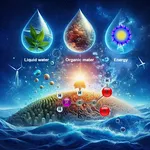
An artistic representation of the three essential elements for life: liquid water, organic matter, and a source of energy. These components are illustrated in a cosmic context, highlighting their rarity in the observable Universe. Image source: astronoo.com (new window)
The Essential Elements
The emergence of life begins with the assembly of the first complex organic molecules, such as amino acids, which are the fundamental building blocks of proteins. For these molecules to form and establish strong chemical bonds, three components are essential: liquid water, organic matter, and a source of energy.
These amino acids must coexist under specific conditions, which are found on Earth but also potentially elsewhere, such as on certain meteorites.
How do the three components of life interact to allow the formation of the first amino acids, and why is their simultaneous presence so rare in the Universe?
N.B.:
An amino acid is characterized by the presence of two functional groups: an amine group (-NH2) and a carboxyl group (-COOH), both attached to a central carbon atom, called the alpha carbon (Cα). This alpha carbon is also linked to a hydrogen atom and a side chain (R), which varies depending on the specific amino acid.
Liquid Water: A Universal Solvent
Liquid water is often considered the cradle of life.
Indeed, liquid water plays a central role in the formation of amino acids. It acts as a universal solvent, allowing organic molecules to dissolve, move, and interact with each other. Water also facilitates chemical reactions by stabilizing reaction intermediates and allowing the formation of peptide bonds, essential for linking amino acids together.
On Earth, aquatic environments, such as hydrothermal vents, likely served as cradles for these reactions. However, liquid water is rare in the Universe, as it requires very specific temperature and pressure conditions.
Where is Liquid Water Found?
- Earth is the only place where we have direct and abundant evidence of liquid water.
- Some moons of giant planets, such as Europa (a moon of Jupiter) and Enceladus (a moon of Saturn), are suspected of having oceans of liquid water beneath their icy surfaces.
- Some comets contain water in the form of ice. When they approach the Sun, this ice can sublimate (transition directly from solid to gas), but under certain conditions, it could also melt and form liquid water.
- Observations of interstellar gas clouds by telescopes and spectroscopic instruments have revealed the presence of water vapor, which under certain conditions could be in a liquid state.
Organic Matter: The Building Blocks of Life
Organic matter, rich in carbon, hydrogen, nitrogen, and oxygen, forms the basis of amino acids.
These chemical elements are abundant in the Universe, but their assembly into complex molecules such as amino acids, for example NH2-CH(R1)-COOH, requires specific conditions.
The formation of amino acids, whether through chemical methods such as the Strecker reaction or through processes simulating the primitive conditions of Earth like the Miller-Urey experiment, requires the presence of certain starting compounds (organic precursors) and an appropriate reaction environment. These conditions allow the necessary chemical reactions to synthesize amino acids, which are essential for the construction of proteins.
The formation of amino acids could also occur in space.
Where is Organic Matter Found?
- Nebulae and Molecular Clouds: Nebulae contain gases and dust rich in organic matter, including complex molecules such as polycyclic aromatic hydrocarbons (PAHs). Spectroscopic observations have revealed the presence of many organic molecules in molecular clouds.
- Comets and Asteroids: Some asteroids, particularly carbonaceous asteroids, contain significant amounts of organic matter, including amino acids and other complex organic compounds. Comets contain frozen water as well as organic compounds. When they approach the Sun, these compounds can be released as gases and dust.
- Carbonaceous Meteorites: These meteorites contain significant amounts of organic matter, including amino acids, hydrocarbons, and other organic compounds.
- Moons: Titan has an atmosphere rich in methane and ethane, as well as lakes and seas of liquid hydrocarbons. The water and steam geysers of Enceladus contain simple organic compounds.
- Interstellar Dust: Interstellar dust grains contain complex organic molecules detected by spectroscopic observations.
N.B.:
Organic matter is primarily composed of carbon, often in combination with other elements such as hydrogen, oxygen, nitrogen, sulfur, and phosphorus.
Energy: The Engine of Chemical Reactions
Energy is necessary to activate the chemical reactions that transform organic precursors into amino acids.
On Earth, this energy can come from various sources, such as ultraviolet light from the Sun, lightning, or geothermal activity.
In space, energy sources include cosmic rays, stellar luminosity, gravitational energy, tidal forces, or meteorite impacts. For example, experiments have shown that amino acids can form under simulated space conditions, under the influence of radiation or thermal shocks.
Where is Energy Found in Space?
- Stars: Stars, including our Sun, produce energy through nuclear fusion reactions in their core. These reactions convert hydrogen into helium, releasing a huge amount of energy in the form of light and heat.
- Cosmic Rays: Cosmic rays are high-energy subatomic particles that travel through space. They can originate from various sources, including supernovae, pulsars, and active galactic nuclei.
- Gravitational Energy: Gravitational waves, detected by observatories like LIGO and Virgo, are perturbations of spacetime caused by violent events such as the merging of black holes or neutron stars. These waves carry energy through the universe.
- Tidal Interactions: Gravitational interactions between celestial bodies, such as planets and stars, can release energy in the form of heat and radiation. For example, tidal forces can heat moons and planets.
The Rarity of These Components in the Universe
Although the basic ingredients of amino acids are widespread in the Universe, the three simultaneous conditions necessary for their formation are rare.
Liquid water, in particular, is difficult to maintain outside the habitable zone of a star.
Organic matter must be sufficiently concentrated and exposed to an appropriate energy source for chemical reactions to occur.
But beyond these conditions, long-term stability is also required. Indeed, for molecular assemblies to continue to evolve and find the path to life, the three elements – liquid water, organic matter, and energy – must coexist stably for millions, even billions of years. This temporal stability is crucial for allowing chemical reactions to become more complex and give rise to more elaborate biological structures.
In Summary
Liquid water, organic matter, and energy are the three key components that allow the assembly of the first amino acids, the fundamental building blocks of life. Although their simultaneous presence on Earth allowed the emergence of life, this combination over the long term is rare in the Universe. However, the discovery of amino acids on meteorites suggests that these molecules could also form in extraterrestrial environments, opening the possibility that life could start elsewhere than on Earth.
 From the Zeroth Law to Generative AI: Asimov's Laws in Question
  How do complex societies emerge and disappear?
  The Brain vs. AI: Chronicle of an Organ Overwhelmed by the Data Deluge
  AI has learned to think: will artificial consciousness learn to be?
  The Future Obsession: When prediction shapes the living
  Which Regions of the World Will Remain Habitable During the Next Ice Age?
  Rapid Evolution: Darwin’s Thunderbolt in the 21st Century
  Fatal Imbalance: The Unsuspected Power of the Infinitely Small
  The Great Filter of Evolution: The Key to the Fermi Paradox
  The Last Glacial Shock: The Younger Dryas and Its Impact on Prehistoric Societies
  Why Does the Sunflower Turn Toward the Sun? An Answer Through the Lagrangian
  World Population 2026: Demographic Trends by Continent
 Why Life Emerges from Imbalance and Dies at Thermodynamic Equilibrium
  The Electromagnetic Spectrum and Vision: What Our Eyes Perceive of Our Planet
  Self and Non-Self: A Simplified Physical Reading of Identity
  The Molecular Clock: From Random Mutations to Measuring Time
  The Minimal Cell: The Inevitable Emergence
  White Sands Footprints: America's First Steps
  Hominins: Appearance, Expansion, and Extinctions
  Declining Births: Demographic Catastrophe or Natural Evolution?
  Natural Selection vs. Chance: Why Evolution is Not a Lottery?
  What if Life Originated from Earth? A Revolution in the Theory of Panspermia
  The Great Bifurcation that will Disrupt Our World: Survival or Collapse?
  Primordial Chemistry: Where Do the First Organic Molecules Originate?
  CO and CO₂: Two Gases, Two Risks, Two Biological Mechanisms
  Spontaneous Synchronization: A Universal Phenomenon, from Physics to Life
  Time Challenge: How to Illustrate a Billion Years?
  The Three Essential Components for the Emergence of Life
  Why Did the Genus Homo Nearly Go Extinct 900,000 Years Ago?
  The First Step Towards the Emergence of Life
  The shadow biosphere
  Decline of anthropocentrism: when the cosmos relativizes our importance
  The horseshoe
crab, a living fossil!
The horseshoe
crab, a living fossil!  Origin of life
on Earth: Panspermia theory
Origin of life
on Earth: Panspermia theory  Origin of life on Earth: White smoker theory
  Why 37 degrees Celsius?
  Are We Alone in the Cosmos? Between Science and Speculation
  Traces
of Life in the Ice: The Emergence of Prehistoric Mammoths
Traces
of Life in the Ice: The Emergence of Prehistoric Mammoths  The Younger Dryas: The Mini Ice Age That Wiped Out the Megafauna
  The Two Great Ice Ages: Surviving in the Oceans of a Frozen Earth
  Regeneration in Animals Following Amputation: Organic Regrowth
  At the Limits
of Life: Mephisto, Worm of the Infernal Depths
At the Limits
of Life: Mephisto, Worm of the Infernal Depths  Discovery
of solid buckyballs in space
Discovery
of solid buckyballs in space  Human Walking:
The Origins of Bipedalism in Hominids
Human Walking:
The Origins of Bipedalism in Hominids  Karabo: A Window into Human Evolution
  Entropy: What
is Time?
Entropy: What
is Time?  The
passage between the inert and the living
The
passage between the inert and the living  The
Great Story of Complexity: From Elementary Particles to the First Organisms
The
Great Story of Complexity: From Elementary Particles to the First Organisms  Megapod uses
volcanic heat
Megapod uses
volcanic heat  Ardipithecus:
The 4.4-Million-Year-Old Ethiopian Hominid
Ardipithecus:
The 4.4-Million-Year-Old Ethiopian Hominid  Natural Selection: The Peppered Moth
  The Ordovician:
The Era of Corals, Trilobites, and Graptolites
The Ordovician:
The Era of Corals, Trilobites, and Graptolites  Liquid
Water, Much More Than a Solvent: A Catalyst for Chemical Reactions
Liquid
Water, Much More Than a Solvent: A Catalyst for Chemical Reactions  Neanderthal:
Humanity's Lost Cousin
Neanderthal:
Humanity's Lost Cousin  ASIMO: The First
Humanoid
ASIMO: The First
Humanoid 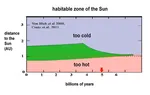 What conditions allowed the emergence of life?
  Fermi Paradox and Plato's Cave: Are We Alone or Blind?
  Tardigrades:
Indestructible Creatures That Defy the Laws of Biology
Tardigrades:
Indestructible Creatures That Defy the Laws of Biology  Toumaï: One
of the Oldest Known Hominins
Toumaï: One
of the Oldest Known Hominins  The
Tree of Life: Billions of Extinct Species and a Single Ancestral Community
The
Tree of Life: Billions of Extinct Species and a Single Ancestral Community  Life
in the Abyss: The Extreme Adaptation of Creatures
Life
in the Abyss: The Extreme Adaptation of Creatures  Cyanobacteria
and the Oxygen Crisis: A Primordial Ecological Catastrophe
Cyanobacteria
and the Oxygen Crisis: A Primordial Ecological Catastrophe  From
Matter to Life: The Blurred Frontier of Biological Emergence
From
Matter to Life: The Blurred Frontier of Biological Emergence  The Smallest Frog in the World: Physiological Secrets of a Microvertebrate
  The explanation of the Little Ice Age
  The Light of Life: A Biosignature Revealed by the Moon
  Living
Light: The Dazzling Secrets of Bioluminescence
Living
Light: The Dazzling Secrets of Bioluminescence  Beyond our senses, the great scientific revolutions
  The
Primordial Soup: Chemical Cradle of Terrestrial Life
The
Primordial Soup: Chemical Cradle of Terrestrial Life  World Population: From One Billion Humans to Demographic Saturation
  Ecology
and Collapse: The Case of Easter Island
Ecology
and Collapse: The Case of Easter Island  Fractals: Universally Self-Organized
Structures
Fractals: Universally Self-Organized
Structures