


Declining Births: Demographic Catastrophe or Natural Evolution?
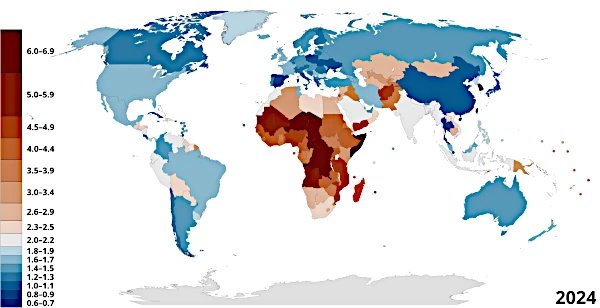
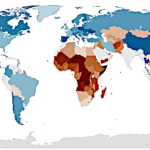
World map of total fertility rates by country.
Image source: astronoo.com (new window)
Scientific Summary
This article examines the global decline in birth rates, which have fallen from 5 children per woman (1960) to less than 2.5 today, with many countries below the replacement threshold (2.1). This phenomenon, rooted in structural transformations (urbanization, women's empowerment, cost of raising children), is interpreted in two ways: as a natural systemic adaptation to global constraints, or as a « low fertility trap » risking irreversible demographic collapse. The concept of « demographic entropic crisis » describes a loss of systemic complexity when the speed of decline exceeds socio-economic self-regulation capacities. The article presents comparative data (South Korea: 0.72; France: 1.68; Niger: 6.65) and discusses scenarios for transitioning to a « quality society ».
Is the global decline in births a silent catastrophe or a necessary transition?
The decline in births is a global phenomenon with structural roots (urbanization, women's empowerment, cost of children). The global fertility rate has fallen from 5 children per woman (1960) to under 2.5 today, with many countries below the replacement threshold (2.1). This transition is interpreted in two opposing ways: 1) as a natural systemic adaptation to global constraints (resources, climate), paving the way for a "quality society"; 2) as a "low-fertility trap" risking irreversible demographic collapse (loss of human capital, fiscal crisis, economic contraction) if the speed of change exceeds the socio-economic system's self-regulation capacities.
Also worth exploring
Continue your exploration of the Universe with these topics:
A Global Phenomenon with Deep Roots
Since the beginning of the 21st century, most developed countries and an increasing number of emerging countries have faced a continuous decline in birth rates. The global fertility rate has dropped from 5 children per woman in the 1960s to less than 2.5 today, with regions like Europe, East Asia, or North America falling below the generational renewal threshold (2.1 children per woman). This phenomenon, far from being cyclical, is rooted in structural transformations: urbanization, women's empowerment, cost of raising children, career prioritization, and changing personal aspirations.
Fertility Rate by Country in 2026: Declining Demographics
Demographic Drift or Systemic Adaptation?
Is the decline in births a dysfunction or a transition towards a new state of equilibrium? From a systemic perspective, human societies tend to stabilize around demographic equilibria when environmental, economic, and social pressures demand it. Japan, often seen as a demographic laboratory, shows that a society can continue to function despite a decrease in its population (at the cost of profound adjustments: robotization, selective immigration, reorganization of social services).
Economic Implications and Intergenerational Dynamics
The main challenge posed by this transition is the imbalance between workers and retirees, with an increasing dependency ratio. This results in pressure on pension and healthcare systems and a reconfiguration of production. However, the decrease in the number of children reduces educational investments and potentially opens margins to improve their quality. The notion of an inverse demographic dividend emerges, with the hope that fewer but better-educated generations will support increasingly technological economies.
A Civilizational Paradigm Shift?
The demographic transition questions the very notion of progress, long associated with continuous growth. Through an anthropological lens, it can be seen as a form of adaptation to a constrained biosphere. Fewer humans, better equipped, more connected: a hypothesis that some demographers qualify as cognitive convergence. Human history has never been linear, and this "silent crisis" could be a natural long-term adjustment comparable to phase transitions in statistical physics.
Towards a Society of Quality Rather Than Quantity?
Rather than a collapse, the decline in births could mark a shift towards controlled demography. This requires rethinking our institutions, growth models, and intergenerational contracts. Far from panic, it would involve a smooth reorganization, as a complex system would do in a transition phase. In this sense, the decline in births, far from being an anomaly, could well be a thermodynamic adjustment towards a more resilient society.
Demographic Catastrophe: When the System Declines Faster Than It Adapts
| Fertility Rate | Demographic Regime | Systemic Effects | Risk of Collapse |
|---|---|---|---|
| >2.1 | Expansion | Pressure on resources, infrastructure, climate | High (in poor countries) |
| ≈ 2.1 | Stability | Generational renewal, intergenerational balance | Low |
| 1.6 – 2.0 | Slow Decline | Possible adjustment with pro-natalist policies or immigration | Moderate |
| 1.3 – 1.5 | Demographic Trap | Rapidly shrinking population, inversion of the age pyramid | High |
| <1.3 | Critical Contraction | Reduction in human capital, loss of innovation, major fiscal stress | Very High (global systemic risk) |
Limit of Socio-Economic Self-Regulation Capacities
While the decline in birth rates may appear to be an adaptive response to global constraints (resources, overpopulation, climate), it can also represent a risk of systemic destabilization when the speed of change exceeds the self-regulation capacities of the socio-economic system. In terms of system dynamics, this is referred to as exceeding the response time of positive or negative feedback loops.
Snowball Effect and Demographic Inertia
In countries with very low fertility rates (≤ 1.3), such as South Korea or Japan, a spiral of decline is triggered: fewer births ⇒ fewer young adults ⇒ fewer future births, in a snowball effect. This inertia, described by the notion of population momentum, makes it practically impossible to return to a replacement level, even if fertility rates were to suddenly rise.
Loss of Dynamic Entropy and Systemic Contraction
From an energy perspective, such a system enters a phase of demographic contraction not compensated by external input (immigration or massive productivity gains). This situation can be modeled by a loss of dynamic entropy: the system loses its diversity, its capacity for innovation, its resilience. The number of brains, arms, producers, and consumers declines, leading to a decrease in economic activity, fiscal contraction, a gradual collapse of social infrastructures, and rising intergenerational tensions.
The "Low Fertility Trap" and Critical Phase Transition
This scenario, described by some demographers as the "low fertility trap", could become as perilous as that of unchecked overpopulation. In the physics of complex systems, this is akin to a critical phase transition without a stable attractor. If no adjustment mechanism (technological, political, migratory, or cultural) takes over, the decline in births could lead to an irreversible demographic collapse in certain regions of the world.
The Paradox of Biological Growth Control
The paradox is as follows: humanity has finally mastered its biological growth, but if it reduces it too quickly without adapting its structures, it risks a sudden loss of organization, a kind of demographic entropic crisis. The demographic entropic crisis, a concept that can be defined as an irreversible loss of complexity in the human system due to rapid and prolonged population decline, can generate a series of systemic catastrophes.
Demographic Entropic Crisis as a Catastrophic Bifurcation
- Collapse of human capital: Examples (disappearance of rare professions, shortage of doctors, engineers, teachers, or specialized technicians).
- Destabilization of pension and healthcare systems: Bankruptcy of social systems, impoverishment of the elderly, and widespread health crisis.
- Self-sustaining economic shrinkage: Serial bankruptcies, GDP contraction, loss of critical scale for innovation or R&D investment.
- Geopolitical crises and intergenerational conflicts: Social tension, tax rejection, institutional instability.
- Loss of technological sovereignty: Decline of critical infrastructures (energy, defense, digital), strategic vulnerability against younger demographic blocs.
- Implosion of cities and territorial disintegration: Geographic contraction, abandonment of public services, urban wastelands, rural desertification.
- Slow cultural extinction: Reduction of cultural complexity, global homogenization, loss of diversity, weakening of collective meaning, increase in nihilism or identity withdrawal.
When will the global population reach its peak?
- Estimated peak date (UN median scenario): around 2086, with approximately 10.4 billion inhabitants.
- UN low scenario: decline starting in 2060, maximum <9.5 billion
References
- World Bank – Indicator SP.DYN.TFRT.IN (new window)
- United Nations, World Population Prospects 2024 (new window).
- INED – Falling births, migration-driven population growth, residential moves and mobility (new window).
- United Nations, World Population Prospects 2024 (new window).
- StatisticsTimes : World Population Prospects 2024, publiées le 19 mars 2026 (nouvelle fenêtre).
FAQ: Everything about the global decline in births
What are the main factors explaining the decline in births?
The decline in births rests on deep structural transformations: urbanization (making children more expensive and less economically useful), women's empowerment (access to education and the labor market), career prioritization, the direct and indirect cost of children (housing, education, childcare), and the evolution of personal aspirations toward smaller family models.
What is meant by a "low-fertility trap" (≤ 1.3 children/woman)?
The "low-fertility trap" refers to a self-perpetuating decline spiral. When a country falls below the critical threshold (around 1.3 children per woman), demographic inertia sets in: fewer births ⇒ fewer young adults ⇒ fewer future births (snowball effect). This dynamic makes a return to the replacement threshold (2.1) practically impossible, even if fertility rates rise. South Korea (0.72), Hong Kong (0.77), and Japan (1.26) are examples.
What is "demographic entropic crisis"?
This is a systemic concept describing an irreversible loss of complexity in the human system due to rapid and prolonged population decline. It manifests as: human capital collapse (shortage of doctors, engineers), destabilization of pension and healthcare systems, self-reinforcing economic contraction (GDP decline), urban implosion, and slow cultural extinction. The systemic risk is considered "very high" for countries with fertility below 1.3.
When will the world population reach its peak?
According to UN projections:
• Median scenario: peak around 2086, with approximately 10.4 billion inhabitants.
• Low scenario: decline starting from 2060, with a maximum below 9.5 billion.
The timing and level of the peak depend on fertility rate trends, particularly in Sub-Saharan Africa where fertility remains high (Niger: 6.65; Nigeria: 5.22).
 From the Zeroth Law to Generative AI: Asimov's Laws in Question
  How do complex societies emerge and disappear?
  The Brain vs. AI: Chronicle of an Organ Overwhelmed by the Data Deluge
  AI has learned to think: will artificial consciousness learn to be?
  The Future Obsession: When prediction shapes the living
  Which Regions of the World Will Remain Habitable During the Next Ice Age?
  Rapid Evolution: Darwin’s Thunderbolt in the 21st Century
  Fatal Imbalance: The Unsuspected Power of the Infinitely Small
  The Great Filter of Evolution: The Key to the Fermi Paradox
  The Last Glacial Shock: The Younger Dryas and Its Impact on Prehistoric Societies
  Why Does the Sunflower Turn Toward the Sun? An Answer Through the Lagrangian
  World Population 2026: Demographic Trends by Continent
 Why Life Emerges from Imbalance and Dies at Thermodynamic Equilibrium
  The Electromagnetic Spectrum and Vision: What Our Eyes Perceive of Our Planet
  Self and Non-Self: A Simplified Physical Reading of Identity
  The Molecular Clock: From Random Mutations to Measuring Time
  The Minimal Cell: The Inevitable Emergence
  White Sands Footprints: America's First Steps
  Hominins: Appearance, Expansion, and Extinctions
  Declining Births: Demographic Catastrophe or Natural Evolution?
  Natural Selection vs. Chance: Why Evolution is Not a Lottery?
  What if Life Originated from Earth? A Revolution in the Theory of Panspermia
  The Great Bifurcation that will Disrupt Our World: Survival or Collapse?
  Primordial Chemistry: Where Do the First Organic Molecules Originate?
  CO and CO₂: Two Gases, Two Risks, Two Biological Mechanisms
  Spontaneous Synchronization: A Universal Phenomenon, from Physics to Life
  Time Challenge: How to Illustrate a Billion Years?
  The Three Essential Components for the Emergence of Life
  Why Did the Genus Homo Nearly Go Extinct 900,000 Years Ago?
  The First Step Towards the Emergence of Life
  The shadow biosphere
  Decline of anthropocentrism: when the cosmos relativizes our importance
  The horseshoe
crab, a living fossil!
The horseshoe
crab, a living fossil!  Origin of life
on Earth: Panspermia theory
Origin of life
on Earth: Panspermia theory  Origin of life on Earth: White smoker theory
  Why 37 degrees Celsius?
  Are We Alone in the Cosmos? Between Science and Speculation
  Traces
of Life in the Ice: The Emergence of Prehistoric Mammoths
Traces
of Life in the Ice: The Emergence of Prehistoric Mammoths  The Younger Dryas: The Mini Ice Age That Wiped Out the Megafauna
  The Two Great Ice Ages: Surviving in the Oceans of a Frozen Earth
  Regeneration in Animals Following Amputation: Organic Regrowth
  At the Limits
of Life: Mephisto, Worm of the Infernal Depths
At the Limits
of Life: Mephisto, Worm of the Infernal Depths  Discovery
of solid buckyballs in space
Discovery
of solid buckyballs in space  Human Walking:
The Origins of Bipedalism in Hominids
Human Walking:
The Origins of Bipedalism in Hominids  Karabo: A Window into Human Evolution
  Entropy: What
is Time?
Entropy: What
is Time?  The
passage between the inert and the living
The
passage between the inert and the living  The
Great Story of Complexity: From Elementary Particles to the First Organisms
The
Great Story of Complexity: From Elementary Particles to the First Organisms  Megapod uses
volcanic heat
Megapod uses
volcanic heat  Ardipithecus:
The 4.4-Million-Year-Old Ethiopian Hominid
Ardipithecus:
The 4.4-Million-Year-Old Ethiopian Hominid  Natural Selection: The Peppered Moth
  The Ordovician:
The Era of Corals, Trilobites, and Graptolites
The Ordovician:
The Era of Corals, Trilobites, and Graptolites  Liquid
Water, Much More Than a Solvent: A Catalyst for Chemical Reactions
Liquid
Water, Much More Than a Solvent: A Catalyst for Chemical Reactions  Neanderthal:
Humanity's Lost Cousin
Neanderthal:
Humanity's Lost Cousin  ASIMO: The First
Humanoid
ASIMO: The First
Humanoid  What conditions allowed the emergence of life?
  Fermi Paradox and Plato's Cave: Are We Alone or Blind?
  Tardigrades:
Indestructible Creatures That Defy the Laws of Biology
Tardigrades:
Indestructible Creatures That Defy the Laws of Biology  Toumaï: One
of the Oldest Known Hominins
Toumaï: One
of the Oldest Known Hominins  The
Tree of Life: Billions of Extinct Species and a Single Ancestral Community
The
Tree of Life: Billions of Extinct Species and a Single Ancestral Community  Life
in the Abyss: The Extreme Adaptation of Creatures
Life
in the Abyss: The Extreme Adaptation of Creatures  Cyanobacteria
and the Oxygen Crisis: A Primordial Ecological Catastrophe
Cyanobacteria
and the Oxygen Crisis: A Primordial Ecological Catastrophe  From
Matter to Life: The Blurred Frontier of Biological Emergence
From
Matter to Life: The Blurred Frontier of Biological Emergence  The Smallest Frog in the World: Physiological Secrets of a Microvertebrate
  The explanation of the Little Ice Age
  The Light of Life: A Biosignature Revealed by the Moon
  Living
Light: The Dazzling Secrets of Bioluminescence
Living
Light: The Dazzling Secrets of Bioluminescence  Beyond our senses, the great scientific revolutions
  The
Primordial Soup: Chemical Cradle of Terrestrial Life
The
Primordial Soup: Chemical Cradle of Terrestrial Life 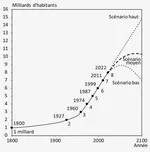 World Population: From One Billion Humans to Demographic Saturation
  Ecology
and Collapse: The Case of Easter Island
Ecology
and Collapse: The Case of Easter Island  Fractals: Universally Self-Organized
Structures
Fractals: Universally Self-Organized
Structures