


How do complex societies emerge and disappear?
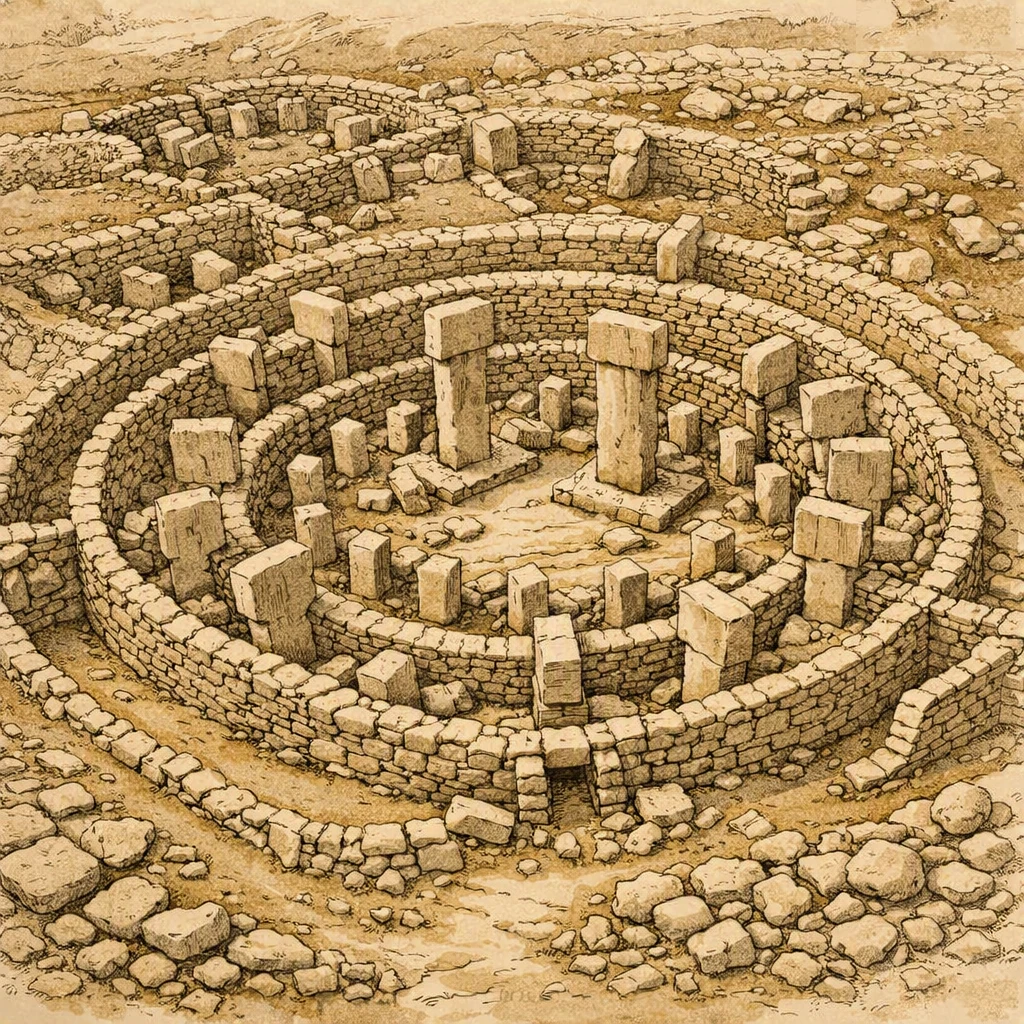
Archaeological reconstruction of Göbekli Tepe (Anatolia, around 9500 BCE): circular megalithic enclosures with T-shaped pillars 3 to 6 metres high and weighing 10 to 20 tonnes.
Image source: astronoo.com (new window): AI-generated image, public domain.
Scientific summary
The Astronoo article explores the emergence of complex societies, organized and symbolically rich, from the Pre-Pottery Neolithic to the Bronze Age. Sites such as Körtik Tepe (Turkey), Tell Qaramel (Syria), Göbekli Tepe (Turkey), Jericho (West Bank), Çatalhöyük (Turkey), Varna (Bulgaria), Caral (Peru), Uruk (Iraq) and Mohenjo-Daro (Pakistan) show that communities of hunter-gatherers, farmers or herders built monuments, produced gold ornaments and structured sophisticated rituals well before the first Egyptian dynasties. These discoveries, often made possible by LiDAR and satellite imagery, push back considerably in time and space the emergence of social complexity.
When did the first complex societies appear?
For a long time, the history of civilization was written backwards: agriculture, villages, cities, temples. Recent discoveries have overturned this linear chronology. The first complex societies appear as early as the Pre-Pottery Neolithic, around 10,700 BCE (Körtik Tepe, Turkey), then around 10,000 BCE (Göbekli Tepe, Turkey), that is, before agriculture. Hunter-gatherers then erected monuments, and monumental cities arose before pottery, such as Caral (3000 BCE, Peru). These societies display an organization and symbolic production that redefine civilization.
Also worth exploring
Continue your exploration of the Universe with these topics:
Comparative table of discoveries of the main complex societies
Three major turning points in this chronology
This table reveals three pivotal moments. The first, around 10,700 to 8,000 BCE, corresponds to the Pre-Pottery Neolithic in the Near East: sedentary hunter-gatherers built sanctuaries, towers and enclosures without agriculture or pottery. The second, between 5000 and 4000 BCE, saw the emergence of metallurgy, princely elites and the first proto-urban towns. The third, from 3600 BCE onwards, marks the entry into the Bronze Age, with writing, the state and great metropolises.
| Site | Location | Dating | Period | Distinctive feature |
|---|---|---|---|---|
| Körtik Tepe | Turkey | around 10,700 BCE | Pre-Pottery Neolithic A | Discovered in 1991: continuous occupation from the Epipalaeolithic (11,800 BP) to the Neolithic (4,200 BP) |
| Tell Qaramel | Syria | 10,650 to 9,650 BCE | Pre-Pottery Neolithic A | Discovered in 1999: oldest known circular stone towers |
| Tell Mureybet | Syria | 10,200 to 8,000 BCE | Pre-Pottery Neolithic A and B | Discovered in 1964: tell occupied for over two millennia, circular architecture |
| Göbekli Tepe | Turkey | around 10,000 BCE | Pre-Pottery Neolithic A | Discovered in 1963: oldest known temple, decorated T-shaped pillars |
| Jericho | West Bank | around 8,000 BCE | Pre-Pottery Neolithic A | Discovered in 1868: tower and enclosure wall, oldest known fortification |
| Çatalhöyük | Turkey | 7400 to 5200 BCE | Neolithic and Chalcolithic | Discovered in 1958: settlement without streets, access via roofs, wall paintings |
| Choirokoitia | Cyprus | 7000 to 6000 BCE | Aceramic Neolithic | Discovered in 1934: circular village, one of the oldest settlements of the eastern Mediterranean |
| Mehrgarh | Pakistan | 7000 to 2500 BCE | Neolithic to Bronze Age | Discovered in 1974: one of the oldest agricultural sites in South Asia, birth of the Indus |
| Dispilio | Greece | 5470 to 4850 BCE | Middle and Final Neolithic | Discovered in 1932: lakeside village, Dispilio tablet |
| Atbai | Egypt, Sudan | 5000 to 2000 BCE | Final Neolithic to Bronze Age | Discovered in 2010 (first circle): 300 stone circles, elite nomadic tombs |
| Goseck | Germany | around 4900 BCE | Middle Neolithic | Discovered in 1991: astronomical ceremonial circle, "German Stonehenge" |
| Varna | Bulgaria | 4600 to 4300 BCE | Chalcolithic | Discovered in 1972: oldest known goldsmithing, social stratification |
| Tell Brak | Syria | around 4000 BCE | Final Chalcolithic | Discovered in 1937: proto-urban city of northern Mesopotamia, organized districts |
| Maltese temples | Malta | 3600 to 2500 BCE | Final Neolithic | Discovered in 1913 (Tarxien): oldest free-standing monumental structures in the world |
| Uruk | Iraq | around 3600 BCE | Final Chalcolithic | Discovered in 1849: first great Mesopotamian metropolis, nascent writing |
| Caral | Peru | 3000 to 1800 BCE | Late Archaic | Discovered in 1905: oldest city in the Americas, pyramids and circular plazas |
| Stonehenge | United Kingdom | 3000 to 1600 BCE | Neolithic to Bronze Age | Written mention in 1130: megalithic monument with astronomical alignments |
| Mohenjo-Daro | Pakistan | 2600 to 1900 BCE | Bronze Age | Discovered in 1922: great city of the Indus, grid plan and sewer system |
The Pre-Pottery Neolithic: builders before agriculture
Körtik Tepe, Tell Qaramel and Tell Mureybet
The oldest sites in the table belong to the Pre-Pottery Neolithic A, a pivotal period when humanity became sedentary without yet domesticating plants. Körtik Tepe, in southeastern Anatolia, was occupied from 10,700 BCE and shows a remarkable continuity between the Epipalaeolithic and the Neolithic. Tell Qaramel, in Syria, has yielded the oldest known circular stone towers, dated between 10,650 and 9,650 BCE. Tell Mureybet, on the Syrian Euphrates, was occupied for more than two millennia, with a characteristic circular architecture.
These sites show that sedentarization, monumental architecture and collective ritual practices preceded agriculture. This sequence, long considered impossible, is now firmly established.
Göbekli Tepe: the temple before all else
On a hill in southeastern Turkey, about fifteen kilometres from the city of Şanlıurfa, the site of Göbekli Tepe was identified in 1963, then truly revealed from 1994 onwards by the German archaeologist Klaus Schmidt (1953-2014). It is now considered the oldest known temple in the world.
Its monumental structures, composed of T-shaped megalithic pillars weighing up to 20 tonnes, are decorated with animal representations: foxes, snakes, scorpions, vultures. They date from around 10,000 BCE, nearly 7,000 years before Stonehenge. The site was deliberately buried around 8000 BCE, which contributed to its exceptional preservation.
Göbekli Tepe overturned a dogma: that agriculture had preceded and made possible the construction of monuments. Here, it was hunter-gatherers, without pottery or metallurgy, who built a major ceremonial centre. The site suggests that the construction of monuments and the organization of complex rituals may have preceded, or even stimulated, the adoption of agriculture. This hypothesis, defended by Klaus Schmidt, remains debated, but it has profoundly renewed prehistoric archaeology.
Jericho, Çatalhöyük and the invention of urban life
Jericho: the oldest known fortification
Identified in 1868, the site of Jericho, in the West Bank, was occupied from 8,000 BCE. It features a tower and an enclosure wall considered the oldest known fortification in the world. This discovery indicates that a collective organization capable of mobilizing a significant workforce already existed in the Pre-Pottery Neolithic.
Çatalhöyük: a city without streets
Discovered in 1958, the site of Çatalhöyük, in central Turkey, was occupied from 7400 to 5200 BCE. It appears as a dense settlement, without streets, where houses are adjoining and access is via the roofs. Its wall paintings, figurines and burials beneath the floors attest to a rich symbolic life and a complex social organization.
Choirokoitia and Dispilio: the eastern Mediterranean and the Balkans
Choirokoitia, in Cyprus, discovered in 1934 and occupied from 7000 to 6000 BCE, is a remarkably well-preserved circular village. Dispilio, in Greece, discovered in 1932 and occupied from 5470 to 4850 BCE, is a lakeside village that yielded the famous Dispilio tablet, one of the oldest traces of writing in Europe. These two sites show that social complexity was not limited to the Near East.
The Chalcolithic revolution: gold, copper and inequalities
Varna: gold before the pharaohs
In 1972, construction work near the city of Varna, on the Bulgarian Black Sea coast, brought to light an exceptional necropolis. Dated between 4600 and 4300 BCE, it precedes the first Egyptian dynasties by more than a thousand years. The excavations, led in particular by the archaeologist Mikhail Lazarov (1934-2020), revealed more than 300 tombs and nearly 3,000 gold artefacts, for a total weight exceeding 6 kilograms.
The richest tomb, that of a man in his sixties, contained necklaces, bracelets, a sceptre and a gold phallic sheath. This accumulation of precious goods in a single burial indicates a marked social stratification, with an elite holding symbolic and probably ritual power.
Goseck and ceremonial circles
Discovered in 1991, the Goseck circle, in Germany, is dated to around 4900 BCE. Nicknamed the "German Stonehenge", it is a ceremonial circle with astronomical alignments, which attests to early celestial knowledge and collective ritual organization in Central Europe.
Atbai: elite tombs of the desert
The first stone circle of the Atbai desert, between Egypt and Sudan, was identified in 2010. Research has since revealed nearly 300 monumental structures, some measuring more than 60 metres in diameter. These are tombs intended for "elite nomads", belonging to a cattle-herding culture, whose construction spans from around 5000 to 2000 BCE. This discovery shows that mobile societies, without cities or writing, could produce monumental funerary architecture.
Towards the Bronze Age: cities, writing and states
Tell Brak and Uruk: the birth of cities
Tell Brak, in Syria, discovered in 1937 and occupied from 4000 BCE, is a proto-urban city of northern Mesopotamia, with organized districts. Uruk, in Iraq, identified in 1849, became around 3600 BCE the first great Mesopotamian metropolis and the place where writing was invented. These two sites mark the threshold of the Bronze Age and the emergence of the state.
Mehrgarh and Mohenjo-Daro: the Indus
Mehrgarh, in Pakistan, discovered in 1974 and occupied from 7000 to 2500 BCE, is one of the oldest agricultural sites in South Asia. It precedes the emergence of the Indus civilization. Mohenjo-Daro, discovered in 1922 and occupied from 2600 to 1900 BCE, is its great city, with its grid plan and sewer system. These sites show that social complexity emerged largely independently in several regions of the world.
Caral: the oldest city in the Americas
Caral, in Peru, discovered in 1905 and occupied from 3000 to 1800 BCE, is the oldest known city in the Americas. Its stepped pyramids, circular plazas and urban organization attest to a complex society, without pottery or writing, contemporary with the first Egyptian dynasties.
The Maltese temples and Stonehenge
The Maltese temples, including the Tarxien site discovered in 1913, are dated from 3600 to 2500 BCE. They constitute the oldest free-standing monumental structures in the world. Stonehenge, first mentioned in writing in 1130, was built between 3000 and 1600 BCE. These two monumental ensembles illustrate the diversity of European trajectories towards social complexity.
Disappearance of complex societies: probable causes and datings
Multiple and non-simultaneous collapses, where war is a possible but rarely unique factor
None of these societies disappeared all at once, nor for a single cause. Their decline spans several centuries, sometimes several millennia, and most often results from the conjunction of environmental, economic, social and, in some cases, warlike factors. War, understood as organized armed conflict, raids, sieges, invasions or violent competition for resources, is rarely identified as the main cause for these sites, because the archaeological evidence is often ambiguous. It intervenes rather as an aggravating factor, especially when societies are already weakened by drought, soil degradation or the breakdown of exchanges.
Summary table of dates of abandonment or main decline of complex societies
| Site | End or decline | Probable main cause | War / conflicts (possible) |
|---|---|---|---|
| Körtik Tepe | around 8000 BCE | Climate change and depletion of local resources | Not documented |
| Tell Qaramel | around 9000 BCE | Gradual abandonment, causes poorly known | Undetermined |
| Tell Mureybet | around 8000 BCE | Change in the course of the Euphrates and aridification | Not documented |
| Göbekli Tepe | around 8000 BCE | Erosion, landslides, climate change | Not retained |
| Jericho | around 3000 BCE (interruption) | Regional drought and collapse of the exchange network | Intergroup conflicts possible, not main cause |
| Çatalhöyük | around 5200 BCE | Demographic pressure, soil degradation, social tensions | Interpersonal violence attested, not organized war |
| Choirokoitia | around 6000 BCE | Voluntary abandonment, causes poorly known | Undetermined |
| Mehrgarh | around 2500 BCE | Climate change and decline of the Indus | Raids or conflicts possible, not main cause |
| Dispilio | around 4850 BCE | Rise in lake level and change of occupation | Not documented |
| Atbai | around 2000 BCE | Aridification of the Sahara and disappearance of pastures | Competition for pastures possible |
| Goseck | around 4600 BCE | Abandonment of ritual practices, social causes | Not retained |
| Varna | around 4300 BCE | Collapse of an overly rigid and hierarchical society | Social tensions, conflicts possible |
| Tell Brak | around 2000 BCE | Urban decline and displacement of trade routes | Regional conflicts possible, not main cause |
| Maltese temples | around 2500 BCE | Abandonment of temples, social and environmental causes | Not retained |
| Uruk | around 300 CE | Displacement of the Euphrates and decline of trade routes | Invasions or regional conflicts possible |
| Caral | around 1800 BCE | 4.2 ka event, droughts and El Niño | Conflicts possible, not main cause |
| Stonehenge | around 1600 BCE | Gradual abandonment of megalithic practices | Not retained |
| Mohenjo-Daro | around 1700 BCE | Prolonged droughts and change in the course of the Indus | Former invasion hypothesis rejected; conflicts possible but not main cause |
Environmental causes: climate, erosion and water
The most frequently identified cause is climate change. Göbekli Tepe was abandoned around 8000 BCE after suffering landslides and severe erosion linked to heavy winter rains[reference:0]. At Çatalhöyük, the abrupt cooling of 8200 cal BP increased pressure on resources and caused the fission of the village around 5200 BCE[reference:1].
In the Atbai desert, the progressive aridification of the Sahara, between 3000 and 2000 BCE, made pastures impossible and forced herding populations to abandon their monumental tombs. At Caral, the 4.2 ka event, a period of severe droughts around 2200 BCE, led to the crisis and collapse of the civilization, with famines and population displacements towards the coast[reference:2].
For the Indus civilization, recent studies have shown that successive droughts, each lasting more than 85 years, played a key role in the collapse of Mohenjo-Daro and the other great Harappan cities[reference:3]. The change in the course of the Indus also deprived the cities of their access to water and navigation routes.
Social causes: rigidity, inequalities and institutional collapse
Environmental factors do not explain everything. The Varna culture, both highly hierarchical and highly rigid, was unable to adapt to a crisis, whether earthquakes, poor harvests or political tensions. Its collapse, around 4300 BCE, illustrates the vulnerability of highly inegalitarian societies[reference:4].
At Çatalhöyük, demographic pressure and competition for resources generated social and biological stress that the community system could no longer absorb. The village split and the eastern mound was deserted[reference:5]. These examples show that social complexity can become a weakness when accompanied by excessive institutional rigidity.
The collapse of the Bronze Age: a systemic phenomenon
Between 1200 and 1150 BCE, a large-scale collapse struck the entire eastern Mediterranean. The Hittite empire disappeared around 1198 BCE, the Mycenaean civilization collapsed, and Egypt entered decline. The causes are multiple: severe droughts attested by tree rings between 1198 and 1196 BCE, invasions of the "Sea Peoples", economic bankruptcies, earthquakes and interruptions of trade routes[reference:6][reference:7].
This collapse is not that of an isolated society, but of an interconnected system of kingdoms and cities that depended on one another for trade, raw materials and political stability. The fall of one led to the fall of the others, in a chain reaction.
N.B.:
The dates of disappearance are often estimates, and the identified causes are hypotheses based on available archaeological and palaeoclimatic data. Research continues to refine these scenarios.
What these discoveries teach us
Complexity precedes writing
None of these oldest societies left any text. Yet all display an elaborate organization: planning of worksites, specialization of tasks, social hierarchy, symbolic production. Social complexity was therefore not born with writing, nor with the city, nor even with agriculture.
A diversity of paths towards civilization
Each site illustrates an original trajectory. Göbekli Tepe experiments with the monument before domestication. Varna develops a princely elite. Caral invents the city without pottery. Uruk invents writing and the state. Mohenjo-Daro plans its city on a grid. There is no single path towards civilization, but a plurality of routes.
Symbolically rich societies
Gold, decorated pillars, astronomical circles, monumental tombs: everywhere, the symbolic occupies a central place. These societies do not merely survive, they produce meaning, organize rituals and inscribe their vision of the world in the landscape. The symbolic is not a late luxury: it is an early driver of social organization.
N.B.:
The datings of these sites are regularly revised as new radiometric and stratigraphic analyses are published. The values indicated here correspond to the consensus published in 2026.
Perspectives: what tomorrow's archaeology could reveal
LiDAR and satellite imagery
LiDAR has already transformed our knowledge of the Amazon, Cambodia and Mexico. Its extension to other regions, such as Central Africa, Southeast Asia or the Congo Basin, could reveal dozens of still unknown sites, profoundly modifying the maps of prehistory.
Biomolecular analyses
Advances in palaeogenetics and the analysis of organic residues make it possible to reconstruct diets, migrations and exchanges. These techniques, applied to the sites of Varna or Atbai, could clarify the origin of elites and the nature of exchange networks.
A global, non-linear history
Recent archaeology is drawing a global history of human societies that is much more teeming than the classic evolutionist model. Far from a single path leading from the horde to the state, it reveals a multiplicity of social experiments, each adapted to its environment and its beliefs.
References
FAQ: Everything you need to know about the emergence of complex societies
What is a complex society?
A complex society is characterized by a hierarchical social organization, specialization of tasks, ritual or political institutions, and an elaborate symbolic production. It does not necessarily presuppose writing, the city or agriculture, as shown by Göbekli Tepe, Caral or the Atbai circles.
What is the oldest site in the table?
The oldest site listed is Körtik Tepe, in Turkey, occupied from around 10,700 BCE. It slightly precedes Tell Qaramel, in Syria, dated 10,650 to 9,650 BCE. Both sites belong to the Pre-Pottery Neolithic A.
Why is Varna so important?
The Varna necropolis, dated between 4600 and 4300 BCE, yielded the oldest known goldsmithing in the world. It proves that a hierarchical society, with an elite holding prestige goods, existed in Europe well before the first Egyptian dynasties.
Is Göbekli Tepe really a temple?
Göbekli Tepe is interpreted as a ceremonial centre, a place of ritual gathering rather than a place of permanent habitation. Its monumental T-shaped pillars, decorated with animals, suggest a symbolic and collective function. The term "temple" remains a convenient label.
When does the Bronze Age begin?
The Bronze Age begins around 3300 BCE in the Near East and around 2300 to 2200 BCE in Europe. It is characterized by the use of bronze, an alloy of copper and tin, and by the emergence of writing and urbanization in certain regions.
Were these societies peaceful?
The data are fragmentary. Jericho has an early fortification, suggesting possible tensions. Varna shows elite tombs with weapons. Göbekli Tepe shows no traces of large-scale war. It is therefore difficult to generalize: each society had its own internal and external dynamics.
 From the Zeroth Law to Generative AI: Asimov's Laws in Question
  How do complex societies emerge and disappear?
  The Brain vs. AI: Chronicle of an Organ Overwhelmed by the Data Deluge
  AI has learned to think: will artificial consciousness learn to be?
  The Future Obsession: When prediction shapes the living
  Which Regions of the World Will Remain Habitable During the Next Ice Age?
  Rapid Evolution: Darwin’s Thunderbolt in the 21st Century
  Fatal Imbalance: The Unsuspected Power of the Infinitely Small
  The Great Filter of Evolution: The Key to the Fermi Paradox
  The Last Glacial Shock: The Younger Dryas and Its Impact on Prehistoric Societies
  Why Does the Sunflower Turn Toward the Sun? An Answer Through the Lagrangian
  World Population 2026: Demographic Trends by Continent
 Why Life Emerges from Imbalance and Dies at Thermodynamic Equilibrium
  The Electromagnetic Spectrum and Vision: What Our Eyes Perceive of Our Planet
  Self and Non-Self: A Simplified Physical Reading of Identity
  The Molecular Clock: From Random Mutations to Measuring Time
  The Minimal Cell: The Inevitable Emergence
  White Sands Footprints: America's First Steps
  Hominins: Appearance, Expansion, and Extinctions
  Declining Births: Demographic Catastrophe or Natural Evolution?
  Natural Selection vs. Chance: Why Evolution is Not a Lottery?
  What if Life Originated from Earth? A Revolution in the Theory of Panspermia
  The Great Bifurcation that will Disrupt Our World: Survival or Collapse?
  Primordial Chemistry: Where Do the First Organic Molecules Originate?
  CO and CO₂: Two Gases, Two Risks, Two Biological Mechanisms
  Spontaneous Synchronization: A Universal Phenomenon, from Physics to Life
  Time Challenge: How to Illustrate a Billion Years?
  The Three Essential Components for the Emergence of Life
  Why Did the Genus Homo Nearly Go Extinct 900,000 Years Ago?
  The First Step Towards the Emergence of Life
  The shadow biosphere
  Decline of anthropocentrism: when the cosmos relativizes our importance
  The horseshoe
crab, a living fossil!
The horseshoe
crab, a living fossil!  Origin of life
on Earth: Panspermia theory
Origin of life
on Earth: Panspermia theory  Origin of life on Earth: White smoker theory
  Why 37 degrees Celsius?
  Are We Alone in the Cosmos? Between Science and Speculation
  Traces
of Life in the Ice: The Emergence of Prehistoric Mammoths
Traces
of Life in the Ice: The Emergence of Prehistoric Mammoths  The Younger Dryas: The Mini Ice Age That Wiped Out the Megafauna
  The Two Great Ice Ages: Surviving in the Oceans of a Frozen Earth
  Regeneration in Animals Following Amputation: Organic Regrowth
  At the Limits
of Life: Mephisto, Worm of the Infernal Depths
At the Limits
of Life: Mephisto, Worm of the Infernal Depths  Discovery
of solid buckyballs in space
Discovery
of solid buckyballs in space  Human Walking:
The Origins of Bipedalism in Hominids
Human Walking:
The Origins of Bipedalism in Hominids  Karabo: A Window into Human Evolution
  Entropy: What
is Time?
Entropy: What
is Time?  The
passage between the inert and the living
The
passage between the inert and the living  The
Great Story of Complexity: From Elementary Particles to the First Organisms
The
Great Story of Complexity: From Elementary Particles to the First Organisms  Megapod uses
volcanic heat
Megapod uses
volcanic heat  Ardipithecus:
The 4.4-Million-Year-Old Ethiopian Hominid
Ardipithecus:
The 4.4-Million-Year-Old Ethiopian Hominid  Natural Selection: The Peppered Moth
  The Ordovician:
The Era of Corals, Trilobites, and Graptolites
The Ordovician:
The Era of Corals, Trilobites, and Graptolites  Liquid
Water, Much More Than a Solvent: A Catalyst for Chemical Reactions
Liquid
Water, Much More Than a Solvent: A Catalyst for Chemical Reactions  Neanderthal:
Humanity's Lost Cousin
Neanderthal:
Humanity's Lost Cousin  ASIMO: The First
Humanoid
ASIMO: The First
Humanoid  What conditions allowed the emergence of life?
  Fermi Paradox and Plato's Cave: Are We Alone or Blind?
  Tardigrades:
Indestructible Creatures That Defy the Laws of Biology
Tardigrades:
Indestructible Creatures That Defy the Laws of Biology  Toumaï: One
of the Oldest Known Hominins
Toumaï: One
of the Oldest Known Hominins  The
Tree of Life: Billions of Extinct Species and a Single Ancestral Community
The
Tree of Life: Billions of Extinct Species and a Single Ancestral Community  Life
in the Abyss: The Extreme Adaptation of Creatures
Life
in the Abyss: The Extreme Adaptation of Creatures  Cyanobacteria
and the Oxygen Crisis: A Primordial Ecological Catastrophe
Cyanobacteria
and the Oxygen Crisis: A Primordial Ecological Catastrophe  From
Matter to Life: The Blurred Frontier of Biological Emergence
From
Matter to Life: The Blurred Frontier of Biological Emergence  The Smallest Frog in the World: Physiological Secrets of a Microvertebrate
  The explanation of the Little Ice Age
  The Light of Life: A Biosignature Revealed by the Moon
  Living
Light: The Dazzling Secrets of Bioluminescence
Living
Light: The Dazzling Secrets of Bioluminescence  Beyond our senses, the great scientific revolutions
  The
Primordial Soup: Chemical Cradle of Terrestrial Life
The
Primordial Soup: Chemical Cradle of Terrestrial Life  World Population: From One Billion Humans to Demographic Saturation
  Ecology
and Collapse: The Case of Easter Island
Ecology
and Collapse: The Case of Easter Island  Fractals: Universally Self-Organized
Structures
Fractals: Universally Self-Organized
Structures