


World Population 2026: Demographic Trends by Continent
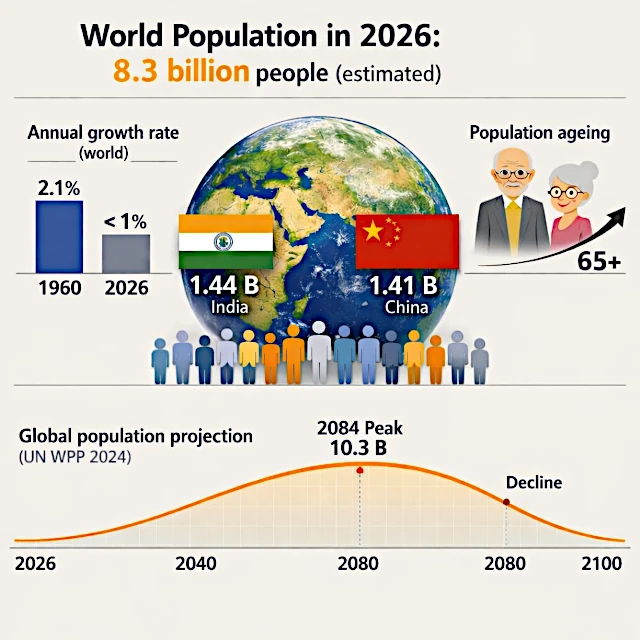
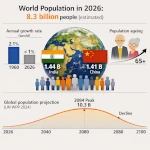
UN estimates (World Population Prospects 2024). World population 2026: 8.30 billion inhabitants.
Scientific summary
In 2026, the world population reaches approximately 8.30 billion inhabitants, with an annual growth rate below 1%, marking a historic demographic slowdown. This dynamic is driven by the inertia of past large generations, while fertility declines globally. UN projections (2024) forecast a peak around 2084 at about 10.3 billion, followed by a decline. Africa remains the main driver of growth, while Europe is in decline. Pressure on resources and energy remains high, illustrating the challenges posed by a population that has multiplied eightfold since 1800.
Why does the world population reach 8.3 billion in 2026?
Because global population growth is slowing: in 2026, humanity reaches about 8.30 billion inhabitants, but the growth rate falls below 1% per year. This deceleration results from a widespread decline in fertility, including in many developing countries, while demographic inertia continues to fuel growth. UN projections forecast a peak around 2084 at about 10.3 billion, before a gradual decline. Despite this slowdown, pressure on resources, ecosystems and energy remains high in a world that has gone from 1 billion humans in 1800 to over 8 billion today.
Also worth exploring
Continue your exploration of the Universe with these topics:
Forecasts regarding population growth in 2026
Revised UN projections
According to the latest UN estimates (World Population Prospects 2024), the world population reaches approximately
8.30 billion inhabitants in 2026.
Global population growth continues to slow: the annual rate is now below 1%, compared to 2.1% in the early 1960s.
The revised 2024 projections indicate that the world population should peak around 2084 at about 10.3 billion inhabitants before beginning a gradual decline.
A widespread slowdown but persistent pressures
The decline in fertility continues in the majority of countries, including developing countries, contributing to this slowdown.
However, humanity continues to exert growing pressure on natural resources, ecosystems and biodiversity.
Number of inhabitants on Earth in 1800
The demographic explosion over two centuries
In 1800, the Earth had about one billion inhabitants. Since then, the world population has multiplied by eight.
All energy sources developed over two centuries have added up without replacing each other, leading to ever-increasing energy consumption.
Energy challenges and the coming demographic peak
At this rate, humanity could need nearly 40 additional terawatts by 2050, equivalent to tens of thousands of power plants.
The world population should increase by about 2 billion more before reaching a peak in the second half of the 21st century.
N.B. :
The world population now increases by about 70 million people per year. It was 7 billion in 2011, 8 billion in 2022 and reaches about 8.3 billion in 2026.
Population mondiale en temps réel
World population in 2000
| Region | Population (in millions) | World population share (%) | Annual growth rate (%) | Children per woman |
|---|---|---|---|---|
| WORLD | 6,120 | 100 | 1.3 | 2.7 |
| AFRICA | 811 | 13.3 | 2.5 | 4.9 |
| LATIN AMERICA | 521 | 8.5 | 1.6 | 2.5 |
| NORTH AMERICA | 314 | 5.1 | 1.0 | 2.0 |
| ASIA | 3,730 | 61.0 | 1.3 | 2.6 |
| EUROPE | 727 | 11.9 | 0.0 | 1.5 |
| OCEANIA | 31 | 0.50 | 1.3 | 2.4 |
World population in 2011
| Region | Population (in millions) | World population share (%) | Annual growth rate (%) | Children per woman |
|---|---|---|---|---|
| WORLD | 7,000 | 100 | 1.2 | 2.5 |
| AFRICA | 1,050 | 15.0 | 2.7 | 4.7 |
| LATIN AMERICA | 590 | 8.4 | 1.2 | 2.2 |
| NORTH AMERICA | 350 | 5.0 | 0.8 | 2.0 |
| ASIA | 4,200 | 60.0 | 1.0 | 2.3 |
| EUROPE | 740 | 10.6 | 0.0 | 1.6 |
| OCEANIA | 37 | 0.53 | 1.4 | 2.4 |
Estimated world population in 2022
| Region | Population (in millions) | World population share (%) | Annual growth rate (%) | Children per woman |
|---|---|---|---|---|
| WORLD | 7,975 | 100 | 0.9 | 2.3 |
| AFRICA | 1,427 | 17.9 | 2.4 | 4.2 |
| LATIN AMERICA | 660 | 8.3 | 0.9 | 1.8 |
| NORTH AMERICA | 377 | 4.7 | 0.3 | 1.6 |
| ASIA | 4,723 | 59.2 | 0.7 | 1.9 |
| EUROPE | 744 | 9.3 | −0.1 | 1.5 |
| OCEANIA | 45 | 0.57 | 1.1 | 2.1 |
Estimated world population in 2026
| Region | Population (in millions) | World population share (%) | Annual growth rate (%) | Children per woman |
|---|---|---|---|---|
| WORLD | 8,300 | 100 | 0.8 | 2.2 |
| AFRICA | 1,470 | 17.7 | 2.2 | 4.1 |
| LATIN AMERICA | 665 | 8 | 0.7 | 1.8 |
| NORTH AMERICA | 382 | 4.6 | 0.2 | 1.6 |
| ASIA | 4,780 | 57.6 | 0.5 | 1.9 |
| EUROPE | 740 | 8.9 | −0.2 | 1.5 |
| OCEANIA | 46 | 0.55 | 1.0 | 2.0 |
References
FAQ – World population 2026
Why does the world population reach 8.3 billion in 2026?
Because population growth is slowing but remains positive. The widespread decline in fertility is offset by demographic inertia: the large generations of the past continue to fuel growth.
Is the population growth rate continuing to increase?
No. The global rate has fallen below 1% per year, compared to over 2% in the 1960s. This is the slowest growth rate in over a century.
When will the world population reach its maximum?
According to UN projections (WPP 2024), the world population should peak around 2084 at about 10.3 billion inhabitants, before beginning a gradual decline.
Why is fertility declining in most countries?
Due to urbanisation, women's education, access to contraception, rising living standards and the increasing cost of raising children.
Which continents contribute most to population growth?
Africa remains the main driver of global growth, with an annual rate above 2%. Asia is slowing sharply, Europe is in decline, and Latin America is approaching stability.
Why is Europe's population decreasing?
Due to very low fertility (about 1.5 children per woman), significant ageing and a negative natural balance, even if immigration partially mitigates the decline.
How many inhabitants did the Earth have in 1800?
About 1 billion. The world population has multiplied by eight in just over two centuries, mainly thanks to medical, agricultural and energy advances.
Why does population growth put pressure on resources?
Because every human consumes energy, water, land and raw materials. Energy demand could increase by an additional 40 terawatts by 2050.
Could the world population decrease before 2100?
Yes. If fertility continues to fall faster than expected, some scenarios foresee a lower peak and an earlier decline, particularly in Asia and Latin America.
Why is the population still increasing while fertility is declining?
Because of demographic inertia: the large generations born between 1950 and 2000 are still reaching adulthood and having children, even if they have fewer children per woman.
How many inhabitants does the Earth gain each year?
About 70 million people per year in 2026, compared to over 90 million in the early 2000s.
Why does Africa remain the most demographically dynamic continent?
Because it combines high fertility, a young population and a gradual but slow decline in infant mortality.
Could the world population stabilise naturally?
Yes. When fertility sustainably falls below 2.1 children per woman, the population eventually stabilises and then declines, as is already the case in several regions of the world.
 From the Zeroth Law to Generative AI: Asimov's Laws in Question
  How do complex societies emerge and disappear?
  The Brain vs. AI: Chronicle of an Organ Overwhelmed by the Data Deluge
  AI has learned to think: will artificial consciousness learn to be?
  The Future Obsession: When prediction shapes the living
  Which Regions of the World Will Remain Habitable During the Next Ice Age?
  Rapid Evolution: Darwin’s Thunderbolt in the 21st Century
  Fatal Imbalance: The Unsuspected Power of the Infinitely Small
  The Great Filter of Evolution: The Key to the Fermi Paradox
  The Last Glacial Shock: The Younger Dryas and Its Impact on Prehistoric Societies
  Why Does the Sunflower Turn Toward the Sun? An Answer Through the Lagrangian
  World Population 2026: Demographic Trends by Continent
 Why Life Emerges from Imbalance and Dies at Thermodynamic Equilibrium
  The Electromagnetic Spectrum and Vision: What Our Eyes Perceive of Our Planet
  Self and Non-Self: A Simplified Physical Reading of Identity
  The Molecular Clock: From Random Mutations to Measuring Time
  The Minimal Cell: The Inevitable Emergence
  White Sands Footprints: America's First Steps
  Hominins: Appearance, Expansion, and Extinctions
  Declining Births: Demographic Catastrophe or Natural Evolution?
  Natural Selection vs. Chance: Why Evolution is Not a Lottery?
  What if Life Originated from Earth? A Revolution in the Theory of Panspermia
  The Great Bifurcation that will Disrupt Our World: Survival or Collapse?
  Primordial Chemistry: Where Do the First Organic Molecules Originate?
  CO and CO₂: Two Gases, Two Risks, Two Biological Mechanisms
  Spontaneous Synchronization: A Universal Phenomenon, from Physics to Life
  Time Challenge: How to Illustrate a Billion Years?
  The Three Essential Components for the Emergence of Life
  Why Did the Genus Homo Nearly Go Extinct 900,000 Years Ago?
  The First Step Towards the Emergence of Life
  The shadow biosphere
  Decline of anthropocentrism: when the cosmos relativizes our importance
  The horseshoe
crab, a living fossil!
The horseshoe
crab, a living fossil!  Origin of life
on Earth: Panspermia theory
Origin of life
on Earth: Panspermia theory  Origin of life on Earth: White smoker theory
  Why 37 degrees Celsius?
  Are We Alone in the Cosmos? Between Science and Speculation
  Traces
of Life in the Ice: The Emergence of Prehistoric Mammoths
Traces
of Life in the Ice: The Emergence of Prehistoric Mammoths  The Younger Dryas: The Mini Ice Age That Wiped Out the Megafauna
  The Two Great Ice Ages: Surviving in the Oceans of a Frozen Earth
  Regeneration in Animals Following Amputation: Organic Regrowth
  At the Limits
of Life: Mephisto, Worm of the Infernal Depths
At the Limits
of Life: Mephisto, Worm of the Infernal Depths  Discovery
of solid buckyballs in space
Discovery
of solid buckyballs in space  Human Walking:
The Origins of Bipedalism in Hominids
Human Walking:
The Origins of Bipedalism in Hominids  Karabo: A Window into Human Evolution
  Entropy: What
is Time?
Entropy: What
is Time?  The
passage between the inert and the living
The
passage between the inert and the living  The
Great Story of Complexity: From Elementary Particles to the First Organisms
The
Great Story of Complexity: From Elementary Particles to the First Organisms  Megapod uses
volcanic heat
Megapod uses
volcanic heat  Ardipithecus:
The 4.4-Million-Year-Old Ethiopian Hominid
Ardipithecus:
The 4.4-Million-Year-Old Ethiopian Hominid  Natural Selection: The Peppered Moth
  The Ordovician:
The Era of Corals, Trilobites, and Graptolites
The Ordovician:
The Era of Corals, Trilobites, and Graptolites  Liquid
Water, Much More Than a Solvent: A Catalyst for Chemical Reactions
Liquid
Water, Much More Than a Solvent: A Catalyst for Chemical Reactions  Neanderthal:
Humanity's Lost Cousin
Neanderthal:
Humanity's Lost Cousin  ASIMO: The First
Humanoid
ASIMO: The First
Humanoid  What conditions allowed the emergence of life?
  Fermi Paradox and Plato's Cave: Are We Alone or Blind?
  Tardigrades:
Indestructible Creatures That Defy the Laws of Biology
Tardigrades:
Indestructible Creatures That Defy the Laws of Biology  Toumaï: One
of the Oldest Known Hominins
Toumaï: One
of the Oldest Known Hominins  The
Tree of Life: Billions of Extinct Species and a Single Ancestral Community
The
Tree of Life: Billions of Extinct Species and a Single Ancestral Community  Life
in the Abyss: The Extreme Adaptation of Creatures
Life
in the Abyss: The Extreme Adaptation of Creatures  Cyanobacteria
and the Oxygen Crisis: A Primordial Ecological Catastrophe
Cyanobacteria
and the Oxygen Crisis: A Primordial Ecological Catastrophe  From
Matter to Life: The Blurred Frontier of Biological Emergence
From
Matter to Life: The Blurred Frontier of Biological Emergence  The Smallest Frog in the World: Physiological Secrets of a Microvertebrate
  The explanation of the Little Ice Age
  The Light of Life: A Biosignature Revealed by the Moon
  Living
Light: The Dazzling Secrets of Bioluminescence
Living
Light: The Dazzling Secrets of Bioluminescence  Beyond our senses, the great scientific revolutions
  The
Primordial Soup: Chemical Cradle of Terrestrial Life
The
Primordial Soup: Chemical Cradle of Terrestrial Life 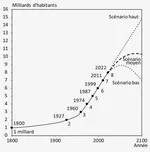 World Population: From One Billion Humans to Demographic Saturation
  Ecology
and Collapse: The Case of Easter Island
Ecology
and Collapse: The Case of Easter Island  Fractals: Universally Self-Organized
Structures
Fractals: Universally Self-Organized
Structures