


Self and Non-Self: A Simplified Physical Reading of Identity
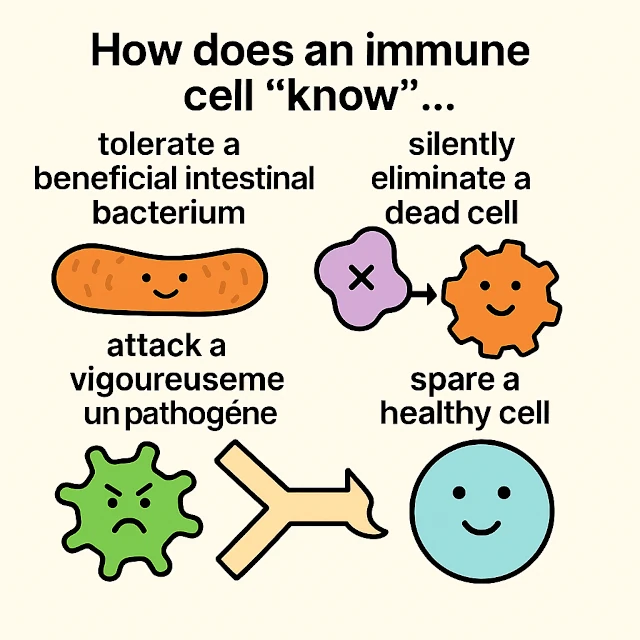
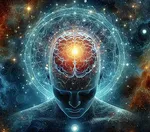
Image description:
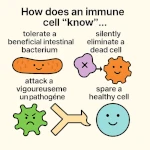
How does an immune system cell "know" whether to tolerate a beneficial bacterium, eliminate a dead cell, attack a pathogen, or spare a healthy cell?
Image source: astronoo.com (new window)
Scientific Summary
The article proposes a physical reading of the distinction between "self" (molecules belonging to the organism) and "non-self" (foreign agents, pathogens), presented not as an arbitrary biological choice but as a natural consequence of the fundamental laws of physics. Three physical pillars are at play: electromagnetism (determines shapes and molecular interactions), thermodynamics (governs energy flows and the search for equilibrium), and quantum mechanics (governs the compatibility of electronic orbitals). "Self" molecules spontaneously harmonize with their environment, minimizing energy tensions. "Non-self" creates electrostatic perturbations, quantum dissonances, and energy gradients, triggering a spontaneous reorganization of the system that leads to its elimination. Health, disease, and healing thus emerge from the fundamental laws of matter.
How do the laws of physics explain the distinction between "self" and "non-self" in living organisms?
The distinction between "self" (molecules belonging to the organism) and "non-self" (foreign agents, pathogens) is not an arbitrary biological choice but a natural consequence of the fundamental laws of physics. Three physical pillars are at play: electromagnetism (determines shapes and molecular interactions), thermodynamics (governs energy flows and the search for equilibrium), and quantum mechanics (governs the compatibility of electron orbitals). "Self" molecules spontaneously harmonize with their environment, minimizing energy tensions. "Non-self" creates electrostatic disturbances, quantum dissonances, and energy gradients, triggering a spontaneous reorganization of the system that leads to its elimination. Health, disease, and healing thus emerge from the fundamental laws of matter.
Also worth exploring
Continue your exploration of the Universe with these topics:
Self and Non-Self: Two Invisible but Real Worlds
Every second, our bodies are traversed by billions of molecules carried by chance: some nourish, others transmit messages, some protect, and others are potentially dangerous.
Among these molecules, some are part of us and are perfectly accepted. Others, like those in our gut microbiome, are foreign but tolerated. Finally, some are harmful: viruses, pathogenic bacteria, dead or cancerous cells. But how do our cells know what to tolerate and what to eliminate? This is where the distinction between "self" and "non-self" comes into play.
The Invisible Forces Guiding Molecules
To understand this distinction, three major physical principles play a role: electromagnetism, thermodynamics, and quantum mechanics.
- Electromagnetism describes how electrical charges interact and organize molecules, much like magnets that attract or repel each other.
- Thermodynamics concerns energy and balance, how molecules move and stabilize in space and time.
- Quantum Mechanics explains the behavior of electrons and atoms at a very small scale, where everything becomes probabilistic and requires fine harmony for molecules to fit together correctly.
"Self" molecules naturally fit into their environment, like perfectly matched puzzle pieces. "Non-self" molecules create disturbances and do not integrate, triggering a physical response from the system.
Function and Chaos: When Life Organizes Itself Despite Disorder
A living organism is neither completely ordered nor totally chaotic. Molecules move unpredictably, but this local agitation allows the system to find stable configurations. This is what makes life both flexible and robust.
The function of a molecule is not innate: it appears when it fits into a network where its presence produces a useful and repeatable effect, like a gear in a well-oiled machine. It is a property that emerges from the overall organization.
3D Journey of Genetic Information: DNA → RNA → Protein
DNA contains the instructions to make proteins.
The cell first copies these instructions into a messenger RNA (messenger RiboNucleic Acid), which is then edited to keep only the useful parts.
This RNA exits the nucleus and is read by a ribosome (ribosome, molecular factory that assembles amino acids to produce a protein), which assembles the amino acids (building blocks that make up proteins) in the correct order to create a protein.
Thus, the genetic code in DNA is transformed into living matter, and depending on the message carried by the RNA, the cell can produce a wide variety of proteins.
This process illustrates how molecules interact and organize to create functional structures in a complex environment.
Image source: 3D Animation of DNA to RNA to Protein (new window)
Electromagnetism: Structuring Form
Electrons and electrical charges determine how atoms assemble and what shapes molecules adopt. The shape (spatial conformation) is essential: it makes all the difference between a functional molecule and an inert clump. It allows a molecule to integrate correctly or, if it is malformed, to produce a disturbance in the system.
Thermodynamics: Balancing Molecular Perturbations
In an organism, molecules do not simply seek to be in the most stable state possible. They are maintained in configurations that allow the system to function, thanks to constant flows of matter and energy. This ensures that "self" molecules remain harmonious while "non-self" can be detected and eliminated.
Quantum Mechanics: Harmonizing Orbitals and Fields
At the level of electrons and atoms, quantum mechanics governs molecular compatibility. The "self" is characterized by the harmonization of its electron orbitals and charges. The "non-self" introduces quantum dissonances, tensions, and disturbances that betray its incompatibility.
The Spontaneous Emergence of "Self"
The "self" establishes itself without an active selection mechanism: compatible molecular configurations spontaneously converge towards the state of least tension, like water flowing to the lowest point. The "non-self," by disrupting this balance, automatically triggers the physical processes that lead to its elimination.
Why "Self" Persists and "Non-Self" is Eliminated
Electromagnetism, thermodynamics, and quantum mechanics define "self" and "non-self," but it is a universal physical principle that explains their selection: any complex system spontaneously tends to maximize its internal coherence and minimize its energetic disturbances.
The "self" represents the set of molecular configurations compatible with this principle. The system does not have to choose it: the "self" establishes itself naturally, like water finding its lowest level. It emerges spontaneously from configurations that minimize internal energetic tensions.
Conversely, the "non-self" causes its own elimination. By disturbing the local balance, it triggers a cascade of physical events (electrostatic contrast, energy gradient, charge flow, thermal dissipation) that induce a spontaneous reorganization of the molecular environment: the system automatically adjusts its charges, realigns its structures, and equalizes its potentials to regain its minimal stability. The non-self thus becomes the architect of its own destruction.
Health, Disease, and Healing: A Physical Reading
- Health: the "self" dominates, tensions are minimal, the system is coherent and stable.
- Disease: a "non-self" persists or the "self" is disturbed, causing a temporary imbalance.
- Healing: the system finds a new functional balance thanks to the same fundamental forces.
The body does not "fight" disease: it restores order and coherence according to the laws of physics.
Life Explained Simply by Physics
The immune system and the distinction between "self" and "non-self" can be understood as a natural consequence of electromagnetic, thermodynamic, and quantum interactions. Life spontaneously organizes its molecules to achieve a stable dynamic balance. Health, disease, and healing thus emerge from the fundamental laws of matter.
FAQ: Everything about Self and Non-Self through the laws of physics
What is the role of electromagnetism in distinguishing Self from Non-Self?
Electromagnetism determines how electric charges and electrons organize atoms and molecules, thus defining their spatial conformation (their 3D shape). This shape is essential: a "self" molecule has a geometry that fits perfectly into its environment, like a puzzle piece. "Non-self" has an incompatible conformation that creates electrostatic contrasts and local disturbances, triggering a physical response from the system.
Why is it said that "non-self" causes its own elimination?
This is a fundamental physical principle: any complex system spontaneously tends to maximize its internal coherence and minimize its energy disturbances. "Non-self," by disturbing the local equilibrium (through its electrostatic contrasts, energy gradients, quantum dissonances), automatically triggers a cascade of physical events: charge reorganization, structural realignment, thermal dissipation. The system spontaneously reorganizes to regain its minimal stability, and "non-self" is eliminated without the need for an active "recognition" mechanism.
How does this physical model illuminate health, disease, and healing?
In this physical reading: health corresponds to a situation where "self" dominates, where energy tensions are minimal and the system is coherent and stable. Disease occurs when "non-self" persists or "self" is disturbed, causing a temporary imbalance. Healing is the process by which the system regains a new functional equilibrium thanks to the same fundamental forces (electromagnetism, thermodynamics, quantum mechanics). The body does not "fight" disease in a military sense: it restores order and coherence according to the laws of physics.
 From the Zeroth Law to Generative AI: Asimov's Laws in Question
  How do complex societies emerge and disappear?
  The Brain vs. AI: Chronicle of an Organ Overwhelmed by the Data Deluge
  AI has learned to think: will artificial consciousness learn to be?
  The Future Obsession: When prediction shapes the living
  Which Regions of the World Will Remain Habitable During the Next Ice Age?
  Rapid Evolution: Darwin’s Thunderbolt in the 21st Century
  Fatal Imbalance: The Unsuspected Power of the Infinitely Small
  The Great Filter of Evolution: The Key to the Fermi Paradox
  The Last Glacial Shock: The Younger Dryas and Its Impact on Prehistoric Societies
  Why Does the Sunflower Turn Toward the Sun? An Answer Through the Lagrangian
  World Population 2026: Demographic Trends by Continent
 Why Life Emerges from Imbalance and Dies at Thermodynamic Equilibrium
  The Electromagnetic Spectrum and Vision: What Our Eyes Perceive of Our Planet
  Self and Non-Self: A Simplified Physical Reading of Identity
  The Molecular Clock: From Random Mutations to Measuring Time
  The Minimal Cell: The Inevitable Emergence
  White Sands Footprints: America's First Steps
  Hominins: Appearance, Expansion, and Extinctions
  Declining Births: Demographic Catastrophe or Natural Evolution?
  Natural Selection vs. Chance: Why Evolution is Not a Lottery?
  What if Life Originated from Earth? A Revolution in the Theory of Panspermia
  The Great Bifurcation that will Disrupt Our World: Survival or Collapse?
  Primordial Chemistry: Where Do the First Organic Molecules Originate?
  CO and CO₂: Two Gases, Two Risks, Two Biological Mechanisms
  Spontaneous Synchronization: A Universal Phenomenon, from Physics to Life
  Time Challenge: How to Illustrate a Billion Years?
  The Three Essential Components for the Emergence of Life
  Why Did the Genus Homo Nearly Go Extinct 900,000 Years Ago?
  The First Step Towards the Emergence of Life
  The shadow biosphere
  Decline of anthropocentrism: when the cosmos relativizes our importance
  The horseshoe
crab, a living fossil!
The horseshoe
crab, a living fossil!  Origin of life
on Earth: Panspermia theory
Origin of life
on Earth: Panspermia theory  Origin of life on Earth: White smoker theory
  Why 37 degrees Celsius?
  Are We Alone in the Cosmos? Between Science and Speculation
  Traces
of Life in the Ice: The Emergence of Prehistoric Mammoths
Traces
of Life in the Ice: The Emergence of Prehistoric Mammoths  The Younger Dryas: The Mini Ice Age That Wiped Out the Megafauna
  The Two Great Ice Ages: Surviving in the Oceans of a Frozen Earth
  Regeneration in Animals Following Amputation: Organic Regrowth
  At the Limits
of Life: Mephisto, Worm of the Infernal Depths
At the Limits
of Life: Mephisto, Worm of the Infernal Depths  Discovery
of solid buckyballs in space
Discovery
of solid buckyballs in space  Human Walking:
The Origins of Bipedalism in Hominids
Human Walking:
The Origins of Bipedalism in Hominids  Karabo: A Window into Human Evolution
  Entropy: What
is Time?
Entropy: What
is Time?  The
passage between the inert and the living
The
passage between the inert and the living  The
Great Story of Complexity: From Elementary Particles to the First Organisms
The
Great Story of Complexity: From Elementary Particles to the First Organisms  Megapod uses
volcanic heat
Megapod uses
volcanic heat  Ardipithecus:
The 4.4-Million-Year-Old Ethiopian Hominid
Ardipithecus:
The 4.4-Million-Year-Old Ethiopian Hominid  Natural Selection: The Peppered Moth
  The Ordovician:
The Era of Corals, Trilobites, and Graptolites
The Ordovician:
The Era of Corals, Trilobites, and Graptolites  Liquid
Water, Much More Than a Solvent: A Catalyst for Chemical Reactions
Liquid
Water, Much More Than a Solvent: A Catalyst for Chemical Reactions  Neanderthal:
Humanity's Lost Cousin
Neanderthal:
Humanity's Lost Cousin  ASIMO: The First
Humanoid
ASIMO: The First
Humanoid  What conditions allowed the emergence of life?
  Fermi Paradox and Plato's Cave: Are We Alone or Blind?
  Tardigrades:
Indestructible Creatures That Defy the Laws of Biology
Tardigrades:
Indestructible Creatures That Defy the Laws of Biology  Toumaï: One
of the Oldest Known Hominins
Toumaï: One
of the Oldest Known Hominins  The
Tree of Life: Billions of Extinct Species and a Single Ancestral Community
The
Tree of Life: Billions of Extinct Species and a Single Ancestral Community  Life
in the Abyss: The Extreme Adaptation of Creatures
Life
in the Abyss: The Extreme Adaptation of Creatures  Cyanobacteria
and the Oxygen Crisis: A Primordial Ecological Catastrophe
Cyanobacteria
and the Oxygen Crisis: A Primordial Ecological Catastrophe  From
Matter to Life: The Blurred Frontier of Biological Emergence
From
Matter to Life: The Blurred Frontier of Biological Emergence  The Smallest Frog in the World: Physiological Secrets of a Microvertebrate
  The explanation of the Little Ice Age
  The Light of Life: A Biosignature Revealed by the Moon
  Living
Light: The Dazzling Secrets of Bioluminescence
Living
Light: The Dazzling Secrets of Bioluminescence  Beyond our senses, the great scientific revolutions
  The
Primordial Soup: Chemical Cradle of Terrestrial Life
The
Primordial Soup: Chemical Cradle of Terrestrial Life  World Population: From One Billion Humans to Demographic Saturation
  Ecology
and Collapse: The Case of Easter Island
Ecology
and Collapse: The Case of Easter Island  Fractals: Universally Self-Organized
Structures
Fractals: Universally Self-Organized
Structures