


Fatal Imbalance: The Unsuspected Power of the Infinitely Small

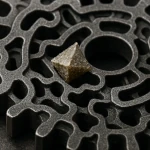
Illustration showing how a single toxic molecule (represented as a sharp-edged speck) lodging in the active site of a large enzymatic protein (represented as a complex gear) can stop its function and paralyze an entire organism.
Image source: astronoo.com (new window)
Scientific Summary
This article explains how an infinitesimal amount of matter can paralyze a giant organism. The answer lies in the hijacking of a fundamental biological mechanism: specific molecular recognition (Emil Fischer's "lock and key" model). A tiny molecule (toxin, poison) can perfectly mimic a natural "key" and bind to a biological "lock" (receptor, enzyme, ion channel) with formidable affinity, permanently blocking or activating an essential function. This domino effect illustrates that the scale of the cause often has no relation to the magnitude of the consequence.
How can the infinitely small bring down a giant organism?
The answer lies in hijacking a fundamental biological mechanism: specific molecular recognition (Emil Fischer's "lock and key" model). An infinitesimal molecule, a toxin or poison, can perfectly mimic the shape and electronic distribution of a natural "key". By inserting itself into a biological "lock" (receptor, enzyme, ion channel) with formidable affinity, it permanently blocks or activates an essential function, triggering a domino effect. Thus, botulinum toxin (1 ng/kg), cyanide (a few mg/kg), or tetrodotoxin (2 mg) paralyze vital functions, illustrating that the scale of the cause often bears no relation to the magnitude of the consequence.
Also worth exploring
Continue your exploration of the Universe with these topics:
The Hidden Fragility of Complex Biological Systems
A living organism is a complex and organized physicochemical system, maintained in a non-equilibrium steady state. This dynamic organization is stabilized by constant exchanges of free energy (thermodynamic potential measuring the energy available to do work at constant temperature and pressure). Its apparent stability relies on a dense network of feedback loops, energy exchanges, and matter flows. In this context, the introduction of a tiny chemical fragment can act as a true catastrophe trigger. When thousands of reactions are coupled, a local disturbance can propagate, amplify through a domino effect, and lead to a global breakdown of vital equilibrium.
N.B.:
The term non-equilibrium does not refer to an unstable or chaotic state.
It describes the steady state of open biological systems, where macroscopic properties remain stable despite continuous entropy production.
This state is maintained by permanent flows of free energy and matter; without these inputs, the system would spontaneously evolve toward thermodynamic equilibrium, where all functional organization disappears.
The Infinitely Small vs. the Immensely Large: The Paradox of Scale
Life, in its most advanced forms, is a structure of staggering complexity. A human being consists of approximately \( 30 \times 10^{12} \) cells, each containing billions of molecules organized with nanometric precision. Yet, this formidable machine can be brought to its knees, paralyzed, or destabilized by interaction with an infinitesimal amount of matter. How can a "chemical speck," a single molecule, or even an isolated atom, overwhelm a giant organism? This question, seemingly biological, finds its ultimate answer in the laws of atomic physics and quantum mechanics: it is the complementarity of electron clouds and the energy of molecular orbitals that determine whether a chemical fragment will bind to a biological target, disrupting essential functions in a cascade.
N.B.:
In a biological system, the concept of a critical threshold is central.
Below a certain concentration, a molecule is harmless.
Beyond it, the global dynamics shift, without direct proportion to the added quantity.
The Lock and Key Principle: A Hijacked Communication System
The power of the infinitesimal is explained by the hijacking of a fundamental biological mechanism: specific molecular recognition, conceptualized by Emil Fischer's (1852-1919) "lock and key" model. This principle is the cornerstone of cellular communication. The organism's proteins (receptors, enzymes, ion channels) have binding sites with unique electronic shapes, true "molecular locks." Only endogenous signaling molecules, the perfectly adapted "keys," can bind to them to trigger a precise response: opening a channel, activating an enzyme, modulating a gene. This is a hyper-efficient filtering system that allows the cell to exchange information and flows securely and in a coordinated manner.
Tragedy strikes when a "chemical speck" (a toxin, poison, or drug) perfectly mimics the shape and electronic distribution of a natural key. This "false key" then inserts itself into the lock with formidable affinity, locking the mechanism in a permanent "on" or "off" state. Although based on weak physical interactions (hydrogen bonds, Van der Waals forces, etc.), this hijacked bond is so specific that it can irreversibly paralyze an essential biological function. The most powerful weapon against a giant is to forge the key that opens (or forever closes) the door to its engine room.
N.B. on the fundamental mechanism:
Modern biology refines Fischer's model by speaking of stereo-electronic complementarity.
The relevant "shape" is that of electron clouds.
This precise quantum match, the result of billions of years of evolution, makes the system both incredibly reliable for the cell and tragically vulnerable to chemical hijacking.
Toxicity or therapeutic effect arises from this molecular identity theft.
Emblematic Examples of the Power of the Infinitely Small
Concrete examples perfectly illustrate the concept of dissipative structures (open systems maintained out of equilibrium by energy flows, capable of self-organization) theorized by Ilya Prigogine (1917-2003). The organism, as a dissipative structure, is stable only within a narrow range of conditions. Each example below shows how a "chemical speck" acts as an infinitesimal but precise "forcing," pushing a vital function outside its stability domain and causing a functional phase transition, often catastrophic.
| Agent / Molecule | Size / Tiny Quantity | Target in the Organism | Major Consequence & Mechanism |
|---|---|---|---|
| Botulinum toxin (type A) | ~1 nanogram per kg (estimated lethal dose) | SNARE proteins in motor nerve terminals | Flaccid paralysis. Blocks the release of the neurotransmitter acetylcholine. |
| Cyanide ion (CN⁻) | A few milligrams per kg | Cytochrome c oxidase (Complex IV of the mitochondrial respiratory chain) | Cellular asphyxiation. Blocks the terminal transfer of electrons, stopping ATP production. |
| Tetrodotoxin (TTX) (Pufferfish) | ~2 mg (total lethal dose) | Voltage-dependent sodium channels in neurons | Neurological paralysis. Physically blocks the channel, preventing action potential generation. |
| Digitoxin (Digitalis) | Narrow therapeutic dose (~0.1 mg/day) | Na⁺/K⁺ ATPase pump in cardiac cells | Modulation of cardiac force. Inhibits the pump, increasing intracellular calcium and contractility. |
| Ricin | A few micrograms per kg | 28S subunit of ribosomal RNA (in the cytosol) | Halt of protein synthesis. Depurinates a ribosomal RNA residue, inactivating the ribosome. |
| Carbon monoxide (CO) | 0.1% in air (prolonged exposure) | Heme of hemoglobin (O₂ binding site) | Severe hypoxia. Binds to heme with 200x greater affinity than oxygen, forming carboxyhemoglobin. |
| Imatinib (drug) | Therapeutic dose of ~400 mg/day | ATP site of BCR-ABL tyrosine kinase (mutated) | Remission of chronic myeloid leukemia. Competitively inhibits activation of the oncogenic enzyme. |
| Amanitin (Death cap mushroom) | ~0.1 mg/kg (lethal dose) | RNA polymerase II (transcription enzyme) | Liver failure. Blocks gene transcription, leading to programmed cell death (apoptosis). |
| Congenital malformation (e.g., Thalidomide) | Single dose during pregnancy | Cereblon protein (regulating limb development) | Phocomelia. Diverts the protein complex, causing aberrant degradation of growth factors. |
| Point mutation (e.g., sickle cell anemia) | Substitution of 1 nucleotide out of ~3 billion | HBB gene (encoding beta-globin) | Sickle cell anemia. Glutamate → Valine change, altering hemoglobin and red blood cell structure. |
- Sources: Journal of Pharmacology and Experimental Therapeutics, National Library of Medicine (NIH), European Medicines Agency (EMA), Clinical Toxicology.
Key Takeaway: The Fragility of Complexity
Life is a machine of extraordinary robustness and resilience, the result of billions of years of evolution. Yet, its very complexity makes it vulnerable to small, targeted disruptions. Understanding this principle reveals both the source of terrible poisons and the foundation of precision medicine. The "speck in the living machine" reminds us that in the living world, the scale of the cause often bears no relation to the magnitude of the consequence.
FAQ: Everything about the power of the infinitely small in living organisms
What is the "lock and key" model in biology?
Proposed by Emil Fischer (1852-1919), this model describes specific molecular recognition. Proteins in the body (receptors, enzymes) have binding sites (locks) with unique electronic shapes. Only endogenous signaling molecules (natural keys) can bind to trigger a precise response. A toxin or drug can act as a "false key" by perfectly mimicking the natural key, then locking the mechanism in a permanent "on" or "off" state.
Why can an infinitesimal amount of poison be lethal?
The main reason is the high affinity and specificity of toxic molecules for their biological targets. For example, cyanide (CN⁻) binds to Complex IV of the mitochondrial respiratory chain with very high affinity, blocking ATP (cellular energy) production. Botulinum toxin (1 ng/kg) targets SNARE proteins in nerve endings, preventing neurotransmitter release. Even a minuscule concentration can saturate essential targets and trigger a cascade of failures.
What is a "critical threshold" in a biological system?
A critical threshold is the concentration at which a molecule (toxic, drug) becomes dangerous or effective. Below this threshold, the body can detoxify, eliminate, or compensate for the disturbance without major consequence. Above it, regulatory mechanisms are overwhelmed, and the global dynamics abruptly tip over. It's a "all-or-nothing" notion: an infinitesimal additional amount can turn a stable state into catastrophe, with no direct proportionality to the added dose.
 From the Zeroth Law to Generative AI: Asimov's Laws in Question
  How do complex societies emerge and disappear?
  The Brain vs. AI: Chronicle of an Organ Overwhelmed by the Data Deluge
  AI has learned to think: will artificial consciousness learn to be?
  The Future Obsession: When prediction shapes the living
  Which Regions of the World Will Remain Habitable During the Next Ice Age?
  Rapid Evolution: Darwin’s Thunderbolt in the 21st Century
  Fatal Imbalance: The Unsuspected Power of the Infinitely Small
  The Great Filter of Evolution: The Key to the Fermi Paradox
  The Last Glacial Shock: The Younger Dryas and Its Impact on Prehistoric Societies
  Why Does the Sunflower Turn Toward the Sun? An Answer Through the Lagrangian
  World Population 2026: Demographic Trends by Continent
 Why Life Emerges from Imbalance and Dies at Thermodynamic Equilibrium
  The Electromagnetic Spectrum and Vision: What Our Eyes Perceive of Our Planet
  Self and Non-Self: A Simplified Physical Reading of Identity
  The Molecular Clock: From Random Mutations to Measuring Time
  The Minimal Cell: The Inevitable Emergence
  White Sands Footprints: America's First Steps
  Hominins: Appearance, Expansion, and Extinctions
  Declining Births: Demographic Catastrophe or Natural Evolution?
  Natural Selection vs. Chance: Why Evolution is Not a Lottery?
  What if Life Originated from Earth? A Revolution in the Theory of Panspermia
  The Great Bifurcation that will Disrupt Our World: Survival or Collapse?
  Primordial Chemistry: Where Do the First Organic Molecules Originate?
  CO and CO₂: Two Gases, Two Risks, Two Biological Mechanisms
  Spontaneous Synchronization: A Universal Phenomenon, from Physics to Life
  Time Challenge: How to Illustrate a Billion Years?
  The Three Essential Components for the Emergence of Life
  Why Did the Genus Homo Nearly Go Extinct 900,000 Years Ago?
  The First Step Towards the Emergence of Life
  The shadow biosphere
  Decline of anthropocentrism: when the cosmos relativizes our importance
  The horseshoe
crab, a living fossil!
The horseshoe
crab, a living fossil!  Origin of life
on Earth: Panspermia theory
Origin of life
on Earth: Panspermia theory  Origin of life on Earth: White smoker theory
  Why 37 degrees Celsius?
  Are We Alone in the Cosmos? Between Science and Speculation
  Traces
of Life in the Ice: The Emergence of Prehistoric Mammoths
Traces
of Life in the Ice: The Emergence of Prehistoric Mammoths  The Younger Dryas: The Mini Ice Age That Wiped Out the Megafauna
  The Two Great Ice Ages: Surviving in the Oceans of a Frozen Earth
  Regeneration in Animals Following Amputation: Organic Regrowth
  At the Limits
of Life: Mephisto, Worm of the Infernal Depths
At the Limits
of Life: Mephisto, Worm of the Infernal Depths  Discovery
of solid buckyballs in space
Discovery
of solid buckyballs in space  Human Walking:
The Origins of Bipedalism in Hominids
Human Walking:
The Origins of Bipedalism in Hominids  Karabo: A Window into Human Evolution
  Entropy: What
is Time?
Entropy: What
is Time?  The
passage between the inert and the living
The
passage between the inert and the living  The
Great Story of Complexity: From Elementary Particles to the First Organisms
The
Great Story of Complexity: From Elementary Particles to the First Organisms  Megapod uses
volcanic heat
Megapod uses
volcanic heat  Ardipithecus:
The 4.4-Million-Year-Old Ethiopian Hominid
Ardipithecus:
The 4.4-Million-Year-Old Ethiopian Hominid  Natural Selection: The Peppered Moth
  The Ordovician:
The Era of Corals, Trilobites, and Graptolites
The Ordovician:
The Era of Corals, Trilobites, and Graptolites  Liquid
Water, Much More Than a Solvent: A Catalyst for Chemical Reactions
Liquid
Water, Much More Than a Solvent: A Catalyst for Chemical Reactions  Neanderthal:
Humanity's Lost Cousin
Neanderthal:
Humanity's Lost Cousin  ASIMO: The First
Humanoid
ASIMO: The First
Humanoid  What conditions allowed the emergence of life?
  Fermi Paradox and Plato's Cave: Are We Alone or Blind?
  Tardigrades:
Indestructible Creatures That Defy the Laws of Biology
Tardigrades:
Indestructible Creatures That Defy the Laws of Biology  Toumaï: One
of the Oldest Known Hominins
Toumaï: One
of the Oldest Known Hominins  The
Tree of Life: Billions of Extinct Species and a Single Ancestral Community
The
Tree of Life: Billions of Extinct Species and a Single Ancestral Community  Life
in the Abyss: The Extreme Adaptation of Creatures
Life
in the Abyss: The Extreme Adaptation of Creatures  Cyanobacteria
and the Oxygen Crisis: A Primordial Ecological Catastrophe
Cyanobacteria
and the Oxygen Crisis: A Primordial Ecological Catastrophe  From
Matter to Life: The Blurred Frontier of Biological Emergence
From
Matter to Life: The Blurred Frontier of Biological Emergence  The Smallest Frog in the World: Physiological Secrets of a Microvertebrate
  The explanation of the Little Ice Age
  The Light of Life: A Biosignature Revealed by the Moon
  Living
Light: The Dazzling Secrets of Bioluminescence
Living
Light: The Dazzling Secrets of Bioluminescence  Beyond our senses, the great scientific revolutions
  The
Primordial Soup: Chemical Cradle of Terrestrial Life
The
Primordial Soup: Chemical Cradle of Terrestrial Life  World Population: From One Billion Humans to Demographic Saturation
  Ecology
and Collapse: The Case of Easter Island
Ecology
and Collapse: The Case of Easter Island  Fractals: Universally Self-Organized
Structures
Fractals: Universally Self-Organized
Structures