


536: The Year Without a Summer and the Beginning of the Late Antique Little Ice Age
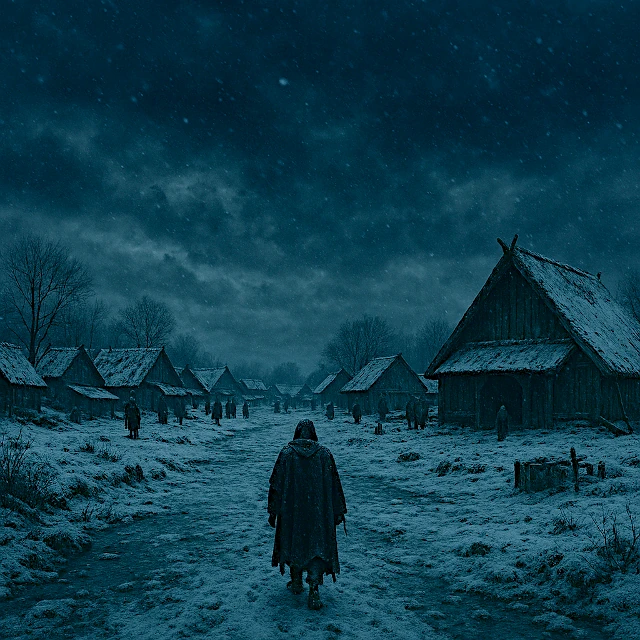
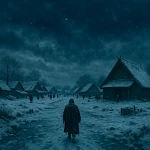
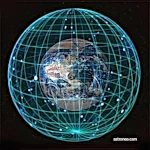
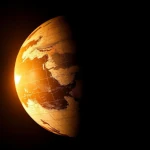
Illustration of the veil of dust and volcanic aerosols in the atmosphere, dimming the sun and plunging the northern hemisphere into prolonged twilight.
This "volcanic twilight," although lasting only a few years (about 3 years), initiated more than a century of climatic cooling.
Image source: astronoo.com (new window)
What was the Late Antique Little Ice Age and what event triggered it?
The year 536 CE marks a brutal climatic turning point. Chroniclers around the world describe a mysterious darkening of the Sun, whose light became "bluish" and whose heat no longer reached the Earth. This event, now identified as one of the largest volcanic eruptions of the last 2,000 years (likely in Iceland or North America), projected vast amounts of sulfur aerosols into the stratosphere, forming a global veil. It is considered the starting point of the Late Antique Little Ice Age (LALIA, ~536-660), a prolonged cooling period. The cascading consequences were dramatic: crop failures, massive famines, then the Plague of Justinian (541-542), weakening of the Byzantine Empire, and widespread political instability.
A catastrophic climatic event
The year 536 CE marks a brutal turning point in the climatic history of the northern hemisphere.
Chroniclers around the world, from Europe to China, describe a mysterious dimming (atmospheric phenomenon caused by the scattering of light by particles suspended in the air) of the sun, whose light appears "bluish" and whose heat no longer manages to warm the Earth.
That summer, snow fell in August in China, and crops were disastrous in Europe.
This singular event, now identified by scientists as one of the largest volcanic eruptions of the last 2000 years, is considered the starting point of the Late Antique Little Ice Age, a period of cooling that lasted more than a century (536–660).
Dendrochronology (science of dating and studying past climate variations through the analysis of tree rings (growth rings).) reveals in millennial trunks the indelible mark of the year 536: an exceptionally narrow ring, a climatic signature of a summer without warmth and a sky veiled by volcanic dust.
N.B.:
Research points to volcanoes located in the northern hemisphere (Iceland, North America, possibly Asia).
Aerosols injected into the stratosphere disperse mainly in the hemisphere of origin before slowly migrating to the other hemisphere.
The direct climatic impact (dimming, cooling) is therefore initially much stronger and more immediate in the hemisphere of origin.
Causes: Dust in the sky
Research in paleoclimatology (science that studies past climates, particularly through the analysis of ice cores) has identified the origin of this catastrophe.
Detailed analysis of ice cores from Greenland and Antarctica reveals an extremely high concentration of sulfates and volcanic ash precisely dating from 536.
Contrary to popular belief, it was not one, but probably two major super-eruptions, occurring a few years apart, that caused it.
The exact location of the volcano(es) remains debated, with likely candidates in Iceland or North America.
The explosion ejected immense quantities of sulfur aerosols (very fine solid or liquid particles suspended in the air) into the stratosphere (layer of the atmosphere located between 10 and 50 km altitude), forming a global veil that reflected part of the solar radiation back into space and caused global cooling.
N.B.:
Volcanic aerosols have a reflective power much greater than that of CO2.
Their cooling effect is powerful but relatively short (1 to 3 years), unlike the warming induced by greenhouse gases, which builds up over centuries.
Cascading historical consequences
The impacts of this climatic shock were profound and lasting.
- Agricultural crisis and famine: Cold and wet summers led to repeated poor harvests, causing massive famines that weakened populations.
- Epidemics: A general weakening of the population, combined with migrations, created favorable conditions for the spread of diseases. The Plague of Justinian, which broke out around 541-542, found fertile ground in this context and caused millions of deaths in the Byzantine Empire and beyond.
- Political and economic instability: The Eastern Roman (Byzantine) Empire was heavily affected, losing a crucial part of its workforce and tax resources. In Western Europe, this event exacerbated the difficulties of the post-Roman period.
- Migrations and cultural transformations: In Central Asia, cooling may have disrupted steppe ecosystems, contributing to the movements of nomadic populations.
N.B.:
The Plague of Justinian (the first historically documented bubonic plague pandemic, 541-542) was not directly caused by climatic cooling.
However, famines and population displacements induced by poor harvests created ideal sanitary and social conditions for the emergence and explosive spread of the bacterium Yersinia pestis.
The climatic shock thus acted as a risk multiplier, transforming a localized epidemic into a continental demographic catastrophe.
The Plague of Justinian persisted in recurrent waves for nearly two centuries (until around 750).
| Period (CE) | Climatic/historical event | Key indicator (ice cores) | Main impact |
|---|---|---|---|
| 536 | Major volcanic eruption, "dimming of the sun". | Extreme peak of sulfates, sulfuric acid. | Sudden cooling, poor summer, start of poor harvests. |
| 540 (approx.) | Probable second major eruption. | Second peak of sulfates in the cores. | Prolongation and worsening of cooling, absence of climatic recovery. |
| 541-542 | Emergence of the Plague of Justinian. | No direct signal, but established context. | Massive demographic decimation, weakening of the Byzantine Empire. |
| 536 - 660 (approx.) | Prolonged cooling period (LALIA). | Sustained high levels of sulfates. | Decline in agricultural yields, recurrent famines, social restructuring. |
Geopolitical consequences: Instability and conflicts
The 6th-century cooling is not the direct origin of conflicts, but an amplifying factor (factor that amplifies pre-existing vulnerabilities).
It exacerbates political tensions, territorial rivalries, and pre-existing social imbalances, transforming latent crises into geopolitical collapses for decades.
- Disorganization of economic networks: Poor harvests and declining craft production disrupted Mediterranean trade circuits. The scarcity of agricultural surpluses reduced long-distance trade, weakened cities, and diminished the ability of states to levy taxes and finance military efforts.
- Weakening of the Byzantine military: The demographic loss due to famines and plague significantly reduced the manpower and tax resources of the Byzantine Empire. This weakening limited its ability to resist Persian pressures on its eastern border and to contain Lombard expansion in Italy.
- Increased migratory pressures: Climatic deterioration in Central Asia may have reduced steppe ecosystems, pushing nomadic peoples like the Avars westward. Their movements and conflicts with established populations created a shockwave across Eastern Europe and the Balkans.
- Fragmentation and local wars: The scarcity of resources (food, productive lands) exacerbated tensions and power struggles within Germanic kingdoms and elsewhere, leading to local conflicts and chronic instability.
A precedent for modern climate change
The study of the Late Antique Little Ice Age offers a crucial perspective. It shows how quickly the Earth's climate system can shift following a major disruption, with consequences that far exceed the environmental realm to completely reshape human societies. In a world now facing rapid anthropogenic warming, this episode reminds us of the intrinsic vulnerability of civilizations to climatic upheavals. It also highlights the importance of natural archives, such as ice cores, for deciphering our past and better understanding the complex dynamics of the Earth system.
FAQ: Everything about the Late Antique Little Ice Age
How did scientists identify the 536 volcanic eruption?
Evidence comes mainly from the analysis of ice cores from Greenland and Antarctica. These cores reveal an extremely high peak of sulfates and volcanic ash dating precisely to 536. Dendrochronology (tree-ring study) confirms the impact: millennia-old trunks show an exceptionally narrow ring in 536, a signature of a summer without warmth and a sky veiled in dust. Contrary to popular belief, it was likely not one but two major super-eruptions (536 and ~540) that prolonged the cooling.
What is the link between the 536 eruption and the Plague of Justinian?
The cooling and darkening of 536-540 caused repeated crop failures and massive famines, severely weakening populations. This context of widespread malnutrition and population displacement created ideal sanitary and social conditions for the emergence and explosive spread of the bacterium Yersinia pestis. The climate shock did not directly cause the plague, but acted as a risk multiplier, turning a localized epidemic into a continent-wide demographic catastrophe. The Plague of Justinian broke out in 541-542 and persisted in recurrent waves until around 750.
What were the geopolitical consequences of this prolonged cooling?
The consequences were profound and lasting. The Byzantine Empire was heavily hit: the demographic loss due to famines and plague reduced its military manpower and fiscal resources, limiting its ability to resist Persian pressures and contain Lombard expansion in Italy. In Western Europe, the event exacerbated the difficulties of the post-Roman period. In Central Asia, the cooling disrupted steppe ecosystems, pushing nomadic peoples (like the Avars) westward, creating a shockwave across Eastern Europe and the Balkans. The scarcity of resources exacerbated tensions and power struggles, leading to chronic instability.
 From Black Basalt to Blue Oceans: Earth's Changing Palette
  Plate Tectonics: The Invisible Engine Moving the Continents
  The Number 360: The Mathematical Key to the Babylonian Sky
  Wet-Bulb Temperature: Humanity's Climate Time Bomb
  Why Doesn't Earth's Atmosphere Escape into Space?
  Origins of Earth: Magmatic Chaos and the Birth of the Solid World
  Earth's Atmosphere: The Invisible Shield Protecting Life
  The 5 Cosmic "End of the World" Scenarios (and Why They Won't Happen)
  Where does the water in the oceans come from? Three key stages
  From Carbon 14 to Uranium-Lead: The Science of Dating
  Major Natural Disasters: What Are the Most Likely Threats?
  The Boundary of Space: Where Does It Really Begin?
  536: The Year Without a Summer and the Beginning of the Late Antique Little Ice Age
  The leap second: scheduled end in 2035
  Planetary Alignments: A Fascinating but Relative Phenomenon
  All Deserts of the World
  Earth's Paleoclimates and Carbon Dioxide
  What is the effect of large lakes and water reservoirs on Earth's rotation?
  International Date Line
  Start Date of the Seasons: A Complex Celestial Mechanism
  Paleomagnetism: the magnetic memory of rocks
  3D Simulator: Revolutions of the Planets
  Geological Time and Mass Extinctions: From the Ordovician to the Cretaceous
  Earth History: Timeline Compressed into 24 Hours
  Earth's Water: An Extraterrestrial Origin?
  Reading the Sky: Understanding Declination and Right Ascension
  How is Earth's magnetic field born and why does it reverse?
  Earth's Magnetosphere: The Invisible Shield
  Fujita Scale: Classifying the Fury of Tornadoes
  Earth's Radioactivity: The Internal Energy of Our Planet
  The Deep Sea: Exploring the Deepest Ocean Trenches
  Why Are Days Getting Longer?
  The Depths of the Earth: From the Lithosphere to the Core
  Earth's Movements: How Earth Traces Its Spiral Through the Universe?
  How much is the sea level rising?
  The Life of Earth: Structure and Layers of the Earth
  The Eccentricity of Earth's Orbit: An Ellipse That Changes Everything
  Little Ice Age: The History of a Natural Climatic Cooling
  The Quest for Time: How Ancient Civilizations Used Astronomy?
  Van Allen Belt: A Rampart Against Cosmic Particles
  The Cosmos in Our Measure: When Man Invents the Universe
  What is the pendulum fixed relative to?
  Problem of longitude at sea
  World population, still gallopingin 2008
  The Oldest Image of Earth from Space
  Earth's Obliquity and Variations in Its Axis of Rotation
  The Astronomical Unit Fixed: A Length, No Longer an Orbit
  Water: one molecule, three states on Earth
  Simulator, the round of near-Earth cruisers
  Satellites that measure underwater relief
  Hadean's Hell
  The First Free Flight of an Astronaut in Space
  The first measurement of the Earth-Sun distance
  La The Announced End of the World on December 21, 2012: A Millennial Prophecy
 The Equinoxes: An Astronomical Event
 Milankovitch Cycles: The Astronomical Rhythm of Earth's Climate
 Why Is Earth So Often Cloudy?