


The carbon cycle: The harmonious interaction of oceans, forests and subsoils
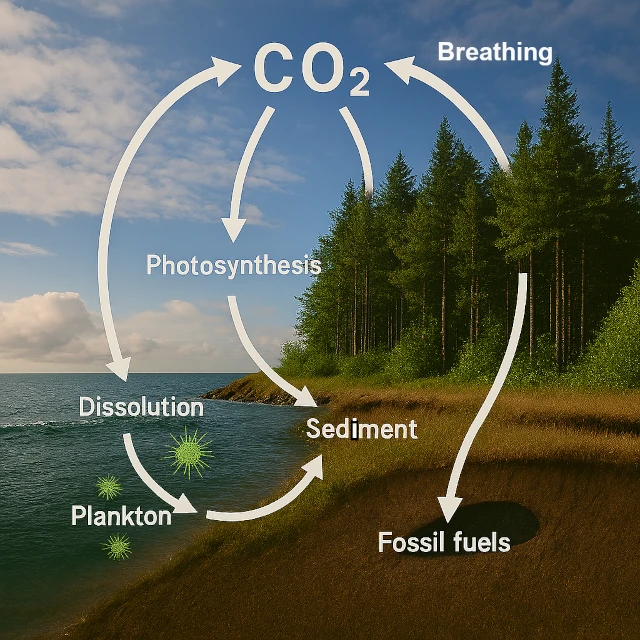
Illustration showing the exchanges of carbon (CO2) between the atmosphere, forests (via photosynthesis and respiration), the oceans (via dissolution and plankton), and deep reservoirs such as sediments and fossil fuels.
Image source: astronoo.com (new window), AI-generated image, public domain.
Scientific abstract
The carbon cycle is the set of physical, chemical and biological processes that ensure the circulation of carbon between the four main terrestrial reservoirs: the atmosphere (about 880 GtC), the biosphere (vegetation, soils, animals), the hydrosphere (oceans, about 38,000 GtC) and the lithosphere (rocks, sediments, fossil fuels, more than 60,000,000 GtC). It operates over a wide range of time scales (from rapid annual exchanges such as photosynthesis to slow processes spanning millions of years such as volcanic subduction). This superposition of fast and slow dynamics, including natural feedbacks (such as silicate weathering), naturally regulates Earth's climate and makes it a planetary thermostat.
What is the carbon cycle and how does it regulate Earth's climate?
The carbon cycle refers to the ceaseless circulation of carbon between the atmosphere, the oceans, the biosphere and the rocks. But how does this phenomenon regulate Earth's climate? The answer lies in a subtle balance between fast fluxes and slow geological processes. Annual exchanges, such as photosynthesis and oceanic dissolution, constantly redistribute tens of billions of tons of carbon. Meanwhile, millennial mechanisms such as silicate weathering and volcanism slowly adjust the atmospheric CO2 content. This dual dynamic gives the carbon cycle the role of a planetary thermostat, capable of damping climatic disturbances over long periods. Understanding this system is essential to assess the impact of human emissions on the climate.
Also worth exploring
Continue your exploration of the Universe with these topics:
Carbon: A structuring element of the Earth system
Carbon, the foundation of organic life
Carbon is much more than a simple chemical element (C, atomic number 6). It is the foundation of organic life and one of the main regulators of our planet's climate.
A major regulator of the planetary climate
Its perpetual journey between the great terrestrial reservoirs: the atmosphere, the hydrosphere (oceans), the biosphere (forests, soils) and the geosphere (subsoils), forms a system of remarkable complexity and harmony that directly influences the climate.
Evolution of the scientific understanding of the carbon cycle
The first experiments on CO2
The carbon cycle was progressively understood as a complex network of fluxes and stocks, linking biogeochemistry and climatology. The identification of CO2 (carbon dioxide) as a gas participating in exchanges between atmosphere, oceans and biosphere began with the experiments of Joseph Priestley (1733–1804) and Antoine Lavoisier (1743–1794), who demonstrated the role of plants in producing oxygen and absorbing CO2.
The discovery of the thermal effect of CO2
In the mid-19th century, Eunice Newton Foote (1819–1888) showed that CO2 absorbs solar heat, highlighting its role in the warming and thermal regulation of the atmosphere, a key element for understanding the carbon cycle.
The formalization of the cycle in the 20th century
Also in the 19th century, studies on animal respiration and organic decomposition showed that carbon could circulate between living organisms and the atmosphere. In the 20th century, the quantification of oceanic and terrestrial fluxes made it possible to formalize the carbon cycle, distinguishing fast reservoirs (biosphere, atmosphere, surface oceans) from slow ones (sediments, fossil fuels, lithosphere).
Modern climate models
Today, the use of climate models and isotopic measurements makes it possible to precisely track the transfer of carbon between reservoirs and to understand the impact of human activities on atmospheric CO2 (carbon dioxide) and global warming.
The carbon cycle: The different time scales
A circulation between four reservoirs
The carbon cycle is the set of physical, chemical and biological processes that ensure the circulation of carbon between the main reservoirs of the Earth: atmosphere, biosphere, hydrosphere and lithosphere.
Highly varied time scales
The carbon cycle operates on highly varied time scales: from rapid exchanges between the atmosphere, biosphere and surface oceans (years to decades) to slow transfers toward sediments and the lithosphere (thousands to millions of years). This superposition of fast and slow dynamics regulates Earth's climate and determines the response to natural or anthropogenic disturbances.
The table below presents the main carbon reservoirs, their stocks, the annual fluxes exchanged, the associated chemical transformations and the characteristic time scales.
| Source reservoir | Stored quantity (GtC) | Target reservoir | Process | Annual flux (GtC/yr) | Dominant transformation | Time scale |
|---|---|---|---|---|---|---|
| Atmosphere (CO2) | ≈ 880 | Plant biosphere | Photosynthesis | ≈ 120 | \( CO_2 + H_2O \xrightarrow{\text{solar energy}} CH_2O + O_2 \) (Reduction of mineral carbon into organic carbon) | Years |
| Plant biosphere | ≈ 450 to 650 | Animal biosphere | Transfer of organic carbon | ≈ 60 | \( CH_2O_{\text{plant}} \rightarrow CH_2O_{\text{animal}} + CO_2 \) | Years to decades |
| Biosphere (plant and animal) | ≈ 2,000 (including soils) | Atmosphere (CO2) | Respiration, decomposition | ≈ 120 | \( CH_2O + O_2 \rightarrow CO_2 + H_2O + \text{energy} \) (Biological oxidation of organic carbon) | Years |
| Atmosphere (CO2) | ≈ 880 | Surface oceans | Oceanic dissolution | ≈ 90 | \(CO_2 + H_2O \rightleftharpoons H_2CO_3 \rightleftharpoons H^+ + HCO_3^- \rightleftharpoons 2H^+ + CO_3^{2-}\) (CO2 / HCO3- / CO32- equilibria) | Months to centuries |
| Oceans (dissolved carbon) | ≈ 38,000 | Marine sediments | Biomineralization | ≈ 0.5 to 1 | \(Ca^{2+} + HCO_3^- \rightleftharpoons CaCO_3(s) + H^+\) (Formation of CaCO3 carbonates) | Centuries to millennia |
| Biosphere and sediments | ≈ 15,000 | Fossil fuels | Burial, diagenesis | ≈ 0.1 | \(CH_2O_{\text{organic matter}} \rightarrow C_{\text{fossil}} + H_2O + CO_2\) (Concentration and fossilization of carbon) | Millions of years |
| Fossil fuels | ≈ 4,000 | Atmosphere (CO2) | Combustion | ≈ 10 | \(C_6H_{12}O_6 (\text{fossil}) + 6\,O_2 \rightarrow 6\,CO_2 + 6\,H_2O\) (Rapid oxidation of fossil carbon) | Instantaneous to decades |
| Lithosphere (carbonate rocks) | >60,000,000 | Atmosphere (CO2) | Subduction, volcanism | ≈ 0.1 | \(CaCO_3(\text{sediment}) + \text{magma} \rightarrow CaO + CO_2(\text{volcanic})\) (Mantle degassing of carbon) | Millions of years |
The biosphere: carbon sink and source
Vegetation absorbs atmospheric CO2 through photosynthesis, but it also releases it through respiration and the decomposition of organic matter. Thus, the biosphere acts both as a carbon sink and source, with a net balance that depends on seasonal fluxes and ecological disturbances.
The geological thermostat: volcanic degassing and silicate weathering
Climatic equilibrium on a geological scale results from the feedback between volcanic degassing (which releases CO2 from lithospheric reservoirs) and silicate weathering (which captures atmospheric CO2). Warming accelerates weathering, reducing CO2 and cooling the climate. This mechanism links carbon stocks and fluxes and acts as a slow but effective planetary thermostat.
References
- NASA Earth Observatory - The Carbon Cycle (new window)
- NOAA - Carbon Cycle (new window)
- IPCC - Reports on climate change (new window)
- Encyclopædia Britannica - Carbon Cycle (new window)
- ChinaFLUX - Chinese flux observation network (new window)
- National greenhouse gas emission factor database (new window)
FAQ: Everything you need to know about the carbon cycle
What are the four main carbon reservoirs on Earth?
The four main reservoirs are: 1) the atmosphere (about 880 GtC, mainly in the form of CO2), 2) the biosphere (vegetation, soils, animals, about 450 to 2,000 GtC of organic carbon), 3) the hydrosphere (oceans, about 38,000 GtC of dissolved carbon), and 4) the lithosphere (carbonate rocks and fossil fuels, more than 60 million GtC). These reservoirs exchange carbon through processes such as photosynthesis, respiration, oceanic dissolution or volcanism.
What is the difference between the fast and the slow carbon cycle?
The fast cycle (years to decades) involves intense exchanges between the atmosphere, the biosphere (photosynthesis and respiration, ~120 GtC/yr) and surface oceans (dissolution, ~90 GtC/yr). The slow cycle (thousands to millions of years) concerns the transfer of carbon to marine sediments (biomineralization), burial and the formation of fossil fuels (diagenesis), as well as the return of lithospheric carbon to the atmosphere via volcanism and subduction.
How does the carbon cycle act as a planetary "thermostat"?
The carbon cycle has natural feedbacks that regulate the climate. A key mechanism is silicate weathering: climatic warming accelerates rock weathering, which captures atmospheric CO2. The decrease in CO2 then cools the climate. Conversely, volcanism releases lithospheric CO2, which can warm the planet. This negative feedback loop, acting over millions of years, maintains long-term climatic equilibrium.
What is the role of the oceans in the carbon cycle?
The oceans constitute the largest surface carbon reservoir on the planet. They absorb atmospheric CO2 through dissolution and through the biological activity of plankton. The dissolved carbon is then transported to the depths by thermohaline circulation and the biological pump, where it can be stored for centuries to millennia. This role as an oceanic sink slows the accumulation of CO2 in the atmosphere, but the growing acidification of the oceans threatens this equilibrium.
How do human activities disrupt the carbon cycle?
Human activities, particularly the combustion of fossil fuels and deforestation, inject into the atmosphere carbon that was once stored in the lithosphere and the biosphere. This rapid transfer, of about 10 GtC per year, far exceeds the capacity of natural sinks (oceans, forests) to reabsorb this surplus. The result is a continuous increase in the atmospheric concentration of CO2, which intensifies the greenhouse effect and disrupts the climatic equilibrium established over millions of years.
What is silicate weathering and what is its role in climate regulation?
Silicate weathering is a slow chemical process by which silicate rocks react with atmospheric CO2 and water to form carbonates. This mechanism consumes CO2 and traps it in mineral form. During periods of warming, weathering accelerates, which decreases atmospheric CO2 and gradually cools the climate. This phenomenon constitutes a major negative feedback that acts as a natural thermostat on geological time scales.
 The Paleocene-Eocene Transition: When Earth's Climate Suddenly Changed
  The Principle of Least Action: Why Does Nature Always Choose the Most Economical Path?
  Evolutionary Convergence: Chance, Necessity… or Mirage?
  The Five Mass Extinctions: What do these planetary catastrophes reveal?
  Cryosphere: when the ice giants still protect us
 The Nitrogen Cycle: From Air to Life
  The Jet Stream: When the Atmospheric River Overflows Its Banks
 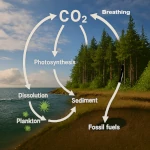 The Carbon Cycle: The Harmonious Interaction of Oceans, Forests, and Subsoils
  The Water Paradox: Without it, no life
  Why did alternating current prevail?
 Evolution of Global Energy Consumption: From Steam Engines to Digital Servers
  The Demographic Transition: Growth or Decline?
  Lake Agassiz: A Deluge that Changed the Climate
  Drunken Forests: Understanding the Phenomenon of Permafrost Thaw
  There is Electricity in the Air!
  Why Doesn't CO2 Fall to the Ground?
 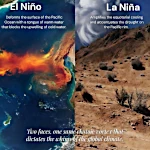 El Niño and La Niña: the two climatic phenomena of the Pacific
  Endangered Species: Dynamics of Extinction
  The Toxic Legacy of Acid Rain
  Major societal collapses: key periods and causes
 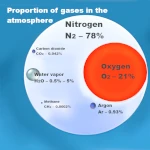 Global Warming in Figures: What the Scientific Data Says
  What is Sustainable Development?
  The Hottest Years Since Records Began
  Magnitude of upcoming climate change
  Earth in Crisis: Collapse or Renaissance?
  Ice on Borrowed Time: The Inexorable Decline of Arctic Sea Ice
  Earth's Water Reservoirs: From Oceans to Groundwater
  Sea Levels Are Rising, But How Fast?
  The Other Climate Threat: Earth Shrouded in Shadow and Humidity
  The Age of the Sahara: From Green Prairie to Stone Desert
  World Population from 1800 to 2100
  Oil: The Fall of a Giant in the Era of Renewable Energy
  Kamchatka King Crab: A Giant of the Oceans
  The collapse of a society
  Slight Progress in the Global Ecological Footprint
  The South Atlantic Anomaly
  The phenomenon of soil sinking is called subsidence
  The Planet's New Clouds