


The Last Glacial Jolt: the Younger Dryas and Its Consequences for Prehistoric Societies
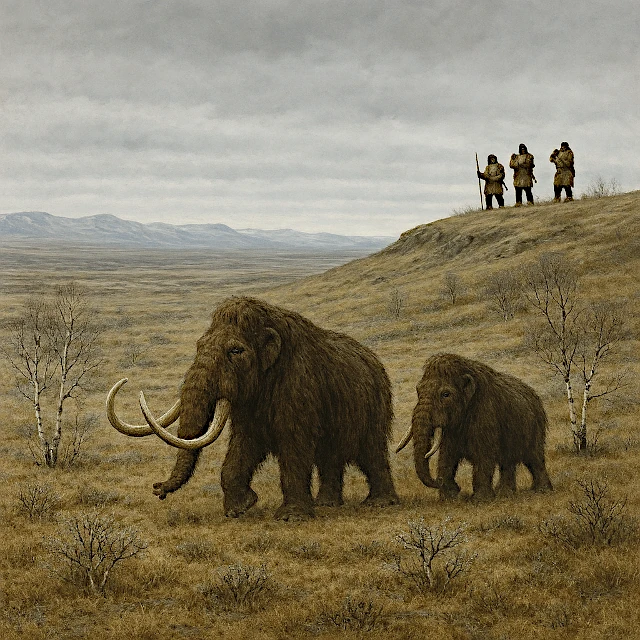
Scene illustrating a glacial landscape of the Younger Dryas, about 12,900 years ago. Two woolly mammoths cross the steppe, while in the distance, on a ridge, a small group of hunter-gatherers draped in skins watches the horizon. The cold, crystalline atmosphere conveys the harshness of the climate of that time.
Image source: astronoo.com (new window), AI-generated image, public domain.
Scientific Abstract
The article presents the Younger Dryas, an episode of brutal cooling that occurred about 12,900 years ago and lasted nearly 1,200 years. While the Earth had been warming since the last glaciation, temperatures dropped by 6°C to 10°C in Greenland within a few decades, bringing much of the Northern Hemisphere back to near-glacial conditions. The main cause is the shutdown of the thermohaline circulation (Gulf Stream) by a massive release of freshwater from melting ice sheets. Consequences: collapse of ecosystems, extinction of megafauna (mammoth, mastodon), and profound transformation of human societies, which had to diversify their diet, develop microlithic tools, and modify their social organization. The Younger Dryas demonstrates how quickly the climate can tip.
What is the Younger Dryas, and how did this brutal return of cold disrupt prehistoric societies?
The Younger Dryas is an episode of brutal cooling that occurred about 12,900 years ago and lasted nearly 1,200 years. While the Earth had been warming since the last glaciation, temperatures dropped by 6°C to 10°C in Greenland within a few decades, bringing much of the Northern Hemisphere back to near-glacial conditions. The main cause is the shutdown of the thermohaline circulation (Gulf Stream) by a massive release of freshwater from melting ice sheets. Consequences: collapse of ecosystems, extinction of megafauna (mammoth, mastodon), and profound transformation of human societies, which had to diversify their diet, develop microlithic tools, and modify their social organization. The Younger Dryas demonstrates how quickly the climate can tip.
Also worth exploring
Continue your exploration of the Universe with these topics:
The Unexpected Return of Cold
A Climate Tipping Point in a Few Decades
About 12,900 years ago, as the Earth was slowly emerging from the last great glacial period and temperatures had been trending toward warming for several millennia, a brutal climatic event occurred. Within a few decades, perhaps even less, much of the Northern Hemisphere plunged back into near-glacial conditions. This episode, known as the Younger Dryas (a cold and dry period, named after a mountain flower (Dryas octopetala) whose pollen becomes abundant in sediments from that time), lasted nearly 1,200 years, from ~12,900 to ~11,700 BCE. This "last jolt" of the Pleistocene profoundly reshaped ecosystems and confronted human societies of the late Paleolithic with one of the most formidable challenges in their history.
How Scientists Identify This Episode
N.B.:
The Younger Dryas is identified by paleoclimatologists through geological and biological indicators.
The most emblematic is the sudden increase in pollen from the Arctic-alpine flower Dryas octopetala in sediment cores, signaling a return to a cold, dry climate.
Other markers include changes in oxygen isotope ratios in Greenland ice cores and anomalies in dust and aerosol concentrations.
The Causes of Such a Sudden Cooling
The Shutdown of the Thermohaline Circulation
Scientists debate the precise mechanisms that triggered this abrupt return of cold. The dominant theory, known as the shutdown of the thermohaline circulation (massive and sudden input of freshwater into an ocean basin, disrupting deep ocean circulation), is supported by numerous lines of evidence. It suggests that the massive melting of the Laurentide and Fennoscandian ice sheets released enormous quantities of cold freshwater into the North Atlantic. This water, less dense than salt water, formed a surface layer, preventing the sinking of warmer salty waters coming from the south. This process shut down the oceanic "conveyor belt," the Gulf Stream (an ocean current that transports warm surface waters northward and cold deep waters southward, thereby warming Northern Europe) and its extensions, depriving Europe and North America of their source of heat.
The Cosmic Impact Hypothesis
Another hypothesis, more controversial but still discussed, is that of a cosmic impact (impact of an extraterrestrial body, such as a comet or asteroid, on the Earth's surface). Proponents of this theory point to the presence, in a thin layer of sediment dating to the beginning of the Younger Dryas, of anomalous concentrations of materials such as nanodiamonds, spherules, and iridium, as well as soot. They propose that one or more airbursts or ground impacts could have triggered massive continental fires, darkened the atmosphere, and precipitated the cooling. This hypothesis is often linked to the debate over the extinction of megafauna (large animals, generally over 45 kg, that disappeared at the end of the Pleistocene, such as the mammoth or the saber-toothed tiger).
The Impacts That Transformed the World ~12,000 Years Ago
A Cooling with Disproportionate Effects
The environmental consequences of the Younger Dryas were dramatic. In Europe, North America, and Asia, landscapes rapidly regressed with an expansion of tundra and cold steppe. Analyses of Greenland ice cores indicate that average temperatures dropped by about \(6^\circ C\) to \(10^\circ C\) within a few decades in that region, with significant cooling across the entire Northern Hemisphere.
Reconstructions based on pollen, beetles, and lake data suggest that the drop in mean annual temperatures in Europe during the Younger Dryas was on the order of \(2^\circ C\) to \(6^\circ C\), with regional variations. While these figures may seem modest on the scale of daily variation, their impact was exceptional and devastating on a climatic and ecological scale. An average drop of only \(4^\circ C\) is enough to:
- Shift climatic zones by several hundred kilometers southward, pushing back temperate forests in favor of tundra and cold steppe.
- Drastically shorten the plant growing season, reducing food availability for herbivores and, consequently, for human hunters.
- Cause a major re-advance of Alpine and Scandinavian glaciers, modifying landscapes and watercourses.
The "exceptional" character of the Younger Dryas therefore lies not in the absolute magnitude of the cooling, but in its speed (1 to 3 decades), its geographic extent (the entire Northern Hemisphere), and the depth of its systemic consequences (all ecosystems and societies).
This climatic deterioration dealt a fatal blow to many species of megafauna that were still surviving. The Younger Dryas coincides with the definitive disappearance of the woolly mammoth (in Eurasia), the American mastodon, the saber-toothed tiger, and the giant sloth in North America. While hunting by humans may have played a role, the rapid and radical change in their habitat and food resources was a decisive factor in their extinction.
Summary of the Impacts of the Younger Dryas
The table below summarizes the main impacts of the Younger Dryas on climate, vegetation, megafauna, and human societies.
| Domain | Change during the Younger Dryas | Main consequence | Archaeological / Geological evidence |
|---|---|---|---|
| Climate | Rapid cooling of \(6^\circ C\) to \(10^\circ C\) (Greenland), drier weather. | Return to near-glacial conditions in the Northern Hemisphere. | Isotope ratios in ice cores (GRIP, GISP2), Dryas pollen. |
| Vegetation | Retreat of forests, expansion of tundra-steppe and cold steppe. | Drastic reduction of edible plant resources and wood. | Pollen analyses in lakes and peat bogs. |
| Megafauna | Extreme pressures on giant herbivores (cold, food). | Final extinction of many species (mammoth, mastodon…). | Disappearance of fossils in later sedimentary layers. |
| Human societies | Scarcity of large game, fragmentation of groups, nutritional stress. | Technological adaptation (microliths), dietary diversification, migrations. | Change in tools (microlithic industry), increase in remains of small animals and fish. |
Adaptation and Survival: The Response of Prehistoric Societies
A Remarkable Resilience in the Face of Crisis
Faced with this ecological crisis of unprecedented magnitude, hunter-gatherer societies of the late Paleolithic underwent a period of profound transformation. The archaeological record, although sometimes fragmentary for this pivotal period, does not show generalized demographic collapse. On the contrary, it bears witness to a remarkable capacity for adaptation and resilience, which led to cultural innovations that were decisive for the later course of prehistory.
Adaptation Strategies of Prehistoric Societies
The following table presents the main adaptation strategies developed by prehistoric societies in response to the Younger Dryas.
| Domain of adaptation | Observable change | Function / Advantage | Key archaeological evidence |
|---|---|---|---|
| Dietary strategy (Diversification) | Transition from big-game hunting to a broader spectrum of resources. | Reduce dependence on a resource that had become rare and unstable; ensure food security. |
|
| Technology (Innovation) | Development and generalization of the microlithic industry(small knapped stone tools, often geometric). | Produce lighter, more efficient composite tools that save raw material: points for hunting small game, sickle armatures. |
|
| Social organization & Mobility | Reduction in group size, increased mobility, intensified networks. | Adapt to dispersed and seasonal resources; share information and risks over a larger territory. |
|
A Transition to the Holocene
The end of the Younger Dryas, around 11,700 BCE, with the rapid return of warmer conditions (the beginning of the Holocene), inaugurated a new era. The societies that had survived and adapted to the rigors of the Younger Dryas were now equipped, technologically and socially, to thrive in this new forested world.
A Legacy and a Lesson for the Present
A Demonstration of Climatic Fragility
The Younger Dryas is not merely a curious climatic episode of the past. It is a powerful demonstration of the speed with which the Earth's climate system can tip, and of the depth of the consequences this entails for the biosphere. For humanity, it represents one of the first and greatest documented environmental challenges.
References
FAQ: Everything you need to know about the Younger Dryas, the last glacial shudder
Why is this climatic episode called the "Younger Dryas"?
The name "Younger Dryas" comes from Dryas octopetala, a small Arctic-alpine flower. Paleoclimatologists observed in sediment cores a sudden increase in the pollen of this plant at the beginning of the episode, signaling a return to a cold and dry climate (Dryas octopetala is typical of cold environments). Other markers include changes in oxygen isotope ratios in Greenland ice cores and dust anomalies.
What is the most likely cause of the Younger Dryas?
The dominant theory is the shutdown of the thermohaline circulation. The massive melting of the Laurentide and Fennoscandian ice sheets released enormous quantities of cold freshwater into the North Atlantic. This water, less dense than salt water, formed a surface layer, preventing the sinking of warmer salty waters coming from the south. This shut down the oceanic "conveyor belt" (Gulf Stream), depriving Europe and North America of their source of heat. A more controversial hypothesis invokes a cosmic impact (meteorite) that triggered massive continental fires.
How did prehistoric societies survive this climatic upheaval?
Hunter-gatherer societies of the late Paleolithic showed a remarkable capacity for adaptation. They diversified their food sources (shifting from big game to small game, birds, fish, and plants). They developed a microlithic industry (small stone tools) that was lighter and more efficient, allowing the manufacture of composite tools for hunting small game or harvesting wild cereals. Finally, their social organization and mobility changed: reduction in group size, increased mobility, and intensified exchange networks over larger territories.
How long did the Younger Dryas last, and when did it end?
The Younger Dryas lasted about 1,200 years, from ~12,900 to ~11,700 BCE. It ended just as abruptly as it had begun: within a few decades, temperatures rose rapidly, marking the beginning of the Holocene, the current geological epoch. This rapid transition to a warmer and wetter climate allowed the expansion of forests and profoundly altered ecosystems and human ways of life.
Is the Younger Dryas responsible for the extinction of the megafauna?
The Younger Dryas played a major role in the extinction of Pleistocene megafauna. By brutally altering habitats and reducing food resources, it dealt a fatal blow to already weakened species such as the woolly mammoth, the mastodon, and the saber-toothed tiger. Hunting by humans probably worsened the situation, but rapid climate change remains the determining factor in the disappearance of these large herbivores and their predators.
Could such an event happen again today?
The Younger Dryas shows that the Earth's climate system can tip rapidly when subjected to major disturbances. Today, anthropogenic global warming could, according to some scenarios, weaken the thermohaline circulation (AMOC) due to the massive input of freshwater from the melting of Greenland. Even though current conditions differ from those of the Younger Dryas, this episode reminds us of the sensitivity and non-linearity of the climate, and of the importance of monitoring potential tipping points.
 From the Zeroth Law to Generative AI: Asimov's Laws in Question
  How do complex societies emerge and disappear?
  The Brain vs. AI: Chronicle of an Organ Overwhelmed by the Data Deluge
  AI has learned to think: will artificial consciousness learn to be?
  The Future Obsession: When prediction shapes the living
  Which Regions of the World Will Remain Habitable During the Next Ice Age?
  Rapid Evolution: Darwin’s Thunderbolt in the 21st Century
  Fatal Imbalance: The Unsuspected Power of the Infinitely Small
  The Great Filter of Evolution: The Key to the Fermi Paradox
  The Last Glacial Shock: The Younger Dryas and Its Impact on Prehistoric Societies
  Why Does the Sunflower Turn Toward the Sun? An Answer Through the Lagrangian
  World Population 2026: Demographic Trends by Continent
 Why Life Emerges from Imbalance and Dies at Thermodynamic Equilibrium
  The Electromagnetic Spectrum and Vision: What Our Eyes Perceive of Our Planet
  Self and Non-Self: A Simplified Physical Reading of Identity
  The Molecular Clock: From Random Mutations to Measuring Time
  The Minimal Cell: The Inevitable Emergence
  White Sands Footprints: America's First Steps
  Hominins: Appearance, Expansion, and Extinctions
  Declining Births: Demographic Catastrophe or Natural Evolution?
  Natural Selection vs. Chance: Why Evolution is Not a Lottery?
  What if Life Originated from Earth? A Revolution in the Theory of Panspermia
  The Great Bifurcation that will Disrupt Our World: Survival or Collapse?
  Primordial Chemistry: Where Do the First Organic Molecules Originate?
  CO and CO₂: Two Gases, Two Risks, Two Biological Mechanisms
  Spontaneous Synchronization: A Universal Phenomenon, from Physics to Life
  Time Challenge: How to Illustrate a Billion Years?
  The Three Essential Components for the Emergence of Life
  Why Did the Genus Homo Nearly Go Extinct 900,000 Years Ago?
  The First Step Towards the Emergence of Life
  The shadow biosphere
  Decline of anthropocentrism: when the cosmos relativizes our importance
  The horseshoe
crab, a living fossil!
The horseshoe
crab, a living fossil!  Origin of life
on Earth: Panspermia theory
Origin of life
on Earth: Panspermia theory  Origin of life on Earth: White smoker theory
  Why 37 degrees Celsius?
  Are We Alone in the Cosmos? Between Science and Speculation
  Traces
of Life in the Ice: The Emergence of Prehistoric Mammoths
Traces
of Life in the Ice: The Emergence of Prehistoric Mammoths  The Younger Dryas: The Mini Ice Age That Wiped Out the Megafauna
  The Two Great Ice Ages: Surviving in the Oceans of a Frozen Earth
  Regeneration in Animals Following Amputation: Organic Regrowth
  At the Limits
of Life: Mephisto, Worm of the Infernal Depths
At the Limits
of Life: Mephisto, Worm of the Infernal Depths  Discovery
of solid buckyballs in space
Discovery
of solid buckyballs in space  Human Walking:
The Origins of Bipedalism in Hominids
Human Walking:
The Origins of Bipedalism in Hominids  Karabo: A Window into Human Evolution
  Entropy: What
is Time?
Entropy: What
is Time?  The
passage between the inert and the living
The
passage between the inert and the living  The
Great Story of Complexity: From Elementary Particles to the First Organisms
The
Great Story of Complexity: From Elementary Particles to the First Organisms  Megapod uses
volcanic heat
Megapod uses
volcanic heat  Ardipithecus:
The 4.4-Million-Year-Old Ethiopian Hominid
Ardipithecus:
The 4.4-Million-Year-Old Ethiopian Hominid  Natural Selection: The Peppered Moth
  The Ordovician:
The Era of Corals, Trilobites, and Graptolites
The Ordovician:
The Era of Corals, Trilobites, and Graptolites  Liquid
Water, Much More Than a Solvent: A Catalyst for Chemical Reactions
Liquid
Water, Much More Than a Solvent: A Catalyst for Chemical Reactions  Neanderthal:
Humanity's Lost Cousin
Neanderthal:
Humanity's Lost Cousin  ASIMO: The First
Humanoid
ASIMO: The First
Humanoid  What conditions allowed the emergence of life?
  Fermi Paradox and Plato's Cave: Are We Alone or Blind?
  Tardigrades:
Indestructible Creatures That Defy the Laws of Biology
Tardigrades:
Indestructible Creatures That Defy the Laws of Biology  Toumaï: One
of the Oldest Known Hominins
Toumaï: One
of the Oldest Known Hominins  The
Tree of Life: Billions of Extinct Species and a Single Ancestral Community
The
Tree of Life: Billions of Extinct Species and a Single Ancestral Community  Life
in the Abyss: The Extreme Adaptation of Creatures
Life
in the Abyss: The Extreme Adaptation of Creatures  Cyanobacteria
and the Oxygen Crisis: A Primordial Ecological Catastrophe
Cyanobacteria
and the Oxygen Crisis: A Primordial Ecological Catastrophe  From
Matter to Life: The Blurred Frontier of Biological Emergence
From
Matter to Life: The Blurred Frontier of Biological Emergence  The Smallest Frog in the World: Physiological Secrets of a Microvertebrate
  The explanation of the Little Ice Age
  The Light of Life: A Biosignature Revealed by the Moon
  Living
Light: The Dazzling Secrets of Bioluminescence
Living
Light: The Dazzling Secrets of Bioluminescence  Beyond our senses, the great scientific revolutions
  The
Primordial Soup: Chemical Cradle of Terrestrial Life
The
Primordial Soup: Chemical Cradle of Terrestrial Life  World Population: From One Billion Humans to Demographic Saturation
  Ecology
and Collapse: The Case of Easter Island
Ecology
and Collapse: The Case of Easter Island  Fractals: Universally Self-Organized
Structures
Fractals: Universally Self-Organized
Structures