


The Jet Stream: When the Atmospheric River Overflows Its Banks
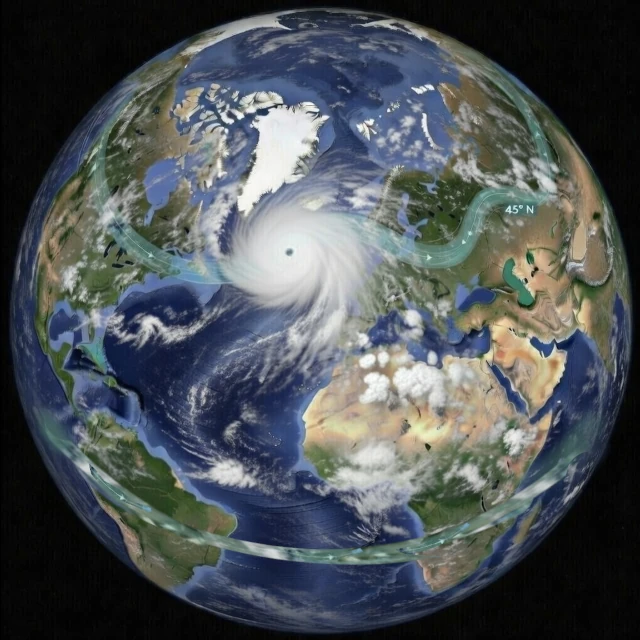
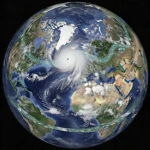
Satellite visualization of the jet stream (in blue and white) meandering above the Atlantic Ocean, with a low-pressure system clinging to its meanders.
The jet stream generally flows from west to east in both hemispheres, under the effect of the Coriolis force linked to the Earth's rotation.
Image source: astronoo.com (new window) — AI-generated image, public domain.
Scientific Summary
The jet stream is a fast-moving air current (150-320 km/h) circulating at high altitude, generated by the thermal contrast between cold polar air and warm subtropical air. The hypothesis of a weakening jet stream linked to Arctic amplification (warming ~4 times faster in the Arctic), popularized from 2012 onwards, remains debated in the scientific community: several recent studies (2023-2025) do not find a long-term trend towards a more sinuous jet. What is better established, however, is the link between persistent atmospheric blockings and recent extreme events: European heatwaves (2019, 2022, 2023, 2025, 2026), floods in Germany (2021) and Pakistan (2022), or cold spells linked to disturbances of the stratospheric polar vortex (Texas 2021, Europe winter 2025-2026).
Why does the jet stream deform, and what are the consequences?
The jet stream deforms under the effect of several mechanisms still debated by climatologists. The most publicized hypothesis links Arctic amplification — the nearly four times faster warming of the Arctic — to a weakening of the thermal contrast with mid-latitudes, which would make the jet slower and more sinuous. Recent studies, however, qualify this cause-and-effect link. What remains firmly established is that when the jet's meanders (Rossby waves) synchronize and stagnate, they create persistent atmospheric blockings. These blockings are responsible for extreme weather events such as European heatwaves (2019, 2023, 2025, 2026), devastating floods (Germany 2021, Pakistan 2022) or intense cold spells linked to the polar vortex (Texas 2021, Europe 2025-2026).
Also worth exploring
Continue your exploration of the Universe with these topics:
The Great Atmospheric River
The jet stream is a fast air current (150 to 320 km/h outside exceptions) circulating at high altitude (between 8 and 12 kilometers) around the Northern Hemisphere. It is a veritable frontier generated by the thermal contrast between cold polar air and warm subtropical air. This flow is a powerful engine of the climate machine. Its position and strength directly influence the trajectory of low-pressure systems and the distribution of surface temperatures. Since the beginning of the 21st century, several extreme weather events have been associated with unusual jet stream behavior, which has sparked a lively scientific debate about the evolution of its behavior.
The jet stream in the Northern Hemisphere meanders naturally
It does not follow a perfectly zonal straight line (parallel to the equator). It forms meanders (undulations) called Rossby waves (planetary waves) that snake southward (troughs) and northward (ridges). This sinuosity has always existed: the scientific question under debate concerns a possible increase in its amplitude with global warming.
The jet stream in the Southern Hemisphere
Because there are fewer continental landmasses to disturb its flow, the Southern Hemisphere jet stream is often more powerful, more regular and straighter than its northern counterpart. It swirls around Antarctica and helps isolate the frozen continent.
A link with global warming still debated
The Arctic amplification hypothesis
From 2012 onwards, climatologists Jennifer Francis and Stephen Vavrus proposed a mechanism that has become influential: Arctic amplification (faster warming of the Arctic compared to the rest of the planet, with the Arctic warming nearly four times faster than the global average) would reduce the thermal contrast between the North Pole and mid-latitudes. The very engine of the jet stream would be weakened, making it more sinuous, slower and more likely to become blocked over a region for several days or weeks.
Recent studies that qualify this mechanism
This hypothesis, long presented as settled in the media, does not achieve consensus among researchers. A study from the University of Exeter (2023, Blackport and Screen) found no long-term trend towards a more sinuous jet despite the observed Arctic amplification. An in-depth modeling study published in Weather and Climate Dynamics (2025) concludes that future Arctic sea ice loss would have only a minimal influence on the morphology of the North Atlantic jet stream. A Dartmouth University study (2025) on North American winter storms shows that the recent sinuosity of the jet remains comparable to that observed before Arctic amplification, suggesting that other mechanisms (a warmer atmosphere retaining more moisture, for example) would better explain the intensification of storms.
What remains solid despite the debate
This debate concerns the cause of a possible long-term trend, not the existence of the blockings themselves. Whether or not the jet becomes structurally more sinuous due to warming, persistent atmospheric blockings remain a well-documented meteorological phenomenon, whose consequences on extreme events are, for their part, largely established.
How do atmospheric blockings form?
A complex and synchronized wave system
Far from being a single wave, the jet stream resembles an atmospheric channel in which several undulations coexist, evolving independently. These meanders can occasionally synchronize their phases and combine with other Rossby waves (large-scale atmospheric waves linked to the Earth's rotation). The jet's speed sometimes determines the appearance of quasi-stationary resonances, freezing these undulatory configurations. It is this dynamic synchronization that transforms a normal fluctuation into a lasting weather event.
Weather systems that remain blocked
This slowdown has a major consequence: weather systems (anticyclones or low-pressure systems) remain blocked longer over the same regions. This explains the persistence of certain extreme phenomena, such as the historic heatwave in Europe in 2019 or the devastating floods in Germany in 2021. Climatologist Michael E. Mann (born 1965) proposed that these atmospheric blocking situations be reinforced by a phenomenon of planetary wave resonance: the jet stream's meanders enter into phase, slow their propagation and lead to an abnormal persistence of weather regimes.
The role of the stratospheric polar vortex
Another actor, distinct from the jet stream but interacting with it, is the stratospheric polar vortex. When it is strong and compact, it keeps the coldest air around the Arctic. When it weakens or splits in two — a phenomenon called sudden stratospheric warming — the westerly winds at altitude slow down, or even reverse, and this disturbance can propagate downward and reorganize the jet stream, favoring descents of Arctic air towards temperate latitudes. It is this mechanism that was closely monitored by meteorological services during the winter of 2025-2026, marked by an early stratospheric warming as early as November 2025.
Visible consequences and extreme events
The influence of atmospheric blockings is not limited to a few heatwaves or a few episodes of intense rainfall. It manifests as a cascade of effects across the entire Northern Hemisphere.
| Event | Year | Region | Mechanism involved |
|---|---|---|---|
| Russian heatwave and fires | 2010 | Western Russia | Blocking of an anticyclone by a persistent meander (stationary Rossby waves) |
| Pakistan floods | 2010 / 2022 | South Asia | Interaction between an abnormally sinuous jet and the monsoon |
| California drought and fires | 2012-2015 | Western United States | Persistent anticyclonic ridge ("Ridiculously Resilient Ridge") blocking precipitation |
| Floods in Germany and Belgium | 2021 | Western Europe | Omega block trapping rainy low-pressure systems for several days |
| "Texas Freeze" cold spell | 2021 | Southern United States | Sudden stratospheric warming and deep plunge of the polar vortex |
| Canadian heat dome | 2021 | British Columbia | Omega block creating extreme adiabatic compression (49.6°C at Lytton) |
| Historic drought in Europe | 2022 | Western and Central Europe | Subtropical anticyclone abnormally rising northward with a weakened jet |
| Multiple heatwaves in Europe | 2023 | Mediterranean basin | Successive heatwaves linked to amplified meanders of the jet |
| Storm Boris | 2024 | Central Europe | Omega block trapping a low-pressure system with torrential rainfall |
| Prolonged heatwaves | 2025 | Europe (Portugal, United Kingdom in particular) | Successive anticyclonic blockings from April to September |
| Prolonged summer heatwaves | 2026 | Europe (record number of heatwave days) | Sequence of persistent anticyclonic blockings over several months |
| Early disturbance of the polar vortex | 2025-2026 | Europe and North America | Sudden stratospheric warming as early as November 2025, marked contrasts between mildness in Western Europe and extreme cold in Siberia |
How do forecasters monitor these phenomena?
Indices and seasonal models
Meteorological services continuously monitor the state of the stratospheric polar vortex (strength of westerly winds at altitude), the extent of Arctic sea ice and climate indices such as El Niño or La Niña, which can favor the propagation of atmospheric waves towards the stratosphere and help destabilize the vortex. Seasonal models from major centers such as the ECMWF make it possible to anticipate, several weeks in advance, an increased risk of vortex disturbance, without however guaranteeing the occurrence or the precise location of a cold spell.
Predictability limited to a few weeks
Even with these tools, the detailed predictability of an atmospheric blocking remains limited to about two to three weeks. Signals such as sudden stratospheric warming give a probable trend (increased risk of cold or persistent heat over a region), but the exact intensity and location remain uncertain until a few days before the event.
References
- NOAA Climate (formerly Climate.gov) (new window)
- World Weather Attribution (new window)
- World Meteorological Organization (new window)
- Anderson, Perez, Maycock (2025). Minimal influence of future Arctic sea ice loss on North Atlantic jet stream morphology. Weather and Climate Dynamics 6, 595-608 (new window)
- Dartmouth College (2025). Study: Winter Jet Stream Was Erratic Before Climate Change (new window)
- University of Exeter (2023). Pioneering New Research Disputes "Wavier" Jet Stream Due to Arctic Warming (new window)
- 2026 European heatwaves — summary of the 2026 European heatwaves (new window)
FAQ: Everything you need to know about the jet stream and its disruption
What exactly is the jet stream?
The jet stream is a fast air current circulating at high altitude (between 8 and 12 km), with typical speeds of 150 to 320 km/h. It is generated by the thermal contrast between cold polar air and warm subtropical air. It is a veritable "atmospheric highway" that directly influences the trajectory of low-pressure systems and the distribution of surface temperatures.
Does global warming really make the jet stream more sinuous?
It is debated. The Arctic amplification hypothesis proposes that the faster warming of the Arctic reduces the thermal contrast with mid-latitudes and weakens the jet, making it more sinuous. But several recent studies (2023-2025), based on meteorological records dating back to the early 20th century and on climate modeling, do not find a long-term trend towards a more sinuous jet. The scientific debate remains open, while the very existence of atmospheric blockings is well established.
What is the link between an atmospheric blocking and extreme weather events?
When the jet stream's meanders (Rossby waves) synchronize and stagnate, they can create persistent atmospheric blockings (such as an omega block). These blockings freeze weather systems (anticyclones or low-pressure systems) over the same regions for several days or weeks, causing heatwaves, droughts, floods or unusually long and intense cold spells.
What is the difference between the jet stream and the polar vortex?
They are two distinct but linked phenomena. The jet stream circulates at low altitude (8-12 km, in the troposphere) and directly influences weather at the surface. The stratospheric polar vortex circulates much higher (about 30 km, in the stratosphere) above the Arctic in winter. When the polar vortex weakens or splits (sudden stratospheric warming), the disturbance can propagate downward and reorganize the jet stream, favoring cold spells at temperate latitudes.
 The Paleocene-Eocene Transition: When Earth's Climate Suddenly Changed
  The Principle of Least Action: Why Does Nature Always Choose the Most Economical Path?
  Evolutionary Convergence: Chance, Necessity… or Mirage?
  The Five Mass Extinctions: What do these planetary catastrophes reveal?
  Cryosphere: when the ice giants still protect us
 The Nitrogen Cycle: From Air to Life
  The Jet Stream: When the Atmospheric River Overflows Its Banks
  The Carbon Cycle: The Harmonious Interaction of Oceans, Forests, and Subsoils
  The Water Paradox: Without it, no life
  Why did alternating current prevail?
 Evolution of Global Energy Consumption: From Steam Engines to Digital Servers
  The Demographic Transition: Growth or Decline?
  Lake Agassiz: A Deluge that Changed the Climate
  Drunken Forests: Understanding the Phenomenon of Permafrost Thaw
  There is Electricity in the Air!
  Why Doesn't CO2 Fall to the Ground?
  El Niño and La Niña: the two climatic phenomena of the Pacific
  Endangered Species: Dynamics of Extinction
  The Toxic Legacy of Acid Rain
  Major societal collapses: key periods and causes
  Global Warming in Figures: What the Scientific Data Says
  What is Sustainable Development?
  The Hottest Years Since Records Began
  Magnitude of upcoming climate change
  Earth in Crisis: Collapse or Renaissance?
  Ice on Borrowed Time: The Inexorable Decline of Arctic Sea Ice
  Earth's Water Reservoirs: From Oceans to Groundwater
  Sea Levels Are Rising, But How Fast?
  The Other Climate Threat: Earth Shrouded in Shadow and Humidity
  The Age of the Sahara: From Green Prairie to Stone Desert
 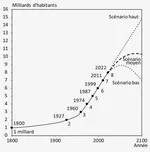 World Population from 1800 to 2100
  Oil: The Fall of a Giant in the Era of Renewable Energy
  Kamchatka King Crab: A Giant of the Oceans
  The collapse of a society
  Slight Progress in the Global Ecological Footprint
  The South Atlantic Anomaly
  The phenomenon of soil sinking is called subsidence
  The Planet's New Clouds