


Why did alternating current prevail?
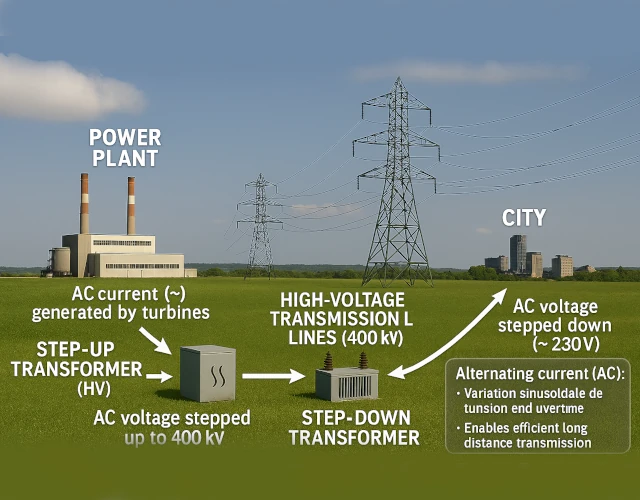
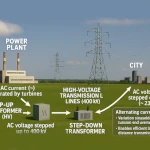
Schematic electrical grid, with a power plant, a step-up transformer, high-voltage lines and a step-down transformer supplying a city.
Image source: astronoo.com (new window) - AI-generated image, public domain.
Scientific summary
The article explains why alternating current (220 V) prevailed in our sockets rather than direct current. The fundamental reason is its ability to use the transformer, which allows the voltage to be raised or lowered very efficiently. To transport electricity over long distances with acceptable losses, a very high voltage (e.g., 400 kV) and a low current intensity are required, because Joule losses are proportional to I²×R. Direct current could not easily change voltage at the time of electrification (late 19th century). The "War of the Currents" was won by Tesla and Westinghouse (alternating current) against Edison (direct current). Today, direct current is returning in specific niches (HVDC links, electronics), but alternating current remains the backbone of global electrical grids.
Why is 220 V alternating current in our sockets rather than direct current?
Alternating current prevailed in our electrical grids mainly thanks to its ability to use the transformer, a device that allows the voltage to be raised or lowered very efficiently. However, to transport electricity over long distances (hundreds of kilometers) with acceptable losses, a very high voltage (e.g., 400 kV) and a low current intensity are required (Joule losses in I²×R). Direct current could not easily change voltage at the time of electrification (late 19th century). The "War of the Currents" was won by Nikola Tesla and George Westinghouse (alternating current) against Thomas Edison (direct current). Today, direct current is returning in specific niches (HVDC links, electronics), but alternating current remains the backbone of our grids.
Also worth exploring
Continue your exploration of the Universe with these topics:
Direct current vs alternating current
Historical context of electrification
At the beginning of electrification, in the second half of the 19th century, the electric current (ordered flow of electrical charges) used in urban networks was mainly direct current. The first installations of generators (conversion of mechanical energy into electrical energy) directly powered lamps and motors located nearby. Voltages were low, distances short and losses acceptable.
Limitations of direct current
With the rapid increase in demand for light, motive power and later household appliances, it became necessary to transport energy over tens, then hundreds of kilometers. Direct current then ran into a simple physical limit: to transport a lot of power without excessive losses, the voltage must be increased and the intensity reduced.
Synthesis between alternating current and direct current
Two complementary forms
The electric current (ordered flow of electrical charges) exists in two complementary forms: alternating current and direct current. The first varies periodically, while the second maintains a constant polarity. However, in modern systems, these two forms are not opposed: direct current is very often obtained by rectifying an alternating current.
Production and transport
Alternating current is generated directly by an alternator (electromechanical generator producing a periodic voltage), whose rotation creates a sinusoidal voltage. This form of energy is ideal for high-voltage transport, because it is easily transformed thanks to the transformer (electromagnetic device modifying an alternating voltage).
Rectification and power electronics
Direct current, historically produced by dynamos, today comes mainly from the rectification of an alternating current. Power electronics (set of components converting AC to DC) allows an alternating voltage to be converted into a stable direct voltage, used in batteries, electronics, storage systems and HVDC links (High Voltage Direct Current). Thus, modern direct current is not an independent form, but a transformation of alternating current.
Why high voltage is essential
Relationship between power, voltage and intensity
The electrical power transported is written \(P = U \times I\), where \(P\) is the power, \(U\) the voltage and \(I\) the intensity. For a given power, if the voltage is doubled, the intensity can be halved. However, the Joule losses in the lines are proportional to \(I^{2} \times R\), with \(R\) the resistance of the cables. Reducing the intensity is therefore the most effective way to limit losses over long distances.
Joule losses
In practice, this leads to using very high voltages for transport, then lowering these voltages as close as possible to the places of consumption. This is precisely what alternating current allows, thanks to a key device of electrical engineering: the transformer (electromagnetic device allowing an alternating voltage to be modified).
Realistic numerical example: power of a nuclear reactor
Let us consider an electrical power of \(P = 1\ \text{GW}\), an order of magnitude of the power supplied by a nuclear reactor. Suppose this power must be transported over \(100\ \text{km}\) by a line whose equivalent resistance (round trip) is \(R = 3\ \Omega\), which corresponds to about \(0{,}03\ \Omega/\text{km}\). Let us compare transport at \(50\ \text{kV}\) and at \(400\ \text{kV}\), which is part of current standards.
1) Transport at 50 kV
The required intensity is:
\(I = \frac{P}{U} = \frac{1\ \text{GW}}{50\ \text{kV}} = 20\ 000\ \text{A}\).
The Joule losses are then:
\(P_{\text{losses}} = I^{2} \times R = (20\ 000)^{2} \times 3 = 1{,}2 \times 10^{9}\ \text{W}\).
The losses reach about 1.2 GW in the form of heat, which means that much more than 1 GW would have to be supplied at the input of the line to deliver 1 GW at the other end.
At such a low voltage, transport therefore becomes totally inefficient.
2) Transport at 400 kV
The intensity becomes:
\(I = \frac{1\ \text{GW}}{400\ \text{kV}} = 2\ 500\ \text{A}\).
The associated losses are:
\(P_{\text{losses}} = (2\ 500)^{2} \times 3 = 18{,}75 \times 10^{6}\ \text{W}\).
Only about 18.75 MW are lost,
or less than 2% of the transported power.
Assessment
By going from \(50\ \text{kV}\) to \(400\ \text{kV}\), the voltage is multiplied by 8, the intensity is divided by 8 and the losses are divided by \(8^{2} = 64\). With a realistic line resistance, we see that very high voltage is essential to transport the power of a nuclear reactor with acceptable losses.
The decisive role of the transformer
Principle of operation
A transformer works only with an alternating current. It relies on the temporal variation of the magnetic flux in an iron circuit, which induces a voltage in a secondary winding when a primary winding is supplied. By adjusting the number of turns of each winding, the voltage is raised or lowered very efficiently.
Structuring of grids
This property made possible the level structure of modern grids: production at medium voltage, raising to very high voltage for transport, then progressive lowering down to domestic voltages. Without a transformer, each voltage level would have required specific machines and complex conversions. Alternating current therefore established itself as the simplest and most robust solution for an extended grid.
The War of the Currents
Edison against Tesla and Westinghouse
The famous "War of the Currents" pitted Thomas Edison (1847-1931), a supporter of direct current, against Nikola Tesla (1856-1943) and George Westinghouse (1846-1914), defenders of alternating current. Edison had already invested in direct current distribution networks and feared seeing his economic model called into question. Tesla, for his part, had designed polyphase systems particularly suited to alternating current.
Buffalo demonstration
The spectacular demonstrations of long-distance transport, such as the supply of the city of Buffalo from Niagara Falls at the end of the 19th century, showed the practical superiority of alternating current for large powers. Power plants could be installed where the primary energy was available, then electricity transported to urban centers with limited losses.
Technical advantages of alternating current: The problem of distance
Transformation and asynchronous motors
Alternating current has several major advantages for a large-scale grid. First, the possibility of easily transforming the voltage makes it possible to optimize each section of the grid according to the distance and the power to be transported. Then, rotating machines, such as asynchronous motors (machines converting electrical energy into mechanical energy), are simple, robust and inexpensive when supplied with alternating current.
Synchronization and reliability
Moreover, the synchronization of several generators on the same grid is facilitated by the periodic nature of alternating current. Large continental interconnections rely on this property of synchronism. Finally, the measurement and protection of lines are historically simpler with alternating quantities, which has contributed to the overall reliability of grids.
Why direct current is making a comeback
HVDC links
Direct current has not disappeared for all that. With the rise of power electronics, it has become possible to efficiently convert alternating current into direct current and vice versa. Very high voltage direct current links, called HVDC (High Voltage Direct Current), are now used to connect remote grids or to transport large powers under water.
Specialized niches
In these applications, direct current offers advantages such as the reduction of certain losses and the absence of synchronization problems between grids. However, these systems always rely on a predominantly alternating current environment, in which production, distribution and most uses remain alternating. The historical choice of alternating current therefore continues to structure the overall architecture of our grids.
A compromise between physics, economics and history
Legacy of standards
The success of alternating current is not only a question of physics. It also results from a compromise between the technologies available at the end of the 19th century, infrastructure costs and the industrial choices of the pioneers of electricity. Once the first large alternating grids were built, standardization effects reinforced this initial choice.
Current perspective
Even today, the 50 Hz frequency in Europe and 60 Hz in North America is a legacy of these historical decisions. Changing paradigm would involve modifying billions of devices and millions of kilometers of lines. Alternating current therefore remains the backbone of our electrical civilization, while direct current occupies specialized niches where its particular qualities are put to use.
Comparison between alternating current and direct current
The following table summarizes the main technical and historical differences between alternating current and direct current.
| Characteristic | Alternating current | Direct current | Comment |
|---|---|---|---|
| Voltage transformation | Easy with a transformer | Long difficult, requires power electronics | Key point for long-distance transport |
| Line losses | Reduced thanks to high voltage | Reduced in HVDC over very long distances | Both solutions are now complementary |
| Rotating machines | Simple and robust asynchronous motors | More complex or specific motors | Historical advantage for industry |
| Grid interconnection | Synchronization required | Allows connecting non-synchronous grids | HVDC used as a "bridge" between systems |
| Typical uses | Public distribution, industry, housing | Long links, electronics, storage | Hybrid AC + DC architecture |
References
- International Energy Agency: definitions of alternating current, direct current and HVDC transmission (new window)
- CIGRE: studies on HVDC links (new window)
- CIGRE: High Voltage Direct Current Transmission (new window)
- U.S. Department of Energy: The War of the Currents (new window)
- MIT School of Engineering: What's the Difference Between AC and DC? (new window)
- Encyclopaedia Britannica: Alternating Current (new window)
- Encyclopaedia Britannica: Transformer (new window)
FAQ: Everything about alternating current vs direct current
Why is high voltage essential for transporting electricity over long distances?
The electrical power transported is written P = U × I. For a given power, the higher the voltage (U), the lower the intensity (I). The Joule losses in the cables are proportional to I² × R (where R is the resistance). By reducing the intensity, the losses are divided by the square of the reduction. For example, transporting 1 GW at 50 kV generates 1.2 GW of losses (inefficient), whereas at 400 kV the losses fall to less than 2%. This is why very high voltages (400 kV, 800 kV) are used for long-distance lines.
What is the decisive role of the transformer in the victory of alternating current?
The transformer is a device that allows the voltage of an alternating current to be modified very easily and with excellent efficiency. By adjusting the number of turns of the primary and secondary windings, the voltage can be raised for long-distance transport (in order to reduce losses), then lowered progressively down to domestic voltages (220 V or 110 V). Direct current cannot use a transformer; at the time of electrification (late 19th century), there was no efficient means of changing its voltage. This is the fundamental technical reason that tipped the grids towards alternating current.
Has direct current completely disappeared from modern electrical grids?
No, direct current has not disappeared, but it occupies specific niches. Thanks to modern power electronics (rectifiers, inverters), it is now possible to efficiently convert alternating current into direct current and vice versa. Direct current is used in HVDC links (High Voltage Direct Current) to transport very large powers over very long distances (submarine, interconnections between non-synchronous grids). It is also present in electronics, batteries, energy storage and embedded applications. However, the backbone of public distribution grids remains alternating current.
What is the "War of the Currents"?
The War of the Currents refers to the industrial and technical rivalry of the late 19th century between the supporters of direct current, led by Thomas Edison, and those of alternating current, represented by Nikola Tesla and George Westinghouse. Edison defended a local direct current network, while Tesla and Westinghouse promoted alternating current, easier to transport over long distances thanks to the transformer. The victory of alternating current materialized in large-scale installations, such as the supply of Buffalo from Niagara Falls.
Is alternating current more dangerous than direct current?
The danger depends mainly on the voltage, the intensity and the duration of contact, more than on the type of current. At comparable voltage and intensity, alternating current can cause different physiological effects, in particular muscle contractions and risks of cardiac fibrillation. Direct current also presents risks, in particular during electric arcs or prolonged contacts. In domestic grids, safety standards and protection devices (circuit breakers, residual current devices) are adapted to alternating current to limit these dangers.
Why is the frequency 50 Hz in Europe and 60 Hz in North America?
The frequency of electrical grids results from historical and industrial choices. In Europe, 50 Hz prevailed under the influence of pioneers such as Werner von Siemens and the progressive standardization of grids. In North America, 60 Hz was adopted notably thanks to the work of Nikola Tesla and George Westinghouse, then generalized by the major equipment manufacturers. These two frequencies are now regional standards: changing them would require modifying billions of devices and entire infrastructures.
 The Paleocene-Eocene Transition: When Earth's Climate Suddenly Changed
  The Principle of Least Action: Why Does Nature Always Choose the Most Economical Path?
  Evolutionary Convergence: Chance, Necessity… or Mirage?
  The Five Mass Extinctions: What do these planetary catastrophes reveal?
  Cryosphere: when the ice giants still protect us
 The Nitrogen Cycle: From Air to Life
  The Jet Stream: When the Atmospheric River Overflows Its Banks
  The Carbon Cycle: The Harmonious Interaction of Oceans, Forests, and Subsoils
  The Water Paradox: Without it, no life
  Why did alternating current prevail?
 Evolution of Global Energy Consumption: From Steam Engines to Digital Servers
  The Demographic Transition: Growth or Decline?
  Lake Agassiz: A Deluge that Changed the Climate
  Drunken Forests: Understanding the Phenomenon of Permafrost Thaw
  There is Electricity in the Air!
  Why Doesn't CO2 Fall to the Ground?
  El Niño and La Niña: the two climatic phenomena of the Pacific
  Endangered Species: Dynamics of Extinction
  The Toxic Legacy of Acid Rain
  Major societal collapses: key periods and causes
  Global Warming in Figures: What the Scientific Data Says
  What is Sustainable Development?
  The Hottest Years Since Records Began
  Magnitude of upcoming climate change
  Earth in Crisis: Collapse or Renaissance?
  Ice on Borrowed Time: The Inexorable Decline of Arctic Sea Ice
  Earth's Water Reservoirs: From Oceans to Groundwater
  Sea Levels Are Rising, But How Fast?
  The Other Climate Threat: Earth Shrouded in Shadow and Humidity
  The Age of the Sahara: From Green Prairie to Stone Desert
  World Population from 1800 to 2100
  Oil: The Fall of a Giant in the Era of Renewable Energy
  Kamchatka King Crab: A Giant of the Oceans
  The collapse of a society
  Slight Progress in the Global Ecological Footprint
  The South Atlantic Anomaly
  The phenomenon of soil sinking is called subsidence
  The Planet's New Clouds