


The Minimal Cell: Inevitable Emergence
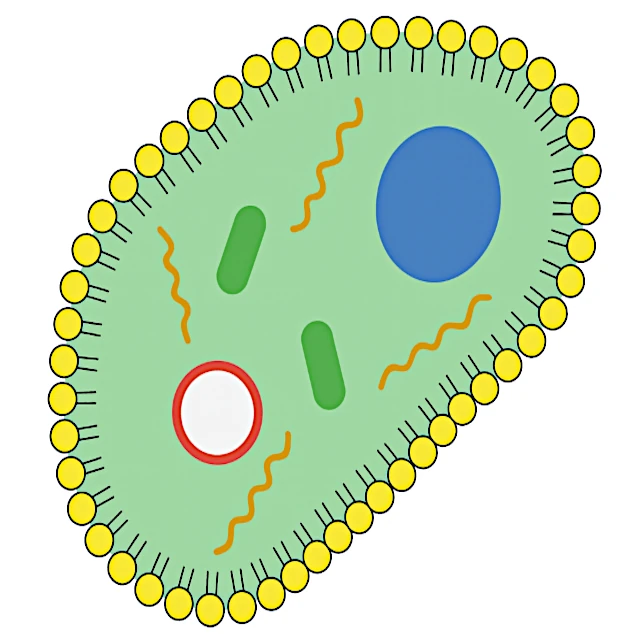
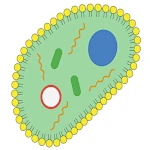
Representation of a protocell formed by electrostatic self-assembly.
This minimal cell shows a lipid membrane (yellow hydrophilic heads and black hydrophobic tails), a primitive nucleus (blue), RNA molecules (orange), ribosomes (green) assembling amino acids and an internal vesicle (white) with a membrane (red) transporting proteins.
Image source: astronoo.com (new window) — AI-generated image, public domain.
Scientific summary
The article proposes an understanding of the emergence of life as a phase transition of matter subjected to an energy flow. The hierarchical process leads from atoms to organic molecules, then to replicative macromolecules (RNA) through structural complementarity. Simultaneously, phospholipids self-assemble into membranes. The minimal protocell then brings together the three essential characteristics of life: metabolism, transmissible information (RNA) and compartmentalization (membrane), allowing Darwinian evolution.
How can a minimal cell spontaneously emerge from inert molecules?
Life can be understood as a phase transition of matter subjected to an energy flow, emerging when specific physicochemical conditions are met. The process follows a hierarchy: atoms assemble into organic molecules (amino acids, sugars, lipids, RNA bases), which organize into replicative macromolecules (RNA) through structural complementarity (electrostatic attraction, alignment, pairing, separation). These molecules, in competition in a non-equilibrium environment, are selected by their replication speed. In parallel, phospholipids spontaneously self-assemble into membranes (lipid bilayers) to form a compartment. The minimal protocell then brings together the three essential characteristics of life: metabolism, transmissible information (RNA) and compartmentalization (membrane). Darwinian evolution can then fully operate.
Also worth exploring
Continue your exploration of the Universe with these topics:
The question of the origin of life has always fascinated humanity
What if life was neither the result of contingency nor of finality, but the expression of a phase transition of matter subjected to an energy flow?
How, from inert molecules, could life have emerged on Earth ~3.8 billion years ago? This question can be approached from a modern angle by examining the principle of the minimal cell (the smallest biological entity capable of autonomous reproduction). It is a matter of determining what is the most elementary organizational form capable of maintaining a regulated internal state against environmental variations and of reproducing autonomously.
Modern cells: staggering diversity and complexity
The modern cell constitutes the fundamental unit of all living organisms (bacteria, archaea, eukaryotes). However, even the simplest cells are already molecular cathedrals of staggering complexity.
In humans, the body is estimated to contain about 37 trillion cells, divided into more than 200 different cell types. Each cell type has specific morphological and biochemical characteristics adapted to its biological functions.
The role of deep time and environmental diversity
The primitive Earth offered a gigantic natural experiment: trillions of chemical reactions carried out simultaneously continued for hundreds of millions of years. Every warm pond, every hydrothermal fissure, every porous mineral or clay grain formed a miniature laboratory where organic molecules could gather. Constantly stirred by natural cycles over long periods, these molecules gradually followed the chemical pathways leading to the building blocks of life: amino acids, sugars, lipids and RNA bases.
N.B.:
Although debates on the origin of life remain lively, there is consensus on one point: amino acids, which form proteins, are essential molecular building blocks for any living organism.
Moreover, their natural formation is possible in space since they have been found in meteorites.
This suggests that amino acids were probably available on the primitive Earth.
From atoms to macromolecules
Perpetual agitation
Atoms are in constant motion due to thermal agitation (average kinetic energy related to temperature), which causes slight displacements and vibrations within molecules. Weak chemical bonds, such as hydrogen bonds and van der Waals interactions (attractive or repulsive forces), hold atoms together in primitive carbon-based molecules. Carbon, with its 4 stable covalent bonds, is the perfect element for building molecular assemblies.
Infinite diversity
The random vibrations of molecules, behaving like tiny electric magnets, allow chemical structures to simultaneously explore different spatial conformations (three-dimensional arrangements of atoms in space). New molecular shapes are continuously created, thus increasing the chances of stable arrangements. This diversity constitutes a virtually unlimited reservoir of molecular shapes, from which only electromagnetically stable structures will persist long enough to be subjected to natural selection.
From macromolecules to replicative macromolecules
The physical mechanism of self-replication
Certain molecular configurations will allow natural self-replication which is based on a simple principle: structural complementarity.
Formation of a complementary strand
A macromolecule (single strand folded into a 3D shape) acts as a mold whose shape and electrical charges precisely attract certain free chemical elements present around it. These free elements align along the strand according to their chemical compatibility to form a second distinct complementary strand (like a photographic negative). One then obtains a two-stranded structure paired together, assembled piece by piece from the surrounding components.
Breaking and continuity of the cycle
The two strands held together by hydrogen bonds eventually break naturally, under the effect of the thermal agitation of the medium. This energy balance is crucial because sufficient agitation is needed to allow encounters and separations, but not too much to preserve the integrity of the assembled structures (warm ponds, hydrothermal vents, etc.). This complementary macromolecule can itself serve as a mold to recreate the initial sequence.
Spontaneous emergence of replication
Through this purely physicochemical mechanism (attraction → alignment → pairing → separation → restitution of the initial sequence) it becomes possible to understand how RNA macromolecules capable of self-replication could have spontaneously emerged on the primitive Earth.
From replicative macromolecules to the minimal cell
Competition and selection of replicative molecules
The system becomes autocatalytic (capable of accelerating its own reproduction): some RNA molecules replicate faster than others, recruiting free nucleotides (A, G, C, U) more efficiently. Small errors and variations create new forms, with different copying speeds and stabilities. The fastest and most stable molecules proliferate, the less efficient ones disappear. This selection is natural and results directly from the laws of chemical kinetics in a non-equilibrium system, that is to say agitated and fed by a constant flow of matter.
Spontaneous formation of the membrane compartment
The transition from replicative molecules to a true cell requires the appearance of a membrane compartment (lipid envelope separating the interior from the exterior). Biological membranes are composed of phospholipids (lipids composed of a polar hydrophilic head and two hydrophobic fatty acid chains), amphiphilic (molecules having both a hydrophilic and a hydrophobic part) molecules that spontaneously organize into bilayers in aqueous medium. This self-assembly is natural: it is thermodynamically favorable and occurs without any external intervention, much like a soap bubble that forms spontaneously on the surface of water.
Emergence of the minimal protocell
A protocell protected by a lipid membrane and containing self-replicating RNA molecules possesses the essential characteristics of a minimal living organism. It has a metabolism (production of its own internal components), a reproductive capacity (cell division) and a transmissible information support (RNA). From this stage, Darwinian evolution can fully operate, favoring the protocells most efficient at growing and dividing in their environment.
References
- Nature Chemistry - Self-reproduction of supramolecular giant vesicles combined with DNA amplification (new window)
- NCBI PMC - The RNA World Hypothesis and the Origin of Life (new window)
- Science - Design and synthesis of a minimal bacterial genome (new window)
- MDPI Life - Self-Assembly of Amphiphiles and Prebiotic Compartmentalization (new window)
- PNAS - Darwinian evolution and growth of primitive protocells (new window)
- Nature Reviews Microbiology - The origin and early evolution of cellular life (new window)
- National Museum of Natural History - Origin and evolution of life (new window)
- Astronoo.com - Source of the original article (new window)
FAQ: Everything you need to know about the minimal cell and the emergence of life
What is the "minimal cell" and how does it differ from modern cells?
The minimal cell is a theoretical concept that defines the most elementary form of organization capable of maintaining a regulated internal state and reproducing autonomously. It brings together three essential characteristics: a metabolism, transmissible information (RNA) and a compartment (membrane). Modern cells, even the simplest ones, are "molecular cathedrals" of staggering complexity, with thousands of genes and sophisticated regulatory systems, far from the simplicity of the primitive protocell.
How could RNA macromolecules spontaneously replicate on the primitive Earth?
Spontaneous replication is based on the principle of structural complementarity. An RNA macromolecule (single strand) acts as a mold: its shape and electrical charges precisely attract free nucleotides (A, G, C, U) which align by chemical compatibility. A second complementary strand forms, then the two strands separate naturally under the effect of thermal agitation. Each strand can then serve as a mold to recreate the initial sequence. This cycle (attraction → alignment → pairing → separation) is a purely physicochemical mechanism.
Why is the formation of a membrane a crucial step towards the living cell?
A membrane allows compartmentalization, that is to say the creation of a protected internal environment distinct from the external medium. Without a membrane, replicative molecules disperse, making it impossible to concentrate reagents. Phospholipids, amphiphilic molecules, spontaneously self-assemble into bilayers in aqueous medium, forming a permeable barrier. A protocell protected by a membrane containing replicative RNA molecules then possesses the three essential characteristics of life, allowing Darwinian evolution to fully operate.
 From the Zeroth Law to Generative AI: Asimov's Laws in Question
  How do complex societies emerge and disappear?
  The Brain vs. AI: Chronicle of an Organ Overwhelmed by the Data Deluge
  AI has learned to think: will artificial consciousness learn to be?
  The Future Obsession: When prediction shapes the living
  Which Regions of the World Will Remain Habitable During the Next Ice Age?
  Rapid Evolution: Darwin’s Thunderbolt in the 21st Century
  Fatal Imbalance: The Unsuspected Power of the Infinitely Small
  The Great Filter of Evolution: The Key to the Fermi Paradox
  The Last Glacial Shock: The Younger Dryas and Its Impact on Prehistoric Societies
  Why Does the Sunflower Turn Toward the Sun? An Answer Through the Lagrangian
  World Population 2026: Demographic Trends by Continent
 Why Life Emerges from Imbalance and Dies at Thermodynamic Equilibrium
  The Electromagnetic Spectrum and Vision: What Our Eyes Perceive of Our Planet
  Self and Non-Self: A Simplified Physical Reading of Identity
  The Molecular Clock: From Random Mutations to Measuring Time
  The Minimal Cell: The Inevitable Emergence
  White Sands Footprints: America's First Steps
  Hominins: Appearance, Expansion, and Extinctions
  Declining Births: Demographic Catastrophe or Natural Evolution?
  Natural Selection vs. Chance: Why Evolution is Not a Lottery?
  What if Life Originated from Earth? A Revolution in the Theory of Panspermia
  The Great Bifurcation that will Disrupt Our World: Survival or Collapse?
  Primordial Chemistry: Where Do the First Organic Molecules Originate?
  CO and CO₂: Two Gases, Two Risks, Two Biological Mechanisms
  Spontaneous Synchronization: A Universal Phenomenon, from Physics to Life
  Time Challenge: How to Illustrate a Billion Years?
  The Three Essential Components for the Emergence of Life
  Why Did the Genus Homo Nearly Go Extinct 900,000 Years Ago?
  The First Step Towards the Emergence of Life
  The shadow biosphere
  Decline of anthropocentrism: when the cosmos relativizes our importance
  The horseshoe
crab, a living fossil!
The horseshoe
crab, a living fossil!  Origin of life
on Earth: Panspermia theory
Origin of life
on Earth: Panspermia theory  Origin of life on Earth: White smoker theory
  Why 37 degrees Celsius?
  Are We Alone in the Cosmos? Between Science and Speculation
  Traces
of Life in the Ice: The Emergence of Prehistoric Mammoths
Traces
of Life in the Ice: The Emergence of Prehistoric Mammoths  The Younger Dryas: The Mini Ice Age That Wiped Out the Megafauna
  The Two Great Ice Ages: Surviving in the Oceans of a Frozen Earth
  Regeneration in Animals Following Amputation: Organic Regrowth
  At the Limits
of Life: Mephisto, Worm of the Infernal Depths
At the Limits
of Life: Mephisto, Worm of the Infernal Depths  Discovery
of solid buckyballs in space
Discovery
of solid buckyballs in space  Human Walking:
The Origins of Bipedalism in Hominids
Human Walking:
The Origins of Bipedalism in Hominids  Karabo: A Window into Human Evolution
  Entropy: What
is Time?
Entropy: What
is Time?  The
passage between the inert and the living
The
passage between the inert and the living  The
Great Story of Complexity: From Elementary Particles to the First Organisms
The
Great Story of Complexity: From Elementary Particles to the First Organisms  Megapod uses
volcanic heat
Megapod uses
volcanic heat  Ardipithecus:
The 4.4-Million-Year-Old Ethiopian Hominid
Ardipithecus:
The 4.4-Million-Year-Old Ethiopian Hominid  Natural Selection: The Peppered Moth
  The Ordovician:
The Era of Corals, Trilobites, and Graptolites
The Ordovician:
The Era of Corals, Trilobites, and Graptolites  Liquid
Water, Much More Than a Solvent: A Catalyst for Chemical Reactions
Liquid
Water, Much More Than a Solvent: A Catalyst for Chemical Reactions  Neanderthal:
Humanity's Lost Cousin
Neanderthal:
Humanity's Lost Cousin  ASIMO: The First
Humanoid
ASIMO: The First
Humanoid  What conditions allowed the emergence of life?
  Fermi Paradox and Plato's Cave: Are We Alone or Blind?
  Tardigrades:
Indestructible Creatures That Defy the Laws of Biology
Tardigrades:
Indestructible Creatures That Defy the Laws of Biology  Toumaï: One
of the Oldest Known Hominins
Toumaï: One
of the Oldest Known Hominins  The
Tree of Life: Billions of Extinct Species and a Single Ancestral Community
The
Tree of Life: Billions of Extinct Species and a Single Ancestral Community  Life
in the Abyss: The Extreme Adaptation of Creatures
Life
in the Abyss: The Extreme Adaptation of Creatures  Cyanobacteria
and the Oxygen Crisis: A Primordial Ecological Catastrophe
Cyanobacteria
and the Oxygen Crisis: A Primordial Ecological Catastrophe  From
Matter to Life: The Blurred Frontier of Biological Emergence
From
Matter to Life: The Blurred Frontier of Biological Emergence  The Smallest Frog in the World: Physiological Secrets of a Microvertebrate
  The explanation of the Little Ice Age
  The Light of Life: A Biosignature Revealed by the Moon
  Living
Light: The Dazzling Secrets of Bioluminescence
Living
Light: The Dazzling Secrets of Bioluminescence  Beyond our senses, the great scientific revolutions
  The
Primordial Soup: Chemical Cradle of Terrestrial Life
The
Primordial Soup: Chemical Cradle of Terrestrial Life  World Population: From One Billion Humans to Demographic Saturation
  Ecology
and Collapse: The Case of Easter Island
Ecology
and Collapse: The Case of Easter Island  Fractals: Universally Self-Organized
Structures
Fractals: Universally Self-Organized
Structures