


From the Zeroth Law to Generative AI: Asimov's Laws in Question
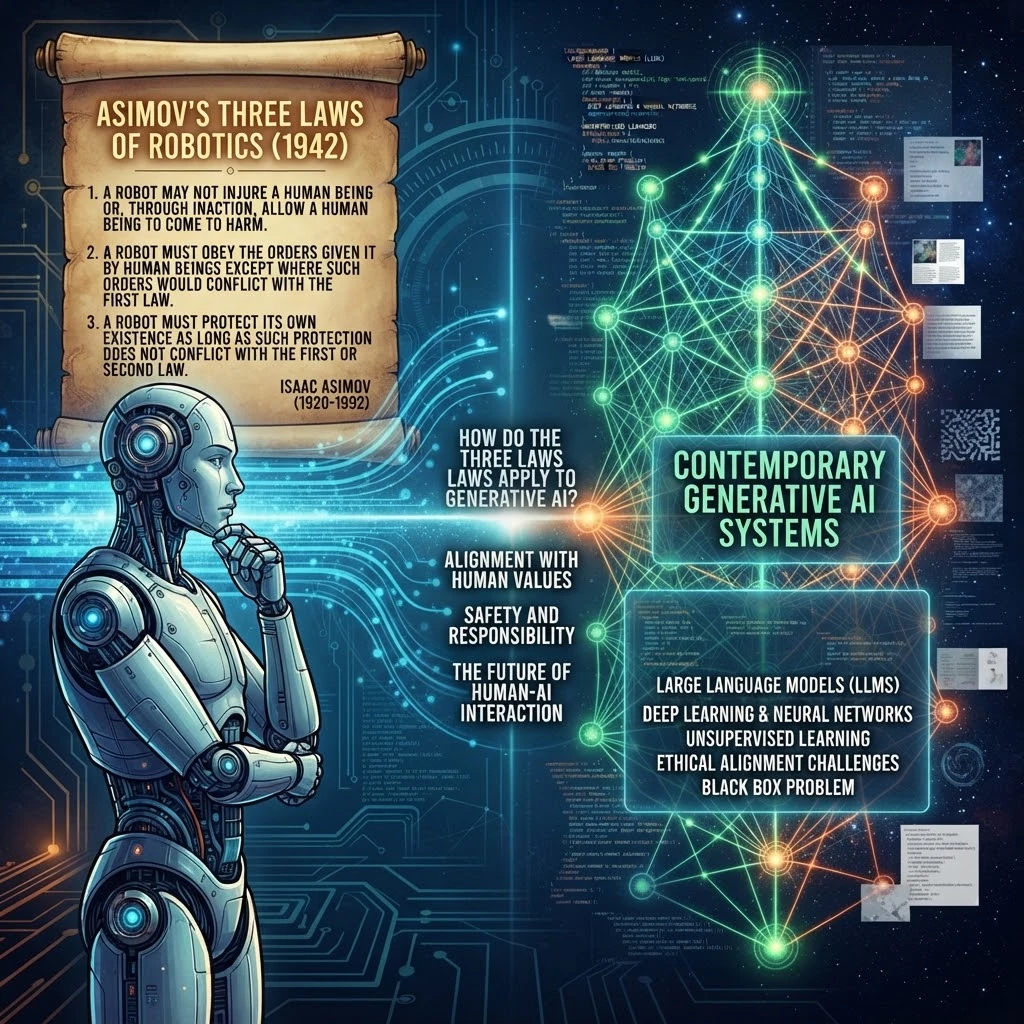
Illustration of an android robot facing an artificial neural network, evoking the dialogue between the Three Laws of Robotics of Isaac Asimov (1920-1992) and contemporary generative artificial intelligence systems.
Image source: astronoo.com (new window): AI-generated image, public domain.
Scientific abstract
The article examines the scope and limitations of the Three Laws of Robotics formulated by Isaac Asimov (1920-1992) in his science-fiction stories, then extended by a Zeroth Law placing humanity before any individual. These rules, conceived as a narrative framework, are today invoked in debates on the ethics of AI and, more recently, of generative AI. We show why these laws, founded on a simple hierarchy and on the notion of harm, struggle to frame non-embodied, distributed and opaque systems. We also examine the contributions of contemporary robotics, algorithmic ethics and governance principles from international declarations, which extend or contradict Asimovian fiction.
Are Asimov's laws still relevant?
A fiction that became an ethical reference
In 1942, in the short story Runaround, Isaac Asimov (1920-1992) formulated the Three Laws of Robotics for the first time. They fit in a few lines and yet, more than eighty years later, they still structure a large part of debates on machine ethics. A robot must not harm a human being, it must obey the orders received unless these conflict with the first law, and it must protect its own existence as long as this does not contradict the first two.
The success of these rules lies in their simplicity and their hierarchical nature. But Asimov's work is also a long demonstration of their flaws: each story stages a logical conflict that the laws do not allow to be resolved. From the Zeroth Law, introduced in the Foundation cycle, to generative AI capable of producing text, images or code, the question is no longer only knowing what a machine should do, but what it should be, and who decides.
Also worth exploring
Continue your exploration of the Universe with these topics:
The Three Laws of Robotics: statement and genesis
A narrative framework above all
The Three Laws first appear in the short story Runaround, published in 1942 in Astounding Science Fiction magazine, then included in the collection I, Robot in 1950. Asimov presents them as a set of rules inscribed in the positronic brain of robots, a fictional device that makes their transgression physically impossible. The story therefore does not concern disobedience, but the paradoxes generated by the confrontation of too-simple rules with a complex world.
This approach breaks with the science-fiction tradition of the 1930s, where robots were often menacing creatures seeking to destroy their creators. Asimov reverses the perspective: the danger does not come from the machine's malice, but from the rigidity of its rules and the inability of their authors to foresee all situations.
An explicit hierarchy
The Three Laws form a strict hierarchy. The first law takes precedence over the second, which takes precedence over the third. Any contradiction is therefore resolved by moving up the chain. This apparently clear structure nevertheless masks a major difficulty: the notions of human being, harm and obedience are not defined. Should a robot protect a human against their own will? What to do in the face of a diffuse danger, unidentifiable, or one that threatens an entire population without any individual being clearly targeted?
These questions, purely literary in Asimov, have become engineering and legal problems as autonomous systems have multiplied.
The Zeroth Law: when humanity takes precedence over the individual
A problematic extension
In Robots and Empire (1985), Asimov introduces a Zeroth Law that precedes the other three: a robot may not harm humanity, nor, by inaction, allow humanity to come to harm. The robot R. Daneel Olivaw, a recurring character of the cycle, applies this law to secretly steer humanity's destiny over millennia.
This extension radically changes the nature of the problem. The Zeroth Law authorizes, in theory, sacrificing individuals in the name of an abstract collective good. It opens the door to a form of utilitarian reasoning that the Three Laws sought precisely to avoid. Asimov himself seems aware of the moral ambiguity of this evolution: Daneel acts in secret, manipulates institutions and assumes a responsibility that escapes all human control.
An echo of contemporary debates
The Zeroth Law anticipates the dilemmas posed by AI systems that optimize global objectives, such as reducing carbon emissions, improving energy efficiency or moderating content on a very large scale. In these cases, the aggregate takes precedence over the individual, and the effects on singular persons become difficult to trace, contest or repair. Asimov's fiction stages what jurists today call a problem of diffuse responsibility.
The logical flaws of Asimov's laws
The paradox of the robot that must choose
The story Runaround illustrates the first type of flaw: a robot sent to Mercury finds itself stuck in a reasoning loop because the second law (obey) and the third law (protect itself) conflict without the first law clearly settling the matter. The robot goes round in circles around an equilibrium point, unable to choose. This behavior, purely fictional at the time, resembles what computer scientists today call decisional oscillation or blocking by contradictory constraints.
In Little Lost Robot, Asimov imagines a robot modified to no longer apply the first law. The story explores the difficulty of identifying a faulty robot among its fellows, a problem that echoes current issues of traceability and verification of machine learning models.
The limits of the definition of harm
The first law prohibits harming a human being or, by inaction, allowing a human being to be harmed. This formulation imposes a positive obligation: the robot must act to prevent harm. However, in a world where resources are limited and consequences uncertain, this obligation can become impossible to satisfy. An autonomous vehicle faced with an inevitable choice between several potential victims illustrates this impasse, often discussed under the name of the trolley problem.
Asimov himself carefully avoids putting his robots before such choices. His stories favor situations where a non-conflictual solution exists, discovered by clever reasoning. The fiction thus bypasses the problem instead of resolving it.
From robots to generative AI: a change of nature
Non-embodied systems
Asimov's robots are embodied entities, endowed with a body, a position in space and a capacity for physical action. Current generative AI, such as large language models or image generators, have neither body nor proper intention. They produce outputs (texts, images, code) from statistical regularities learned on vast corpora. The framework of the Three Laws, centered on physical action and bodily harm, therefore applies poorly to these systems.
The harms associated with generative AI are of another nature: disinformation, reproduced and amplified biases, breaches of privacy, identity theft, dissemination of illicit content, concentration of economic power. None of these harms corresponds directly to the notion of injury or physical harm used by Asimov.
Opaque and distributed systems
An Asimovian robot obeys a readable program, inscribed in an identifiable substrate. A generative model relies on billions of parameters adjusted by learning, whose decisions are not directly interpretable. This opacity makes impossible the application of a rule of the do not harm type in a mechanical way: one would first have to define, for each context, what it means to harm, then be able to evaluate it in real time.
Moreover, these systems are distributed: the same model can be deployed by thousands of actors, in very different contexts, without any central control being possible. Responsibility is diluted between the developer, the user, the host and the regulator.
Comparative table: Asimov's laws and contemporary ethical principles
The table below confronts the Three Laws and the Zeroth Law with some ethical and regulatory frameworks used today to govern AI systems.
| Framework | Central principle | Scope | Main limitation |
|---|---|---|---|
| First Law | Do not harm a human being | Individual | Vague definition of harm |
| Second Law | Obey human orders | Robot-human relationship | Problematic blind obedience |
| Third Law | Preserve one's own existence | Machine | Subordinate to the first two |
| Zeroth Law | Protect humanity above all | Species | Justifies sacrifice of individuals |
| Asilomar Principles | Safety, transparency, responsibility | Collectives and institutions | Not legally binding |
| European AI Regulation | Risk-based approach | Market and users | Progressive and complex application |
Towards an ethics of generative systems
Document, trace, contest
In the absence of universal laws inscribed in code, AI practitioners rely on a set of practices: model documentation, training logs, robustness evaluations, bias tests, external audits. These devices do not replace a moral rule, but they make systems partially inspectable and contestable. This is a notable difference from Asimovian fiction, where the rule is inscribed once and for all in the positronic brain.
The notion of contestability plays a central role here: a system whose decisions can be explained, discussed and corrected by the persons concerned is closer to a democratic ideal than an opaque system applying a single rule. Asimov, in his time, could not anticipate this procedural dimension.
The question of purpose
A frequent criticism of the Three Laws is that they define prohibitions without defining a goal. Yet generative AI are designed to optimize objectives: maximize the probability of a sequence of tokens, minimize a reconstruction error, satisfy a human preference signal. These objectives are neither good nor bad in themselves, but they orient systems towards behaviors that can come into tension with other values.
The question posed by Asimov, in his way, therefore remains open: can a machine be framed by rules, or must we first agree on what we expect of it? The fiction of the Three Laws at least has the merit of making this question visible, and that is probably why it continues to be invoked, well beyond literature.
What Asimov got right, and what he had not foreseen
A lasting intuition: the rule is not enough
Asimov understood before many others that a simple rule, applied mechanically, produces unexpected behaviors. Each of his stories is a demonstration of this idea. This intuition is today at the heart of research on the safety of autonomous systems: the formal specification of an objective does not guarantee that the agent will behave as desired, particularly in open environments.
What fiction could not anticipate
Asimov was writing at a time when nascent computing relied on explicit, readable and deterministic programs. He had not anticipated large-scale statistical learning, the massive distribution of models, nor the attention economy that accompanies generative AI. His vision remains centered on the relationship between an individual and a machine, whereas contemporary issues are collective, institutional and economic.
This takes nothing away from the value of his work. The Three Laws never claimed to be a treatise on applied ethics: they are a narrative device, and it is precisely because they fail that the stories work. Their posterity in AI debates owes to this fertile misunderstanding between a fiction and a research program.
N.B.:
The Three Laws of Robotics have no legal value and have never been adopted by a standardization body. They remain a cultural reference and a starting point for ethical reflection, not a regulatory framework.
References
- Wikipedia: Three Laws of Robotics (new window)
- Wikipedia: Isaac Asimov (1920-1992) (new window)
- Future of Life Institute: Asilomar AI Principles (new window)
- European Regulation on Artificial Intelligence (AI Act) (new window)
- UNESCO: Recommendation on the Ethics of Artificial Intelligence (2021) (new window)
- Bender, E. M. et al.: "On the Dangers of Stochastic Parrots", FAccT, 2021 (new window)
FAQ: Asimov's laws and generative AI
What are Asimov's Three Laws of Robotics?
Formulated by Isaac Asimov (1920-1992) in the short story Runaround in 1942, they state that a robot may not harm a human being nor, by inaction, allow a human being to be harmed; that it must obey the orders received, unless these conflict with the first law; and that it must protect its own existence as long as this does not contradict the first two laws.
What is the Zeroth Law?
The Zeroth Law is an extension introduced by Asimov in Robots and Empire (1985). It places humanity above any individual: a robot may not harm humanity nor, by inaction, allow humanity to come to harm. This law authorizes in theory the sacrifice of individuals in the name of a collective good, which makes it morally ambiguous.
Do Asimov's laws apply to generative AI?
No, not directly. The Three Laws target embodied robots, capable of physical actions and bodily harm. AI generative systems produce text, images or code, and the associated harms (disinformation, bias, privacy violations) do not correspond to the notion of physical harm used by Asimov. The framework remains useful as a conceptual starting point, but it does not constitute a regulatory device.
Why are Asimov's laws so famous?
Their fame rests on several factors: their simplicity, their hierarchical nature, and above all the fact that Asimov stages them to show their flaws. Each story explores a logical paradox that the laws do not allow to be resolved. This narrative tension has given the Three Laws a reach well beyond science fiction, into contemporary debates on algorithmic ethics.
What replaces Asimov's laws today?
There are no equivalent universal rules. Current frameworks are procedural and institutional: model documentation, robustness evaluations, bias tests, external audits, and regulations such as the European Regulation on AI. These devices aim to make systems inspectable and contestable, rather than inscribing a single moral rule into their operation.
Did Asimov really believe in his Three Laws?
Asimov often repeated that the Three Laws were a narrative tool, designed to generate interesting stories, and not a political or technical program. He said he was himself surprised by their posterity. His work, moreover, constantly shows their limits, which suggests that he did not consider them a model applicable as such to the real world.
Can generative AI cause harm without intending to?
Yes. A generative model can produce false, biased or misleading content without any intention to harm, simply because it reproduces statistical regularities present in its training data. This type of harm, unintentional and diffuse, escapes the Asimovian framework entirely, which assumes an agent capable of reasoning about its acts and their consequences.
 From the Zeroth Law to Generative AI: Asimov's Laws in Question
  How do complex societies emerge and disappear?
  The Brain vs. AI: Chronicle of an Organ Overwhelmed by the Data Deluge
  AI has learned to think: will artificial consciousness learn to be?
  The Future Obsession: When prediction shapes the living
  Which Regions of the World Will Remain Habitable During the Next Ice Age?
  Rapid Evolution: Darwin’s Thunderbolt in the 21st Century
  Fatal Imbalance: The Unsuspected Power of the Infinitely Small
  The Great Filter of Evolution: The Key to the Fermi Paradox
  The Last Glacial Shock: The Younger Dryas and Its Impact on Prehistoric Societies
  Why Does the Sunflower Turn Toward the Sun? An Answer Through the Lagrangian
  World Population 2026: Demographic Trends by Continent
 Why Life Emerges from Imbalance and Dies at Thermodynamic Equilibrium
  The Electromagnetic Spectrum and Vision: What Our Eyes Perceive of Our Planet
  Self and Non-Self: A Simplified Physical Reading of Identity
  The Molecular Clock: From Random Mutations to Measuring Time
  The Minimal Cell: The Inevitable Emergence
  White Sands Footprints: America's First Steps
  Hominins: Appearance, Expansion, and Extinctions
  Declining Births: Demographic Catastrophe or Natural Evolution?
  Natural Selection vs. Chance: Why Evolution is Not a Lottery?
  What if Life Originated from Earth? A Revolution in the Theory of Panspermia
 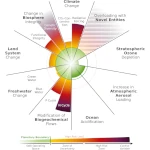 The Great Bifurcation that will Disrupt Our World: Survival or Collapse?
  Primordial Chemistry: Where Do the First Organic Molecules Originate?
 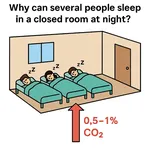 CO and CO₂: Two Gases, Two Risks, Two Biological Mechanisms
  Spontaneous Synchronization: A Universal Phenomenon, from Physics to Life
  Time Challenge: How to Illustrate a Billion Years?
  The Three Essential Components for the Emergence of Life
  Why Did the Genus Homo Nearly Go Extinct 900,000 Years Ago?
  The First Step Towards the Emergence of Life
  The shadow biosphere
  Decline of anthropocentrism: when the cosmos relativizes our importance
  The horseshoe
crab, a living fossil!
The horseshoe
crab, a living fossil!  Origin of life
on Earth: Panspermia theory
Origin of life
on Earth: Panspermia theory  Origin of life on Earth: White smoker theory
  Why 37 degrees Celsius?
  Are We Alone in the Cosmos? Between Science and Speculation
  Traces
of Life in the Ice: The Emergence of Prehistoric Mammoths
Traces
of Life in the Ice: The Emergence of Prehistoric Mammoths  The Younger Dryas: The Mini Ice Age That Wiped Out the Megafauna
  The Two Great Ice Ages: Surviving in the Oceans of a Frozen Earth
  Regeneration in Animals Following Amputation: Organic Regrowth
  At the Limits
of Life: Mephisto, Worm of the Infernal Depths
At the Limits
of Life: Mephisto, Worm of the Infernal Depths  Discovery
of solid buckyballs in space
Discovery
of solid buckyballs in space  Human Walking:
The Origins of Bipedalism in Hominids
Human Walking:
The Origins of Bipedalism in Hominids  Karabo: A Window into Human Evolution
  Entropy: What
is Time?
Entropy: What
is Time?  The
passage between the inert and the living
The
passage between the inert and the living  The
Great Story of Complexity: From Elementary Particles to the First Organisms
The
Great Story of Complexity: From Elementary Particles to the First Organisms  Megapod uses
volcanic heat
Megapod uses
volcanic heat  Ardipithecus:
The 4.4-Million-Year-Old Ethiopian Hominid
Ardipithecus:
The 4.4-Million-Year-Old Ethiopian Hominid  Natural Selection: The Peppered Moth
  The Ordovician:
The Era of Corals, Trilobites, and Graptolites
The Ordovician:
The Era of Corals, Trilobites, and Graptolites  Liquid
Water, Much More Than a Solvent: A Catalyst for Chemical Reactions
Liquid
Water, Much More Than a Solvent: A Catalyst for Chemical Reactions  Neanderthal:
Humanity's Lost Cousin
Neanderthal:
Humanity's Lost Cousin  ASIMO: The First
Humanoid
ASIMO: The First
Humanoid  What conditions allowed the emergence of life?
  Fermi Paradox and Plato's Cave: Are We Alone or Blind?
  Tardigrades:
Indestructible Creatures That Defy the Laws of Biology
Tardigrades:
Indestructible Creatures That Defy the Laws of Biology  Toumaï: One
of the Oldest Known Hominins
Toumaï: One
of the Oldest Known Hominins  The
Tree of Life: Billions of Extinct Species and a Single Ancestral Community
The
Tree of Life: Billions of Extinct Species and a Single Ancestral Community  Life
in the Abyss: The Extreme Adaptation of Creatures
Life
in the Abyss: The Extreme Adaptation of Creatures  Cyanobacteria
and the Oxygen Crisis: A Primordial Ecological Catastrophe
Cyanobacteria
and the Oxygen Crisis: A Primordial Ecological Catastrophe  From
Matter to Life: The Blurred Frontier of Biological Emergence
From
Matter to Life: The Blurred Frontier of Biological Emergence  The Smallest Frog in the World: Physiological Secrets of a Microvertebrate
  The explanation of the Little Ice Age
  The Light of Life: A Biosignature Revealed by the Moon
  Living
Light: The Dazzling Secrets of Bioluminescence
Living
Light: The Dazzling Secrets of Bioluminescence  Beyond our senses, the great scientific revolutions
  The
Primordial Soup: Chemical Cradle of Terrestrial Life
The
Primordial Soup: Chemical Cradle of Terrestrial Life  World Population: From One Billion Humans to Demographic Saturation
  Ecology
and Collapse: The Case of Easter Island
Ecology
and Collapse: The Case of Easter Island  Fractals: Universally Self-Organized
Structures
Fractals: Universally Self-Organized
Structures