


The Universe: Matter... or Information?
The Universe: A Web of Information?
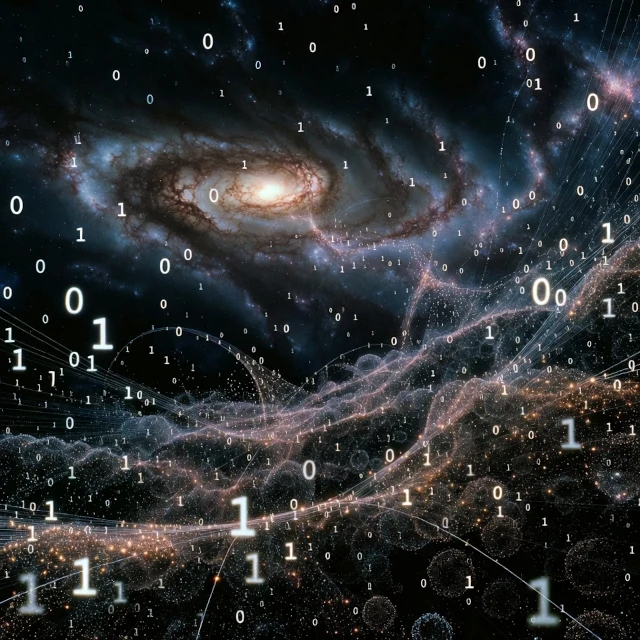
Binary patterns intertwine with galaxies and quantum structures, symbolizing the idea that information is the underlying fabric of physical reality.
This representation evokes the principle that every particle, every physical law, could be the expression of fundamental information.
Image source: astronoo.com (new window)
Scientific Summary
This article explores the hypothesis that information is a fundamental component of the Universe, on par with matter and energy. It is based on three pillars: Landauer's principle (erasing a bit dissipates energy, E = kBT ln 2), the black hole information paradox (which led to the holographic principle, where a 3D volume can be encoded on a 2D surface), and John Wheeler's "It from bit" maxim. These concepts suggest that information has a physical reality, structuring spacetime itself.
What if everything were just information?
Information could be a fundamental component of the Universe, on par with matter, energy, space, and time. This idea rests on three pillars: Landauer's principle (erasing a bit of information dissipates energy), the black hole information paradox (which led to the holographic principle, where a 3D volume could be encoded on a 2D surface), and John Wheeler's "It from bit" maxim. Information is therefore no longer just a mathematical concept, but a physical quantity.
Also worth exploring
Continue your exploration of the Universe with these topics:
From Matter to Information: A Paradigm Shift
For centuries, physics has sought to reduce the complexity of the Universe to its most elementary components. We have identified matter, energy, space, and time as the pillars of our reality. But a question arises from the most recent theories: What if a piece of the puzzle is missing? What if, behind the dance of particles and the curvature of spacetime, there lies an even more fundamental entity: information?
The idea may seem abstract, even philosophical. Yet, it is at the heart of some of the deepest advances in theoretical physics, linking the thermodynamics of black holes (theory that unifies quantum mechanics and general relativity, where information is a key quantity) to quantum mechanics. Information is no longer just a mathematical concept or a measure of our ignorance; it may be a physical quantity, with its own reality, on par with mass or energy.
The Landauer Principle: When Information Meets Physics
A Revolutionary Idea
The first solid bridge between information and physics was built by Rolf Landauer (1927-1999), a German physicist working at IBM. In 1961, in an article titled "Irreversibility and Heat Generation in the Computing Process," he formulated a principle that became fundamental: information has a physical reality. His famous principle, the Landauer Principle, states that in any computing system, the irreversible erasure of a bit of information must necessarily be accompanied by the dissipation of energy in the form of heat.
The Formula Linking Information and Thermodynamics
Mathematically, this is expressed by the equation: \( E = k_B T \ln 2 \) where \(E\) is the minimum energy dissipated, \(k_B\) is the Boltzmann constant, and \(T\) is the temperature of the system. This is a fundamental law of nature. Information is intangible, but its manipulation and erasure have physical consequences, measurable in the material world. This was the first clear demonstration that information is a physical quantity subject to thermodynamics. The Landauer Principle was experimentally verified in 2012 by researchers at CEA-Saclay, who trapped a microscopic particle with a laser to simulate a "bit" and measured the heating produced during its erasure.
The Information Paradox
The role of information became unavoidable with the study of black holes. In the 1970s, Jacob Bekenstein (1947-2015) and Stephen Hawking (1942-2018) revolutionized our understanding of these objects. Hawking demonstrated that a black hole is not completely black: it emits radiation (the Hawking radiation) and eventually evaporates.
What Happens to the Lost Information?
This created a major problem: the information paradox. If a black hole evaporates, what happens to the information about the objects that fell into it? Is it destroyed? In quantum physics, nothing is truly erased in an isolated system. Information can hide or disperse, but it is never lost. The potential solution to this paradox emerged from another discovery by Bekenstein: the entropy of a black hole is proportional to the surface area of its event horizon, not its volume.
The Holographic Principle
The maximum amount of information that can be contained in a region is proportional to the surface area of its boundary. From this idea emerged the holographic principle, developed by Gerard 't Hooft (1946-) and Leonard Susskind (1940-). According to this bold theory, our perception of a three-dimensional cosmos (height, width, depth) might just be a projection, like a giant hologram. All the information describing our reality would actually be encoded on a two-dimensional surface, located at the edge of the Universe. What appears to us as volume would only be a "three-dimensional image" projected from this surface.
Information as a Fundamental Constituent: The Digital Turn
If information is so closely linked to entropy, energy, and the geometry of spacetime, could it not be more fundamental than matter itself? This is the hypothesis of physicists like John Archibald Wheeler (1911-2008), who popularized the maxim "It from bit". Every element of physical reality (It) emerges from a fundamental base of information (Bit). The Universe would be a giant quantum system, computing its own reality from which spacetime and matter-energy emerge.
Information in Major Physical Theories
| Concept / Principle | Proposed by | Key Idea |
|---|---|---|
| Landauer Principle (1961) | Rolf Landauer (1927-1999) | The erasure of a bit of information dissipates energy, experimentally verified (2012). Information has a thermodynamic reality. |
| Black Hole Entropy (1972) | Jacob Bekenstein (1947-2015) | The entropy of a black hole is proportional to the surface area of its horizon. Links information to geometry. |
| Hawking Radiation (1974) | Stephen Hawking (1942-2018) | Black holes emit radiation and evaporate, raising the paradox of information conservation. |
| "It from bit" (1989) | John Archibald Wheeler (1911-2008) | Physical objects (it) derive their existence from information (bit). Information is primordial. |
| Holographic Principle (1993) | Gerard 't Hooft (1946-), Leonard Susskind (1940-) | All information contained in a volume can be encoded on its boundary surface. The Universe could be a hologram. Strongly supported hypothesis, not proven. |
| Quantum Information Mechanics | David Deutsch (born 1953) | Physical reality is a process of quantum information processing. Qubit as the fundamental building block of reality. Active research program in quantum computing. |
N.B.: While these concepts are firmly rooted in theoretical physics, they are not yet consensus. The status of information as a fundamental component, on par with spacetime, remains a working hypothesis at the intersection of quantum physics, cosmology, and the philosophy of science.
Towards a Physics of Information
So far, we have seen the Universe as a stage where physical phenomena unfold, and ourselves as mere spectators. Information may not be a "thing" we can touch, but it could well be the secret ingredient that structures reality. A fascinating idea that invites us to rethink our place in the cosmos!
FAQ: Information as a fundamental component of the Universe
What is Landauer's principle?
Formulated in 1961 by Rolf Landauer, this principle states that the irreversible erasure of one bit of information must be accompanied by a dissipation of energy as heat, according to the formula E = kBT ln 2. It is the first clear demonstration that information has physical reality. This principle was experimentally verified in 2012 by researchers at CEA-Saclay.
What is the black hole information paradox?
Stephen Hawking showed that black holes emit radiation and eventually evaporate. The paradox is: what happens to the information about objects that fell into the black hole? In quantum physics, information can never be completely destroyed in an isolated system. This paradox led to the holographic principle, suggesting that information is conserved, perhaps encoded on the surface of the horizon.
What does John Wheeler's "It from bit" mean?
This maxim, popularized by physicist John Archibald Wheeler, encapsulates the idea that every element of physical reality (It) emerges from a fundamental information base (bit). The Universe would be a gigantic quantum system computing its own reality, from which space-time and matter-energy would emerge. Information would then become the primary constituent of the cosmos.
 Beyond Our Senses: What the Universe Still Hides from Us
  Little Red Dots: The Compact Enigmas of the Early Universe
  The Weak and Strong Anthropic Principles: Two Ways of Reading the Same Universe
  The Universe: Matter... or Information?
  Dark Energy: The Most Mysterious Force in the Universe
  The Fountains of Creation: The Myth of White Holes
  The Great Silence: 10 Insurmountable Walls to Meeting E.T.
 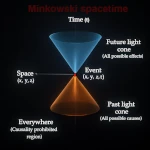 Why the Cause Always Precedes the Effect: The Order of the World is Written in This Principle
  Absolute Zero and Nothingness: Two Limits the Universe Refuses to Reach
  Economical Nature: The Secrets of Conserved Quantities
  The Incredible Precision of the Universe's Laws: Chance or Necessity?
  The Mystery of the Arrow of Time: Why Can't We Go Back?
 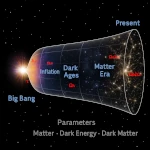 The Big Bang: At the Frontiers of the Model
  When Space Bends: The Tiny Slope That Guides the Universe
  Nabataean Astronomy: Masters of the Desert Between Starry Skies and Stone Constructions
  Polynesian Astronomy: The Art of Navigating the Pacific Ocean
  Mesopotamian Astronomy: The Cradle of Celestial Observation
  Andean Astronomy: A Sacred Link Between Sky and Earth
  Ancient Persian Astronomy: Between Babylon and the Islamic Golden Age
  Mayan Astronomy: Celestial Cycles Dictated Religious, Agricultural, and Political Time
  Islamic Astronomy: When Baghdad Illuminated the Sky of Science
  Indian Astronomy: From Sacred Poetry to Scientific Thought
  Ancient Greek Astronomy: The Universe of Philosophers in Search of Cosmic Order
  The Three Cosmic Shapes: A Hidden Geometry of the Universe
  Egyptian Astronomy: Between Sky and Nile, the Secrets of Time
  Babylonian Astronomy: When the Sky Predicted Destiny
  Chinese Imperial Astronomy: A Millennial Scientific Legacy
  Extreme Cosmic Objects: Where Physics Explodes
  Mirror Universe: Coexistence of Two Worlds in a Cosmic Reflection
  The first second of our history
 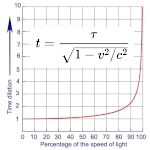 Time Dilation: Relativistic Mirage or Reality?
  Space Through Time: A Constantly Evolving Concept
  The Expanding Universe: What Does "Creating Space" Really Mean?
  From Nothingness to the Cosmos: Why Is There Something Rather Than Nothing?
  How can the Universe measure 93 billion light-years?
  How can we say that the Universe has an age?
  First Proof of the Expansion of the Universe
  Space-time slices of the observable Universe
  When the Universe Was Blind: The Long Night Before the First Stars
  Alternative theories to the accelerated expansion of the universe
  The primitive atom: the first cosmological theory
  Great walls and filaments: the great structures of the Universe
  The Origins of the Universe: A History of Cosmic Representations
  Lyman-alpha Blobs: Gaseous Traces of the First Galaxies
  Perspective on the Inflation of the Universe
  The Planck Universe: the Image of the Universe Becomes Clearer
 The sky is immense with Laniakea
  The Symmetries of the Universe: A Journey Between Mathematics and Physical Reality
  The Geometry of Time: Exploring the Fourth Dimension of the Universe
  How to measure distances in the Universe?
  Why ‘nothing’ is impossible: Do nothingness and emptiness exist?
  The Horizon Problem: Understanding the Uniformity of the Cosmos
  What is Dark Matter? The Invisible Force Shaping the Universe
  Metaverse, the next stage of evolution
  Multiverse: An Ocean where each Spacetime Bubble has its own Physical Laws
  Cosmological Recombination: When the Universe Became Transparent
  Cosmological constants: the fine-tuning of the universe
  The Thermodynamics of the Sandpile and the Avalanche Effect
  The engine of the accelerated expansion of the Universe
  The X-Ray Universe: When Space Becomes Transparent
  The oldest galaxies in the universe
  Hubble constant and expansion of the Universe
  Dark Energy: When the Universe Defies Its Own Gravity
  What is the Size of the Universe? Between Cosmological Horizon and Infinity
  Quantum Vacuum and Virtual Particles: The Physical Reality of Nothingness
  Paradox of the dark night
  Journey into the Heart of Paradoxes: The Enigmas That Revolutionized Science
  Cosmic Microwave Background: The Thermal Echo of the Big Bang