


Economical Nature: The Secrets of Conserved Quantities

When a light ray passes from air to water, it does not follow the shortest path in distance, but the one that minimizes its travel time (Fermat's principle).
There is a "break" at the interface (refraction) which is, in reality, the optimal trajectory allowing light to go from one point to another in the shortest possible time, given the different speeds in the two media.
Image source: astronoo.com (new window)
Scientific summary
This article explores conservation laws as a manifestation of nature's economy. It explains that quantities like energy, momentum, and angular momentum are neither created nor destroyed, but transformed. Noether's theorem (1915) reveals that these conservations stem directly from continuous symmetries of spacetime: time translation invariance implies energy conservation, space translation invariance implies momentum conservation, and rotation invariance implies angular momentum conservation. Conservation laws are therefore not arbitrary postulates, but inevitable mathematical consequences of the fundamental symmetries of the Universe.
Why is nature economical?
Nature is economical because it obeys conservation laws that ensure certain physical quantities (energy, momentum, angular momentum, electric charge) are never lost. This economy originates from Noether's theorem (1915): every continuous symmetry of physical laws implies a conserved quantity. Time invariance conserves energy, space invariance conserves momentum, and rotational invariance conserves angular momentum. These symmetries are not accidental: they reflect the deep structure of spacetime and make conservation laws fundamental and universal principles.
Also worth exploring
Continue your exploration of the Universe with these topics:
The Principle of Universal Laziness
Since ancient times, philosophers and scientists have sought a unifying principle explaining the order of the world. In the 18th century, such a principle emerged.
The Principle of Least Action
The principle of least action (physical principle according to which the path taken by a system between two states is the one that minimizes a quantity called 'action'.), formulated by thinkers such as Pierre-Louis Moreau de Maupertuis (1698-1759) and Leonhard Euler (1707-1783), postulates that nature always acts in the most "economical" way possible. Whether it is a light ray refracting as it passes from air to water or the orbital motion of a planet around its star, the observed trajectories are never arbitrary. They correspond to those that minimize, or more precisely make "critical" (neither increasing nor decreasing), a mathematical quantity called action (integral linking the dynamics of a system to its variational formulation). This logic of parsimony, where nature favors certain evolutions among all possible ones, appears as a fundamental principle structuring the entire Universe.
Conservation Laws: Nature's Economy
At all scales, nature seems to obey a logic of economy. Certain physical quantities are neither created nor destroyed, but simply transformed or redistributed. This regularity is manifested through conservation laws, pillars of modern physics. Whether it is energy, momentum, or electric charge, each quantity can be compared to a volume of water circulating in a network of rivers and lakes. Just as water moves and changes form between rivers, lakes, and underground aquifers without disappearing, these "physical volumes" circulate and transform, their total remaining strictly constant in an isolated system.
One Symmetry, One Law: Noether's Revelation
Since Isaac Newton (1643-1727), physicists had observed and empirically verified fundamental conservation laws. The energy of an isolated system is neither created nor lost, its total momentum remains constant, and its angular momentum is conserved. These principles worked perfectly, but one question persisted: why does the Universe obey such rules?
The answer, as profound as it is elegant, was provided in 1915 by the German mathematician Amalie Emmy Noether (1882-1935). Her revolutionary theorem established a fundamental link between the geometry of spacetime and the laws of physics.
The core of her discovery can be summarized in a powerful principle:
- Every continuous symmetry of the laws of Nature implies a conserved physical quantity.
Imagine a strategy game whose fundamental rules remain strictly identical, no matter when you play (symmetry in time), where you are (symmetry in space), or the orientation of the board (rotational symmetry).
Noether's theorem reveals that this perfect stability of the rules mathematically guarantees the conservation of a specific "value" throughout the game.
Thus, just as in a classic game the total number of pieces remains constant, the continuous symmetries of the Universe ensure the conservation of fundamental quantities such as energy, momentum, and angular momentum.
The theorem also works the other way around, serving as a discovery tool:
- Every conserved quantity we observe betrays the existence of an underlying continuous symmetry.
Thus, Noether showed that conservation laws are not accidents or arbitrary postulates. They are the inevitable and mathematical consequences of the fundamental symmetries that structure our Universe. The economy of nature finds here its deepest explanation.
The Dictionary of Symmetries
Noether's theorem provides us with a precise dictionary to translate symmetries into conservation laws. Here are the most fundamental correspondences:
- Invariance under time translation: If the laws of physics are the same today, yesterday, and tomorrow (the experiment gives the same result regardless of when it is performed), then the total energy of the system is conserved.
- Invariance under space translation: If the laws of physics are the same here or a meter away (space is homogeneous), then momentum (or impulse) is conserved.
- Invariance under space rotation: If the laws of physics are the same in all directions (space is isotropic), then angular momentum is conserved.
| Symmetry | Conserved quantity | Concrete example | Economy principle |
|---|---|---|---|
| Time translation (Homogeneity of time) | Energy | When an object falls, gravitational potential energy decreases while kinetic energy increases, the total sum remaining constant in the absence of dissipation. | Energy never disappears: it changes form while respecting an invariant global balance. |
| Space translation (Homogeneity of space) | Momentum | Recoil of a cannon when firing: the forward momentum of the cannonball is exactly compensated by the backward momentum of the cannon. | No overall movement can spontaneously appear in an isolated system. Any momentum created in one direction is exactly compensated by momentum in the opposite direction. |
| Space rotation (Isotropy of space) | Angular momentum | A skater spins faster by pulling her arms in, without adding any extra rotation. | The total rotation of an isolated system is an inviolable capital. No net rotation can spontaneously emerge from within. |
| U(1) gauge invariance (Phase symmetry) | Electric charge | During an electric current, electrons move through the conductor, but the total charge of the circuit remains constant at every moment. | Electric charge is transported and redistributed, with no net creation or destruction. |
FAQ: Everything about nature's economy and conserved quantities
What is the principle of least action?
Formulated by Maupertuis and Euler in the 18th century, the principle of least action postulates that nature always acts in the most "economical" way possible. Whether it is the path of a light ray or the orbit of a planet, the observed paths are never arbitrary: they correspond to those that minimize a mathematical quantity called action. This principle structures the entire Universe.
What is Noether's theorem?
Discovered in 1915 by mathematician Emmy Noether, this fundamental theorem establishes a direct link between the symmetries of physical laws and conserved quantities. It states that every continuous symmetry of the laws of Nature implies a conserved physical quantity. Conversely, every conserved quantity betrays the existence of an underlying symmetry. Noether thus revealed that conservation laws are not accidents, but the inevitable mathematical consequences of the symmetries of space-time.
What are the three main symmetries and their associated conservation laws?
Noether's theorem establishes three fundamental correspondences: 1) time translation invariance (physical laws are the same today, yesterday, and tomorrow) implies conservation of energy; 2) space translation invariance (laws are the same here and elsewhere) implies conservation of momentum; 3) space rotation invariance (laws are the same in all directions) implies conservation of angular momentum. A fourth symmetry, gauge invariance, is associated with the conservation of electric charge.
 The Paleocene-Eocene Transition: When Earth's Climate Suddenly Changed
  The Principle of Least Action: Why Does Nature Always Choose the Most Economical Path?
  Evolutionary Convergence: Chance, Necessity… or Mirage?
 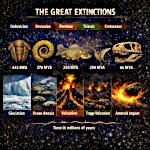 The Five Mass Extinctions: What do these planetary catastrophes reveal?
  Cryosphere: when the ice giants still protect us
 The Nitrogen Cycle: From Air to Life
  The Jet Stream: When the Atmospheric River Overflows Its Banks
 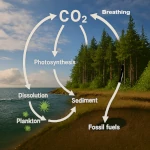 The Carbon Cycle: The Harmonious Interaction of Oceans, Forests, and Subsoils
  The Water Paradox: Without it, no life
 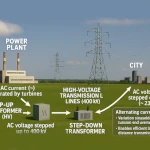 Why did alternating current prevail?
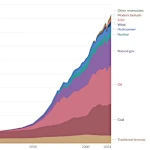 Evolution of Global Energy Consumption: From Steam Engines to Digital Servers
  The Demographic Transition: Growth or Decline?
  Lake Agassiz: A Deluge that Changed the Climate
  Drunken Forests: Understanding the Phenomenon of Permafrost Thaw
  There is Electricity in the Air!
  Why Doesn't CO2 Fall to the Ground?
  El Niño and La Niña: the two climatic phenomena of the Pacific
  Endangered Species: Dynamics of Extinction
  The Toxic Legacy of Acid Rain
  Major societal collapses: key periods and causes
  Global Warming in Figures: What the Scientific Data Says
  What is Sustainable Development?
 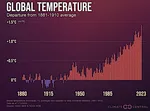 The Hottest Years Since Records Began
  Magnitude of upcoming climate change
  Earth in Crisis: Collapse or Renaissance?
  Ice on Borrowed Time: The Inexorable Decline of Arctic Sea Ice
 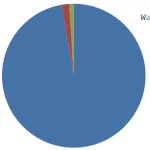 Earth's Water Reservoirs: From Oceans to Groundwater
 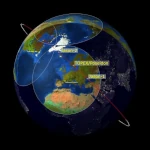 Sea Levels Are Rising, But How Fast?
  The Other Climate Threat: Earth Shrouded in Shadow and Humidity
  The Age of the Sahara: From Green Prairie to Stone Desert
 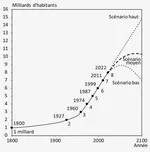 World Population from 1800 to 2100
  Oil: The Fall of a Giant in the Era of Renewable Energy
  Kamchatka King Crab: A Giant of the Oceans
  The collapse of a society
 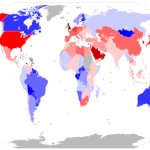 Slight Progress in the Global Ecological Footprint
 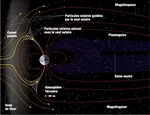 The South Atlantic Anomaly
  The phenomenon of soil sinking is called subsidence
  The Planet's New Clouds