


The 5 Cosmic "Doomsdays" (and Why They Will Not Happen)
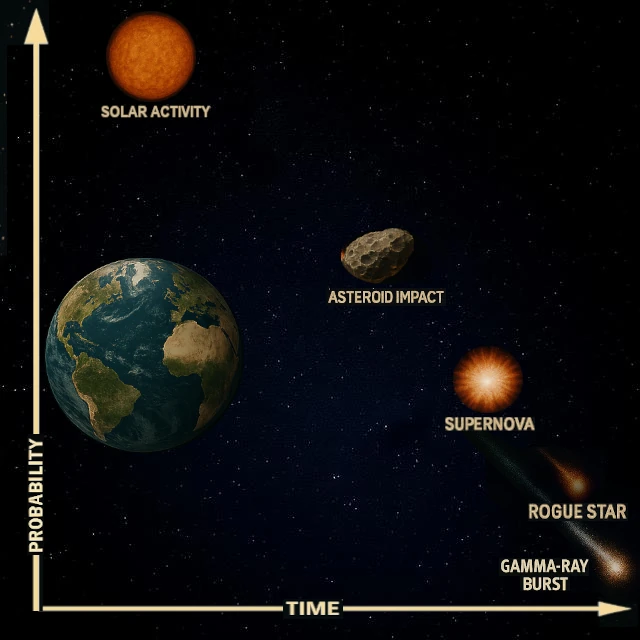
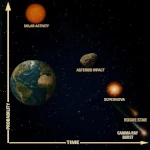
Earth surrounded by the five stylized cosmic threats: solar activity, a threatening asteroid, the distant explosion of a supernova, a wandering star passing at a distance and a gamma-ray jet.
Image source: astronoo.com (new window)
Scientific abstract
Although cosmic phenomena such as extreme solar activity, the impact of a giant asteroid, a nearby supernova, the passage of a wandering star or a gamma-ray burst are real, their probability of causing an apocalypse is extremely low. Earth and humanity are protected by several factors: Earth's magnetic field, space monitoring programs (95% of large asteroids are catalogued), the rarity of these events (e.g. dangerous supernova <1 per billion years), the low local stellar density, and forecasting capability (24-48h warning for solar storms). The most certain threat is distant: the Sun will become a red giant in 5 billion years.
Why should Earth survive the 5 great cosmic threats?
Although cosmic phenomena such as extreme solar activity, the impact of a giant asteroid, a nearby supernova, the passage of a wandering star or a gamma-ray burst are real, their probability of causing an apocalypse is extremely low. Earth and humanity are protected by several factors: Earth's magnetic field, space monitoring programs (95% of large asteroids are catalogued), the rarity of these events (e.g. dangerous supernova <1 per billion years), the low local stellar density, and forecasting capability (24-48h warning for solar storms). The most certain threat is distant: the Sun will become a red giant in 5 billion years.
Also worth exploring
Continue your exploration of the Universe with these topics:
Is the sky a threat?
An ancestral fear confronted by science
Since the dawn of humanity, the sky has been a source of wonder but also of doomsday terrors. Prophecies announcing the end of the world often originate in misunderstood astronomical phenomena. Today, modern science allows us to separate truth from falsehood, to quantify the real risks posed by the universe and, reassuringly, to observe that our planet is a far more robust and fortunate ark than it appears.
Extreme solar activity: An electromagnetic storm under surveillance
Solar flares and coronal mass ejections (ejections of large quantities of solar plasma) represent the closest and most likely threat. These events project billions of tonnes of solar plasma into space at dizzying speeds. Their power is such that a single large CME releases energy equivalent to millions of nuclear bombs detonated simultaneously.
The main risk for our modern civilization, hyper-dependent on technology, is "extreme space weather". When this wave of charged particles and electromagnetic radiation strikes Earth, it interacts violently with our magnetosphere (the region of space surrounding Earth where its magnetic field prevails). It can induce powerful electric currents (geomagnetically induced currents) in power transmission networks, oil and gas pipelines, and communication cables.
Why this will not have apocalyptic consequences:
Several factors protect us and make it possible to mitigate the risks. First, our planet possesses an exceptional natural shield: its magnetic field, which deflects most solar particles toward the poles, creating the aurora borealis and australis. Second, we are not in ignorance. Agencies such as NASA and NOAA (National Oceanic and Atmospheric Administration) continuously monitor the Sun with fleets of satellites (SOHO, SDO, ACE, Parker Solar Probe). These observations allow solar activity forecasts with 24 to 48 hours' notice, enough time for power grid operators to take preventive measures (islanding parts of the grid, activating compensation systems).
Moreover, the design of critical infrastructure has evolved since the last major event, the Carrington Event (Carrington event in 1859, a major solar storm that disrupted telegraph networks) of 1859. Construction standards and protection of power grids now incorporate this threat. Finally, the outages that a super-storm could cause would probably be regional and temporary (from a few days to a few weeks), requiring costly repairs but not amounting to a global and lasting civilizational collapse.
The impact of a giant asteroid
The scenario is cinematic: a space rock several kilometres in diameter strikes Earth, causing an impact winter and a mass extinction. This is, moreover, what probably sealed the fate of the dinosaurs 66 million years ago.
Why does this only rarely happen?
Collisions with bodies more than 10 km in diameter, capable of causing mass extinctions, are rare events. Models of Solar System dynamics show that the majority of potentially dangerous objects are either already identified or gravitationally stabilized by Jupiter.
The international astronomical community, through programs such as Pan-STARRS (near-Earth Object Observations Program) or the future Vera C. Rubin Observatory, diligently catalogues and tracks NEOs (near-Earth Objects). To date, more than 95% of asteroids over one kilometre — the planet killers — have been listed and none presents a collision trajectory with Earth for centuries to come.
The explosion of a nearby supernova
The explosion of a star at the end of its life less than a hundred light-years away could flood Earth with X-rays and cosmic rays, with consequences similar to the GRB (gamma-Ray Burst) scenario.
Why this will (probably) not happen?
There is currently no candidate supernova star in this "danger zone" around the Sun. Massive stars capable of exploding as supernovae are rare, luminous and well known. Betelgeuse, often cited, is about 640 light-years away, a safe distance. The closest star presenting a distant risk, IK Pegasi B, is a white dwarf that could become a type Ia supernova… but in several million years and it is 150 light-years away. Space is vast, and dangerous stars are very far away.
The passage of a wandering star
Our solar system is not an isolated sanctuary. It travels through the galaxy and could, theoretically, cross the path of another star. Too close a passage would gravitationally disturb the Oort cloud, sending a shower of comets toward the inner planets, and could even destabilize planetary orbits.
Why this will (probably) not happen?
The stellar density in our corner of the galaxy is very low. Stars are separated by light-years of emptiness. Simulations, such as those conducted by Coryn Bailer-Jones (active in the 21st century), show that the probability of a star passing within 0.5 light-years of the Sun (close enough to disturb the Oort cloud) is about once every 50 million years. And even in that case, the major risk would be a moderate increase in the comet rate over thousands of years, not an instantaneous cataclysmic bombardment.
A deadly gamma-ray burst
A GRB (gamma-Ray Burst) is the most energetic explosion in the universe, releasing in a few seconds the equivalent of the energy the Sun will emit during its entire life. A jet directed toward Earth could sterilize half the planet by destroying the ozone layer, exposing living things to deadly ultraviolet radiation.
Why this will (probably) not happen?
These events are extremely rare in a galaxy like ours. They are associated with the collapse of very massive and rapid stars, or with the merger of neutron stars, phenomena that do not occur in our immediate stellar neighbourhood. To be a direct threat, a GRB would have to occur less than a few thousand light-years away and its narrow jet would have to be perfectly aligned with Earth. The combined probability of these conditions is infinitesimal. Moreover, our galaxy, the Milky Way, is not the type of galaxy (low in star formation and metallicity) that favours the production of these cosmic monsters.
Table of the five celestial cataclysms: risk assessment
Comparative synthesis of cosmic risks
The table below synthesizes the five cosmic threats studied, specifying their danger zone, their estimated frequency, the main protective factors and the maximum plausible consequences.
| Cosmic threat | Critical distance / danger zone | Estimated frequency (in the Galaxy or near Earth) | Main protective / mitigating factor(s) | Maximum plausible consequence |
|---|---|---|---|---|
| Extreme solar activity (Super-flare / giant CME) | Earth (direct impact) | Major event: every ~100 to 500 years (e.g. Carrington 1859, 1989, 2003). | Earth's magnetosphere, forecasting capability (satellites), hardening of power grids. | Prolonged regional power outages, disruption of satellites and communications, costly repairs. |
| Asteroid or comet impact (>1 km) | Intersection trajectory with Earth's orbit (<1 AU). | Global impact: ~once every 50 to 100 million years (e.g. Cretaceous-Paleogene). | Jupiter's protective role, monitoring programs (NEO), deflection tests (DART). More than 95% of the largest objects catalogued. | Impact winter, global ecological collapse, mass extinction. |
| Nearby supernova (Type II or Ia) | <25-50 light-years for serious biological effects. | Near the Solar System: <1 per billion years. No known candidate in this zone. | Immense distance of massive stars. Atmospheric shield (attenuates secondary cosmic rays). | Ozone layer degradation, increase in UV and cosmic rays at ground level over several centuries. |
| Passage of a disturbing wandering star | Passage at <0.5 light-year to disturb the Oort Cloud. | ~1 star every 50 million years in this zone. Very close passage (<10,000 AU): >1 billion years. | Low local stellar density. Long response time of the Oort Cloud (comets over millennia). | Significant and prolonged increase in the rate of comets entering the inner solar system. |
| Gamma-ray burst (nearby and aligned GRB) | <1,000 - 10,000 light-years with perfectly aligned jet. | In the Milky Way: ~1 every 5 to 10 million years. With alignment toward Earth: extremely rare. | Rarity of progenitor stars (Wolf-Rayet, neutron star merger). Directional randomness (narrow jet). | Sterilization of one hemisphere by destruction of the ozone layer, intense UV irradiation. |
What will happen: The Sun will become a red giant
An inescapable astrophysical deadline
This "threat" is more an inescapable chapter in the history of the solar system than an imminent risk for our civilization. It is an astrophysical certainty: in about 5 billion years, the Sun, having run out of hydrogen, will begin to swell enormously to become a red giant, probably swallowing Mercury, Venus and perhaps even Earth.
The unknown is real, but the Universe is not capricious. It is vast, slow, and remarkably tolerant of Earth's existence.
References
FAQ: Everything you need to know about the 5 great cosmic threats and their low probability
What is the most likely cosmic threat for our modern civilization?
The closest and most likely threat is extreme solar activity (solar flares and coronal mass ejections). A major "Carrington"-type event (1859) could induce destructive electric currents in power grids, causing prolonged regional outages. However, we are protected by Earth's magnetosphere and forecasting systems (NASA, NOAA) providing 24 to 48 hours' warning, allowing preventive measures.
Why do we not need to fear a catastrophic asteroid impact?
Collisions with asteroids larger than 10 km (capable of mass extinction) are extremely rare: about once every 50 to 100 million years. Moreover, more than 95% of asteroids larger than one kilometre (the "planet killers") have already been catalogued by programs such as Pan-STARRS, and none presents a collision trajectory with Earth for centuries to come. Jupiter also acts as a gravitational shield.
Could a supernova or a gamma-ray burst sterilize Earth?
To be dangerous, a supernova would have to explode less than 25-50 light-years away. However, no candidate star exists in this "danger zone". Betelgeuse is 640 light-years away. For gamma-ray bursts (GRBs), they are extremely rare in our galaxy and their jet would have to be perfectly aligned with Earth, an infinitesimal probability. Space is vast and dangerous stars are very far away.
Can Earth's magnetic field protect us from all cosmic threats?
Earth's magnetic field is an effective shield against the charged particles of the solar wind and solar flares. It deflects most of these particles toward the poles, creating the auroras. However, it does not protect against X-rays and gamma rays, which are uncharged electromagnetic radiation. For these threats, it is the atmosphere that plays the role of screen, but it remains vulnerable to a very close and aligned gamma-ray burst.
Are asteroid monitoring programs sufficient?
Current programs such as Pan-STARRS, Catalina and the future Vera C. Rubin have catalogued more than 95% of asteroids larger than one kilometre. For smaller objects (tens of metres), coverage is still partial. Missions such as DART have demonstrated that deflection is possible. Surveillance is therefore robust for planet killers, but it must be continued and extended to medium-sized objects.
Why is the threat of the Sun becoming a red giant certain but distant?
Stellar evolution is well understood: in about 5 billion years, the Sun will exhaust its central hydrogen and transform into a red giant. This deadline is certain, but it is so distant that humanity will probably have disappeared or migrated long before. It does not constitute an imminent threat to our current civilization, unlike short-term risks such as solar storms or asteroids.
 From Black Basalt to Blue Oceans: Earth's Changing Palette
  Plate Tectonics: The Invisible Engine Moving the Continents
  The Number 360: The Mathematical Key to the Babylonian Sky
  Wet-Bulb Temperature: Humanity's Climate Time Bomb
  Why Doesn't Earth's Atmosphere Escape into Space?
  Origins of Earth: Magmatic Chaos and the Birth of the Solid World
  Earth's Atmosphere: The Invisible Shield Protecting Life
  The 5 Cosmic "End of the World" Scenarios (and Why They Won't Happen)
  Where does the water in the oceans come from? Three key stages
  From Carbon 14 to Uranium-Lead: The Science of Dating
  Major Natural Disasters: What Are the Most Likely Threats?
  The Boundary of Space: Where Does It Really Begin?
  536: The Year Without a Summer and the Beginning of the Late Antique Little Ice Age
  The leap second: scheduled end in 2035
  Planetary Alignments: A Fascinating but Relative Phenomenon
  All Deserts of the World
  Earth's Paleoclimates and Carbon Dioxide
  What is the effect of large lakes and water reservoirs on Earth's rotation?
  International Date Line
  Start Date of the Seasons: A Complex Celestial Mechanism
  Paleomagnetism: the magnetic memory of rocks
  3D Simulator: Revolutions of the Planets
  Geological Time and Mass Extinctions: From the Ordovician to the Cretaceous
  Earth History: Timeline Compressed into 24 Hours
  Earth's Water: An Extraterrestrial Origin?
  Reading the Sky: Understanding Declination and Right Ascension
  How is Earth's magnetic field born and why does it reverse?
  Earth's Magnetosphere: The Invisible Shield
  Fujita Scale: Classifying the Fury of Tornadoes
  Earth's Radioactivity: The Internal Energy of Our Planet
  The Deep Sea: Exploring the Deepest Ocean Trenches
  Why Are Days Getting Longer?
  The Depths of the Earth: From the Lithosphere to the Core
  Earth's Movements: How Earth Traces Its Spiral Through the Universe?
  How much is the sea level rising?
  The Life of Earth: Structure and Layers of the Earth
  The Eccentricity of Earth's Orbit: An Ellipse That Changes Everything
  Little Ice Age: The History of a Natural Climatic Cooling
  The Quest for Time: How Ancient Civilizations Used Astronomy?
  Van Allen Belt: A Rampart Against Cosmic Particles
  The Cosmos in Our Measure: When Man Invents the Universe
  What is the pendulum fixed relative to?
  Problem of longitude at sea
  World population, still gallopingin 2008
  The Oldest Image of Earth from Space
  Earth's Obliquity and Variations in Its Axis of Rotation
  The Astronomical Unit Fixed: A Length, No Longer an Orbit
  Water: one molecule, three states on Earth
  Simulator, the round of near-Earth cruisers
  Satellites that measure underwater relief
  Hadean's Hell
  The First Free Flight of an Astronaut in Space
  The first measurement of the Earth-Sun distance
  La The Announced End of the World on December 21, 2012: A Millennial Prophecy
 The Equinoxes: An Astronomical Event
 Milankovitch Cycles: The Astronomical Rhythm of Earth's Climate
 Why Is Earth So Often Cloudy?