


Absolute Zero and Nothingness: Two Limits the Universe Refuses to Reach
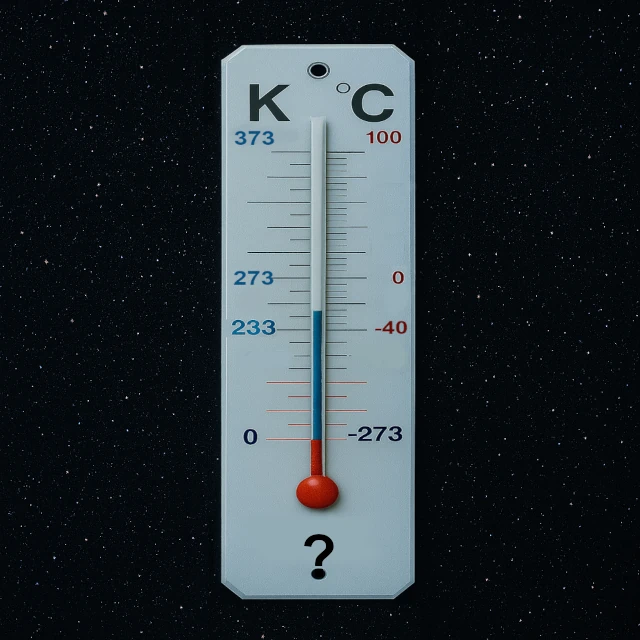
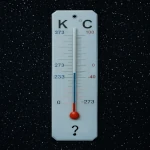
The thermometer represents the quest for absolute zero (0 K), an unattainable limit.
Around it, a "nothingness" filled with matter illustrates the total absence of perfect emptiness.
Finally, the laws of quantum physics erect an insurmountable barrier before these two extremes.
Image source: astronoo.com (new window)
Scientific Summary
This article explores two fundamental limits of physics: absolute zero (0 K) and perfect nothingness. Absolute zero is an unattainable limit because Heisenberg's uncertainty principle imposes a residual zero-point energy: particles can never be completely motionless. Perfect nothingness (total absence of matter, energy, space, and time) does not exist either: the "vacuum" is in reality a dynamic quantum vacuum populated by fluctuations and virtual particle-antiparticle pairs (Casimir effect). These two impossibilities are not accidents, but fundamental principles that guarantee the stability of matter and the possibility of the existence of the universe.
Do Absolute Zero and Perfect Nothingness Really Exist in Our Universe?
No, neither absolute zero (0 Kelvin) nor perfect nothingness exist physically. Absolute zero is an unattainable limit because Heisenberg's uncertainty principle imposes a residual zero-point energy: particles can never be completely motionless. Perfect nothingness (total absence of matter, energy, space, and time) also does not exist: "emptiness" is actually a dynamic quantum vacuum populated by fluctuations and virtual particle-antiparticle pairs (Casimir effect). These two impossibilities are not accidents but fundamental principles that guarantee the stability of matter and the possibility of the universe's existence.
Also worth exploring
Continue your exploration of the Universe with these topics:
The Illusion of Extremes
The Fascination with Absolute Limits
The human mind is fascinated by extremes and limits. We conceptualize absolute cold (thermodynamic zero at 0 Kelvin) and perfect nothingness (total absence of matter, energy, space, and time) as if they existed.
Unreachable Horizons
These concepts (cold and nothingness) seem logical, even necessary, to define our reality. Yet, when fundamental physics takes hold, it reveals a troubling truth: these two states do not seem to exist in our universe. They are not achievable destinations but rather horizons that recede as we approach them. This impossibility is not an accident; it stems from the most intimate laws of nature.
Absolute Zero: An Unattainable Limit
What Is Temperature?
Temperature is not a substance but a measure of the thermal agitation of the particles that make up matter (atoms, molecules). The greater this agitation, the higher the temperature. Absolute zero would theoretically correspond to the complete cessation of this agitation. Quantum mechanics forbids this state of perfect stillness, ensuring a minimum residual energy even at the lowest level.
A Historical Quest
The quest for ultimate cold has a long history. In the 18th century, scientists like Guillaume Amontons (1663–1705) already discussed the idea of "extreme cold." The concept of absolute zero (0 Kelvin, corresponding to -273.15°C, is the lowest theoretically possible temperature.) was firmly established in the 19th century. It represents the state where a system's thermal energy is minimal, where atoms would cease all movement.
The Uncertainty Principle: A Fundamental Obstacle
However, quantum mechanics, born in the early 20th century, imposed a fundamental prohibition. The Heisenberg uncertainty principle (fundamental principle of quantum mechanics stated by Werner Heisenberg, stipulating that it is impossible to simultaneously know with arbitrary precision the position and momentum of a particle.) (1927) forbids a particle from having a perfectly defined position and momentum (both zero). Even at its lowest energy level, a system possesses a zero-point energy (minimum residual energy that a quantum system possesses, even at absolute zero temperature. It is a direct consequence of the uncertainty principle.).
An Asymptotic Limit
Thus, reaching 0 K would be equivalent to completely freezing the quantum nature of matter, which is impossible. Physicists can get extraordinarily close (to a few billionths of a Kelvin), but the "wall" of the uncertainty principle remains insurmountable. Absolute zero is an asymptotic limit.
Nothingness: A Concept That Evaporates
The Quantum Vacuum: A Dynamic Nothingness
Similarly, the notion of nothingness seems just as elusive. Our intuition of "emptiness" is a completely empty space. Yet, quantum field theory teaches us that what we call emptiness is actually a dynamic and complex entity: the quantum vacuum (the lowest possible energy state of a quantum field. Unlike classical nothingness, it is the site of permanent quantum fluctuations.).
In this vacuum, virtual particle-antiparticle pairs (elementary particle and its antiparticle, such as an electron and a positron, which can be temporarily created from the energy of vacuum fluctuations.) constantly appear and disappear, borrowing their energy from the uncertainty principle in the form \(\Delta E \Delta t \ge \frac{\hbar}{2}\). This is not just a theoretical artifact; effects like the Casimir force (weak attractive force between two uncharged conductive plates, due to the modification of the spectrum of vacuum fluctuations between them. It is direct experimental proof of the existence of quantum vacuum fluctuations.) (predicted in 1948, measured precisely later) prove it experimentally.
Spacetime: An Indispensable Framework
Let's go further. Spacetime itself, the framework of all existence, is a "something" with properties (curvature, expansion). If, as some cosmological models suggest, the "Big Bang" marks the emergence of spacetime, then the question "what was there before?" might be meaningless, as there might have been no "before" without time to measure it. In this context, "nothingness" would not even be an emptiness in spacetime but the total absence of spacetime itself, a notion so radical that it defies our ability to conceptualize it.
Nothingness: A Conceptual Contradiction
Conceptualizing nothingness is to give it an existence it does not have. As physicist Lawrence Krauss (born 1954) pointed out in his book "A Universe from Nothing," the "nothing" of physics is not the philosophical "nothing."
A Deep Connection? Impossibility as a Principle
Impossibility as the Foundation of Reality
The analogy between the unattainability of absolute zero and the nonexistence of nothingness is not just a poetic coincidence. It points to an underlying principle: nature seems to reject states of total absence, of perfect nullity.
Vacuum Energy and the Stability of the Universe
This impossibility guarantees the existence and stability of the universe. Without zero-point energy, atoms could collapse. Without vacuum fluctuations, there might not have been the seeds for the inhomogeneities that led to galaxies. The fact that the universe is filled with a fundamental energy (vacuum energy, or cosmological constant) is another clue in this regard.
Conceptual Limits, Not Physical Ones
The two limits of absolute zero and nothingness are therefore not boundaries of the universe but limits of our classical concepts. They refer us back to the founding oddities of quantum and relativistic reality.
| Concept | Intuitive Definition | Physical Reality | Cause of Impossibility | Consequence for the Universe |
|---|---|---|---|---|
| Absolute Zero (0 K) | Temperature at which all thermal agitation ceases. | Unattainable limit. Zero-point energy persists. | Heisenberg's uncertainty principle (\(\Delta x \Delta p \ge \frac{\hbar}{2}\)). | Stability of atoms, existence of matter. |
| Nothingness / Perfect Vacuum | Total absence of matter, energy, space, time. | Does not exist. "Emptiness" is a dynamic quantum vacuum. | Quantum fluctuations of the vacuum (\(\Delta E \Delta t \ge \frac{\hbar}{2}\)). | Possibility of particle creation, seed of cosmic structures, vacuum energy. |
- Sources: Principles of Quantum Mechanics (Heisenberg, Dirac). Modern Cosmology (vacuum energy, inflation). Casimir Effect.
Are We the Children of the Impossible?
The Enigma of "Something" Rather Than Nothing
Science tells us how something came from almost nothing. But the mystery of why there is "something" rather than absolute nothingness remains at the frontier of physics and philosophy.
Impossibility as the Condition of Our Existence
This double impossibility leads us to a dizzying question: are these two unattainable limits, absolute zero and nothingness, not precisely what makes our existence possible? If absolute zero were attainable, matter would collapse, deprived of the zero-point energy that maintains the structure of atoms. If perfect nothingness existed, there would be no quantum fluctuations to trigger the genesis of particles, nor a spacetime framework for a story to unfold. The fundamental laws of physics seem to favor, or at least allow, the emergence of complexity.
An Existence Inscribed in the Limits of Physics
Our presence in the universe would then not be a contingent accident but a consequence inscribed in the very impossibility of nothingness and absolute cold.
FAQ: Everything You Need to Know About Absolute Zero and Nothingness
Why Can't We Reach Absolute Zero (0 K)?
Absolute zero is a theoretical limit (-273.15°C) where the thermal agitation of particles would be zero. It is impossible to reach because of the Heisenberg uncertainty principle (Δx × Δp ≥ ħ/2). This quantum principle forbids a particle from having both a perfectly defined position and momentum. Even at the lowest energy level, a zero-point energy persists. Physicists can get within a few billionths of a kelvin, but they can never cross this quantum "wall."
What Is the "Quantum Vacuum" and Why Isn't It Truly Empty?
Contrary to intuition, emptiness is not an absence of matter. The quantum vacuum is a dynamic and complex medium. By virtue of the uncertainty principle (in the form ΔE × Δt ≥ ħ/2), virtual particle-antiparticle pairs constantly appear and disappear. This effect is not just theory: the Casimir force (predicted in 1948, experimentally measured) is direct proof. The quantum vacuum thus has intrinsic activity, even in the absence of any "real" particles.
What Is the Connection Between These Impossibilities and the Existence of the Universe?
The inaccessibility of absolute zero and the nonexistence of perfect nothingness are not mere curiosities: they are guarantors of the very existence of the universe. Without zero-point energy, electrons would collapse into nuclei, making atoms impossible. Without quantum vacuum fluctuations, there would not have been the primordial inhomogeneities necessary for the formation of galaxies. Physics suggests that our existence is a direct consequence of the fact that nature "rejects" states of total absence. We are the children of the impossible.
 Beyond Our Senses: What the Universe Still Hides from Us
  Little Red Dots: The Compact Enigmas of the Early Universe
  The Weak and Strong Anthropic Principles: Two Ways of Reading the Same Universe
  The Universe: Matter... or Information?
  Dark Energy: The Most Mysterious Force in the Universe
  The Fountains of Creation: The Myth of White Holes
  The Great Silence: 10 Insurmountable Walls to Meeting E.T.
  Why the Cause Always Precedes the Effect: The Order of the World is Written in This Principle
  Absolute Zero and Nothingness: Two Limits the Universe Refuses to Reach
  Economical Nature: The Secrets of Conserved Quantities
  The Incredible Precision of the Universe's Laws: Chance or Necessity?
  The Mystery of the Arrow of Time: Why Can't We Go Back?
  The Big Bang: At the Frontiers of the Model
  When Space Bends: The Tiny Slope That Guides the Universe
  Nabataean Astronomy: Masters of the Desert Between Starry Skies and Stone Constructions
  Polynesian Astronomy: The Art of Navigating the Pacific Ocean
  Mesopotamian Astronomy: The Cradle of Celestial Observation
  Andean Astronomy: A Sacred Link Between Sky and Earth
  Ancient Persian Astronomy: Between Babylon and the Islamic Golden Age
  Mayan Astronomy: Celestial Cycles Dictated Religious, Agricultural, and Political Time
  Islamic Astronomy: When Baghdad Illuminated the Sky of Science
  Indian Astronomy: From Sacred Poetry to Scientific Thought
  Ancient Greek Astronomy: The Universe of Philosophers in Search of Cosmic Order
  The Three Cosmic Shapes: A Hidden Geometry of the Universe
 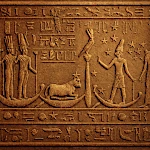 Egyptian Astronomy: Between Sky and Nile, the Secrets of Time
 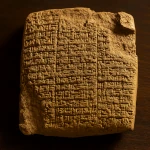 Babylonian Astronomy: When the Sky Predicted Destiny
  Chinese Imperial Astronomy: A Millennial Scientific Legacy
 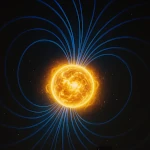 Extreme Cosmic Objects: Where Physics Explodes
  Mirror Universe: Coexistence of Two Worlds in a Cosmic Reflection
  The first second of our history
 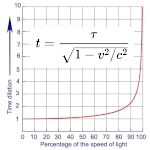 Time Dilation: Relativistic Mirage or Reality?
  Space Through Time: A Constantly Evolving Concept
 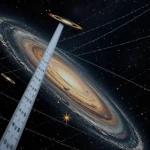 The Expanding Universe: What Does "Creating Space" Really Mean?
  From Nothingness to the Cosmos: Why Is There Something Rather Than Nothing?
 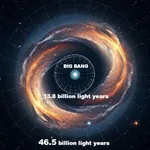 How can the Universe measure 93 billion light-years?
  How can we say that the Universe has an age?
  First Proof of the Expansion of the Universe
  Space-time slices of the observable Universe
  When the Universe Was Blind: The Long Night Before the First Stars
  Alternative theories to the accelerated expansion of the universe
  The primitive atom: the first cosmological theory
 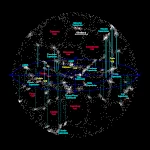 Great walls and filaments: the great structures of the Universe
 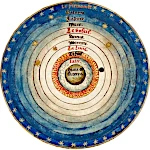 The Origins of the Universe: A History of Cosmic Representations
  Lyman-alpha Blobs: Gaseous Traces of the First Galaxies
  Perspective on the Inflation of the Universe
  The Planck Universe: the Image of the Universe Becomes Clearer
 The sky is immense with Laniakea
  The Symmetries of the Universe: A Journey Between Mathematics and Physical Reality
  The Geometry of Time: Exploring the Fourth Dimension of the Universe
  How to measure distances in the Universe?
  Why ‘nothing’ is impossible: Do nothingness and emptiness exist?
  The Horizon Problem: Understanding the Uniformity of the Cosmos
  What is Dark Matter? The Invisible Force Shaping the Universe
  Metaverse, the next stage of evolution
  Multiverse: An Ocean where each Spacetime Bubble has its own Physical Laws
  Cosmological Recombination: When the Universe Became Transparent
  Cosmological constants: the fine-tuning of the universe
  The Thermodynamics of the Sandpile and the Avalanche Effect
  The engine of the accelerated expansion of the Universe
  The X-Ray Universe: When Space Becomes Transparent
  The oldest galaxies in the universe
  Hubble constant and expansion of the Universe
  Dark Energy: When the Universe Defies Its Own Gravity
  What is the Size of the Universe? Between Cosmological Horizon and Infinity
  Quantum Vacuum and Virtual Particles: The Physical Reality of Nothingness
  Paradox of the dark night
  Journey into the Heart of Paradoxes: The Enigmas That Revolutionized Science
  Cosmic Microwave Background: The Thermal Echo of the Big Bang