


The Mystery of the Arrow of Time: Why Can't We Go Back?
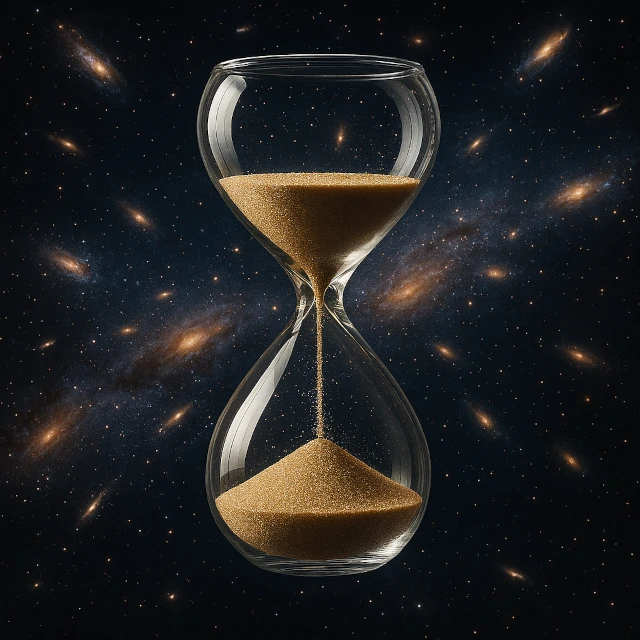
Illustration of the irreversibility of time.
A giant hourglass, whose sand only flows downward, is placed against a cosmic background showing galaxies moving away, evoking the expansion of the universe and the cosmological arrow of time.
Image source: astronoo.com (new window)
Scientific Summary
The article explains why time has an irreversible direction (the arrow of time) even though the fundamental laws of physics are time-symmetric. This arrow emerges primarily from the second law of thermodynamics: the entropy of an isolated system can only increase. The universe began in an extraordinarily ordered state (low entropy) at the Big Bang, and its expansion creates a gradient that allows entropy to increase. The other arrows (cosmological, psychological, radiative, quantum) derive from this fundamental thermodynamic arrow. While order can be created locally, this always comes at the cost of an even greater increase in entropy in the environment.
Why does time always move forward and why can't we go back?
Although the fundamental laws of physics are time-symmetric, our universe has an irreversible temporal direction. This arrow of time emerges primarily from the second law of thermodynamics: the entropy (measure of disorder) of an isolated system can only increase. The universe began in an extraordinarily ordered state (low entropy) at the Big Bang, and its expansion creates a gradient that allows entropy to increase. The other arrows (cosmological, psychological, radiative, quantum) derive from this fundamental thermodynamic arrow. While we can locally create order (a house, a crystal, life), this always comes at the cost of an even greater increase in entropy in the environment.
Also worth exploring
Continue your exploration of the Universe with these topics:
The Fundamental Enigma of Time
We all live with a deep intuition: time flows from the past to the future. A glass falls and shatters, but the pieces never spontaneously reassemble to form the glass on the table. This asymmetry, this unique direction, is what physicists call the arrow of time (concept designating the direction and irreversibility of time.). Yet, surprisingly, the fundamental laws of physics (Newtonian mechanics, relativity, quantum mechanics) are almost all time-reversal symmetric. The equations work just as well forwards as backwards. So, where does this irreversibility we observe come from? The answer lies at the intersection of several arrows of time, the most powerful of which is thermodynamic.
The Thermodynamic Arrow: From "Order" to "Disorder"
The most fundamental law explaining the direction of time is the second law of thermodynamics (physical principle according to which the entropy, a measure of disorder, of an isolated system can only increase or remain constant.), formulated in the 19th century. It introduces the notion of entropy, a measure of the degree of energy dispersion. The principle states that the entropy of an isolated system can only increase or remain constant: \(\Delta S \ge 0\).
It is this inevitable increase that defines the thermodynamic arrow. When you put an ice cube in your soda, heat diffuses from the drink (hot) to the ice cube (cold) until thermal equilibrium is reached, never the other way around. The universe itself, considered as the ultimate isolated system, has seen its entropy increase since the Big Bang, providing a cosmic direction to time.
N.B.:
The physicist Ludwig Boltzmann (1844-1906) gave a statistical interpretation of entropy.
A disordered state (high entropy) is much more probable than an ordered state (low entropy) simply because there are astronomically more ways to achieve it.
Time "moves forward" because the universe evolves statistically towards more probable states.
The Cosmological Arrow: The Expansion of the Universe
The thermodynamic arrow is intimately linked to another: the cosmological arrow. The universe has been expanding since its initial state of very high density and temperature. This Big Bang state was remarkably ordered (low entropy), although very hot. The expansion created the necessary gradient for the increase in entropy. If the universe were to contract again in a "Big Crunch", would the direction of the arrow of time reverse? The debate is open, but the dominant scenario today is one of accelerated and eternal expansion.
The Psychological Arrow: Our Perception of the Flow of Time
We perceive time passing and remember the past, not the future. This psychological arrow is probably a consequence of the thermodynamic arrow. Our brain, like any biological system, operates by dissipating energy and increasing overall entropy.
In other words, at the finest scale, memorizing information in the brain involves very real material changes: electrical signals propagate, chemical molecules are released between neurons, and neural connections change. Once these transformations have occurred, it is impossible to return exactly to the previous state. The brain therefore retains traces of the past, but cannot obtain information about the future. The future, not having yet produced any correlatable physical states, cannot be extracted from it.
This asymmetry does not come from a mysterious property of time, but from the fact that, like any complex physical system, the brain obeys the laws of thermodynamics, which impose irreversible evolution. Thus, our perception of time passing is rooted in the physical laws that govern our neurons. The process of memory formation is irreversible at the chemical and neurological level.
The Radiative Arrow: Light That Never Returns
The radiative arrow is the temporal asymmetry observed in the behavior of light and electromagnetic waves. We constantly receive light emitted by stars years ago, but we never observe the reverse: light from space spontaneously converging towards a source to be "reabsorbed".
This directionality is encoded in the Maxwell's equations (fundamental equations describing electrical, magnetic, and light phenomena.). Although they are mathematically time-reversal symmetric, their physical solutions in our universe impose specific boundary conditions: we systematically choose the "outgoing wave" solution (which moves away from the source), and not the "incoming wave" solution. This choice is directly related to the thermodynamic arrow and the expansion of the universe, which establish a global temporal framework. This is why we see the past of stars (their light reaching us), and not their future.
The Quantum Arrow: The Mystery of Decoherence
At the microscopic level, the quantum world has its own asymmetries, summarized under the term quantum arrow. The most discussed phenomenon is that of decoherence (process by which a quantum system loses its interference properties by interacting with its environment, transitioning from a superposition state to a classical state.).
A quantum particle can exist in a superposition of states (such as passing through two slits at the same time). When it interacts irreversibly with its environment (for example, by emitting a photon), this superposition "unravels" to give way to a single classical state. This process seems to go in only one direction: we observe the transition from a pure quantum state to a mixed classical state, rarely the reverse. Decoherence is considered a key mechanism explaining why the macroscopic world appears classical and defined. Its exact relationship with thermodynamic irreversibility and the origin of the arrow of time remains an active research topic in fundamental physics.
Local Order in a Globally Disordered Universe
A crucial observation is that it is possible to locally reduce entropy. Building a house, assembling a computer, or growing a crystal are actions that create order. However, the second law of thermodynamics is not violated. These processes are always accompanied by an even greater increase in entropy in the immediate environment: heat release, waste production, energy consumption. The overall entropy balance increases inexorably.
Life: A Non-Equilibrium Phenomenon
Living organisms are the most striking examples of locally ordered systems. A cell, a plant, or a human being maintains a complex structure and low entropy. They only exist as open and out-of-equilibrium systems, constantly fueled by an energy flow (sunlight, food). Life does not contradict the arrow of time; it is a sophisticated and dynamic consequence of it, exploiting the energy gradient to locally delay the march towards disorder.
| Type of Arrow | Manifestation | Probable Origin | Irreversible? |
|---|---|---|---|
| Thermodynamic | Increase in entropy, heat diffusion | Initial low-entropy conditions of the Big Bang (statistical law) | Yes, at the macroscopic scale |
| Cosmological | Expansion of the universe | Big Bang and dark energy | Yes, observed |
| Psychological | Perception of past/future, memory | Consequence of the thermodynamic arrow in brain processes | Yes, subjective |
| Radiative | Waves emitted and not absorbed (delay) | Thermodynamics + boundary conditions of the universe | Yes, empirical |
| Quantum (decoherence) | Collapse of state superpositions to a defined classical state | Irreversible interaction with the environment (coupling) | Practically irreversible at the macroscopic scale |
| Biological | Growth, aging, evolution of species | Consequence of the thermodynamic arrow in open systems (energy flow) | Yes, at the organism level |
| Historical/Causal | Cause >effect sequence, impossibility of changing the past | Emerges from the thermodynamic arrow and the structure of spacetime (light cone) | Yes, in our physical framework |
- Source: Inspired by the work of Arthur Eddington (1882-1944), Stephen Hawking (1942-2018), and modern developments in cosmology and thermodynamics.
Summary: A Direction Rooted in Initial Conditions
Ultimately, time flows in only one direction because the universe began in an extraordinarily particular and ordered state. It is this initial condition of low entropy at the Big Bang that gave meaning to thermodynamic evolution and, by extension, to all other arrows. The microscopic laws are reversible, but the history of the universe is not. Understanding the arrow of time is therefore understanding the mystery of the initial conditions of cosmology. Why did the universe begin in such an "improbable" state? This question remains one of the frontiers between physics and philosophy.
FAQ: Everything about the arrow of time
What is entropy and why does its increase give direction to time?
Entropy is a measure of disorder or energy dispersion in a system. The second law of thermodynamics states that the entropy of an isolated system (like the entire Universe) can only increase or remain constant (ΔS ≥ 0). This inexorable increase creates an asymmetry between past and future: a glass falls and breaks (disorder), but the pieces never spontaneously reassemble to reform the glass. The Universe began in an extremely ordered state (low entropy) at the Big Bang, and its evolution toward more probable, more disordered states gives direction to the arrow of time.
Why are the fundamental laws of physics time-symmetric, but not our experience?
This is the central paradox of the arrow of time. The equations of Newtonian mechanics, relativity, and quantum mechanics work equally well forward and backward in time. However, this microscopic symmetry is not incompatible with macroscopic irreversibility. Irreversibility emerges from statistics and initial conditions: there are astronomically more ways to be in a disordered state (high entropy) than in an ordered state (low entropy). Our universe began in an extremely improbable low-entropy state, and it naturally evolves toward more probable states, thus creating a privileged direction.
Does life, which locally creates order, contradict the second law of thermodynamics?
Absolutely not. Life is an open, non-equilibrium system. A living organism locally creates order (cellular structure, DNA, body architecture) by importing energy from its environment (sunlight, food) and rejecting heat and waste. The global entropy balance (system + environment) always increases. A plant, for example, builds ordered molecules through photosynthesis, but it absorbs solar energy and dissipates it as heat, increasing the entropy of the Sun and the environment. Life does not violate the second law; it exploits it to locally delay the march toward disorder.
 Beyond Our Senses: What the Universe Still Hides from Us
  Little Red Dots: The Compact Enigmas of the Early Universe
  The Weak and Strong Anthropic Principles: Two Ways of Reading the Same Universe
  The Universe: Matter... or Information?
  Dark Energy: The Most Mysterious Force in the Universe
  The Fountains of Creation: The Myth of White Holes
  The Great Silence: 10 Insurmountable Walls to Meeting E.T.
  Why the Cause Always Precedes the Effect: The Order of the World is Written in This Principle
  Absolute Zero and Nothingness: Two Limits the Universe Refuses to Reach
  Economical Nature: The Secrets of Conserved Quantities
  The Incredible Precision of the Universe's Laws: Chance or Necessity?
  The Mystery of the Arrow of Time: Why Can't We Go Back?
  The Big Bang: At the Frontiers of the Model
  When Space Bends: The Tiny Slope That Guides the Universe
  Nabataean Astronomy: Masters of the Desert Between Starry Skies and Stone Constructions
  Polynesian Astronomy: The Art of Navigating the Pacific Ocean
  Mesopotamian Astronomy: The Cradle of Celestial Observation
  Andean Astronomy: A Sacred Link Between Sky and Earth
  Ancient Persian Astronomy: Between Babylon and the Islamic Golden Age
  Mayan Astronomy: Celestial Cycles Dictated Religious, Agricultural, and Political Time
  Islamic Astronomy: When Baghdad Illuminated the Sky of Science
  Indian Astronomy: From Sacred Poetry to Scientific Thought
  Ancient Greek Astronomy: The Universe of Philosophers in Search of Cosmic Order
  The Three Cosmic Shapes: A Hidden Geometry of the Universe
  Egyptian Astronomy: Between Sky and Nile, the Secrets of Time
  Babylonian Astronomy: When the Sky Predicted Destiny
  Chinese Imperial Astronomy: A Millennial Scientific Legacy
  Extreme Cosmic Objects: Where Physics Explodes
  Mirror Universe: Coexistence of Two Worlds in a Cosmic Reflection
  The first second of our history
  Time Dilation: Relativistic Mirage or Reality?
  Space Through Time: A Constantly Evolving Concept
  The Expanding Universe: What Does "Creating Space" Really Mean?
  From Nothingness to the Cosmos: Why Is There Something Rather Than Nothing?
  How can the Universe measure 93 billion light-years?
  How can we say that the Universe has an age?
  First Proof of the Expansion of the Universe
  Space-time slices of the observable Universe
  When the Universe Was Blind: The Long Night Before the First Stars
  Alternative theories to the accelerated expansion of the universe
  The primitive atom: the first cosmological theory
  Great walls and filaments: the great structures of the Universe
  The Origins of the Universe: A History of Cosmic Representations
  Lyman-alpha Blobs: Gaseous Traces of the First Galaxies
  Perspective on the Inflation of the Universe
  The Planck Universe: the Image of the Universe Becomes Clearer
 The sky is immense with Laniakea
  The Symmetries of the Universe: A Journey Between Mathematics and Physical Reality
  The Geometry of Time: Exploring the Fourth Dimension of the Universe
  How to measure distances in the Universe?
  Why ‘nothing’ is impossible: Do nothingness and emptiness exist?
  The Horizon Problem: Understanding the Uniformity of the Cosmos
  What is Dark Matter? The Invisible Force Shaping the Universe
  Metaverse, the next stage of evolution
  Multiverse: An Ocean where each Spacetime Bubble has its own Physical Laws
  Cosmological Recombination: When the Universe Became Transparent
  Cosmological constants: the fine-tuning of the universe
  The Thermodynamics of the Sandpile and the Avalanche Effect
  The engine of the accelerated expansion of the Universe
  The X-Ray Universe: When Space Becomes Transparent
  The oldest galaxies in the universe
  Hubble constant and expansion of the Universe
  Dark Energy: When the Universe Defies Its Own Gravity
  What is the Size of the Universe? Between Cosmological Horizon and Infinity
  Quantum Vacuum and Virtual Particles: The Physical Reality of Nothingness
  Paradox of the dark night
  Journey into the Heart of Paradoxes: The Enigmas That Revolutionized Science
  Cosmic Microwave Background: The Thermal Echo of the Big Bang