


The incredible precision of the laws of the universe: Chance or Necessity?
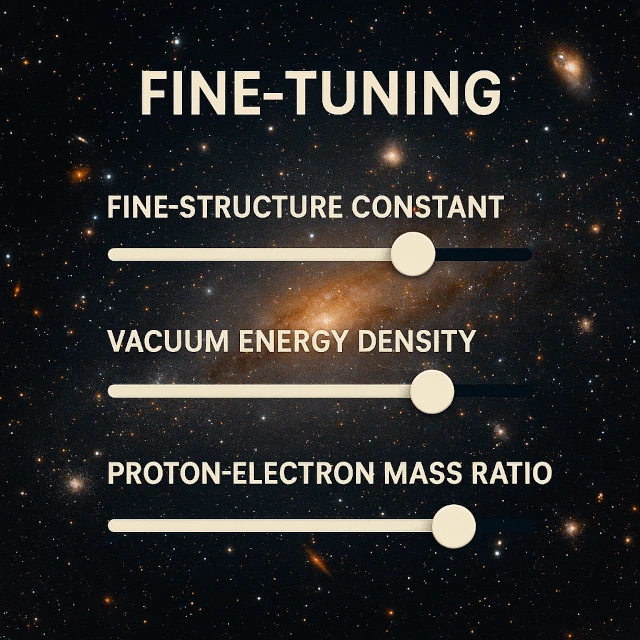
Fine-tuning of the universal constants on a cosmic control panel.
Illustration of the "cosmic contingency or deep law" of the universe, with sliders adjusting parameters such as the fine-structure constant, the vacuum energy density and the proton-electron mass ratio, set against a background of galaxies and stars.
Image source: astronoo.com (new window), AI-generated image, public domain.
Scientific abstract
The article examines the problem of the "fine-tuning" of the universe, where the fundamental physical constants (G, α, Λ, etc.) possess critical values that, if they varied by even 1%, would render the universe sterile. Faced with this precision, three major interpretations are confronted: design (metaphysical intention), necessity (a future Theory of Everything that would predict these values uniquely) and the multiverse (an infinity of universes, ours being conducive to life through a selection effect). The article emphasizes that none of these paths is confirmed, making fine-tuning an open cosmological and philosophical mystery, at the heart of the contemporary scientific quest.
Is the incredible precision of the laws of the universe due to chance or necessity?
Many fundamental physical constants seem to possess very specific values, without which neither stable atoms, nor stars, nor complex chemistry could exist. Faced with this "fine-tuning" of the universe, three major interpretations clash: 1) the design hypothesis (an intention or a creator), 2) the necessity hypothesis (a future Theory of Everything that would predict the constants uniquely), and 3) the multiverse hypothesis (an infinity of universes with variable constants, ours being by chance conducive to life, through a selection effect). None of these answers is yet confirmed, and fine-tuning remains one of the greatest mysteries of modern cosmology.
Also worth exploring
Continue your exploration of the Universe with these topics:
The fine-tuning problem in cosmology
A disconcerting cosmic precision
The fine-tuning (extremely precise adjustment of the fundamental constants, the structure of space and the dynamics of time) of the universe refers to the fact that several physical constants, as well as the structure of space and the evolution of time, seem to take very specific values and properties, without which neither stable atoms, nor stars, nor complex chemistry could exist.
Among these parameters are the gravitational constant \(G\), the fine-structure constant \(\alpha\), and the cosmological constant \(\Lambda\). Slight relative variations, sometimes on the order of <1%, would suffice to make the universe sterile.
Table of cosmological constants: The numbers that govern everything
Multiple and interdependent parameters
"Fine-tuning" does not concern one or two constants, but a critical set of independent and interdependent parameters.
| Parameter | Value of the constant | Role in the emergence of complexity | Sensitivity |
|---|---|---|---|
| Gravitational constant \(G\) | 6.674 × 10⁻¹¹ m³ kg-1 s-2 | Formation of stars and galaxies | Variations >1% → sterile universe |
| Speed of light \(c\) | ≈ 299,792,458 m/s | Structure of spacetime and causality | Variations → inconsistency of physics |
| Planck constant \(\hbar\) | 1.054 × 10⁻³⁴ J·s | Determines the quantum scale | Variations → chemistry and atomic physics impossible |
| Electric constant \(ε_0\) | ≈ 8.854 × 10⁻¹² F/m | Electrostatic force, atomic stability | Variations ±1% → chemistry impossible |
| Elementary charge \(e\) | 1.602 × 10⁻¹⁹ C | Atomic and chemical structure | Variations ±1% → chemistry impossible |
| Fine-structure constant \(\alpha\) | ≈ 1/137 | Stability of atoms and molecules | Variations >1% → chemistry impossible |
| Proton mass \(m_p\) | ≈ 1.673 × 10⁻²⁷ kg | Nucleosynthesis and chemistry | Variations ±10% → chemistry impossible |
| Electron mass \(m_e\) | ≈ 9.109 × 10⁻³¹ kg | Structure of atoms | Variations ±10% → chemistry impossible |
| Ratio \(m_p / m_e\) | ≈ 1836 | Determines chemistry and nuclear equilibrium | Variations ±10% → complex chemistry impossible |
| Mass and potential of the Higgs field | MH ≈ 125 GeV | Determines the masses of elementary particles | Variations ±10% → universe without chemistry |
| Strong and weak coupling constants | αs ≈ 0.118 ; GF ≈ 1.166 × 10⁻⁵ GeV-2 | Nuclear stability and fusion reactions | Variations ±1% → unstable stars or nuclei |
| Neutrino masses and mixing angles | mν ≈ 0.01-0.1 eV ; θ12, θ23, θ13 | Neutrino oscillations and cosmic nucleosynthesis | Variations → affect formation of light elements |
| Cosmological constant \(\Lambda\) | ≈ 1.1 × 10-52 m-2 | Expansion of the universe and structure formation | Variations ×10 → universe without galaxies |
| Primordial fluctuations | Amplitude ≈ 10-5 | Emergence of galaxies and structures | Amplitude ±10% → universe too homogeneous or fragmented |
| Baryonic density, dark matter, dark energy | Ωb ≈ 0.05 ; ΩDM ≈ 0.27 ; ΩΛ ≈ 0.68 | Formation of galaxies and cosmic dynamics | Variations ±50% → universe without complex structures |
| Initial nucleosynthesis conditions | Abundances: H ≈ 75%, He ≈ 25% | Sets the abundance of light elements | Variations → absence of oxygen or carbon |
| Number of spatial dimensions | 3 | Ensures the stability of orbits and gravitational laws | ≠3 → universe incompatible with stable structures |
| Metric signature of spacetime | + − − − | Guarantees causality and the arrow of time | Inadequate → impossibility of coherent chronology |
| Stability of the quantum vacuum | ΔVvac ≈ 0 | Ensures the long-term coherence of the universe | Unstable → collapse or catastrophic expansion |
The three great interpretations: Chance, Necessity or Multiverse?
Three radically different answers
The incredible precision of the fundamental constants cannot be left without explanation. If this precision were that of a watch, we would look for the watchmaker. For the universe, physicists and philosophers have formulated three great possible answers, radically different. Each of them, if it turned out to be true, would overturn our conception of reality, causality and our place in the cosmos.
The design hypothesis (or teleological argument)
An intention at the origin of the laws
This is the oldest interpretation. Fine-tuning would be the proof of an intention, of a "Designer" having specifically chosen the laws allowing the emergence of life and consciousness. This view, defended by some theologians and philosophers, falls outside the framework of the scientific method but answers the question of "why" in a metaphysical way. For its detractors, it simply shifts the mystery one step further (who tuned the tuner?).
N.B.:
A teleological argument is a reasoning that seeks to explain a phenomenon by its finality, its purpose or its "goal", rather than by its material or mechanical causes. The word comes from the Greek telos, meaning "end" or "goal".
The necessity hypothesis (or Theory of Everything)
A predictive Theory of Everything
Championed by physicists and mathematicians such as Albert Einstein (1879-1955), who believed that "God does not play dice", this perspective holds that the fundamental constants are not free. According to this idea, a future Theory of Everything (theory unifying the four fundamental forces and describing all particles and their interactions), possibly arising from string theory or a still-unknown mathematical formulation, could uniquely predict the observed values.
Illustrious precursors
Other scientists have explored similar paths. Paul Dirac (1902-1984) studied surprising numerical relations between constants, suggesting that they could derive from fundamental constraints. Hermann Weyl (1885-1955) thought that deep mathematical symmetries would determine the constants. Paul Ehrenfest (1880-1933) showed that the stability of atoms and planetary orbits depended on the number of spatial dimensions, suggesting a geometric necessity. More recently, Steven Weinberg (1933-2021) and Max Tegmark (1967-) have studied how certain constants could be fixed by universal physical or mathematical constraints, even if a particular environment allows some variation.
In this framework, there would then be no "tuning", simply a single possible physics, where the values we observe emerge from fundamental constraints rather than chance. This elegant solution remains to be discovered.
The multiverse hypothesis (or selected chance)
An infinity of cosmic bubbles
This is today the most discussed explanation in the scientific community. It proposes that our universe is only one bubble among an infinity of others in a "multiverse", each with its own set of physical laws and constants. In this immensity, by pure law of large numbers, some universes are, by chance, tuned for life. We inevitably find ourselves in one of them, because it is the only condition where observers can exist to ask the question. This idea is supported by certain interpretations of quantum mechanics and eternal cosmic inflation.
N.B.:
The multiverse hypothesis proposes that our universe is only one among a multitude. In this framework, the fundamental constants could vary from one universe to another. The fine-tuning observed in our universe would then be interpreted as a selection effect: only universes whose constants allow the existence of complex structures and observers would actually be "observable". This idea is explored in the context of inflationary theories, string cosmology and certain quantum models.
The anthropic principle: an answer or a tautology?
The anthropic principle is often seen as a tautology that explains nothing: we observe a universe compatible with our existence because we exist to observe it. However, within the framework of the multiverse hypothesis, it becomes a mechanism of observer selection: among all possible universes, only those whose constants allow the appearance of life can be observed. It does not modify the constants, but explains why we find a universe conducive to our existence.
Is the next Copernican revolution cosmological?
An unprecedented change of perspective
The question "Chance or Necessity?" goes far beyond the framework of astrophysics. It touches on the philosophy of science, metaphysics and our place in the cosmos. If the multiverse hypothesis were to be corroborated by indirect evidence (such as a particular signature in the cosmic microwave background), it would represent a Copernican revolution as great as the decentering of the Earth or our galaxy: we would not only be in a banal universe, but in a universe among countless others.
Conversely, the discovery of a fundamental theory that would necessarily deduce our constants would crown Einstein's dream of a universe comprehensible and deterministic in its ultimate laws. Meanwhile, fine-tuning remains one of the deepest mysteries of contemporary science, a permanent invitation to push back the frontiers of knowledge.
References
- Stanford Encyclopedia of Philosophy: Fine-Tuning (new window)
- Luke A. Barnes: The Fine-Tuning of the Universe for Intelligent Life (new window)
- Luke A. Barnes: The Fine-Tuning of the Universe for Life (new window)
- Publications of the Astronomical Society of Australia: The Fine-Tuning of the Universe for Intelligent Life (new window)
- Stanford Encyclopedia of Philosophy: Philosophy of Cosmology (new window)
- Stanford Encyclopedia of Philosophy: Many Worlds in Cosmology (new window)
- NASA Science: Universe (new window)
- ESA Planck Collaboration: Planck 2018 Results (new window)
- ESA: Planck and the cosmic microwave background (new window)
- CERN: The Standard Model (new window)
- Steven Weinberg: Anthropic Bound on the Cosmological Constant (new window)
- Leonard Susskind: The Cosmic Landscape (new window)
- George F. R. Ellis: Issues in the Philosophy of Cosmology (new window)
FAQ: Everything you need to know about the fine-tuning of the universe
What is cosmological "fine-tuning"?
Fine-tuning refers to the fact that several fundamental physical constants (such as the gravitational constant G, the fine-structure constant α, or the cosmological constant Λ) seem to take extremely precise and interdependent values. A slight relative variation, sometimes on the order of less than 1%, would suffice to make the universe sterile: no stable atoms, no stars, no complex chemistry, and therefore no life. This phenomenon raises the question of whether this precision is the fruit of chance, necessity or design.
What is the multiverse hypothesis?
The multiverse hypothesis proposes that our universe is only a bubble among an infinity of others in a vast multiverse, each bubble possessing its own set of physical laws and constants. In this immensity, by pure law of large numbers, some universes are, by chance, tuned to allow life. We inevitably find ourselves in one of them, because it is the only condition where observers can exist to ask the question. This selection mechanism is called the anthropic principle.
What is the difference between the necessity hypothesis and the design hypothesis?
The necessity hypothesis (or Theory of Everything) is a scientific explanation: it postulates that a future fundamental theory, mathematically inevitable, will uniquely predict the constants we observe. There would then be no "tuning": the universe is as it is because it could not be otherwise. The design hypothesis is a metaphysical explanation: it attributes fine-tuning to an intention, a "Designer" or creator. Unlike necessity, it falls outside the framework of the scientific method, because it does not produce testable predictions.
Is fine-tuning scientific proof of intelligent design?
No. Fine-tuning is a physical observation, but it does not in itself constitute proof of intelligent design. Science describes regularities and mechanisms, not intentions. The design argument is a metaphysical interpretation that goes beyond the testable domain of physics. It can be philosophically defended, but it can neither be confirmed nor refuted by experience, which distinguishes it from scientific hypotheses such as the multiverse or necessity.
What is the anthropic principle?
The anthropic principle is the idea that our observations of the universe are necessarily biased by the fact that we exist. In other words, we can only observe a universe compatible with the appearance of observers. In its weak form, it is a simple observational selection constraint. In its strong form, it suggests that the universe must produce life, which remains highly controversial and close to a metaphysical assertion.
How could scientists test the multiverse hypothesis?
Testing the multiverse is extremely difficult, because by definition we observe only one universe. Some researchers propose indirect tests: looking for traces of collisions between cosmic bubbles in the cosmic microwave background, or detecting signatures of string theory. No convincing evidence exists to date. The hypothesis therefore remains, for the moment, a coherent but not directly falsifiable theoretical construction.
 Beyond Our Senses: What the Universe Still Hides from Us
  Little Red Dots: The Compact Enigmas of the Early Universe
  The Weak and Strong Anthropic Principles: Two Ways of Reading the Same Universe
  The Universe: Matter... or Information?
  Dark Energy: The Most Mysterious Force in the Universe
  The Fountains of Creation: The Myth of White Holes
  The Great Silence: 10 Insurmountable Walls to Meeting E.T.
  Why the Cause Always Precedes the Effect: The Order of the World is Written in This Principle
  Absolute Zero and Nothingness: Two Limits the Universe Refuses to Reach
  Economical Nature: The Secrets of Conserved Quantities
  The Incredible Precision of the Universe's Laws: Chance or Necessity?
  The Mystery of the Arrow of Time: Why Can't We Go Back?
  The Big Bang: At the Frontiers of the Model
  When Space Bends: The Tiny Slope That Guides the Universe
  Nabataean Astronomy: Masters of the Desert Between Starry Skies and Stone Constructions
  Polynesian Astronomy: The Art of Navigating the Pacific Ocean
  Mesopotamian Astronomy: The Cradle of Celestial Observation
  Andean Astronomy: A Sacred Link Between Sky and Earth
  Ancient Persian Astronomy: Between Babylon and the Islamic Golden Age
  Mayan Astronomy: Celestial Cycles Dictated Religious, Agricultural, and Political Time
  Islamic Astronomy: When Baghdad Illuminated the Sky of Science
  Indian Astronomy: From Sacred Poetry to Scientific Thought
  Ancient Greek Astronomy: The Universe of Philosophers in Search of Cosmic Order
 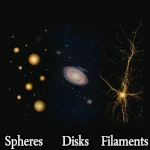 The Three Cosmic Shapes: A Hidden Geometry of the Universe
  Egyptian Astronomy: Between Sky and Nile, the Secrets of Time
  Babylonian Astronomy: When the Sky Predicted Destiny
  Chinese Imperial Astronomy: A Millennial Scientific Legacy
  Extreme Cosmic Objects: Where Physics Explodes
  Mirror Universe: Coexistence of Two Worlds in a Cosmic Reflection
  The first second of our history
  Time Dilation: Relativistic Mirage or Reality?
  Space Through Time: A Constantly Evolving Concept
  The Expanding Universe: What Does "Creating Space" Really Mean?
  From Nothingness to the Cosmos: Why Is There Something Rather Than Nothing?
  How can the Universe measure 93 billion light-years?
  How can we say that the Universe has an age?
  First Proof of the Expansion of the Universe
  Space-time slices of the observable Universe
  When the Universe Was Blind: The Long Night Before the First Stars
  Alternative theories to the accelerated expansion of the universe
  The primitive atom: the first cosmological theory
  Great walls and filaments: the great structures of the Universe
  The Origins of the Universe: A History of Cosmic Representations
  Lyman-alpha Blobs: Gaseous Traces of the First Galaxies
  Perspective on the Inflation of the Universe
  The Planck Universe: the Image of the Universe Becomes Clearer
 The sky is immense with Laniakea
  The Symmetries of the Universe: A Journey Between Mathematics and Physical Reality
  The Geometry of Time: Exploring the Fourth Dimension of the Universe
  How to measure distances in the Universe?
  Why ‘nothing’ is impossible: Do nothingness and emptiness exist?
  The Horizon Problem: Understanding the Uniformity of the Cosmos
  What is Dark Matter? The Invisible Force Shaping the Universe
  Metaverse, the next stage of evolution
  Multiverse: An Ocean where each Spacetime Bubble has its own Physical Laws
  Cosmological Recombination: When the Universe Became Transparent
  Cosmological constants: the fine-tuning of the universe
  The Thermodynamics of the Sandpile and the Avalanche Effect
  The engine of the accelerated expansion of the Universe
  The X-Ray Universe: When Space Becomes Transparent
  The oldest galaxies in the universe
  Hubble constant and expansion of the Universe
  Dark Energy: When the Universe Defies Its Own Gravity
  What is the Size of the Universe? Between Cosmological Horizon and Infinity
  Quantum Vacuum and Virtual Particles: The Physical Reality of Nothingness
  Paradox of the dark night
  Journey into the Heart of Paradoxes: The Enigmas That Revolutionized Science
  Cosmic Microwave Background: The Thermal Echo of the Big Bang