


The Fountains of Creation: The Myth of White Holes
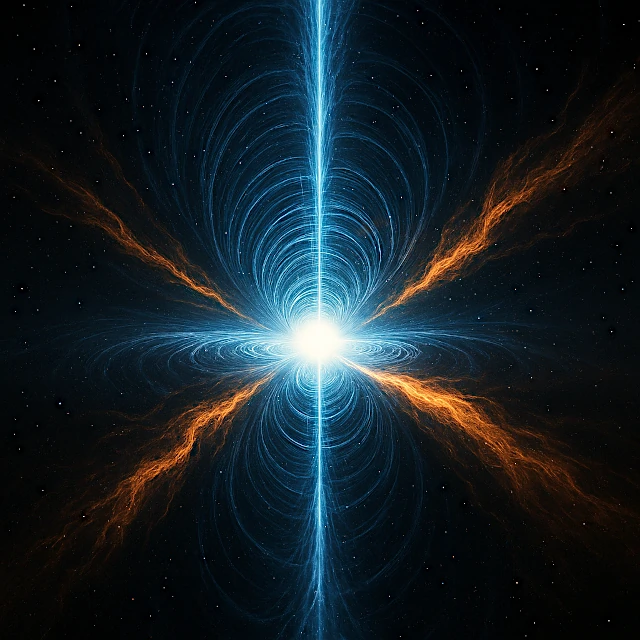
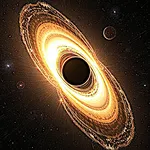
Representation of a relativistic white hole, a hypothetical region of spacetime from which energy and matter would gush.
Unlike a black hole, it appears as an intense luminous source at the center, with streams of plasma and gas escaping to nourish the surrounding space.
Image source: astronoo.com (new window)
Scientific Summary
White holes are mathematical solutions to Einstein's general relativity equations, conceived as the time-reversal of black holes. Unlike black holes which capture all matter and light, a white hole would expel matter and energy from its singularity. However, their physical existence is considered highly unlikely, even impossible, as they would violate the entropy principle (being born in a highly ordered state) and would be unstable (the slightest particle would cause them to collapse into a black hole). No conclusive observation has ever been made.
What are white holes, these "cosmic fountains"?
White holes are mathematical solutions to Einstein's equations of general relativity, conceived as the time-reversal of black holes. Unlike black holes, which capture all matter and light, a white hole would expel matter and energy from its singularity. However, their physical existence is considered highly improbable, even impossible, as they would violate the entropy principle (being born in a highly ordered state) and be unstable (the slightest dust particle would cause them to collapse into a black hole). No conclusive observation has ever been made.
Also worth exploring
Continue your exploration of the Universe with these topics:
The Reverse of the Black Hole
Black holes (region of spacetime whose gravitational field is so intense that no matter or radiation can escape) are now a confirmed cosmic reality. They are gravitational monsters that capture all light and matter.
White holes (theoretical solution to the equations of general relativity, symmetrical to a black hole in time) are imagined as cosmic fountains: their impassable horizon from the inside would spew matter and energy into the cosmos. This concept remains one of the most poetic ideas in physics.
An Idea Born from Equations
The notion of a white hole emerges directly from the solutions to Albert Einstein's (1879-1955) equations. In the 1960s, while exploring the mathematical implications of general relativity, physicists realized that the equations describing a black hole were, from a purely theoretical standpoint, reversible in time.
A black hole is a region where the curvature of spacetime is so extreme that the future of every particle inevitably points toward the central singularity (point of infinite density and infinite curvature of spacetime). If one reverses the arrow of time in these equations, one obtains the description of an object whose past points toward a singularity: that is, an object that would "expel" matter and light from a point of infinite density. This is the mathematical definition of a white hole.
The Problem of Real Existence
While white holes constitute a mathematically coherent solution, their physical existence is deemed highly unlikely, if not impossible, given the known laws of physics. The main obstacle is the entropy principle (second law of thermodynamics: the entropy of an isolated system can only increase or remain constant).
A white hole would be born in a highly ordered state (low entropy) and then expel disorder in the form of matter and energy, which seems to contradict the thermodynamic arrow of time, irreversibly oriented toward increasing disorder. Added to this is a fundamental instability: the slightest cosmic dust particle drifting in its direction would suffice to break its theoretical equilibrium and precipitate its collapse into a black hole.
Cosmic Hypotheses and Speculations
Despite these obstacles, white holes fuel fascinating speculations:
- The Big Bang itself: Some physicists, such as cosmologist Andrei Sakharov (1921-1989), have suggested that the primordial Universe may have exhibited white hole characteristics, exploding from a singularity.
- The "fountains" of quasars: In the 1970s, it was imagined that the immense jets emitted by active galactic nuclei could be linked to white hole-like mechanisms. This idea has largely been replaced by the model of an accretion disk around a supermassive black hole.
- The exit of wormholes: In some theories, a traversable wormhole (hypothetical 'bridge' through spacetime connecting two distant regions) would have a black hole as an entrance and a white hole as an exit. This remains pure science fiction, as traversal would require "exotic matter" with negative energy density to keep the wormhole open.
The Impossible Quest: In Search of White Holes
How to search for an object that most physicists believe is impossible to observe? The search for white holes faces this paradox. It focuses on two fronts: the study of theoretical signatures and the analysis of unexplained cosmic events.
Researchers track unique signals. A genuine white hole would suddenly appear in the sky, emitting a titanic flash of radiation and particles before possibly collapsing. This would resemble a colossal energy explosion, with no apparent cause like a supernova.
Some astrophysicists have hypothesized that short, extremely energetic gamma-ray bursts could fit this profile. The mysterious FRB (fast Radio Burst: a very brief and intense flash of radio waves of cosmic origin) (Fast Radio Burst) or certain anomalies in the cosmic microwave background have also been considered as candidates. To date, no observation has been convincingly attributed to a white hole.
FAQ: Everything about white holes
Where does the idea of white holes come from?
The idea of white holes comes from Einstein's equations of general relativity. In the 1960s, physicists discovered that these equations are time-reversible. If a black hole represents a region where all futures point toward a singularity, its time reversal describes a white hole: a region where all pasts originate from a singularity, expelling matter and light.
Why do physicists think white holes probably don't exist?
Two main reasons argue against their physical existence. First, the entropy principle: a white hole would be born in a highly ordered state (low entropy), violating the thermodynamic arrow of time that irreversibly moves towards disorder. Second, their fundamental instability: the slightest cosmic dust particle would suffice to break their equilibrium and cause them to instantly collapse into a black hole.
Could we ever observe a white hole?
In theory, a white hole would suddenly appear in the sky, emitting a titanic flash of radiation and particles before collapsing. Some astrophysicists have considered that short gamma-ray bursts, fast radio bursts (FRBs), or certain cosmological anomalies could be candidates, but to date, no observation has been convincingly attributed to a white hole.
 Beyond Our Senses: What the Universe Still Hides from Us
  Little Red Dots: The Compact Enigmas of the Early Universe
  The Weak and Strong Anthropic Principles: Two Ways of Reading the Same Universe
  The Universe: Matter... or Information?
  Dark Energy: The Most Mysterious Force in the Universe
  The Fountains of Creation: The Myth of White Holes
  The Great Silence: 10 Insurmountable Walls to Meeting E.T.
  Why the Cause Always Precedes the Effect: The Order of the World is Written in This Principle
  Absolute Zero and Nothingness: Two Limits the Universe Refuses to Reach
  Economical Nature: The Secrets of Conserved Quantities
  The Incredible Precision of the Universe's Laws: Chance or Necessity?
  The Mystery of the Arrow of Time: Why Can't We Go Back?
  The Big Bang: At the Frontiers of the Model
  When Space Bends: The Tiny Slope That Guides the Universe
  Nabataean Astronomy: Masters of the Desert Between Starry Skies and Stone Constructions
  Polynesian Astronomy: The Art of Navigating the Pacific Ocean
  Mesopotamian Astronomy: The Cradle of Celestial Observation
  Andean Astronomy: A Sacred Link Between Sky and Earth
  Ancient Persian Astronomy: Between Babylon and the Islamic Golden Age
  Mayan Astronomy: Celestial Cycles Dictated Religious, Agricultural, and Political Time
  Islamic Astronomy: When Baghdad Illuminated the Sky of Science
  Indian Astronomy: From Sacred Poetry to Scientific Thought
  Ancient Greek Astronomy: The Universe of Philosophers in Search of Cosmic Order
  The Three Cosmic Shapes: A Hidden Geometry of the Universe
  Egyptian Astronomy: Between Sky and Nile, the Secrets of Time
  Babylonian Astronomy: When the Sky Predicted Destiny
  Chinese Imperial Astronomy: A Millennial Scientific Legacy
  Extreme Cosmic Objects: Where Physics Explodes
  Mirror Universe: Coexistence of Two Worlds in a Cosmic Reflection
  The first second of our history
  Time Dilation: Relativistic Mirage or Reality?
  Space Through Time: A Constantly Evolving Concept
  The Expanding Universe: What Does "Creating Space" Really Mean?
  From Nothingness to the Cosmos: Why Is There Something Rather Than Nothing?
  How can the Universe measure 93 billion light-years?
  How can we say that the Universe has an age?
  First Proof of the Expansion of the Universe
  Space-time slices of the observable Universe
  When the Universe Was Blind: The Long Night Before the First Stars
  Alternative theories to the accelerated expansion of the universe
  The primitive atom: the first cosmological theory
  Great walls and filaments: the great structures of the Universe
  The Origins of the Universe: A History of Cosmic Representations
  Lyman-alpha Blobs: Gaseous Traces of the First Galaxies
  Perspective on the Inflation of the Universe
  The Planck Universe: the Image of the Universe Becomes Clearer
 The sky is immense with Laniakea
  The Symmetries of the Universe: A Journey Between Mathematics and Physical Reality
  The Geometry of Time: Exploring the Fourth Dimension of the Universe
  How to measure distances in the Universe?
  Why ‘nothing’ is impossible: Do nothingness and emptiness exist?
  The Horizon Problem: Understanding the Uniformity of the Cosmos
  What is Dark Matter? The Invisible Force Shaping the Universe
  Metaverse, the next stage of evolution
  Multiverse: An Ocean where each Spacetime Bubble has its own Physical Laws
  Cosmological Recombination: When the Universe Became Transparent
  Cosmological constants: the fine-tuning of the universe
  The Thermodynamics of the Sandpile and the Avalanche Effect
  The engine of the accelerated expansion of the Universe
  The X-Ray Universe: When Space Becomes Transparent
  The oldest galaxies in the universe
  Hubble constant and expansion of the Universe
  Dark Energy: When the Universe Defies Its Own Gravity
  What is the Size of the Universe? Between Cosmological Horizon and Infinity
  Quantum Vacuum and Virtual Particles: The Physical Reality of Nothingness
  Paradox of the dark night
  Journey into the Heart of Paradoxes: The Enigmas That Revolutionized Science
  Cosmic Microwave Background: The Thermal Echo of the Big Bang