


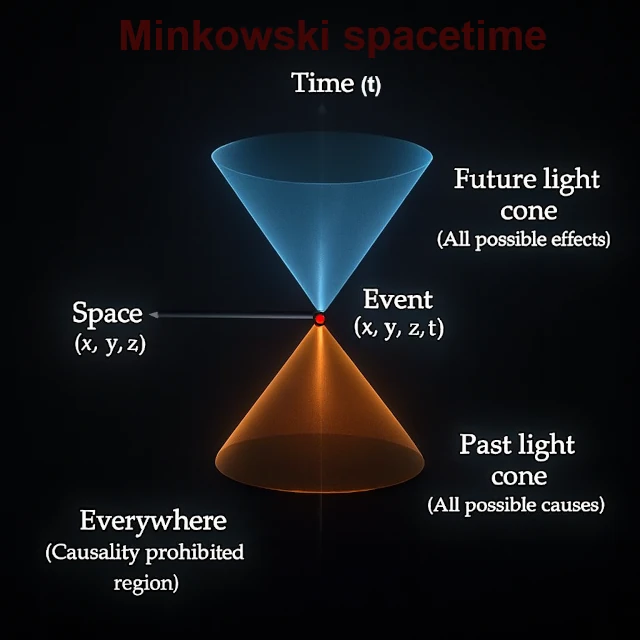
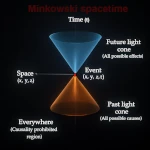
In Einstein's relativity, causality is not a simple imposed rule, but a direct consequence of the geometry of space-time. Around each event, a light cone is defined, delimiting all possible paths of light. One event can influence another only if it lies inside or on the surface of its light cone. Outside (the "spacelike" or "elsewhere" region), no causal interaction is possible because it would require exceeding the speed of light. Thus, the very structure of the universe guarantees that the cause always precedes the effect.
In classical physics, causality (the fact that a cause always precedes its effect) was considered a rule imposed on space and time. Albert Einstein's (1879-1955) vision changed everything.
In special and general relativity, spacetime is not a mere backdrop: it is organized in such a way as to ensure that cause-and-effect relationships always respect a logical order. This organization is embodied by a fundamental geometric object: the light cone. It delimits, around each event, the areas where causes can act and where effects can occur, prohibiting any interaction that would violate the speed of light, and thus, the causal chronology.
Each point in spacetime, each moment in the Universe, is at the apex of a double light cone, thus structuring the limits of its past and future influence.
Imagine an event (such as turning on a flashlight in space). The light cone represents all possible trajectories of light rays emitted by this source. In other words, this geometry determines what is possible and impossible to explain this event. If an event is outside your light cones, it cannot influence you and you cannot influence it. It is causally disconnected from you.
N.B.:
In relativity, the intervals between two events are classified into three fundamental categories: timelike (inside the light cones, where causality is possible), lightlike (on the surface of the cones, accessible only at the speed of light), and spacelike ("elsewhere," outside the cones, where no causal interaction can exist).
The "elsewhere" (spacelike region) is the domain of the causal impossible. Each event has an "elsewhere." This is the zone of mutual exclusion between the double cones of two events that are too far apart in space relative to the time separating them.
Thus, two events separated by a spacelike region cannot be linked by a cause or effect. In the "elsewhere" region, sending a signal or any message would require exceeding the speed of light, which is impossible.
An astronaut on Mars (about 20 light-minutes away) sends a radio message to Earth. During the 20 minutes the message travels, the astronaut and Earth controllers live in causally separated "presents." What Earth does during these 20 minutes cannot affect the astronaut's decision to send the message, and vice versa. They are temporarily in their respective "elsewhere" and neither can be the cause of the other.
Spacetime is a vast fabric woven by intertwined light cones, where each event, each moment, is the center of a double cone that delimits its history and possible future. An organized hubbub, where the very geometry of the Universe ensures that cause and effect never get lost in chaos.
In this sense, spacetime reveals itself through the network of events: without these anchor points where past and future intertwine, the Universe would lose its causal framework and its physical meaning.
For events that are causally linked (one is in the other's light cone), all observers agree on the order of events: the cause always precedes the effect.
For events that are not causally linked, the order can reverse depending on the observer.
Earth and the Moon send a laser beam to each other at exactly the same time t=0. (Earth-Moon distance: ~384,400 km, Speed of light: ~300,000 km/s, Light travel time: ~1.28 seconds).
The principle that the cause always precedes the effect is not just a convention, but a fundamental constraint of spacetime. Light cones, relativity, and the very structure of the Universe make it an inviolable law: without this order, causality would collapse, and with it, our ability to understand reality. In this sense, the arrow of time and the logic of events are not illusions, but the invisible pillars on which the coherence of the world rests.
A light cone is a geometric representation in space-time. Around an event (a precise point in time and space), a double cone is drawn: a past light cone (containing all events that could have influenced the event) and a future light cone (containing all events that the event could influence). The surface of the cone corresponds to the paths of light. Any event inside the cones is causally connected (timelike). Any event outside is causally disconnected (spacelike or "elsewhere").
The "spacelike" region (often called "elsewhere") refers to all events that lie outside the light cone of a given event. These events are too far apart in space relative to the time separating them for a causal interaction (cause-effect) to be possible. For a signal to go from one event to another in its "elsewhere" region, it would have to travel faster than light, which is physically impossible. These events are therefore causally disconnected.
No, not always. Relativity teaches us that the order of events can vary depending on the observer, with one essential condition: this is only possible for events that are not causally linked, i.e., located in each other's "elsewhere" region. However, if two events are causally linked (one is in the other's light cone), then all observers agree on the order: the cause always precedes the effect. This property guarantees the consistency of physics.
 The Weak and Strong Anthropic Principles: Two Ways of Reading the Same Universe
  The Universe: Matter... or Information?
  Dark Energy: The Most Mysterious Force in the Universe
  The Fountains of Creation: The Myth of White Holes
  The Great Silence: 10 Insurmountable Walls to Meeting E.T.
  The 5 Cosmic "End of the World" Scenarios (and Why They Won't Happen)
  Why the Cause Always Precedes the Effect: The Order of the World is Written in This Principle
  Absolute Zero and Nothingness: Two Limits the Universe Refuses to Reach
  Economical Nature: The Secrets of Conserved Quantities
  The Incredible Precision of the Universe's Laws: Chance or Necessity?
  The Mystery of the Arrow of Time: Why Can't We Go Back?
  The Big Bang: At the Frontiers of the Model
  When Space Bends: The Tiny Slope That Guides the Universe
  Nabataean Astronomy: Masters of the Desert Between Starry Skies and Stone Constructions
  Polynesian Astronomy: The Art of Navigating the Pacific Ocean
  Mesopotamian Astronomy: The Cradle of Celestial Observation
  Andean Astronomy: A Sacred Link Between Sky and Earth
  Ancient Persian Astronomy: Between Babylon and the Islamic Golden Age
  Mayan Astronomy: Celestial Cycles Dictated Religious, Agricultural, and Political Time
  Islamic Astronomy: When Baghdad Illuminated the Sky of Science
  Indian Astronomy: From Sacred Poetry to Scientific Thought
  Ancient Greek Astronomy: The Universe of Philosophers in Search of Cosmic Order
  The Three Cosmic Shapes: A Hidden Geometry of the Universe
  Egyptian Astronomy: Between Sky and Nile, the Secrets of Time
  Babylonian Astronomy: When the Sky Predicted Destiny
  Chinese Imperial Astronomy: A Millennial Scientific Legacy
  Extreme Cosmic Objects: Where Physics Explodes
  Mirror Universe: Coexistence of Two Worlds in a Cosmic Reflection
  The first second of our history
  Time Dilation: Relativistic Mirage or Reality?
  Space Through Time: A Constantly Evolving Concept
  The Expanding Universe: What Does "Creating Space" Really Mean?
  From Nothingness to the Cosmos: Why Is There Something Rather Than Nothing?
  Glossary of Astronomy and Astrophysics: Key Definitions and Fundamental Concepts
  How can the Universe measure 93 billion light-years?
  How can we say that the Universe has an age?
  First Proof of the Expansion of the Universe
  Space-time slices of the observable Universe
  When the Universe Was Blind: The Long Night Before the First Stars
  Alternative theories to the accelerated expansion of the universe
  The primitive atom of Abbot Georges Lemaître
  Great walls and filaments: the great structures of the Universe
  The Origins of the Universe: A History of Cosmic Representations
  Lyman-alpha Blobs: Gaseous Traces of the First Galaxies
  Gamma-Ray Bursts: The Ultimate Breath of Giant Stars
  Perspective on the Inflation of the Universe
  The Planck Universe: the Image of the Universe Becomes Clearer
 The sky is immense with Laniakea
  The Symmetries of the Universe: A Journey Between Mathematics and Physical Reality
  The Geometry of Time: Exploring the Fourth Dimension of the Universe
  How to measure distances in the Universe?
  Why ‘nothing’ is impossible: Do nothingness and emptiness exist?
  The Horizon Problem: Understanding the Uniformity of the Cosmos
  What is Dark Matter? The Invisible Force Shaping the Universe
  Metaverse, the next stage of evolution
  Multiverse: An Ocean of Expanding Space-Time Bubbles
  Cosmological Recombination: When the Universe Became Transparent
  The cosmological and physical constants of our Universe
  The Thermodynamics of the Sandpile and the Avalanche Effect
  The engine of the accelerated expansion of the Universe
  The X-Ray Universe: When Space Becomes Transparent
  The oldest galaxies in the universe
  Hubble constant and expansion of the Universe
  Dark Energy: When the Universe Defies Its Own Gravity
  What is the Size of the Universe? Between Cosmological Horizon and Infinity
  Quantum Vacuum and Virtual Particles: The Physical Reality of Nothingness
  Paradox of the dark night
  Journey into the Heart of Paradoxes: The Enigmas That Revolutionized Science
  Cosmic Microwave Background: The Thermal Echo of the Big Bang