


The Weak and Strong Anthropic Principles: Two Ways of Reading the Same Universe
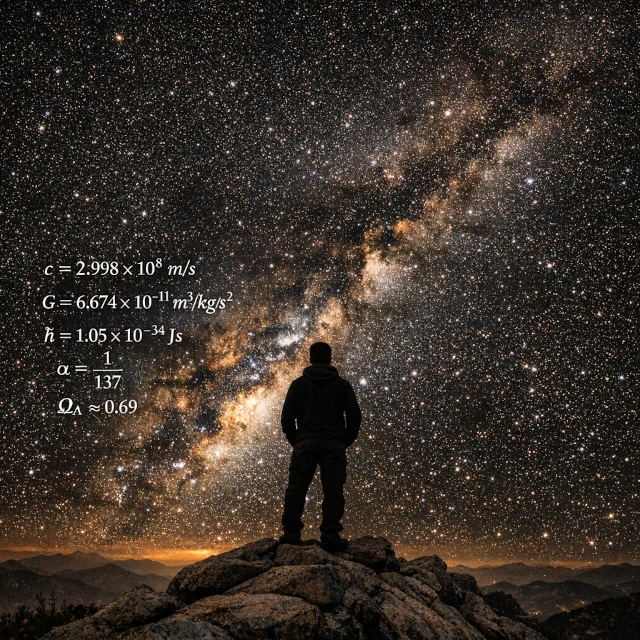
An observer contemplating a cosmos whose physical constants seem precisely calibrated to allow their existence.
The anthropic principle invites us to reverse the question: it is not the Universe that created us by chance, but perhaps our very existence that selects the universes where we can ask the question.
Image source: astronoo.com (new window)
Scientific Summary
The anthropic principle, formulated by Brandon Carter in 1973, addresses the fine-tuning of the Universe. Its weak version (WAP) is a selection bias: we observe a universe compatible with our existence because we could not exist in another. This version is logically sound and widely accepted. The strong version (SAP) is more controversial, suggesting a cosmic necessity or a multiverse to explain physical constants. The debate touches on epistemology and the testability of fundamental physics, without settling the ultimate nature of this apparent fine-tuning.
Why does the Universe seem so finely tuned for life to exist?
The Universe displays a set of physical constants so precisely adjusted that the slightest variation would make the emergence of stars, planets, and life impossible. The anthropic principle then suggests a puzzling idea: if we observe a cosmos compatible with our existence, it may simply be because only such universes allow observers to arise. An intuition that opens a dizzying question about the very nature of this fine‑tuning.
Also worth exploring
Continue your exploration of the Universe with these topics:
A dizzying question: why is the Universe so finely tuned?
Among all the questions raised by modern cosmology, few are as unsettling as this one: why do the fundamental constants of physics have precisely the values that allow the existence of complex matter, stars, planets, and ultimately beings capable of questioning their own origin?
If the gravitational constant were slightly stronger, stars would collapse too quickly to forge the heavy atoms necessary for the chemistry of life. If the strong nuclear force were slightly weaker, atomic nuclei would not form. If the cosmological constant had a slightly different value, the Universe would either have collapsed in on itself or diluted too rapidly to allow any structure to form. This apparent fine-tuning has led physicists to formulate what is known as the anthropic principle (principle according to which the observed properties of the Universe must be compatible with the existence of observers).
The original formulation: Brandon Carter and the 1973 revolution
It was the British cosmologist Brandon Carter (1942-) who, during a symposium in Krakow in 1973 marking the 500th anniversary of the birth of Nicolaus Copernicus (1473-1543), first rigorously formulated the anthropic principle. The irony was deliberate: while Copernicus had removed humanity from the center of the Universe, Carter suggested that a certain form of epistemological centrality remained inevitable.
Carter immediately distinguished two versions of the principle, with very different philosophical implications. The first, cautious and logically unassailable, is the weak version. The second, ambitious and controversial, is the strong version. These two readings of the same cosmological observation have fueled debates that have not ceased since.
The Weak Anthropic Principle: a selection, not an explanation
The weak anthropic principle (version of the anthropic principle stating that our observations are necessarily biased by the conditions required for our existence) (WAP) is formulated as follows: our observations of the Universe are necessarily biased by the fact that we can only observe from a position compatible with our existence.
In other words, we should not be surprised that the Universe is as we see it, because if the conditions had not been met for our existence, we would not be here to observe it. This is a selection bias (bias introduced by the fact that any observer necessarily selects an environment compatible with their own existence) argument, analogous to that of a survivor wondering about their good fortune: the dead cannot testify to their bad luck.
Example 1: our position in the Galaxy
We live about 26,000 light-years from the galactic center, neither too close nor too far. Near the center, gamma-ray bursts would have sterilized any planetary surface; too far, the low abundance of heavy elements would have prevented the formation of rocky planets. The WAP simply responds: we can only find ourselves in the galactic habitable zone (annular zone of a galaxy where conditions are sufficiently stable and rich in heavy elements to allow the emergence of complex life). Our galactic address is not a lucky coincidence: it is a necessary condition for our existence.
Example 2: the age of the Universe
Why do we live about 13.8 billion years after the Big Bang? Stars first had to synthesize heavy elements, explode as supernovae, and then a second generation of stars had to form rocky planets on which life could evolve over billions of years. All this takes about 10 billion years, and a younger Universe would not yet have allowed our emergence. There is therefore nothing mysterious about the age we observe: it is the shortest possible for us to be here to measure it.
Example 3: the proton-electron mass ratio
The mass of the proton is about 1,836 times greater than that of the electron. Without this precise balance, chemical bonds could not form, and with them any molecule capable of storing genetic information. The WAP does not say that this ratio "had to" be 1,836: it simply says that any conscious being who asks this question finds themselves, by construction, in a universe where this ratio allows organic chemistry (chemistry of complex carbon-based molecules, the foundation of all known forms of life). The astonishment at this figure is an illusion born from forgetting our condition as selected observers.
The WAP is generally accepted by the scientific community because it only applies rigorous statistical reasoning. It does not predict that the Universe had to be as it is; it only explains why, among all possible universes or all possible regions of a universe, we necessarily find ourselves in a region compatible with our existence.
The weak WAP does not require the existence of other universes to be valid.
The Strong Anthropic Principle: does the Universe have a purpose?
The strong anthropic principle (version of the anthropic principle stating that the Universe must have the properties necessary to allow the emergence of observers at some point in its history) (SAP) goes much further. In Carter's formulation, it states: The Universe "must" have the properties that allow the emergence of life within it at some point in its history.
The term "must" suggests a necessity, a constraint that imposes itself on the Universe itself. Several interpretations are possible, some scientific, others frankly metaphysical.
Physical interpretation: the multiverse as an answer
In a physical interpretation, the SAP is associated with the hypothesis of the multiverse (hypothetical ensemble of a multitude of universes with different physical laws, of which ours is but one among countless). If countless universes exist with different physical constants, then it is inevitable that some of them allow the emergence of observers, and that these observers find themselves, by definition, in one of these particular universes. The fine-tuning ceases to be miraculous: it is merely the result of selection within a vast ensemble.
Speculative interpretation: a Universe that observes itself
In a more speculative interpretation, the SAP approaches a form of teleology (philosophical doctrine according to which natural processes tend toward a goal or purpose): the Universe would carry within it the seeds of its own observation. Physicists like John Archibald Wheeler (1911-2008) pushed this idea to the point of suggesting that quantum mechanics, by its appeal to the observer, implies that the Universe cannot exist without conscious beings to "realize" it, which he called the participatory Universe (principle according to which the Universe must necessarily give rise to observers who participate in its reality).
Comparative table: weak SAP vs. strong SAP
The following table summarizes the main differences between the two formulations of the anthropic principle, specifying their scientific status and philosophical implications.
| Criterion | Weak Anthropic Principle (WAP) | Strong Anthropic Principle (SAP) |
|---|---|---|
| Formulation | Our observations are biased by the conditions necessary for our existence. | The Universe must have the properties that allow the emergence of observers. |
| Nature | Selection bias argument (useful tautology) | Statement about cosmic necessity |
| Scientific status | Widely accepted, logically sound | Controversial, difficult to test empirically |
| Implication | Explains why we observe a "fine-tuned" Universe | Suggests a purpose or necessity in the physical laws |
| Link with the multiverse | Compatible, but does not require it | Often invoked to justify it |
| Philosophical risk | May seem trivial or circular | May slide into teleology or metaphysics |
| Reference author | Brandon Carter (1942-), 1973 | Brandon Carter (1942-); John D. Barrow (1952-2020) and Frank J. Tipler (1947-) |
N.B.: The term "anthropic" (from the Greek anthropos, "human being") is actually somewhat misleading. The principle does not specifically concern the human species, but any form of conscious observer capable of questioning the Universe. Some authors prefer to speak of the "bioscopic" principle or the selection principle.
Anthropic principle and contemporary cosmology
In the cosmology of recent decades, the anthropic principle has found particularly fertile ground with the theory of inflation (cosmological theory proposing a very rapid exponential expansion phase of the early Universe) and the notion of the string theory landscape (landscape of possible solutions of string theory, featuring an astronomical number of universes with different physical constants).
String theory predicts the existence of an astronomical number of possible solutions (on the order of \(10^{500}\)), each corresponding to a universe with different physical constants. Physicists like Leonard Susskind (1940-) have argued that this "landscape" of solutions, combined with eternal inflation that creates a multiverse, makes the weak anthropic principle sufficient to explain fine-tuning: we necessarily inhabit one of the rare regions of the multiverse where the constants allow life.
This position is firmly defended by part of the theoretical physics community, but it raises a fundamental objection: if the multiverse is in principle unobservable, is the explanation it provides truly scientific, or does it constitute a form of metaphysics dressed as physics? This debate, which touches on the very foundations of the scientific approach, is far from settled.
A principle with two faces, one enigma
The weak anthropic principle and the strong anthropic principle are not two competing answers to the same question, but two epistemological attitudes toward the same enigma.
The WAP says: "You are surprised that the Universe is habitable? Do not be surprised: if it were not, you would not be here to be surprised." This is reasoning of almost disappointing sobriety, but of impeccable logical rigor. It does not solve the mystery of fine-tuning; it dissolves it: the mystery was merely an illusion of astonishment.
The SAP, on the other hand, says: "The Universe had to be as it is for us to exist." This "had to" opens a door to metaphysics, teleology, the multiverse, or an as-yet-unknown fundamental physics. It stimulates research, but it also risks satisfying too quickly a curiosity that deserves to be kept awake.
Between the two, the debate remains open. If all possible universes exist, we did not have the luck to inhabit the right one: we could only inhabit this one. And perhaps that is its greatest merit: it reminds us that physics, when it touches on our origin, inevitably becomes epistemology: explaining why we are here forces us to define what explaining means.
FAQ
What is the “anthropic principle”?
It is the idea that the Universe must have properties compatible with the existence of observers who can notice it.
Why do we speak of a “fine‑tuned” Universe?
Because many physical constants appear extremely precise, allowing stars, planets, and life to emerge.
Does the anthropic principle imply intention or design?
No. In its weak form, it simply reflects an observation bias: we exist only in a universe where life is possible.
Is the multiverse related to the anthropic principle?
Yes, some theories propose many universes with different laws, only a few of which allow observers to arise.
Is the anthropic principle a scientific theory?
It is more a conceptual framework than a testable theory, helping interpret fine‑tuning.
 Beyond Our Senses: What the Universe Still Hides from Us
  Little Red Dots: The Compact Enigmas of the Early Universe
  The Weak and Strong Anthropic Principles: Two Ways of Reading the Same Universe
  The Universe: Matter... or Information?
  Dark Energy: The Most Mysterious Force in the Universe
  The Fountains of Creation: The Myth of White Holes
  The Great Silence: 10 Insurmountable Walls to Meeting E.T.
  Why the Cause Always Precedes the Effect: The Order of the World is Written in This Principle
  Absolute Zero and Nothingness: Two Limits the Universe Refuses to Reach
  Economical Nature: The Secrets of Conserved Quantities
  The Incredible Precision of the Universe's Laws: Chance or Necessity?
  The Mystery of the Arrow of Time: Why Can't We Go Back?
  The Big Bang: At the Frontiers of the Model
  When Space Bends: The Tiny Slope That Guides the Universe
  Nabataean Astronomy: Masters of the Desert Between Starry Skies and Stone Constructions
  Polynesian Astronomy: The Art of Navigating the Pacific Ocean
  Mesopotamian Astronomy: The Cradle of Celestial Observation
  Andean Astronomy: A Sacred Link Between Sky and Earth
  Ancient Persian Astronomy: Between Babylon and the Islamic Golden Age
  Mayan Astronomy: Celestial Cycles Dictated Religious, Agricultural, and Political Time
  Islamic Astronomy: When Baghdad Illuminated the Sky of Science
  Indian Astronomy: From Sacred Poetry to Scientific Thought
  Ancient Greek Astronomy: The Universe of Philosophers in Search of Cosmic Order
  The Three Cosmic Shapes: A Hidden Geometry of the Universe
  Egyptian Astronomy: Between Sky and Nile, the Secrets of Time
  Babylonian Astronomy: When the Sky Predicted Destiny
  Chinese Imperial Astronomy: A Millennial Scientific Legacy
  Extreme Cosmic Objects: Where Physics Explodes
  Mirror Universe: Coexistence of Two Worlds in a Cosmic Reflection
  The first second of our history
  Time Dilation: Relativistic Mirage or Reality?
  Space Through Time: A Constantly Evolving Concept
  The Expanding Universe: What Does "Creating Space" Really Mean?
  From Nothingness to the Cosmos: Why Is There Something Rather Than Nothing?
  How can the Universe measure 93 billion light-years?
  How can we say that the Universe has an age?
  First Proof of the Expansion of the Universe
  Space-time slices of the observable Universe
  When the Universe Was Blind: The Long Night Before the First Stars
  Alternative theories to the accelerated expansion of the universe
  The primitive atom: the first cosmological theory
  Great walls and filaments: the great structures of the Universe
  The Origins of the Universe: A History of Cosmic Representations
  Lyman-alpha Blobs: Gaseous Traces of the First Galaxies
  Perspective on the Inflation of the Universe
  The Planck Universe: the Image of the Universe Becomes Clearer
 The sky is immense with Laniakea
  The Symmetries of the Universe: A Journey Between Mathematics and Physical Reality
  The Geometry of Time: Exploring the Fourth Dimension of the Universe
  How to measure distances in the Universe?
  Why ‘nothing’ is impossible: Do nothingness and emptiness exist?
  The Horizon Problem: Understanding the Uniformity of the Cosmos
  What is Dark Matter? The Invisible Force Shaping the Universe
  Metaverse, the next stage of evolution
  Multiverse: An Ocean where each Spacetime Bubble has its own Physical Laws
  Cosmological Recombination: When the Universe Became Transparent
  Cosmological constants: the fine-tuning of the universe
  The Thermodynamics of the Sandpile and the Avalanche Effect
  The engine of the accelerated expansion of the Universe
  The X-Ray Universe: When Space Becomes Transparent
  The oldest galaxies in the universe
  Hubble constant and expansion of the Universe
  Dark Energy: When the Universe Defies Its Own Gravity
  What is the Size of the Universe? Between Cosmological Horizon and Infinity
  Quantum Vacuum and Virtual Particles: The Physical Reality of Nothingness
  Paradox of the dark night
  Journey into the Heart of Paradoxes: The Enigmas That Revolutionized Science
  Cosmic Microwave Background: The Thermal Echo of the Big Bang