


Convergent Evolution: chance, necessity… or mirage?
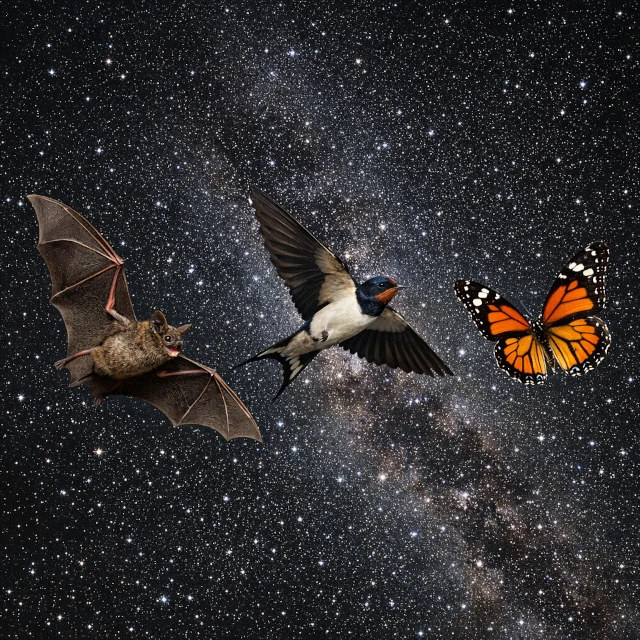
Three wing structures from independent lineages: the bat (mammal), the bird (avian dinosaur) and the butterfly (insect).
Each developed active flight without inheriting it from a common flying ancestor.
Is this troubling convergent evolution not the fruit of chance?
Image source: astronoo.com (new window) - AI-generated image, public domain.
Scientific abstract
The Astronoo article examines convergent evolution, a phenomenon by which independent lineages develop analogous traits in response to comparable environmental constraints. Through examples such as the eye of cephalopods and vertebrates, the flight of birds, bats and insects, or even carcinisation, the author shows that certain morphological and functional solutions reappear recurrently. However, the discovery of shared ancestral genes, such as Pax6, and the phenomenon of atavism suggest that these convergences are not always pure independent inventions, but sometimes the reactivation of ancient genetic programmes. The article thus questions the part played by contingency and necessity in the evolution of life.
Why do species with no evolutionary link end up looking alike?
Because evolution responds to the same constraints with the same solutions: when organisms live in similar environments or face comparable challenges, natural selection pushes them towards analogous forms, functions or behaviours, even if they have no recent common ancestor. This is the principle of convergent evolution, which explains why the dolphin and the ichthyosaur share a hydrodynamic silhouette, why the octopus eye resembles that of vertebrates, or why desert plants develop the same survival strategies. Nature explores countless paths, but the laws of physics and biology often bring solutions back to the same architectures.
Also worth exploring
Continue your exploration of the Universe with these topics:
What is convergent evolution?
A simple definition
Convergent evolution is one of the most fascinating phenomena in evolution. It shows that species from very distant lineages, separated by hundreds of millions of years, can develop astonishingly similar traits. These resemblances, presented as the result of separate evolutions, raise the question of whether the mechanisms invoked are really sufficient to explain such close solutions.
Millions of years reinventing — or repeating — the same wonders
Swimming fast to escape a predator, perceiving light in the depths, conquering the air, withstanding temperature variations, optimising gas exchange in oxygen-poor environments, enduring extreme pressures, saving energy during shortages, detecting chemical signals, or camouflaging to escape predation: so many constraints imposed by the environment.
According to the theory, the evolutionary mechanism, devoid of plan, purpose or design, explores and selects, generation after generation, the most effective solutions. But when very distant lineages seem to arrive at the same answers, again and again, the question arises: does nature really reinvent, or does it follow more signposted paths than we think? Everything happens as if evolution were pushed, almost in spite of itself, to repeat some of its inventions.
An ineluctable tendency… or something that resembles one
This phenomenon seems to challenge the idea of an entirely contingent and haphazard evolution. It would no longer be merely a matter of chance, but of a form of recurrent tendency: natural selection, like an inflexible engineer, would push species towards a limited set of effective solutions. As if the laws of matter and energy imposed, in the background, certain possible forms of life. Wings for flying, eyes for seeing, venoms for neutralising prey… so many innovations that appeared in lineages with no direct link, to the point of suggesting that nature might be following an instruction manual we are only beginning to glimpse.
Stephen Jay Gould's question: chance or the inevitable?
The palaeontologist Stephen Jay Gould (1941–2002), who saw evolution as a largely unpredictable and contingent process, nevertheless recognised that convergence raises a troubling question: what if certain forms of life were not only the product of chance, but also the expression of deeper constraints and perhaps inevitable ones? In his essay Wonderful Life, he imagined "replaying the tape of life" and asked: if evolutionary history began again, would we see the same creatures reappear, or at least the same solutions to the challenges of existence? Convergence seems to suggest a repetition… but also leaves doubt about what, in evolution, really belongs to chance.
A truly predictable diversity?
This idea opens a vertiginous perspective: the diversity of life, despite its apparent profusion, might fit into a framework more predictable than we imagine. The constraints of the physical world would then act as a filter, allowing only certain innovations to emerge, those that, curiously, end up appearing in species with very distant origins. A lesson in humility, perhaps, but also an invitation to ask whether there might exist deeper rules, still poorly understood, that orient the inventiveness of nature.
Table of convergent evolution in the living world — or what resembles it
The table below lists several frequently cited cases of convergent evolution, specifying the groups concerned, their adaptive function, the estimated age of their divergence and a representative example.
| Supposedly convergent trait | So-called independent groups | Adaptive function | Age of divergence | Example & particularity |
|---|---|---|---|---|
| Single-lens eye | Vertebrates / Cephalopods | Image formation | >550 Ma | Human (blind spot) / Cuttlefish (no blind spot): astonishing similarities despite a shared genetic heritage |
| Active flight (wings) | Insects / Pterosaurs / Birds / Bats | Aerial displacement | >350 Ma | Four different body plans, but aerodynamic constraints that seem to impose similar solutions |
| Carcinisation (crab shape) | True crabs / False crabs (anomurans) | Protection, sideways walking | >200 Ma | "Crabification": distant lineages adopt the same silhouette, perhaps under similar constraints |
| Echolocation | Bats / Dolphins / Swiftlets | Navigation and hunting in darkness | >80 Ma | Similar acoustic mechanisms, but sometimes astonishingly convergent genetic bases |
| Camouflage (homochromy) | Insects / Birds / Mammals | Concealment | >300 Ma | Stick insect, orchid mantis, Arctic hare: similar strategies, but biochemical pathways not always independent |
| Paralysing venom | Snakes / Slow worms / Spiders / Scorpions / Frogs | Immobilisation of prey or defence | >200 Ma | Similar toxins, sometimes based on gene families already present in the common ancestor |
| Bioluminescence | Insects / Deep-sea fish / Bacteria / Fungi / Squid | Attraction, lure, camouflage | >500 Ma | Luciferin and luciferase: same chemical reactions, but truly independent origins remain debated |
| Extremophily (radiation resistance) | Archaea / Bacteria / Tardigrades | Extreme resistance | >2.7 Ga | Similar DNA repair mechanisms, perhaps derived from very ancient molecular modules |
The troubled history of vision
An unexpected common ancestor
Among all the examples put forward for convergent evolution, the eye is undoubtedly the most spectacular, and perhaps also the most disconcerting. For the more biologists explore its origins, the more the idea of a simple convergence and obvious seems to become complicated.
The common ancestor of octopuses and humans was a primitive bilateral worm, living about 550 to 600 million years ago (late Precambrian). This animal did not possess a structured eye with lens, retina and pupil, but it was not devoid of all visual equipment either: it already carried rudimentary photoreceptors, the Pax6 gene (master gene of eye development, conserved from the fly to the human via the octopus), a true conductor of ocular development, as well as an ancestral opsin (primitive photosensitive protein common to all animals, molecular precursor of all current visual pigments) shared by the entire animal lineage.
The role of Pax6
This is precisely where the notion of convergence becomes less obvious. When Walter Jakob Gehring (1939–2014) showed in 1983 that injecting the mouse Pax6 gene into a Drosophila could trigger the formation of an eye on an antenna, he revealed that the founding genetic programme of the eye is common to animals separated for hundreds of millions of years. The octopus and the human therefore did not perhaps "reinvent" the eye from nothing: they seem rather to have reactivated, each in their own way, the same ancestral molecular kit, leading to astonishingly similar architectures.
Atavism: a challenge for convergence
What is atavism?
Atavism refers to the reappearance, in a modern organism, of an ancient character that disappeared millions of years ago. This phenomenon shows that certain traits are not really "reinvented" by evolution: they can simply be reactivated from ancestral genetic programmes still present in the genome, but silent. Chickens that develop teeth, whales that reappear with legs, or snakes that manifest limb buds illustrate this capacity of life to reactivate ancient structures rather than recreate them.
Consequences for convergence
Atavism therefore complicates the interpretation of convergent evolution: what is sometimes presented as an independent invention might be only a reactivation of a pre-existing genetic module. In other words, certain "convergences" might not be new solutions imposed by environmental constraints, but possible returns to ancient states inscribed in the deep history of life.
The foundations laid by Darwin remain solid
The three Darwinian pillars
The framework proposed by Charles Darwin (1809–1882) in 1859 rests on three major principles: descent with modification from common ancestors, hereditary variation between individuals, and natural selection as a sorting mechanism. These three pillars are today confirmed by genetics, palaeontology, molecular phylogeny and direct observation. No serious member of the scientific community questions them.
A confirmed and enriched framework
Darwin had grasped the essentials, even if the mechanisms he proposed are no longer sufficient to explain everything. Biology in the 21ste century does not contradict his work: it extends, completes and enriches it, sometimes beyond what we imagined. The contributions of modern genetics and recent palaeontological data confirm the power of the Darwinian framework while nuancing it.
What to remember: convergence vs contingency
A possible predictability
Convergent evolution would show to what extent the environment and physical laws can orient evolution towards solutions that resemble one another, without being entirely left to chance. It thus opens up the possibility — and not the certainty — that forms of extraterrestrial intelligence might emerge elsewhere, if similar constraints are exerted there. Eyes, wings or analogous social structures might then appear… or suggest that life sometimes follows more signposted paths than we imagined.
Irreducible contingency
But this theoretical possibility must not mask a deeper reality: evolutionary trajectories remain largely shaped by unique sequences, impossible to anticipate.
And yet, despite these troubling resemblances, terrestrial life remains the product of an extraordinarily contingent history (in evolution, contingency designates the unique and non-reproducible character of a sequence of events: a history that happens only once and cannot be replayed identically.), shaped by a succession of improbable and non-reproducible events. Nothing suggests that this journey, with its ruptures, accidents and detours, could be reproduced elsewhere; everything suggests on the contrary that it is specific to Earth and to its unique history.
References
- Wikipédia — Convergence évolutive (new window)
- Wikipedia - Convergent evolution (new window)
- Van Belleghem et al. — High level of novelty under the hood of convergent evolution, Science (2022) (new window)
- Wu, Wang & Xu — Convergent adaptive evolution: how common, or how rare?, National Science Review (2020) (new window)
- Stayton — What does convergent evolution mean?, Philosophical Transactions of the Royal Society B (new window)
- Grossnicklaus et al. — Quantification provides a conceptual basis for convergent evolution, Biological Reviews (new window)
- Losos — Toward a Predictive Framework for Convergent Evolution, Integrative and Comparative Biology (2017) (new window)
- Feiner et al. — Plasticity and evolutionary convergence in Greater Antillean Anolis lizards, eLife (2020) (new window)
- Anderson — The evolution of flight in bats: a novel hypothesis, Mammal Review (2020) (new window)
- Convergent evolution: mechanisms and limits of evolution — veterinary thesis (DUMAS, French) (new window)
FAQ – Convergent evolution
What is convergent evolution?
Convergent evolution refers to the independent appearance of similar traits in species that do not have a recent common ancestor. These resemblances result from comparable environmental pressures that orient evolution towards analogous solutions.
Does convergence imply "programmed" evolution?
No. Convergence is not a pre-established plan: it emerges from physical, biological and ecological constraints that limit the number of viable solutions. Evolution remains a contingent process, but not unlimited.
Why do different species develop the same forms?
Because certain forms are particularly effective at solving similar problems: swimming fast, flying, seeing in the dark, resisting pressure, etc. The environment acts as a filter that selects the most efficient solutions.
Does convergence prove that evolution follows predictable paths?
It suggests a degree of predictability: faced with the same constraints, organisms tend to evolve towards comparable architectures. But the diversity of life also shows that many trajectories remain possible.
What are the best-known examples of convergent evolution?
The wings of birds, bats and insects; the eyes of cephalopods and vertebrates; the hydrodynamic forms of fish, dolphins and ichthyosaurs; or the social strategies of ants and termites.
Does convergent evolution also concern intelligence?
Yes. Several lineages have developed advanced forms of cognition: cephalopods, corvids, primates, marine mammals. This suggests that intelligence can emerge independently when ecological conditions favour it.
Can convergence help understand life elsewhere in the Universe?
It offers a heuristic framework: if certain solutions are universally effective, they might reappear on other worlds subject to similar constraints. This guides hypotheses in exobiology.
Does convergent evolution contradict the theory of evolution?
On the contrary. It is a natural consequence of it: natural selection explores a space of possibilities limited by the laws of physics, chemistry and biology. Convergence illustrates the power of these constraints.
 The Paleocene-Eocene Transition: When Earth's Climate Suddenly Changed
  The Principle of Least Action: Why Does Nature Always Choose the Most Economical Path?
  Evolutionary Convergence: Chance, Necessity… or Mirage?
  The Five Mass Extinctions: What do these planetary catastrophes reveal?
  Cryosphere: when the ice giants still protect us
 The Nitrogen Cycle: From Air to Life
  The Jet Stream: When the Atmospheric River Overflows Its Banks
  The Carbon Cycle: The Harmonious Interaction of Oceans, Forests, and Subsoils
  The Water Paradox: Without it, no life
  Why did alternating current prevail?
 Evolution of Global Energy Consumption: From Steam Engines to Digital Servers
  The Demographic Transition: Growth or Decline?
  Lake Agassiz: A Deluge that Changed the Climate
  Drunken Forests: Understanding the Phenomenon of Permafrost Thaw
  There is Electricity in the Air!
  Why Doesn't CO2 Fall to the Ground?
  El Niño and La Niña: the two climatic phenomena of the Pacific
  Endangered Species: Dynamics of Extinction
  The Toxic Legacy of Acid Rain
  Major societal collapses: key periods and causes
  Global Warming in Figures: What the Scientific Data Says
  What is Sustainable Development?
  The Hottest Years Since Records Began
  Magnitude of upcoming climate change
  Earth in Crisis: Collapse or Renaissance?
  Ice on Borrowed Time: The Inexorable Decline of Arctic Sea Ice
  Earth's Water Reservoirs: From Oceans to Groundwater
  Sea Levels Are Rising, But How Fast?
  The Other Climate Threat: Earth Shrouded in Shadow and Humidity
  The Age of the Sahara: From Green Prairie to Stone Desert
  World Population from 1800 to 2100
  Oil: The Fall of a Giant in the Era of Renewable Energy
  Kamchatka King Crab: A Giant of the Oceans
  The collapse of a society
  Slight Progress in the Global Ecological Footprint
  The South Atlantic Anomaly
  The phenomenon of soil sinking is called subsidence
  The Planet's New Clouds