


Cryosphere: When Ice Giants Still Protect Us
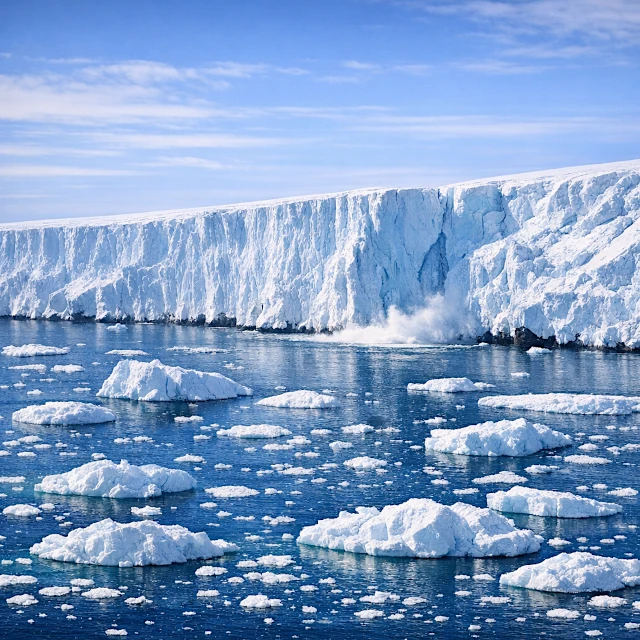
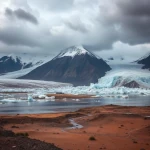
A glacial landscape where an imposing glacier front plunges into a sea dotted with icebergs.
The immaculate whiteness contrasts with the deep blue of the water.
This expanse of ice, which seems eternal, is in reality a dynamic and vulnerable actor of the Earth system.
Image source: astronoo.com (new window) - AI-generated image, public domain.
Scientific Abstract
The Astronoo article presents the cryosphere, the set of terrestrial surfaces where water is in solid state. It explains the role of sea ice, ice sheets, glaciers and permafrost in climate regulation. Albedo, thermohaline circulation and climate feedbacks are detailed. Satellite data from GRACE and ice cores from Vostok and EPICA show accelerated melting and unprecedented CO₂ concentrations. The impacts on sea level and tipping points, such as the Thwaites Glacier and permafrost, are examined. The article concludes on the urgency to act to preserve these ice giants.
What role does the cryosphere play in Earth's climate and why does its melting threaten us?
This article is devoted to the cryosphere, that is, all of Earth's ice: sea ice, polar ice caps, mountain glaciers, snow and permafrost. But what role does it play exactly in the climate, and why does its melting threaten us? The answer lies first in its capacity to reflect solar radiation. With a high albedo, ice sends a large part of the energy back to space and cools the planet. By melting, it gives way to dark surfaces, oceans or soils, which absorb more heat: this is the albedo-temperature feedback. The cryosphere also regulates the oceans. The formation of sea ice rejects salt and creates dense waters that sink to the depths, feeding the thermohaline circulation. Without it, the ocean currents that redistribute heat would be disrupted. Finally, the Greenland and Antarctic ice sheets store immense volumes of fresh water. Their accelerated melting raises sea level and threatens coastlines. Ice archives show that current CO₂ exceeds levels known for millions of years. Preserving the cryosphere has therefore become a climate imperative.
Also worth exploring
Continue your exploration of the Universe with these topics:
What is the cryosphere?
Definition and composition of the cryosphere
The cryosphere designates all terrestrial surfaces where water is in solid state. Sea ice, ice sheets, valley glaciers, permafrost and seasonal snow: all these elements constitute what climatologists call the planet's "refrigerator". Far from being passive, these ice giants interact permanently with the atmosphere and oceans. They form a regulation system of formidable efficiency, but fragile. Their accelerated disappearance, observed since the beginning of the 20th century, is one of the clearest signals of ongoing climate disruption.
Albedo, a reflecting shield
The most immediate function of the cryosphere relies on albedo. This term, from Latin albus (white), measures the capacity of a surface to reflect solar radiation. With a typical albedo between 0.7 and 0.9, fresh ice and snow send back to space 70% to 90% of the solar energy they receive. Conversely, the dark ocean, with an albedo of about 0.1, absorbs 90% of this energy. As ice retreats, it gives way to water that captures heat, warming the polar region and accelerating melting. This self-sustaining mechanism has a name: the albedo-temperature feedback.
The role of thermal and oceanic regulator
Sea ice formation and brine rejection
Beyond the simple mirror effect, ice sheets and sea ice directly influence global ocean circulation. This phenomenon, often overlooked, is nevertheless fundamental. The formation of sea ice expels the salt contained in liquid water, a process called brine rejection (release of dense brine during seawater freezing). The underlying water then becomes colder and saltier, therefore denser. This dense water sinks toward the abyss, initiating what oceanographers call the thermohaline circulation.
Thermohaline circulation and global climate
This immense oceanic conveyor belt redistributes heat on a planetary scale. Without ice formation in the North Atlantic and around Antarctica, the circulation would be disrupted, with major consequences for the climate of Europe, North America and tropical regions. According to current projections, the weakening of this density pump, caused by accelerated ice melting, could disrupt major ocean currents as early as the end of this 21st century.
When the giants melt: impacts on sea level
Sea ice and land ice sheets: distinct effects
One of the most tangible consequences of the melting of ice giants is sea level rise. But be careful: not all ice is equal. Sea ice, because it already floats on water, obeys Archimedes' principle. Its melting does not directly raise ocean level. It is the disappearance of land ice sheets, such as those of Greenland and Antarctica, that constitutes the real danger.
Greenland, Antarctica and GRACE satellites
The Greenland ice sheet contains the equivalent of 7.4 meters of potential sea level rise. The Antarctic ice sheet, much vaster, contains nearly 58 meters. To measure these infinitesimal but global changes, science uses satellites like GRACE (Gravity Recovery and Climate Experiment). These satellites measure the tiny variations of Earth's gravity field, directly linked to mass transfers, in particular ice melting.
The following table compares the main terrestrial ice reservoirs and their potential contribution to sea level rise.
| Ice reservoir | Location | Ice volume (million km³) | Potential sea level rise (meters) | Recent trend (annual loss) |
|---|---|---|---|---|
| Antarctic Ice Sheet (total) | South Pole | ~ 26.5 | ~ 58.0 | ~ 150 gigatonnes (2010-2020) |
| Antarctic Ice Sheet (East) | East Antarctica | ~ 23.0 | ~ 52.0 | Moderate loss, partly compensated |
| Antarctic Ice Sheet (West) | West Antarctica | ~ 3.2 | ~ 5.0 | Accelerated loss, vulnerable glaciers |
| Greenland Ice Sheet | Arctic (Northern Hemisphere) | ~ 2.9 | ~ 7.4 | ~ 280 gigatonnes (2010-2020) |
| Mountain glaciers and minor ice caps | Himalaya, Andes, Alaska, Alps... | ~ 0.2 | ~ 0.5 | Rapid and well-documented loss |
N.B.:
One gigatonne (Gt) corresponds to one billion tonnes.
It represents the equivalent of one cubic kilometer of water.
Values are from IPCC reports (2021-2023) and GRACE mission data.
Climate archives: ice cores to read the past
Fossil air bubbles in ice
Ice giants are also incomparable natural archives. By drilling into the Greenland or Antarctic ice sheet, glaciologists extract ice cores that contain air bubbles trapped for hundreds of thousands of years. Analysis of these bubbles reveals the past composition of the atmosphere, notably concentrations of greenhouse gases such as carbon dioxide (CO₂) and methane (CH₄).
Vostok and EPICA: 800,000 years of history
One of the most famous results comes from the Russian station Vostok, in Antarctica. Cores drilled in the 1990s made it possible to reconstruct climate history over more than 420,000 years, covering four glacial-interglacial cycles. These data showed a close correlation between temperatures, deduced from the isotopic composition of water (\( \delta^{18}O \)), and CO₂ and CH₄ levels.
The EPICA project (European Project for Ice Coring in Antarctica) pushed the horizon of continuous ice archives to 800,000 years. The deepest ice, near Dome C, tells us of a world where the atmosphere never exceeded 280 ppm of CO₂. Yet, in 2026, we exceed 420 ppm, a value without equivalent for at least 3 million years. To go further back in time, scientists rely on other archives (marine sediments, fossils). These reveal that one must go back about 3 million years, to the Middle Pliocene, to find CO₂ levels as high as today.
N.B.:
\( \delta^{18}O \) measures the variation of the ratio between the heavy isotope of oxygen (18O) and the light isotope (16O) in a water (or ice) sample, relative to an international standard (generally mean ocean water, noted SMOW for Standard Mean Ocean Water)
Tipping points: when the regulation system runs away
What is a tipping point?
Climatologists dread the activation of a tipping point caused by a bifurcation in mathematical models. It is a threshold beyond which a change becomes self-sustaining and irreversible (point of no return) on a human scale. The cryosphere is at the heart of several of these mechanisms.
- The albedo effect in the Arctic: the disappearance of summer sea ice (expected before 2050) will replace reflective ice with a dark ocean, amplifying Arctic warming by 20 to 40%. The Arctic is already warming three to four times faster than the global average, a phenomenon called Arctic amplification.
- The collapse of Antarctic glaciers: the Thwaites Glacier, nicknamed the "Doomsday Glacier", could disintegrate within decades to centuries, releasing a mass of ice sufficient to raise sea level by 65 cm on its own. Its collapse would then destabilize the entire West Antarctic basin, adding several meters.
- The release of permafrost: the thawing of permanently frozen ground (permafrost) releases immense quantities of carbon and methane, creating a formidable positive feedback. Northern Hemisphere permafrost contains about 1,500 gigatonnes of carbon, nearly double what is currently present in the atmosphere.
Critical thresholds for the cryosphere
The scientific community agrees on one point: a warming maintained between +1.5 °C and +2.0 °C could activate several cryosphere tipping points. With a current trajectory of +2.7 °C by the end of the century, the ice giants would enter a regime of self-sustaining degradation, whose consequences would extend over several millennia.
Preserving the ice giants: a challenge for humanity
A message from the ice
The cryosphere has been sending us a clear message for several decades. Antarctic ice cores contain the history of our planet, but also the most solemn warning. These ice giants, which regulated the global climate for millions of years, are today weakened by our activity.
Acting in the coming years
The fate of the ice giants (polar ice sheets, glaciers, sea ice) depends directly on the decisions that humanity will make in a very near future (the coming years), and not in a distant future.
References
FAQ: Everything you need to know about the cryosphere
What is the cryosphere?
The cryosphere is the set of terrestrial surfaces where water is in solid state: sea ice, ice sheets, glaciers, snow and permafrost. It covers about 10% of the globe's surface, but its influence on the climate is planetary. It stores enormous quantities of fresh water and plays a key role in thermal regulation.
Why is the cryosphere essential to the climate?
Because it reflects a large part of solar radiation thanks to its high albedo. It thus limits warming of the polar regions. Moreover, sea ice formation feeds the thermohaline circulation, which redistributes heat on a global scale. Without it, climate equilibria would be profoundly disrupted.
What is the difference between sea ice and an ice sheet?
Sea ice is floating sea ice, formed by the freezing of salt water. Its melting does not directly raise sea level. An ice sheet is a mass of continental ice, resting on land, as in Greenland or Antarctica. Its melting contributes directly to sea level rise.
How does ice melting affect sea level?
The melting of polar ice sheets and mountain glaciers adds fresh water to the oceans. Greenland contains enough to raise the seas by 7.4 meters, and Antarctica by nearly 58 meters. Even a fraction of this melting is enough to threaten coastal zones and coastal populations.
What is a climate tipping point in the cryosphere?
A tipping point is a threshold beyond which a change becomes self-sustaining and difficult to reverse. In the cryosphere, the collapse of the Thwaites Glacier or the thawing of permafrost are examples. Once triggered, these processes can accelerate without possible return on a human scale.
What can be done to preserve the ice giants?
The priority is to drastically reduce greenhouse gas emissions to limit warming. This involves energy transition, protection of carbon sinks and adaptation of societies. Every fraction of a degree avoided reduces the risk of activating tipping points and preserves the balance of the cryosphere.
 The Paleocene-Eocene Transition: When Earth's Climate Suddenly Changed
  The Principle of Least Action: Why Does Nature Always Choose the Most Economical Path?
  Evolutionary Convergence: Chance, Necessity… or Mirage?
  The Five Mass Extinctions: What do these planetary catastrophes reveal?
  Cryosphere: when the ice giants still protect us
 The Nitrogen Cycle: From Air to Life
  The Jet Stream: When the Atmospheric River Overflows Its Banks
  The Carbon Cycle: The Harmonious Interaction of Oceans, Forests, and Subsoils
  The Water Paradox: Without it, no life
  Why did alternating current prevail?
 Evolution of Global Energy Consumption: From Steam Engines to Digital Servers
  The Demographic Transition: Growth or Decline?
  Lake Agassiz: A Deluge that Changed the Climate
  Drunken Forests: Understanding the Phenomenon of Permafrost Thaw
  There is Electricity in the Air!
  Why Doesn't CO2 Fall to the Ground?
  El Niño and La Niña: the two climatic phenomena of the Pacific
  Endangered Species: Dynamics of Extinction
  The Toxic Legacy of Acid Rain
  Major societal collapses: key periods and causes
  Global Warming in Figures: What the Scientific Data Says
  What is Sustainable Development?
  The Hottest Years Since Records Began
  Magnitude of upcoming climate change
  Earth in Crisis: Collapse or Renaissance?
  Ice on Borrowed Time: The Inexorable Decline of Arctic Sea Ice
  Earth's Water Reservoirs: From Oceans to Groundwater
  Sea Levels Are Rising, But How Fast?
  The Other Climate Threat: Earth Shrouded in Shadow and Humidity
  The Age of the Sahara: From Green Prairie to Stone Desert
  World Population from 1800 to 2100
  Oil: The Fall of a Giant in the Era of Renewable Energy
  Kamchatka King Crab: A Giant of the Oceans
  The collapse of a society
  Slight Progress in the Global Ecological Footprint
  The South Atlantic Anomaly
  The phenomenon of soil sinking is called subsidence
  The Planet's New Clouds