


The Principle of Least Action: Why Does Nature Always Choose the Most Economical Path?
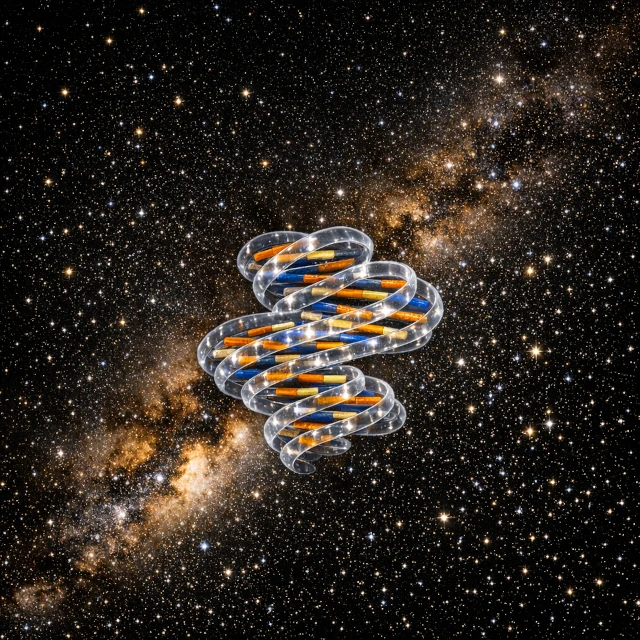
From the DNA helix to the structure of galaxies, nature saves energy without calculating.
Image source: astronoo.com (new window)
Why Does Nature Always Follow the Path of Least Action?
Because at all scales, nature evolves by minimizing a quantity called "action": whether it's the folding of a protein, the growth of a tree, or the formation of a galaxy, physical and biological systems spontaneously follow the most "economical" trajectory in terms of energy. This principle, first formulated by Maupertuis and later unified by Euler, Lagrange, and Hamilton, reveals a deep law: the Universe does not choose the shortest or simplest path, but the one that optimizes the difference between kinetic and potential energy over time. From the quantum world to cosmic structures, this minimization of action weaves an invisible coherence that organizes matter and life.
A Universal Principle, from the Infinitely Small to the Infinitely Large
An electron "choosing" its orbit, a protein folding in a few microseconds, a tree whose roots direct toward water, a river carving its bed, or a galaxy spiraling: all these phenomena, as varied as they are, obey a single fundamental law, the principle of least action.
A Gradual Discovery
This principle, whose origins date back to the 18th century, states that nature always favors the path that minimizes a quantity called action.
First formulated by Pierre Louis Maupertuis (1698-1759) in 1744, then refined by Leonhard Euler (1707-1783) and Joseph-Louis Lagrange (1736-1813), the principle acquired its definitive form with William Rowan Hamilton (1805-1865) in the 19th century (19th century).
From the Tangled Protein to the Functional Structure
A nascent protein is a disordered molecular chain, tossed by thermal agitation. Yet, in a fraction of a second, it folds into a precise and stable three-dimensional structure. This folding is not the result of chance.
An Energy Landscape Shaped by Evolution
Over the course of evolution, the cell has selected amino acid sequences whose energy landscape has a deep minimum, a state of low energy, like a ball rolling to the bottom of a valley. This low-energy conformation (3D structure) corresponds to the three-dimensional structure where the protein is biologically active and performs its function, such as catalyzing reactions or transmitting signals.
Minimizing a Generalized Action
In reality, the protein always takes the "most efficient path" to fold, as if it were trying to spend the least energy possible while reaching its most stable conformation. This process amounts to minimizing a generalized action. This is obtained by adding, at each moment of the movement, the difference between the kinetic energy \( T \) and the potential energy \( V \). This sum over time is none other than the integral of the Lagrangian \( \mathcal{L} = T - V \).
The Mathematical Formulation of the Principle
Mathematically, this is written as \( S = \int_{t_1}^{t_2} (T - V) \, dt \).
The principle of least action states that the trajectory actually followed by the protein is the one that makes this sum minimal.
From the Leafy Canopy to Optimal Architecture
A tree is a living structure in perpetual growth, pulled between the need to capture light, absorb water, and resist the wind. Yet, despite this complexity, the tree develops a remarkably balanced architecture. This organization is not the result of chance.
Natural Selection Oriented Toward Economy
Over the course of evolution, natural selection has favored trees whose branching and root systems minimize energy costs. The landscape of hydraulic and mechanical constraints has a deep minimum, a state of equilibrium where the tree spends the least energy possible to ensure its survival. This optimal configuration corresponds to an architecture where sap circulation is maximized for minimal structural investment.
The Tree, a System that Minimizes its Action
In reality, the tree always takes the "most efficient path" to deploy its branches and roots, as if it were trying to spend the least energy possible while ensuring its growth and stability. This process amounts to minimizing a generalized action. This is obtained by adding, at each moment of development, the difference between the kinetic energy (related to sap flow and growth) and the potential energy (related to the position of branches and mechanical constraints). This sum over time is none other than the integral of the Lagrangian \( \mathcal{L} = T - V \), adapted to biological systems.
From Physical Principle to Forest Ecosystem
The principle of least action applied to the forest suggests that the growth trajectory actually followed by each tree, and by the entire ecosystem, is the one that makes this sum minimal, thus ensuring maximum efficiency in the use of available resources.
From the Gas Disk to the Galactic Spiral
A cloud of gas and dust, vast and diffuse, slowly contracts under the effect of its own gravity. Yet, over millions of years, this primordial chaos organizes itself into a majestic, flat, and swirling structure, dotted with spiral arms. This transformation is not the result of chance.
A Subtle Balance Between Gravity and Rotation
During the formation of a galaxy, the forces at play interact: gravity pulls matter toward the center, while rotation generates a centrifugal force that tends to push it away. The system evolves toward a state of equilibrium where energy is minimized. This optimal configuration corresponds to a thin disk in which stars and gas circulate in nearly circular orbits.
A Dynamics that Minimizes Gravitational Action
In reality, galactic matter always takes the "most efficient path" to organize itself, as if it were trying to spend the least energy possible while respecting the laws of gravity. This process amounts to minimizing a generalized action. This is obtained by adding, at each moment of the movement, the difference between the kinetic energy (related to the rotation of stars and gas) and the gravitational potential energy (related to the mutual attraction of masses). This sum over time is none other than the integral of the Lagrangian \( \mathcal{L} = T - V \), where \( T \) is the kinetic energy and \( V \) is the gravitational potential energy.
The Mathematical Formulation of the Principle on a Cosmic Scale
\( S = \int_{t_1}^{t_2} (T - V) \, dt \). The principle of least action applied to galactic dynamics suggests that the trajectory actually followed by each cluster of stars, and by the entire galaxy, is the one that makes this sum minimal. This is how spiral arms are born, elegant structures that are not fixed material objects, but density waves that propagate by minimizing the action of the system.
From Darwinian Evolution to Minimal Action: A Fascinating Convergence
The principle of least action is not a mysterious force, but a profound consequence of the laws of physics. Yet, natural selection has "learned" to exploit this fundamental constraint. Proteins that fold incorrectly form toxic aggregates (diseases like Alzheimer's, Parkinson's); trees that waste energy in inefficient branches are outcompeted by their better-architected neighbors. Thus, in the long term, living systems converge toward configurations where action is minimal.
Key Takeaways
The principle of least action is not just a simple theorem of mechanics. It is a universal filter that traverses all levels of organization of matter and life. All of nature, from the smallest to the most cosmic, obeys this same Lagrangian \( \mathcal{L} = T - V \), as if it constantly seeks to spend the least energy possible.
Look at a simple daisy in the meadow: as evening falls, it gently closes its petals to protect its heart from the cold and humidity. At dawn, when the first rays of the sun warm it, it reopens its corolla to welcome the light. This daily movement, however modest, also follows the path of least action. The flower minimizes the difference between its kinetic energy (the movement of the petals) and its potential energy (the tension in the tissues and the water in the cells), thus finding at every moment the most economical posture.
It reminds us that nature, without ever calculating, always acts with stunning economy. The next time you come across a daisy by the side of a path, stop for a moment: you are contemplating a humble solution to the problem of least action, written in the language of petals and light.
FAQ – Principle of Least Action
What is "action" in physics?
Action is a mathematical quantity that combines the kinetic and potential energy of a system. Nature evolves in such a way as to make this quantity minimal or stationary.
Why do we speak of "least" action?
Because the observed physical trajectories correspond to those for which the variation of action is minimal. It is not always the shortest or fastest path, but the one most consistent with the laws of energy.
What is the connection with Newton's laws?
Newton's equations can be derived from the principle of least action. This principle is therefore more fundamental: it encompasses and goes beyond classical mechanics.
Why is this principle so important in modern physics?
Because it unifies very different fields: mechanics, optics, relativity, and quantum mechanics. It serves as the basis for the Lagrangian and Hamiltonian formulations used throughout theoretical physics.
Does nature really "choose" a trajectory?
It is just a manner of speaking. The principle expresses a mathematical property of physical equations: the observed solutions are those that make the action stationary.
What is the connection with philosophy?
The principle of least action evokes a form of "natural economy," a harmony in the way the Universe evolves. It has inspired many debates on the purpose, order, and simplicity of natural laws.
 The Paleocene-Eocene Transition: When Earth's Climate Suddenly Changed
  The Principle of Least Action: Why Does Nature Always Choose the Most Economical Path?
  Evolutionary Convergence: Chance, Necessity… or Mirage?
  The Five Mass Extinctions: What do these planetary catastrophes reveal?
  Cryosphere: when the ice giants still protect us
 The Nitrogen Cycle: From Air to Life
  The Jet Stream: When the Atmospheric River Overflows Its Banks
  The Carbon Cycle: The Harmonious Interaction of Oceans, Forests, and Subsoils
  The Water Paradox: Without it, no life
  Why did alternating current prevail?
 Evolution of Global Energy Consumption: From Steam Engines to Digital Servers
  The Demographic Transition: Growth or Decline?
  Lake Agassiz: A Deluge that Changed the Climate
  Drunken Forests: Understanding the Phenomenon of Permafrost Thaw
  There is Electricity in the Air!
  Why Doesn't CO2 Fall to the Ground?
  El Niño and La Niña: the two climatic phenomena of the Pacific
  Endangered Species: Dynamics of Extinction
  The Toxic Legacy of Acid Rain
  Major societal collapses: key periods and causes
  Global Warming in Figures: What the Scientific Data Says
  What is Sustainable Development?
  The Hottest Years Since Records Began
  Magnitude of upcoming climate change
  Earth in Crisis: Collapse or Renaissance?
  Ice on Borrowed Time: The Inexorable Decline of Arctic Sea Ice
 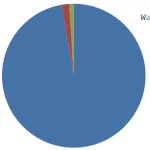 Earth's Water Reservoirs: From Oceans to Groundwater
 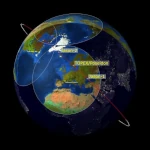 Sea Levels Are Rising, But How Fast?
  The Other Climate Threat: Earth Shrouded in Shadow and Humidity
 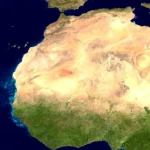 The Age of the Sahara: From Green Prairie to Stone Desert
 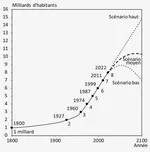 World Population from 1800 to 2100
  Oil: The Fall of a Giant in the Era of Renewable Energy
  Kamchatka King Crab: A Giant of the Oceans
  The collapse of a society
  Slight Progress in the Global Ecological Footprint
  The South Atlantic Anomaly
  The phenomenon of soil sinking is called subsidence
  The Planet's New Clouds