


How to Spot Starlink Satellite Trains in the Sky?
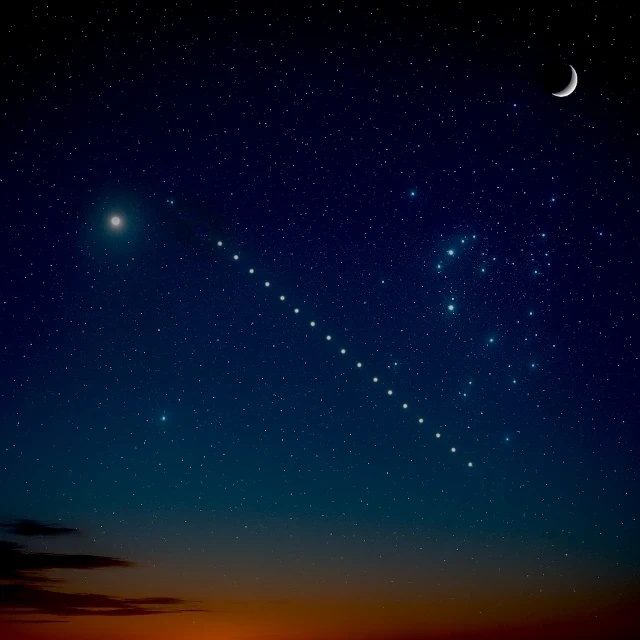
The Starlink satellite constellation: A line of bright dots crosses the celestial vault, about 1 hour after sunset.
These "trains" of stars have become a recurring spectacle for observers, provided they know when and where to look.
Image source: astronoo.com (new window)
Scientific Summary
This article describes methods for observing SpaceX's Starlink satellites, placed in low Earth orbit (~550 km) to provide global Internet access. Their naked-eye visibility results from the reflection of sunlight, optimal just after sunset or before sunrise. The satellite "trains," very bright for a few days post-launch, become less luminous in operational phase. Digital tools (Find Starlink, Heavens-Above) allow for predicting their passes. The article also addresses the challenges posed to professional astronomy and the anti-reflective solutions being tested (VisorSat).
How to see Starlink satellites in the night sky?
To see Starlink satellites, observe them just after sunset or before sunrise, when they reflect sunlight. "Trains" are very bright for a few days after a launch. Use tools like "Find Starlink" or "Heavens-Above" to know precise pass times for your location.
Also worth exploring
Continue your exploration of the Universe with these topics:
Why Can We See Starlink Satellites from Earth?
Starlink satellites, deployed by SpaceX to provide global internet access, are placed in low orbit (about 550 km altitude). Unlike stars that emit their own light, these satellites are visible because they reflect sunlight. This is why the best observation windows are just after sunset or just before sunrise: the observer is in darkness, but the satellites, still illuminated by the Sun, stand out as aligned moving stars against the sky.
The most impressive phenomenon remains the "train" of satellites. If these trains are particularly spectacular in the days following a launch (when the satellites are not yet dispersed), we can also observe bright lines in operational phase. Indeed, satellites in the same orbital plane can appear in a tight convoy depending on the observation angle, creating this string of bright pearls moving in single file.
When and Where to Look to See the Satellite Constellation?
Observing Starlink satellites requires no optical instrument, just a clear sky. There are two types of passes:
- Passes of "trains" of newly launched satellites: They are much brighter (easily visible like the stars of the Big Dipper or the North Star) and form a spectacular line. These passes are only visible for a few days after launch. Their formation changes rapidly. Day after day, the gap between them increases, the orientation of the group changes, until they reach their operational orbit.
- Passes of operational satellites: They are less bright (visible with a little attention) but very numerous. Their orbital configuration is stabilized. Each follows a precise and repetitive orbit.
Essential Tools to Not Miss Them
However, to avoid scanning the sky at random, it is essential to know the passing times, which vary depending on your geographical location. To know exactly the time of the next pass over your location, the use of digital tools is essential. Several applications and websites, using data from TLE elements (north American Aerospace Defense Command, providing orbital elements of objects in orbit), allow predicting passes with an accuracy of a few seconds.
- Find Starlink (new window): Simple and effective, just enter your location to get the list of upcoming bright passes.
- Heavens-Above (new window): A historic tool for satellite enthusiasts. It provides detailed star maps with the exact trajectory.
Table of Orbital Characteristics and Visibility of Starlink Satellites
| Generation / Phase | Altitude (km) | Inclination (°) | Visibility to the Naked Eye | Observation Particularity |
|---|---|---|---|---|
| Post-launch Train | ~ 300 - 350 | Variable (53°) | Very easy | Spectacular single file for 3 to 5 days. |
| V1.0 (Operational) | ~ 550 | 53° - 70° | Possible | Reduced brightness compared to trains, but visible. |
| V1.5 (VisorSat) | ~ 550 | 53° - 97.6° | Difficult | Equipped with anti-reflective visors to reduce light pollution for astronomers. |
| V2 Mini | ~ 550 - 560 | 43° - 53° | Possible | Larger, but better optimized to reduce light reflection. |
The Future of Observation
It is estimated that the number of satellites in low orbit could exceed 100,000 by 2030. For professional astronomers, this represents a major challenge. Long exposures from telescopes are systematically streaked by the passage of these objects. In response, SpaceX is experimenting with anti-reflective coatings (such as "DarkSat" and "VisorSat") and attitude adjustments to minimize their albedo.
FAQ: Everything about observing Starlink satellites
Why are Starlink satellites visible from Earth?
They are visible because they reflect sunlight. The best times to observe them are just after sunset or just before sunrise, when the observer is in darkness but the satellites are still illuminated.
What is the difference between a "train" of satellites and an operational satellite?
The satellite train, visible for a few days after a launch, is very bright and forms a spectacular line. Operational satellites are less bright, more numerous, and follow stable, repetitive orbits.
Is special equipment needed to see Starlink satellites?
No, observation requires no optical instruments, just a clear sky. However, to avoid scanning the sky randomly, it is essential to use apps or websites (like Find Starlink or Heavens-Above) that accurately predict pass times.
 How to Spot Starlink Satellite Trains in the Sky?
  AI, the Astronomer's New Eye: From Analysis to Cosmic Prediction
  What the First Images from Perseverance Show Us: The Surface of Mars, As If We Were There
  GRAIL Twin Probes: Mapping the Moon's Hidden Interior
  Earth Under Surveillance: Observation Satellites
  March 2010: The Ring of Fire Captured by the SDO Observatory
  Positions of Space Probes in 2025
  Giants of Observation: The Largest Ground-Based Telescopes
  Low Earth Orbits and their uses
  Pioneer, first message to extraterrestrials!
  Infrared images: how to make them visible?
  Sputnik 1 and 2: The Dawn of the Space Age
  ENVISAT: Ten Years of Uninterrupted Observation of Earth's Ecosystems
  Lagrange Points: Gravitational Gateways of the Solar System
  Mars Reconnaissance Orbiter: The Lynx Eye Revealing Martian Secrets
  Kepler: 4,000 Worlds and More, A New Map of the Sky
  Cheops Space Telescope: A New Vision on Exoplanets
  The world of Planck
  Rosetta Space Probe: Comet Churyumov-Gerasimenko
  The Hubble Space Telescope: Three Decades of Revelations
  Première photo du télescope Hubble
  Satellites that measure underwater relief
  MESSENGER: The First Probe to Visit the Mysterious Planet
  How GPS Locates Your Position at Any Time?
  The ISS and Beyond? Towards the End of a Space Chapter
  Space Telescopes: Humanity's Eye Beyond the Atmosphere
  Space Probes: Interplanetary Travelers and Beyond
  The GAIA satellite maps the Milky Way
  How to calculate the synchronous orbit?
  E-ELT: The World's Largest Optical Telescope
  Mercury probes
  Space debris: the nightmare of operational satellites
  Aquarius: A Mission to Map Ocean Salinity
  JWST: An Unprecedented Look at the First Lights of the Universe
  METEOSAT: A Key Satellite for Climate Monitoring
  Curiosity, the first shovel, sample of Martian soil
  From Mariner to Perseverance: Successes and Failures of Mars Probes
  Where is the geostationary orbit?
  MOM, the technological demonstration
  Venus under surveillance: an overview of space probes
  What Is an Astronomical Interferometer?
  The Philae Robot and the Rosetta Comet
  Mauna Kea Under the Stars: The CFHT Telescope in Pursuit of the Universe's Mysteries