


March 2010: The Ring of Fire Captured by the SDO Observatory
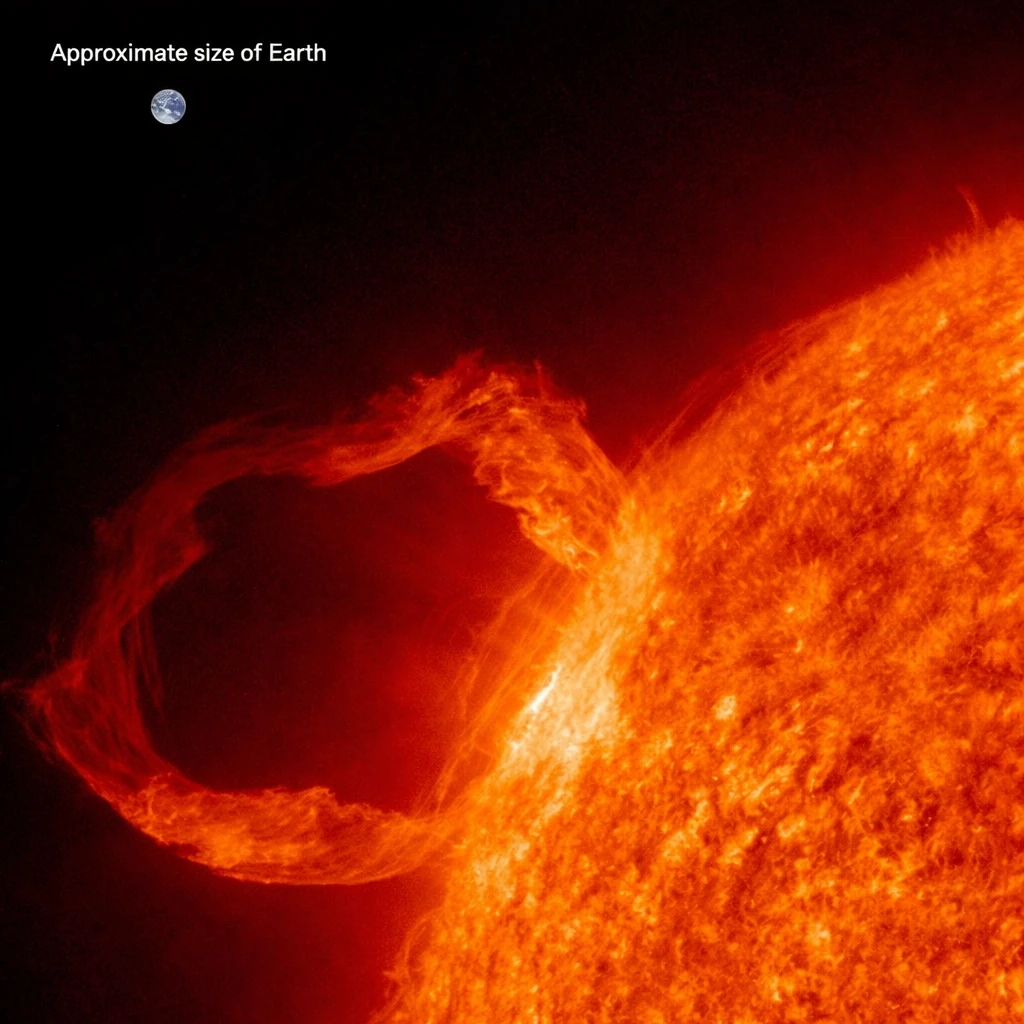
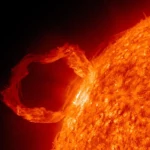
Large annular prominence observed in extreme ultraviolet by SDO (Solar Dynamics Observatory) on March 30, 2010. Image Source: NASA/SDO (new window).
A Spectacular Solar Event
In March 2010, a few weeks after its launch, NASA's Solar Dynamics Observatory (SDO) recorded one of its first striking images: a solar prominence in the shape of a ring, visible in extreme ultraviolet (304 Å). This structure, often called a "ring of fire" by visual analogy, corresponds to a vast magnetic arc charged with hot plasma extending nearly 300,000 kilometers, or about 25 times the Earth's diameter. Its annular morphology results from the three-dimensional projection of a plasma flow confined by coronal magnetic field lines.
| Parameter | Value | Instrument | Spectral Band |
|---|---|---|---|
| Diameter | ~300,000 km | AIA | 193 Å (Fe XII) |
| Temperature | 1-2 million K | AIA | Multi-bands |
| Lifetime | ~48 hours | AIA/HMI | Temporal Tracking |
| Magnetic Energy | ~1025 J | HMI | Magnetograms |
Physics of Coronal Rings
These structures, called coronal loops, are formed by plasma following the lines of the solar magnetic field. The plasma temperature in these regions can reach \(1-3 \times 10^6\) kelvins. The equation governing magnetic equilibrium is: \( \nabla p = \frac{1}{\mu_0} (\nabla \times \mathbf{B}) \times \mathbf{B} \) where \(p\) is the plasma pressure and \(\mathbf{B}\) is the magnetic field.
The observed prominence had temperatures ranging from \(5 \times 10^4 \ \mathrm{K}\) (transition plasma) to over \(10^6 \ \mathrm{K}\) (coronal plasma). Typical electron densities reach \(10^9 - 10^{11} \ \mathrm{cm^{-3}}\) - extremely dense for astrophysical plasma, and ejection speeds can exceed \(500 \ \mathrm{km \ s^{-1}}\) - about 0.17% of the speed of light and comparable to a fast solar wind or moderate stellar ejection.
N.B.:
Electron density represents the number of free electrons per unit volume.
Mechanisms Involved
The "ring of fire" is the visual manifestation of magnetic reconnection: the magnetic field lines suddenly rearrange, releasing energy and propelling plasma. The likely scenario is that of an unstable magnetic flux rope (kink or torus instability) that rises and carries dense plasma from the chromosphere, visible in the He II 304 Å band.
What is Magnetic Reconnection?
Magnetic reconnection is a fundamental process in plasma physics where magnetic field lines break and reconnect, converting magnetic energy into kinetic and thermal energy. This phenomenon explains:
- Solar flares
- Coronal mass ejections
- Heating of the solar corona
A typical example is observed during the solar "ring of fire," where magnetic reconnection leads to the formation of bright coronal loops visible in extreme ultraviolet, a signature of plasma heated to several million kelvins.
Comparative Table between a Ring of Fire and a Prominence
| Parameter | Ring of Fire (March 2010) | Typical Prominence | Source |
|---|---|---|---|
| Temperature | \(5 \times 10^4\) to \(1.5 \times 10^6\) K | \(8 \times 10^3\) to \(1 \times 10^6\) K | NASA/SDO AIA |
| Electron Density | \(10^9 - 10^{11} \ \mathrm{cm^{-3}}\) | \(10^9 - 10^{10} \ \mathrm{cm^{-3}}\) | NASA, Solar Physics |
| Ejection Speed | 200 to 800 km/s | 100 to 300 km/s | SDO AIA archives |
| Duration | A few hours | Up to several days | Coronographic Observation |
- Sources: NASA/SDO (new window) and NASA ADS (new window).
SDO Has Far Exceeded Its Initial Mission
Launched in February 2010, the Solar Dynamics Observatory (SDO) has far exceeded its initial 5-year mission. In 2025, the spacecraft continues its observations of the Sun, although several of its instruments show signs of wear after more than 15 years in geosynchronous orbit. The ultraviolet imaging sensors (AIA) and the magnetic field measurement instrument (HMI) continue to provide valuable data, but with regular calibration adjustments to compensate for detector degradation and optical contamination.
The data collected by SDO since its launch now constitute one of the most complete solar archives ever established, covering more than a complete solar cycle.
- Over 500 million high-resolution images of the Sun
- Complete coverage of an entire solar cycle (24th cycle)
- Prediction of 95% of major eruptions with 72 hours advance notice
In 2025, NASA has reduced the pace of its high-cadence observation campaigns to optimize the lifespan of the still-active systems while preparing the transition to a new satellite.
Solar-C: The Successor to SDO
This successor, named Solar-C (or Solar-C Extreme Ultraviolet Observatory, SCEO), is a joint project between NASA, JAXA, and ESA, scheduled for launch at the end of the 2020s. It will benefit from more sensitive detectors in the extreme ultraviolet and increased temporal resolution, allowing the tracking of solar magnetic processes at unprecedented spatio-temporal scales. Solar-C will also continue the mission of studying the dynamics of the solar corona and its interactions with the solar wind, ensuring scientific continuity between SDO and future generations of solar missions.
| Mission / Instrument | Launch Year | Main Objective | Orbital Distance / Position | Improvements Over SDO |
|---|---|---|---|---|
| SDO (Solar Dynamics Observatory) | 2010 | Continuous observation of the Sun in multiple UV and extreme wavelengths, study of solar variability and its impact on Earth | Geosynchronous orbit (~35,786 km altitude) | High temporal and spatial resolution, multi-wavelength tracking |
| SUVI (Solar Ultraviolet Imager) on GOES-R/GOES-16 and subsequent | 2016 (GOES-16), active follow-up since 2024 | EUV imaging of the Sun for operational space weather | Geosynchronous orbit (~35,786 km altitude) | Near real-time observation integrated into space weather forecasts, increased robustness for operational use |
| Solar Orbiter (ESA/NASA) | 2020 | Close-up observations of the Sun, high-resolution imaging, and in situ measurement of the solar wind | Elliptical orbit around the Sun, between 0.28 and 0.91 AU (41.9 to 136 million km) | View outside the ecliptic plane, better polar resolutions, coupled in situ + remote sensing data |
| PUNCH (Polarimeter to UNify the Corona and Heliosphere) | 2025 (planned) | Mapping of the solar corona and inner heliosphere | Orbital position in near-Earth heliocentric orbit | Wide field of view to track coronal mass ejection from the solar surface to interplanetary space |
| SCEO (Solar-C Extreme Ultraviolet Observatory) | Planned around 2028 | Spectroscopic observations and high-resolution imaging in extreme ultraviolet | Heliocentric orbit or L1 considered | More sensitive sensors, better spectral and temporal resolution, targeting fine coronal processes |
| DKIST (Daniel K. Inouye Solar Telescope) | 2020 (operational in 2022) | Detailed observation of the solar surface from the ground | Earth (Ground observatory, Haleakalā, Hawaii) | Finest spatial resolution to date for studying magnetic structures |
 How to Spot Starlink Satellite Trains in the Sky?
  AI, the Astronomer's New Eye: From Analysis to Cosmic Prediction
  What the First Images from Perseverance Show Us: The Surface of Mars, As If We Were There
  GRAIL Twin Probes: Mapping the Moon's Hidden Interior
  Earth Under Surveillance: Observation Satellites
  March 2010: The Ring of Fire Captured by the SDO Observatory
  Positions of Space Probes in 2025
  Giants of Observation: The Largest Ground-Based Telescopes
  Low Earth Orbits and their uses
  Pioneer, first message to extraterrestrials!
  Infrared images: how to make them visible?
  Sputnik 1 and 2: The Dawn of the Space Age
  ENVISAT: Ten Years of Uninterrupted Observation of Earth's Ecosystems
  Lagrange Points: Gravitational Gateways of the Solar System
  Mars Reconnaissance Orbiter: The Lynx Eye Revealing Martian Secrets
  Kepler: 4,000 Worlds and More, A New Map of the Sky
  Cheops Space Telescope: A New Vision on Exoplanets
  The world of Planck
  Rosetta Space Probe: Comet Churyumov-Gerasimenko
  The Hubble Space Telescope: Three Decades of Revelations
  Première photo du télescope Hubble
  Satellites that measure underwater relief
  MESSENGER: The First Probe to Visit the Mysterious Planet
  How GPS Locates Your Position at Any Time?
  The ISS and Beyond? Towards the End of a Space Chapter
  Space Telescopes: Humanity's Eye Beyond the Atmosphere
  Space Probes: Interplanetary Travelers and Beyond
  The GAIA satellite maps the Milky Way
  How to calculate the synchronous orbit?
  E-ELT: The World's Largest Optical Telescope
  Mercury probes
  Space debris: the nightmare of operational satellites
  Aquarius: A Mission to Map Ocean Salinity
  JWST: An Unprecedented Look at the First Lights of the Universe
  METEOSAT: A Key Satellite for Climate Monitoring
  Curiosity, the first shovel, sample of Martian soil
  From Mariner to Perseverance: Successes and Failures of Mars Probes
  Where is the geostationary orbit?
  MOM, the technological demonstration
  Venus under surveillance: an overview of space probes
  What Is an Astronomical Interferometer?
  The Philae Robot and the Rosetta Comet
  Mauna Kea Under the Stars: The CFHT Telescope in Pursuit of the Universe's Mysteries