


AI, the Astronomer's New Eye: From Analysis to Cosmic Prediction
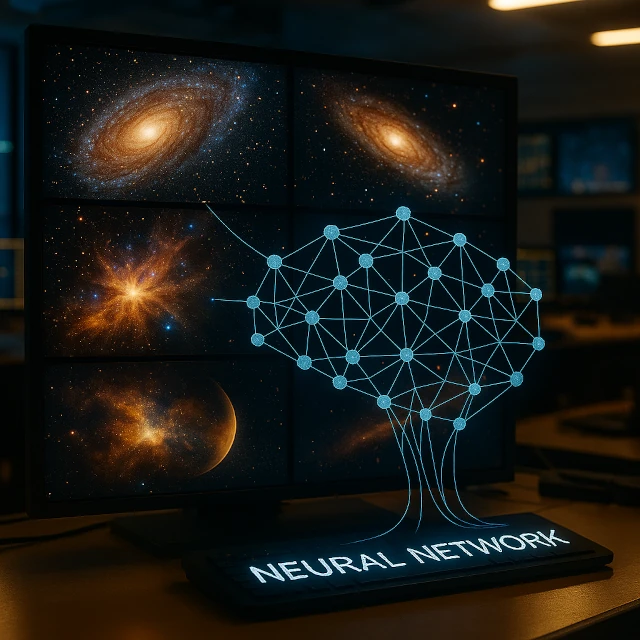
Illustration showing on a screen an artificial neural network superimposed on a star field and light curves.
Bright points represent AI discoveries.
Image source: astronoo.com (new window)
Scientific summary
The article examines how artificial intelligence (AI) is transforming astronomy in the face of data deluges (e.g., 20 TB/night with LSST). Neural networks, especially convolutional ones, automate exoplanet detection (AstroNet), galaxy classification (>95% accuracy), and supernova identification, with massive time savings. AI goes beyond analysis: it simulates universes via GANs and predicts transient phenomena (fast radio bursts, stellar flares). However, model interpretability (XAI) and real-time integration into telescopes remain key challenges for physically validating discoveries.
How is artificial intelligence revolutionizing astronomy?
AI is revolutionizing astronomy by automating the analysis of massive data streams where the human eye is overwhelmed. It detects exoplanets (e.g., Kepler-90i) using neural networks, classifies billions of galaxies with >95% accuracy, and identifies supernovae far faster than manual methods. Beyond analysis, AI simulates universes and predicts cosmic events (fast radio bursts, stellar flares). The future challenge is explainable AI to validate these discoveries and its direct integration into telescopes for real-time response to rare phenomena like kilonovae.
Also worth exploring
Continue your exploration of the Universe with these topics:
The Era of Astronomical Data Deluge
Astronomy has entered the era of Big Data (volume, Velocity, Variety, Veracity, Value). Observatories like the LSST (Vera C. Rubin Observatory) will generate nearly 20 terabytes of data per night. Manually analyzing these mountains of information is impossible. AI (artificial Intelligence), and more specifically Machine Learning (machine Learning) and Deep Learning (deep Learning), have become essential tools for sorting, classifying, and discovering hidden phenomena in these data streams.
Historically, discoveries relied on patient observation and manual calculation. Today, algorithms trained on millions of images can identify galaxies, supernovae, or asteroids in a fraction of a second, often with greater accuracy than the human eye.
Supervised machine learning (fitting mathematical models to data sets) techniques allow models to be trained to recognize specific features in light spectra or light curves. For example, the detection of Type Ia supernovae (violent explosion of a compact star after reaching a critical mass), crucial for measuring the expansion of the Universe, is now largely automated thanks to these algorithms.
Exoplanet Hunting: The Transit Method Revolutionized
The transit method, which detects drops in a star's brightness as a planet passes in front of it, has discovered thousands of exoplanets. However, the signals are tiny and often drowned out by instrumental noise or stellar variations.
Neural networks, such as those used by the Kepler and TESS missions, filter this noise much more effectively than traditional statistical methods. They learn to distinguish a real transit from a natural variation in the star's brightness. The TRAPPIST-1 star system, with its seven rocky planets, has particularly benefited from these advanced analyses to confirm complex orbital periods.
N.B.:
The AstroNet algorithm, developed by Google, discovered two new exoplanets (Kepler-90i and Kepler-80g) by reanalyzing old Kepler data, demonstrating the power of AI to find what humans had missed.
Automatic Classification of Galaxies
The morphology of galaxies reveals crucial information about their history and evolution. The Galaxy Zoo project, launched in 2007, initially mobilized hundreds of thousands of volunteers to manually classify galaxy images. Today, convolutional neural networks accomplish this task with comparable or even superior accuracy in seconds.
Algorithms can distinguish between spiral, elliptical, and irregular galaxies, and even identify fine structures such as galactic bars or spiral arms. This automation allows the processing of catalogs containing billions of galaxies, paving the way for statistical studies of unprecedented scale on the formation and evolution of cosmic structures.
Key Applications of AI in Astronomy (2025-2026)
| Application Area | AI Technique | Typical Accuracy | Time Saved |
|---|---|---|---|
| Exoplanet detection (transits) | Convolutional neural networks | 95-98% | × 1000 |
| Galaxy classification | Deep Learning (CNN) | >95% | × 10,000 |
| Supernova detection | Supervised learning | 90-95% | × 100 |
| Automatic spectral analysis | Recurrent networks (RNN) | 92-96% | × 500 |
| Search for gravitational lenses | Computer vision | 88-93% | × 5000 |
| Reconstruction of astronomical images | Autoencoders / GANs | 90-97% | × 2000 |
| Space weather forecasting (solar winds, CME) | Recurrent networks / LSTM | 85-92% | × 500 |
| Identification of comets and asteroids | CNN + supervised learning | 90-96% | × 1000 |
| Detection of gamma-ray bursts | Deep learning on time series | 93-97% | × 300 |
| Mapping of interstellar dust clouds | Autoencoders + segmentation | 88-94% | × 2000 |
| Optimization of observation scheduling | Reinforcement learning | 80-90% | × 50 |
| Analysis of stellar brightness variations (variability) | RNN / Transformer | 91-95% | × 400 |
- Source: Compiled from Baron (2019), arXiv:1904.07248 (new window) and Fluke & Jacobs (2019), WIREs Data Mining and Knowledge Discovery (new window).
Astrophysical Predictions and Simulations
AI does more than analyze: it predicts and simulates. Cosmological models simulating the formation of large-scale structures in the Universe (filaments, galaxy clusters) are extremely computationally intensive. GANs (generative Adversarial Networks) can now generate realistic simulations in record time, allowing researchers to test thousands of cosmological parameters \( \Omega_m, \sigma_8 \) and compare them with observations.
It also helps predict the behavior of variable objects such as fast radio bursts (FRB) or stellar flares, by identifying precursor patterns in historical data.
N.B.:
Convolutional neural networks (convolutional Neural Networks) (CNN) are particularly suited to the analysis of astronomical images because they can automatically learn relevant features at different spatial scales, from individual pixels to large-scale structures, without requiring manual programming of detection filters.
Challenges and Future Perspectives
The main challenge remains the interpretability of AI models. A neural network can identify an anomaly, but does not always provide a clear physical explanation. XAI (explainable Artificial Intelligence) is a crucial research field for astronomy.
In the future, AI will be integrated directly into telescopes for real-time processing, deciding for itself to point towards rare transient events, such as gravitational waves or kilonovae. Projects like the ZTF (Zwicky Transient Facility) and soon the LSST at the Vera C. Rubin Observatory already use algorithms to analyze data on the fly and trigger automatic alerts within minutes.
N.B.:
A kilonova (kilonova) is a transient explosion resulting from the merger of two compact objects (neutron stars or a black hole and a neutron star).
First detected in 2017 during the GW170817 event, its brightness fades rapidly over a few days, requiring almost instantaneous observation.
FAQ: Everything about AI in astronomy
How has AI revolutionized the hunt for exoplanets?
The transit method, which detects tiny dips in a star's brightness as a planet passes in front of it, generates faint signals often buried in noise. Neural networks filter this noise far more effectively than traditional statistical methods. They learn to distinguish a real transit from a star's natural brightness variation. The most striking example is the AstroNet algorithm, which proved that AI can find what humans missed. The TRAPPIST-1 system also benefited from these advanced analyses.
How accurate is AI at classifying galaxies compared to humans?
Convolutional neural networks now achieve typical accuracy greater than 95% for galaxy classification. They can even identify fine structures like galactic bars or spiral arms. This performance is comparable to, or even better than, the volunteers of the Galaxy Zoo project, but with a considerable time gain: an algorithm can process in seconds what took years for thousands of humans.
What is "explainable AI" and why is it crucial in astronomy?
The main challenge of AI in astronomy is its lack of interpretability. A neural network can identify an anomaly or make a prediction, but it does not always provide a clear physical explanation for its reasoning. Explainable AI is a research field that aims to make AI decisions transparent and understandable to scientists. This is crucial for validating a discovery and incorporating it into our physical understanding of the Universe.
 How to Spot Starlink Satellite Trains in the Sky?
  AI, the Astronomer's New Eye: From Analysis to Cosmic Prediction
  What the First Images from Perseverance Show Us: The Surface of Mars, As If We Were There
 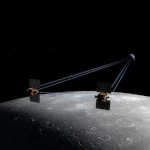 GRAIL Twin Probes: Mapping the Moon's Hidden Interior
 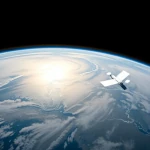 Earth Under Surveillance: Observation Satellites
 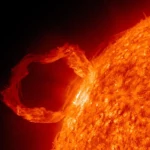 March 2010: The Ring of Fire Captured by the SDO Observatory
 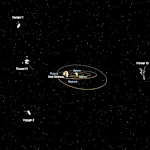 Positions of Space Probes in 2025
  Giants of Observation: The Largest Ground-Based Telescopes
  Low Earth Orbits and their uses
  Pioneer, first message to extraterrestrials!
  Infrared images: how to make them visible?
  Sputnik 1 and 2: The Dawn of the Space Age
  ENVISAT: Ten Years of Uninterrupted Observation of Earth's Ecosystems
  Lagrange Points: Gravitational Gateways of the Solar System
  Mars Reconnaissance Orbiter: The Lynx Eye Revealing Martian Secrets
  Kepler: 4,000 Worlds and More, A New Map of the Sky
  Cheops Space Telescope: A New Vision on Exoplanets
  The world of Planck
  Rosetta Space Probe: Comet Churyumov-Gerasimenko
  The Hubble Space Telescope: Three Decades of Revelations
  Première photo du télescope Hubble
  Satellites that measure underwater relief
  MESSENGER: The First Probe to Visit the Mysterious Planet
  How GPS Locates Your Position at Any Time?
  The ISS and Beyond? Towards the End of a Space Chapter
  Space Telescopes: Humanity's Eye Beyond the Atmosphere
  Space Probes: Interplanetary Travelers and Beyond
  The GAIA satellite maps the Milky Way
  How to calculate the synchronous orbit?
  E-ELT: The World's Largest Optical Telescope
  Mercury probes
  Space debris: the nightmare of operational satellites
  Aquarius: A Mission to Map Ocean Salinity
  JWST: An Unprecedented Look at the First Lights of the Universe
  METEOSAT: A Key Satellite for Climate Monitoring
  Curiosity, the first shovel, sample of Martian soil
  From Mariner to Perseverance: Successes and Failures of Mars Probes
  Where is the geostationary orbit?
  MOM, the technological demonstration
  Venus under surveillance: an overview of space probes
  What Is an Astronomical Interferometer?
  The Philae Robot and the Rosetta Comet
  Mauna Kea Under the Stars: The CFHT Telescope in Pursuit of the Universe's Mysteries