


The Paleocene-Eocene Transition: When Earth's Climate Suddenly Changed

In Earth's archives: the climate crisis from 56 million years ago.
This outcrop shows the boundary between the Paleocene and Eocene. It is at this precise location in the ground that traces of the PETM, a rapid global warming caused by a massive carbon release, are recorded.
Image source: AI generated (Public domain).
Scientific summary
56 million years ago, Earth experienced one of its fastest and most intense global warming events: the Paleocene-Eocene Thermal Maximum (PETM). In less than 20,000 years, the global average temperature rose by 5 to 8 °C, disrupting marine and terrestrial ecosystems. This phenomenon is linked to a massive release of carbon (estimated between 2000 and 4500 gigatons) into the atmosphere and oceans, likely triggered by volcanic eruptions in the North Atlantic, the melting of methane hydrates, or permafrost thawing. The PETM offers a valuable — but imperfect — analogy with current climate change: the rate of carbon emissions we experience today is significantly faster than that of the PETM.
What is the Paleocene-Eocene Thermal Maximum (PETM) and why is it so important for understanding current climate?
Astronoo's article answers this question by exploring the Paleocene-Eocene Thermal Maximum (PETM) in depth. It is a period of extreme global warming that occurred 56 million years ago, at the boundary between the geological epochs of the Paleocene and Eocene. Within a few thousand years, a colossal amount of carbon was released into the atmosphere, causing global temperatures to rise by 5 to 8 °C. This upheaval had major consequences: acidification and anoxia of the oceans, extinction of numerous marine species (notably foraminifera), and forced migration of terrestrial mammals towards the poles. The article details the probable causes of this event, such as intense volcanic activity related to the opening of the Atlantic Ocean, and highlights the importance of the PETM as a natural analogue for current climate disruption — while specifying an essential difference: the rate at which carbon is currently released into the atmosphere has no known equivalent in the last 66 million years.
Also worth exploring
Continue your exploration of the Universe with these topics:
Unprecedented global warming
56 million years ago, Earth experienced one of its greatest climate shocks. The Paleocene-Eocene Thermal Maximum (PETM) saw global temperatures rise by 5 to 8 °C in less than 20,000 years. This warming, extremely rapid on a geological scale, profoundly altered carbon cycles, ocean currents, and biodiversity. Marine sediments from this era bear witness to massive ocean acidification, making life difficult for organisms with calcareous shells, such as foraminifera (unicellular marine organisms whose shell is an excellent climate indicator).
Causes of the climatic tipping point
The exact cause of the PETM is still debated, but the most accepted scenario involves a sudden and massive release of carbon into the Earth system. Several sources are considered:
- Volcanism of the North Atlantic Igneous Province: The opening of the Atlantic Ocean caused colossal volcanic eruptions, burning vast coal and oil shale deposits, thereby releasing phenomenal amounts of \(CO_2\) and methane.
- Melting of methane hydrates: The initial warming, possibly of volcanic origin, could have destabilized methane hydrates (solid compounds of water and methane, stable at high pressure and low temperature) present in seafloor sediments, in turn releasing this potent greenhouse gas.
- Permafrost thawing: Warming could also have thawed vast areas of permafrost (permanently frozen ground), releasing methane and \(CO_2\) trapped for millennia.
Biological and environmental consequences
The effects of the PETM were catastrophic for many species, but also acted as a selective force and driver of diversification for others.
| Domain | Observed impact | Reference |
|---|---|---|
| Oceans | Massive acidification, anoxia (dead zones), extinction of 30 to 50% of benthic foraminifera | Zachos et al. (2005) |
| Terrestrial | Migration of mammals (e.g., Hyracotherium(ancestor of horses)) towards high latitudes, dwarfism in some mammals | Gingerich (2006) |
| Vegetation | Expansion of tropical and subtropical forests towards the poles, changes in floral composition | Wing et al. (2005) |
In the oceans
The massive absorption of \(CO_2\) by the oceans caused unprecedented acidification, dissolving the shells of planktonic organisms. Benthic foraminifera, living in the sediments, suffered a mass extinction, with disappearance rates reaching 50%. This disappearance was accompanied by anoxia (oxygen depletion) in deep waters, creating widespread "dead zones."
On the continents
On land, warming allowed mammals to migrate to higher latitudes. It was at this time that the first primates and ungulates appeared in Europe and North America. A phenomenon of dwarfism was also observed in some mammals, with body size decreasing in response to heat stress and lower nutrient availability.
The PETM: a warning for the future
Studying the PETM is crucial because it constitutes the best geological analogue for current climate change. The observed consequences (ocean acidification, mass extinction, ecosystem disruption) offer a glimpse into what a world warmer by several degrees might look like. But this analogue has its limits, as shown in the next chapter.
A lesson on climate thresholds
The PETM showed that the Earth system can abruptly shift from one climate state to another once a certain warming threshold is crossed. The most recent estimates place the amount of carbon accumulated during the initial phase of the PETM between 2,500 and 4,500 gigatons, a magnitude that our fossil fuel reserves could match or exceed over the coming centuries. Understanding this threshold is essential for anticipating tipping points in the climate system, such as permafrost thawing or ice sheet melting.
An unprecedented emission rate: the PETM compared to current warming
While the PETM remains the best natural analogue for modern climate change, an important nuance applies: the rate at which carbon is released today is incomparable to that of the PETM. A landmark study by Richard Zeebe, Andy Ridgwell, and James Zachos, published in 2016 in Nature Geoscience, reconstructed the carbon release rate at the onset of the PETM from sediments on the New Jersey continental shelf. Their results show that the initial carbon injection lasted at least 4,000 years, with a maximum sustained rate of less than approximately 1.1 gigatons of carbon per year.
A rate ten times faster today
However, human carbon emissions reached approximately 10 gigatons per year by the mid-2010s and continue to rise. In other words, humanity is currently releasing carbon into the atmosphere at a rate about ten times faster than during the most intense warming episode known in the last 66 million years. The study's authors speak of a "no-analogue state": no event in the geological record allows us to predict with certainty how the climate system will respond to such a rapid perturbation. This difference in rate is crucial, because a system pushed abruptly can react more sharply and less predictably than one subjected to a slow perturbation, even if the total amount of carbon involved is of the same order of magnitude.
Returning to balance: the slow healing of the Earth system
Another valuable lesson from the PETM: the rapidity with which excess carbon can be injected into the climate system contrasts sharply with the slowness of its removal. Once the warming peak was reached, Earth's climate took approximately 150,000 to 200,000 years to return to conditions close to those before the PETM. This recovery occurred primarily through the weathering of continental silicates, a slow geochemical process that consumes atmospheric \(CO_2\) over hundreds of thousands of years, as well as through the gradual burial of organic carbon in marine sediments.
Slow recovery of the oceans
Ocean sediment cores also show that after the peak of acidification, the carbonate compensation depth (the limit below which calcareous shells dissolve in the ocean) experienced a temporary overshoot before gradually stabilizing, indicating that ocean chemistry took a very long time to return to a stable equilibrium. This lag between the speed of the perturbation (a few millennia) and that of the recovery (several hundred thousand years) is one of the most important messages the PETM sends to the present: even if carbon emissions were to stop quickly today, they would commit Earth's climate to timescales far exceeding those of human societies.
Key figures in the discovery
Understanding the PETM is the result of work by numerous paleoclimatologists and geochemists. Among them, James Zachos from the University of California, Santa Cruz, whose work on carbon and oxygen isotopes was fundamental in quantifying the extent of warming and acidification. Philip Gingerich (born 1946) from the University of Michigan provided major evidence on mammal migrations and evolution during this event. More recently, Richard Zeebe from the University of Hawaii at Mānoa highlighted the unprecedented nature of the current carbon emission rate compared to the PETM.
References
- Zachos J.C. et al., Science 308, 1611-1615, 2005 (new window)
- Gingerich P.D., Trends in Ecology & Evolution 21(5), 246-253, 2006 (new window)
- Wing S.L. et al., Science 310(5750), 993-996, 2005 (new window)
- Dickens G.R., O'Neil J.R., Rea D.K., Owen R.M., Paleoceanography 10(6), 965-971, 1995 (new window)
- Zeebe R.E., Ridgwell A., Zachos J.C., Nature Geoscience 9, 325-329, 2016 (new window)
FAQ: Everything you need to know about the Paleocene-Eocene Thermal Maximum (PETM)
What does the acronym PETM mean?
PETM stands for "Paleocene-Eocene Thermal Maximum." It designates the rapid global warming event that occurred 56 million years ago.
How much did the temperature increase during the PETM?
Isotopic studies indicate a global temperature increase of 5 to 8 °C in less than 20,000 years, an extremely rapid rate in Earth's geological history.
What caused this sudden warming?
The primary cause is a massive release of carbon into the atmosphere. Several mechanisms are proposed, the most likely being a combination of intense volcanic eruptions (linked to the formation of the North Atlantic) that burned significant coal deposits, and the melting of seafloor methane hydrates, amplifying the greenhouse effect.
Is the PETM comparable to current global warming?
Only partially. The PETM remains the best natural analogue for modern climate change in terms of the total amount of carbon released and its consequences (ocean acidification, extinctions, sea-level rise). However, the current emission rate is about ten times faster than that of the PETM, placing Earth's climate in a state unprecedented for at least 66 million years.
What was the impact of the PETM on ocean life?
The impact was severe. Acidification and deoxygenation of deep waters led to a mass extinction of benthic foraminifera, with species losses of 30 to 50%. Marine ecosystems took hundreds of thousands of years to recover.
How did the PETM affect mammals?
On the continents, warming allowed the migration of many mammal species towards the poles, including the ancestors of horses and primates. A dwarfism phenomenon was also observed in some lineages, with animals becoming smaller to better dissipate body heat.
How long did it take for Earth to recover from the PETM?
The return to climatic conditions close to those before the PETM took approximately 150,000 to 200,000 years, mainly through the weathering of continental silicates, a natural \(CO_2\) absorption process operating over hundreds of millennia.
 The Paleocene-Eocene Transition: When Earth's Climate Suddenly Changed
  The Principle of Least Action: Why Does Nature Always Choose the Most Economical Path?
  Evolutionary Convergence: Chance, Necessity… or Mirage?
 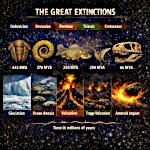 The Five Mass Extinctions: What do these planetary catastrophes reveal?
  Cryosphere: when the ice giants still protect us
 The Nitrogen Cycle: From Air to Life
  The Jet Stream: When the Atmospheric River Overflows Its Banks
  The Carbon Cycle: The Harmonious Interaction of Oceans, Forests, and Subsoils
  The Water Paradox: Without it, no life
  Why did alternating current prevail?
 Evolution of Global Energy Consumption: From Steam Engines to Digital Servers
  The Demographic Transition: Growth or Decline?
  Lake Agassiz: A Deluge that Changed the Climate
  Drunken Forests: Understanding the Phenomenon of Permafrost Thaw
  There is Electricity in the Air!
  Why Doesn't CO2 Fall to the Ground?
  El Niño and La Niña: the two climatic phenomena of the Pacific
  Endangered Species: Dynamics of Extinction
  The Toxic Legacy of Acid Rain
  Major societal collapses: key periods and causes
  Global Warming in Figures: What the Scientific Data Says
  What is Sustainable Development?
  The Hottest Years Since Records Began
  Magnitude of upcoming climate change
  Earth in Crisis: Collapse or Renaissance?
  Ice on Borrowed Time: The Inexorable Decline of Arctic Sea Ice
  Earth's Water Reservoirs: From Oceans to Groundwater
  Sea Levels Are Rising, But How Fast?
  The Other Climate Threat: Earth Shrouded in Shadow and Humidity
  The Age of the Sahara: From Green Prairie to Stone Desert
  World Population from 1800 to 2100
  Oil: The Fall of a Giant in the Era of Renewable Energy
  Kamchatka King Crab: A Giant of the Oceans
  The collapse of a society
  Slight Progress in the Global Ecological Footprint
  The South Atlantic Anomaly
  The phenomenon of soil sinking is called subsidence
  The Planet's New Clouds