


Asteroid 2012 DA14: Historic Earth Flyby of February 15, 2013
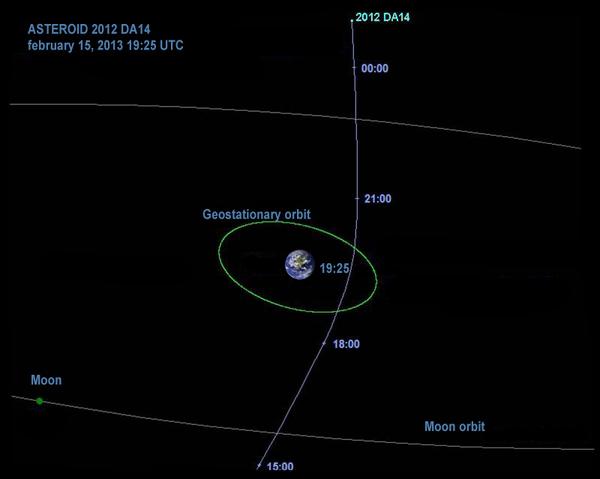
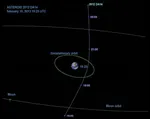
On February 15, 2013 at 8:25 PM (local time), a remarkable astronomical event occurred: asteroid 2012 DA14, measuring 45 meters in diameter and weighing approximately 135,000 tons, skimmed past Earth at an exceptionally close distance of just 27,700 kilometers. This passage, although harmless, left a lasting impression due to its record proximity to our planet, well within the orbit of geostationary satellites.
Image source: astronoo.com (new window) — AI-generated image, public domain.
Scientific abstract
Astronoo's article analyzes the flyby of asteroid 2012 DA14, a 45-meter near-Earth object that passed 27,700 km from Earth in 2013. This event provided an opportunity to test the detection capabilities of near-Earth objects (NEOs) and to model their orbital dynamics. The trajectory, perturbed by Earth's gravity, was calculated with kilometer-scale precision. The study highlights that objects of this size impact Earth on average every 1,200 years, and that their monitoring is crucial for planning future deflection missions, such as those being considered by space agencies.
Why was the passage of asteroid 2012 DA14 a major event for astronomers?
This article is devoted to the near-Earth asteroid 2012 DA14, which grazed Earth on February 15, 2013. But why did this passage generate such scientific interest? The answer lies in several factors: first, its size of 45 meters and mass of 135,000 tons make it a potentially devastating projectile on a regional scale. Second, its distance of 27,700 km placed it within the orbit of geostationary satellites, an unprecedented proximity for an object of this size since the beginning of detection programs. Finally, it was detected a year before its approach, giving astronomers a unique opportunity to study in detail its trajectory, composition, and the gravitational effects of Earth. This event highlighted the importance of space surveillance and planetary defense strategies, while demonstrating that actual collision risks remain low in the short term, but require constant vigilance.
Also worth exploring
Continue your exploration of the Universe with these topics:
Asteroid 2012 DA14: Near-Earth Asteroid
Detection and physical characteristics
This time, we saw it coming toward us as early as February 2012, and astronomers were able to detect it before its passage. Asteroid 2012 DA14 has a modest size of 45 meters and a mass of 135,000 tons. It approached Earth on February 15, 2013 at 7:24 PM (UTC).
Approach distance and comparison
Since the beginning of the near-Earth asteroid detection program, this asteroid is the largest object to have passed so close to Earth. The distance is still large enough to pose no collision danger, astronomers indicated. It will pass closest to Earth at 27,700 km, which represents a very small distance on the scale of the solar system; the Moon is at 360,000 km.
Origin and location in the solar system
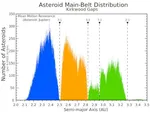
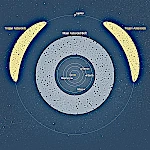
Many small rocky bodies called asteroids are present in the solar system. A significant portion of them orbit in a ring between the orbits of Mars and Jupiter, between 2 and 4 AU, in what astronomers call the asteroid belt, also known as the main belt. It thus marks the boundary between the terrestrial planets and the gas giants.
Definition and impact frequency
An asteroid is a celestial object not visible to the naked eye due to its small size, ranging from a few tens of meters to several hundred kilometers in diameter. Objects less than 50 m in diameter, like asteroid 2012 DA14, are called meteoroids. "On average, an asteroid of this size approaches as close to Earth every forty years and is likely to collide with our planet every twelve hundred years," said Donald Yeomans, director of the Near Earth Object (NEO) office at NASA's Jet Propulsion Laboratory.
Potentially Hazardous Objects (PHOs)
PHO classification criteria
An asteroid is classified as a near-Earth object if its size is greater than 152 meters and its distance is less than 7.5 million kilometers from Earth. It is important to note that although these objects are described as "potentially hazardous," this does not mean that a collision with Earth is imminent or certain. Astronomers actively monitor these objects to calculate their future trajectories and assess the actual risks they pose. NASA has already cataloged 9,500 potentially hazardous small celestial bodies, or one-tenth of the total.
Impact scenarios and associated damage
An asteroid 45 meters in diameter that enters the atmosphere at a very shallow angle (a few degrees) fails to penetrate the atmosphere and causes no damage. It simply bounces off Earth's atmospheric layer and heads back into space. This occurred on August 10, 1972 in the skies over Montana in the northern United States. However, if it falls vertically, its size is sufficient to cause damage on the scale of a department (region). A 50-meter object creates a gigantic crater like the famous Meteor Crater in Arizona. By comparison, a 1 km meteorite would create a crater 20 kilometers in diameter and kill 2 to 3 billion people due to the tsunami triggered on the scale of a terrestrial hemisphere. The probability of this happening is once every 150,000 years.
The meteorite responsible for the extinction of the dinosaurs, which fell in the Gulf of Mexico 66 million years ago, measured 10 kilometers in diameter.
Largest known near-Earth asteroids
| Asteroid | Mean diameter (km) | Discovery date | Type / Family | Risk (Turin) | Next flyby |
|---|---|---|---|---|---|
| (53319) 1999 JM8 | 7.0 | 1999 | Apollo | 0 | 2045 |
| (4183) Cuno | 5.6 | 1959 | Apollo | 0 | 2030 |
| 3200 Phaethon | 5.1 | 1983 | Apollo | 0 | 2026 |
| (52768) 1998 OR2 | 4.1 | 1998 | Amor | 0 | 2031 |
| (85990) 1999 JV6 | 3.4 | 1999 | Aten | 0 | 2034 |
| (308242) 2005 GO21 | 2.2 | 2005 | Apollo | 0 | 2034 |
| (214869) 2007 PA8 | 1.6 | 2007 | Apollo | 0 | 2028 |
| (85640) 1998 OX4 | 1.5 | 1998 | Apollo | 0 | 2032 |
| (29075) 1950 DA | 1.3 | 1950 | Apollo | 0 | 2880 |
| (137108) 1999 AN10 | 1.3 | 1999 | Apollo | 0 | 2046 |
| (385250) 2001 DH47 | 1.2 | 2001 | Apollo | 0 | 2043 |
| 2020 QU6 | 1.1 | 2020 | Amor | 0 | 2035 |
| (410777) 2009 FD | 1.0 | 2009 | Apollo | 0 | 2039 |
| 162173 Ryugu | 0.9 | 1999 | Apollo | 0 | 2027 |
| (153201) 2000 WO107 | 0.8 | 2000 | Amor | 0 | 2040 |
| 101955 Bennu | 0.5 | 1999 | Apollo | 0 | 2035 |
| 2021 GT3 | 0.5 | 2021 | Apollo | 0 | 2038 |
| (99942) Apophis | 0.37 | 2004 | Aten | 0 | 2029 |
| 25143 Itokawa | 0.3 | 1998 | Apollo | 0 | 2027 |
N.B.:
Near-Earth asteroids are classified into three main orbital families:
— Apollo asteroids have a semi-major axis greater than 1 AU and a perihelion less than 1.017 AU. They cross Earth's orbit and represent the majority of potentially hazardous objects.
— Amor asteroids have a perihelion between 1.017 and 1.3 AU. They do not cross Earth's orbit but can approach it under the effect of gravitational perturbations.
— Aten asteroids have a semi-major axis less than 1 AU and an aphelion greater than 0.983 AU. Their trajectory lies mainly inside Earth's orbit.
The table above presents the largest known specimens for each family, with their risk on the Torino scale (0 = no risk) and the estimated date of their next flyby.
References
- CNEOS - Center for Near-Earth Object Studies (NASA/JPL) (new window)
- JPL Small-Body Database - Search Engine (new window)
- Minor Planet Center (MPC) - International Astronomical Union (new window)
- ESA NEO Coordination Centre - Near-Earth Objects (new window)
- NASA Asteroid Watch - JPL (new window)
- NASA Goldstone Radar - Asteroid Radar Research (new window)
- International Meteor Organization - 3200 Phaethon/Geminids (new window)
- Space.com - 2020 QU6 asteroid flyby (new window)
- OSIRIS-REx Mission - Asteroid Bennu (NASA) (new window)
- Hayabusa2 Mission - Asteroid Ryugu (JAXA) (new window)
- Sanders et al. (2013) - Coma Cluster - Preprint arXiv:1309.1820 (new window)
FAQ: Everything you need to know about asteroid 2012 DA14
What is asteroid 2012 DA14?
2012 DA14 is a near-Earth asteroid of the Apollo family, discovered in February 2012 by the La Sagra astronomical observatory in Spain. It measures approximately 45 meters in diameter with an estimated mass of 135,000 tons. It became famous for its extremely close approach to Earth on February 15, 2013, at just 27,700 km from the surface, closer than the altitude of geostationary satellites.
Was there any risk of collision with Earth?
No, astronomers had calculated its trajectory with very high precision. Although it passed within the orbit of geostationary satellites, the minimum approach distance was 27,700 km, which is far greater than Earth's radius. No impact risk was identified for this passage, nor for the coming centuries.
How were scientists able to predict its passage with such precision?
Thanks to radar and optical observations carried out over more than a year, astronomers determined its orbit with an uncertainty of less than 100 meters at the time of approach. Data from the Arecibo Observatory and the Goldstone Deep Space Network were particularly useful in refining orbital parameters and predicting the effect of Earth's gravitational attraction on its trajectory.
What happened after its flyby?
After its closest approach to Earth, asteroid 2012 DA14 continued its orbit around the Sun, slightly modified by Earth's gravity. Its orbital period, initially about 366 days, was reduced by a few minutes, bringing it slightly closer to the Sun. It continues to be monitored by NEO detection programs, but poses no threat for the coming decades.
Where can I find updated data on this asteroid?
Orbital data and ephemerides for 2012 DA14 are available on the CNEOS (new window) (Center for Near-Earth Object Studies) website at NASA, as well as on the JPL Small-Body Database (new window). These sources provide updated information on its position, velocity, and orbit.
 Dwarf Planets: The Forgotten Worlds of the Solar System
  Kuiper Belt: Composition and Origins
  Haumea and its Moons: A Singularity of the Solar System
  The Enigma of the Oort Cloud: Indirect Evidence and Uncertainties
  Sedna: The Mysterious Remnant at the Edge of the Solar System
  Quaoar: The Dwarf Planet That Defies the Roche Limit with Its Two Rings
  What is Dust? Between the Dust on Our Shelves and the Dust that Builds Planets
  Ceres: Boundary Between Asteroid and Dwarf Planet
  Pluto and its Moons: Charon, Nix, Hydra, Styx, and Kerberos
  Eris: The Dwarf Planet at the Edge of the Solar System
  Gonggong: An Eccentric Witness to Distant Perturbations
  Meteor Showers: Perseids, Leonids, Geminids...
  Interstellar Comets: When the Universe Sends its Messengers
  The Asteroid Bennu: The Building Blocks of Life
  Formation of Asteroids: From Cosmic Dust to Small Rocky Bodies
  Yarkovsky Effect: Orbit and Rotation of Asteroids
  Arrokoth: Unique Witness to the Primordial Solar Nebula
  The Kirkwood Gaps in the Main Asteroid Belt
  Asteroid Belt: Dark, Bright, or Red
  The Great Comet of 1577 Shattered the Crystal Spheres
  The Invisible Threat of Asteroids: From Pebbles to Flying Mountains
  Meteorites: Messengers from Space and Witnesses of the Solar System
  Comet Hartley 2: The Icy Heart Scrutinized by Deep Impact
  When Two Asteroids Collide: The Strange Case of P/2010 A2
  2005 YU55: The 400 m Asteroid that Grazed Earth
  Asteroid Apophis: The Perfect Candidate for a Global Impact?
  Vesta: The Colossus of the Asteroid Belt
  From Asteroids to Planets
  Comet Ison C/2012: between the promise of brilliance and disillusionment
  Giants of the Asteroid Belt: Classification by Size
  Impact Craters on Earth: Between Destruction and Mineral Resources
  Online Simulator: Orbits of Asteroids
  Online Simulator: Orbits of Near-Earth Asteroids
  Rosetta has a date with a comet
  Near-Earth Asteroids: An Underestimated Threat?
  Asteroid 2009 DD45: A Reminder of Planetary Vulnerability to Asteroids
  Strange Resemblance Between Comet Hartley 2 and Asteroid Itokawa
  Earth Trojan Asteroids: The Companions Sharing our Orbit
  Torino Scale: a classification system for impact risks
  The Nice Model: Towards an Explanation of the Late Heavy Bombardment
  NEO Monitoring: The Case of Asteroid 2012 LZ1
  Comet Lemmon C/2012 F6: The green visitor of the southern hemisphere
  Asteroid 2012 DA14 passed on February 15, 2013
  Near-Earth Asteroid 2012 BX34: A Record Close Approach to Our Planet
  Didymos and Dimorphos: The First Asteroid Moon Moved by Humanity
  Chariklo and its rings: a surprising centaur asteroid
  Rosetta and Philae: A Feat 500 Million Kilometers from Earth
  The Passage of Comets: Eccentric Orbits at the Heart of the Solar System
  Vesta and its Curiosities: The Enigma of the Torn South Pole
  Meeting the Asteroids: The Main Belt
  Orbits of Near-Earth Asteroids: When Asteroids Brush Past Earth
  Comets: Streaks of Light, Promises of Life, and Cosmic Threats
  Asteroid Pallas: A Giant of the Main Belt
  Asteroid Juno: an unknown giant of the solar system
  Ganymed (1036): Near-Earth and Mars-crosser
  Earth's quasi-satellite: 2016 HO3