


Meteor Showers: Perseids, Leonids, Geminids...
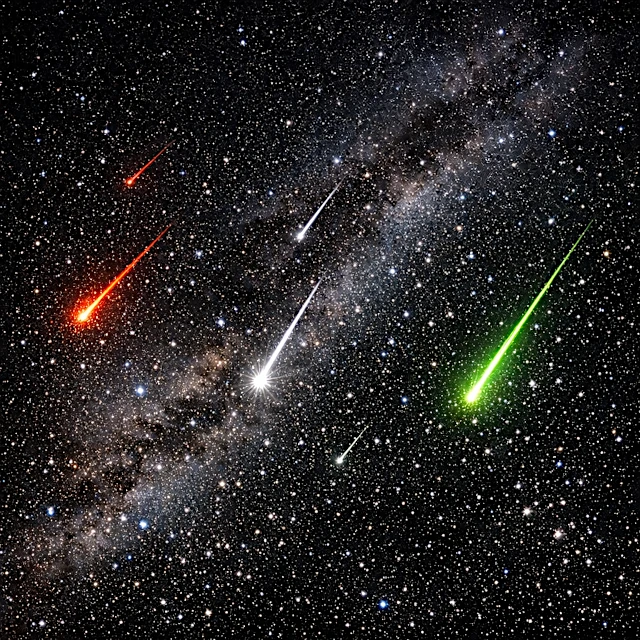
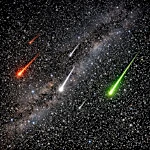
Three bright trails symbolize the three major meteor showers: the Perseids (warm red), the Leonids (fast white), and the Geminids (pale green).
Each originates from a fragment of a comet or asteroid.
These fleeting flashes, which extinguish in less than a second, are the last breaths of cometary dust grains thousands of years old.
Image source: astronoo.com (new window)
What is a shooting star?
A shooting star is not a star but a tiny dust grain released by a comet or an asteroid. As it enters Earth’s atmosphere at speeds of up to 72 km/s, the particle heats up, vaporizes, and produces a brief streak of light. When Earth crosses a dense stream of debris, the phenomenon becomes a meteor shower, such as the Perseids or Geminids. These fleeting flashes reveal the constant activity of the Solar System and the ongoing encounter between our planet and cosmic dust.
Where do these luminous trails come from?
Despite their poetic name, shooting stars are not stars at all. They are particles of dust smaller than a millimeter (no larger than a grain of sand) that originate from the disintegration of a comet or asteroid. These grains of matter, called meteoroids, enter Earth's atmosphere at speeds between 11 km/s and 72 km/s. Friction with air molecules compresses and heats these particles until they completely vaporize, producing a streak of light visible from the ground: this is a meteor.
When Earth passes through the dusty trail left by a comet in its orbit, hundreds or even thousands of meteoroids enter the atmosphere simultaneously. This predictable and recurring spectacle occurs every year on the same dates, forming a meteor shower. The most famous include the Perseids, Leonids, and Geminids.
Why do major meteor showers repeat every year?
The origin of this dust is almost always linked to comets. As comets approach the Sun, their ice sublimates, releasing a stream of rocky and dusty particles that form their coma and long luminous tail. Along their orbit, comets leave behind a ribbon of debris. Every year, when Earth passes through this "river of dust" at the same time, the phenomenon repeats, giving rise to meteor showers.
Where do shooting stars come from?
Each shower is distinguished by its radiant: the point in the sky from which the trails appear to diverge, due to a perspective effect. The name of the shower is derived from the constellation where this radiant is located. This apparent point of convergence gives each shower its name: the radiant of the Perseids is in the constellation Perseus, that of the Leonids in Leo, and that of the Geminids in Gemini.
The height of the radiant above the horizon directly influences the number of observable meteors. The higher the radiant is in the sky, the more numerous and longer the meteors are. This is why a shower's activity reaches its maximum after midnight, when the radiant is at its highest. The activity rate is expressed in ZHR (Zenithal Hourly Rate), a theoretical value standardized for a perfect sky.
The Perseids: The Summer Shower
The Perseids are a meteor shower, yellow to orange in color, sometimes green, active every year from July 17 to August 24. They peak around August 11-12, with a ZHR that can exceed 100 meteors per hour under a dark sky. Their entry speed into the atmosphere is about 59 km/s, which often generates persistent trails and particularly spectacular colored fireballs.
The parent comet of the Perseids is comet 109P/Swift-Tuttle, discovered in 1862 by Lewis Swift and Horace Parnell Tuttle. Its nucleus is about 26 km in diameter, making it one of the largest known comets to regularly approach Earth. It completes a full orbit around the Sun in about 130 years; its next perihelion passage will be on July 12, 2126. With each revolution, the comet ejects new particles that settle on the same orbit and overlap with debris from previous passes, enriching the stream over millennia. Gravitational perturbations from Jupiter and Saturn spread these particles along a portion of the orbit, forming distinct filaments.
The Leonids: The Storm Shower
The Leonids are active every year from November 6 to 30, with a peak around November 17-18. Their particularity lies in their exceptional speed: they enter the atmosphere at about 71 km/s, the highest speed of all major meteor showers. These are very bright meteors, white-bluish or pure white, which leave persistent trails lasting several seconds.
The comet responsible for the Leonids is 55P/Tempel-Tuttle, a periodic comet whose 33-year orbit replenishes the meteor stream responsible for this meteor shower every year. First identified in 1865 by Wilhelm Tempel and independently in 1866 by Horace Parnell Tuttle, this comet offers an exceptional show every 33 years: when Earth crosses areas of the stream recently replenished by its passage near the Sun, the Leonids turn into true meteor storms.
These storms can reach several thousand, or even tens of thousands of meteors per hour (estimated at 150,000 meteors/hour in 1966). The last perihelion occurred in 1998, resulting in spectacular storms between 1999 and 2002. The next passages are expected around 2031 (with visible effects around 2034, as the debris disperses) and 2064 (with a peak around 2065).
The Geminids: The Shower from Asteroid Phaethon
The Geminids stand out from other meteor showers due to their unique origin: they do not come from a comet, but from an asteroid, (3200) Phaethon, about 5 km in diameter. This celestial body has a rare feature for an asteroid: it develops a dust trail similar to that of a comet when it approaches the Sun. Phaethon's perihelion passage occurs every 1.43 years (about 524 days).
Every year, Earth passes through the same point in its orbit around December 13, and this is precisely where the trail of debris left by Phaethon is located. The Geminids are active from December 4 to 20, with a peak around December 13-14. With a ZHR that can reach 120 to 150 meteors per hour, they are already active in the early evening, when the radiant rises around 8 PM in Gemini. The meteors enter the atmosphere at about 35 km/s, a moderate speed that gives them a green, yellow, or sometimes white color.
Table of Major Meteor Showers
| Shower Name | Activity Dates | Peak (Maximum Date) | Parent Body | Speed (km/s) | ZHR (Typical Maximum) | Color |
|---|---|---|---|---|---|---|
| Quadrantids | December 28 – January 12 | January 3–4 | Asteroid (196256) 2003 EH1 (probably an extinct comet) | 41 | 80–120 | Bluish or white |
| Lyrids | April 16–25 | April 22–23 | Comet C/1861 G1 (Thatcher) | 48 | 15–20 (sometimes up to 90) | White, sometimes bluish |
| Eta Aquarids | April 19 – May 28 | May 5–6 | Halley's Comet (1P/Halley) | 66 | 40–60 (best in the southern hemisphere) | Yellowish or white |
| Alpha Capricornids | July 3 – August 15 | July 29–30 | Comet 169P/NEAT | 23 | 5–10 (but often very bright, fireballs) | Yellow or orange |
| Perseids | July 17 – August 24 | August 11–13 | Comet Swift-Tuttle (109P/Swift-Tuttle) | 59 | 100–150 | Yellow or orange, sometimes green |
| Orionids | October 2 – November 7 | October 21–22 | Halley's Comet (1P/Halley) | 66 | 15–25 (sometimes 40) | White-bluish or white-yellow; green is rare but possible |
| Taurids (South and North) | September 10 – December 10 | November 5–12 | Comet 2P/Encke (and associated debris) | 28 | 5–10 (but fireballs are very frequent) | Orange or reddish |
| Leonids | November 6–30 | November 17–18 | Comet Tempel-Tuttle (55P/Tempel-Tuttle) | 71 | 10–15 (up to thousands during storms) | White-bluish or pure white |
| Geminids | December 4–17 | December 13–14 | Asteroid (3200) Phaethon | 35 | 120–150 | Green, yellow, sometimes white |
N.B.: ZHR (Zenithal Hourly Rate) is the theoretical number of meteors visible per hour under a perfectly dark sky, with the radiant at the zenith. The values indicated are averages; some years, higher peaks may occur. The colors mentioned are those generally observed, but may vary depending on the composition of the meteors and observation conditions.
FAQ – Shooting Stars
Is a shooting star really a star?
No. It is a tiny grain of cosmic dust burning up as it enters Earth’s atmosphere.
Where do shooting stars come from?
Most originate from dust trails left by comets, and sometimes from fragmented asteroids.
Why do we see a streak of light?
The particle heats up due to atmospheric friction, vaporizes, and produces a bright flash.
What is a meteor shower?
A meteor shower occurs when Earth passes through a dense stream of debris, such as the Perseids or Geminids.
Do shooting stars reach the ground?
Very rarely. Most particles burn up completely. If a fragment survives, it becomes a meteorite.
 Dwarf Planets: The Forgotten Worlds of the Solar System
  Kuiper Belt: Composition and Origins
  Haumea and its Moons: A Singularity of the Solar System
  The Enigma of the Oort Cloud: Indirect Evidence and Uncertainties
  Sedna: The Mysterious Remnant at the Edge of the Solar System
  Quaoar: The Dwarf Planet That Defies the Roche Limit with Its Two Rings
  What is Dust? Between the Dust on Our Shelves and the Dust that Builds Planets
  Ceres: Boundary Between Asteroid and Dwarf Planet
  Pluto and its Moons: Charon, Nix, Hydra, Styx, and Kerberos
  Eris: The Dwarf Planet at the Edge of the Solar System
  Gonggong: An Eccentric Witness to Distant Perturbations
  Meteor Showers: Perseids, Leonids, Geminids...
  Interstellar Comets: When the Universe Sends its Messengers
  The Asteroid Bennu: The Building Blocks of Life
  Formation of Asteroids: From Cosmic Dust to Small Rocky Bodies
  Yarkovsky Effect: Orbit and Rotation of Asteroids
  Arrokoth: Unique Witness to the Primordial Solar Nebula
  The Kirkwood Gaps in the Main Asteroid Belt
  Asteroid Belt: Dark, Bright, or Red
  The Great Comet of 1577 Shattered the Crystal Spheres
  The Invisible Threat of Asteroids: From Pebbles to Flying Mountains
  Meteorites: Messengers from Space and Witnesses of the Solar System
  Comet Hartley 2: The Icy Heart Scrutinized by Deep Impact
  When Two Asteroids Collide: The Strange Case of P/2010 A2
  2005 YU55: The 400 m Asteroid that Grazed Earth
  Asteroid Apophis: The Perfect Candidate for a Global Impact?
  Vesta: The Colossus of the Asteroid Belt
  From Asteroids to Planets
  Comet Ison C/2012: between the promise of brilliance and disillusionment
  Giants of the Asteroid Belt: Classification by Size
  Impact Craters on Earth: Between Destruction and Mineral Resources
  Online Simulator: Orbits of Asteroids
  Online Simulator: Orbits of Near-Earth Asteroids
  Rosetta has a date with a comet
  Near-Earth Asteroids: An Underestimated Threat?
  Asteroid 2009 DD45: A Reminder of Planetary Vulnerability to Asteroids
  Strange Resemblance Between Comet Hartley 2 and Asteroid Itokawa
  Earth Trojan Asteroids: The Companions Sharing our Orbit
  Torino Scale: a classification system for impact risks
  The Nice Model: Towards an Explanation of the Late Heavy Bombardment
  NEO Monitoring: The Case of Asteroid 2012 LZ1
  Comet Lemmon C/2012 F6: The green visitor of the southern hemisphere
  Asteroid 2012 DA14 passed on February 15, 2013
  Near-Earth Asteroid 2012 BX34: A Record Close Approach to Our Planet
 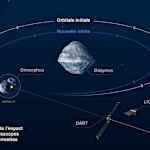 Didymos and Dimorphos: The First Asteroid Moon Moved by Humanity
  Chariklo and its rings: a surprising centaur asteroid
  Rosetta and Philae: A Feat 500 Million Kilometers from Earth
  The Passage of Comets: Eccentric Orbits at the Heart of the Solar System
  Vesta and its Curiosities: The Enigma of the Torn South Pole
  Meeting the Asteroids: The Main Belt
  Orbits of Near-Earth Asteroids: When Asteroids Brush Past Earth
  Comets: Streaks of Light, Promises of Life, and Cosmic Threats
  Asteroid Pallas: A Giant of the Main Belt
  Asteroid Juno: an unknown giant of the solar system
  Ganymed (1036): Near-Earth and Mars-crosser
  Earth's quasi-satellite: 2016 HO3