


Interstellar Comets: When the Universe Sends its Messengers
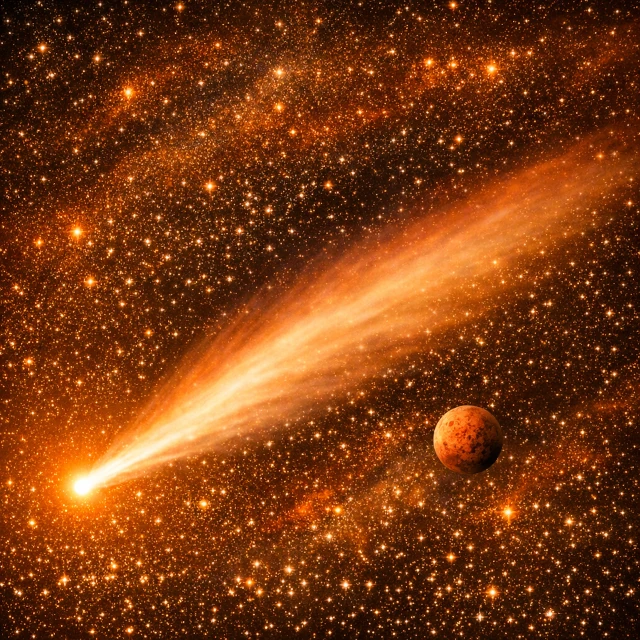
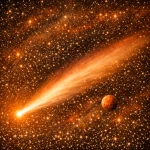
An interstellar comet in transit through our solar system, its hyperbolic trajectory revealing its external origin.
Its tail of gas and dust, blown by the solar wind, testifies to a composition forged in the outskirts of a distant star.
These ephemeral visitors are the silent ambassadors of other planetary systems, bearers of information about the processes of stellar formation across the entire Galaxy.
Image source: astronoo.com (new window), AI-generated image, public domain.
Scientific abstract
Interstellar comets are icy bodies ejected from their stellar systems of origin, wandering through the Galaxy before crossing our Solar System on hyperbolic trajectories. Their study began with the discovery of 1I/'Oumuamua (2017) and was confirmed with 2I/Borisov (2019), which displayed classic cometary activity. These objects provide natural samples of extrasolar matter, revealing the chemical diversity of galactic protoplanetary disks. Their existence confirms an exchange of matter on the scale of the Milky Way, with implications for panspermia and planetary formation.
What are interstellar comets?
They are galactic travelers ejected from their star of origin and wandering for billions of years before crossing our solar system. Their hyperbolic trajectory and their composition make them messengers from other worlds, offering a unique insight into the diversity of protoplanetary environments in the Milky Way and the exchange of matter between stellar systems.
Also worth exploring
Continue your exploration of the Universe with these topics:
Interstellar Comets: Billions of Years of Wandering for a Single Passage
Wandering bodies ejected from their system of origin
Interstellar comets are wandering celestial bodies, galactic nomads that orbit no star. Ejected from their system of origin during the formation of the planets, they drift freely through interstellar space, subject only to the collective gravity of the Milky Way. Unlike so-called "local" comets, which move on closed elliptical orbits around the Sun, they follow hyperbolic trajectories (an open curve whose eccentricity is strictly greater than 1, precluding a closed orbit around the Sun) (eccentricity greater than 1).
Hyperbolic trajectories with no return
These objects cross our stellar neighborhood only once, by the pure chance of their trajectory, without ever being captured by the Sun's gravity, before departing toward the depths of the Galaxy for hundreds of millions of additional years.
N.B.:
During the birth of a stellar system, the gravitational perturbations of the forming planets eject billions of small bodies into interstellar space.
Our own Sun released a considerable quantity of such debris.
This debris now wanders through the Galaxy, carrying the chemical imprint of its system of origin (minerals, ices, organic molecules) like so many "messages in bottles" in the cosmic ocean.
The discovery of 'Oumuamua: a historic first
A chance detection by Pan-STARRS1
On October 19, 2017, astronomer Robert Weryk (born in 1982), working with the Pan-STARRS1 telescope in Hawaii, detected an object moving at an unusual speed, far greater than solar gravity alone can explain. The object received the designation 1I/'Oumuamua (first confirmed interstellar object, whose Hawaiian name means approximately 'scout sent from afar in advance'), a Hawaiian term meaning approximately "scout from afar". It was the first confirmed interstellar object ever detected in our solar system.
The object was detected while it was already moving rapidly away from the Sun, after its perihelion. Astronomers had only a few weeks to observe it before it became too faint. Spectroscopy attempts, which would have made it possible to identify molecules on its surface or outgassing, were largely unsuccessful, for lack of a sufficient signal.
An unexplained non-gravitational acceleration
Its baffling behavior immediately sparked intense scientific controversy. Its shape appeared highly elongated and showed a periodic variation in brightness suggesting a tumultuous rotation. Even more surprisingly, its acceleration did not fully match the gravitational predictions: an excess of thrust, non-gravitational in nature, was measured.
Borisov: the first confirmation of an interstellar comet
An amateur discovery from Crimea
On August 30, 2019, Ukrainian amateur astronomer Gennady Borisov (born in 1966) discovered, from his observatory in Crimea, an object with a distinctly cometary appearance. Its hyperbolic orbit was quickly calculated: its eccentricity of 3.356 left no doubt about its interstellar origin. The comet received the official designation 2I/Borisov, the second confirmed interstellar object, and the first to display unambiguously classic cometary activity.
A revealing chemical composition
Unlike 'Oumuamua, 2I/Borisov proved to be much more familiar. Spectroscopic analyses conducted from the ground and from space revealed the presence of carbon monoxide (CO), water (H₂O) and cyanide (CN), compounds commonly found in the comets of our own solar system. Studies published in the journal Nature Astronomy by the teams of Piotr Guzik and Bin Yang in 2020 showed that this comet had a particularly high proportion of CO, far more than the average of solar comets, suggesting a formation in a cold environment, at a great distance from its star of origin.
For the first time, humanity could directly analyze the chemical composition of a celestial body formed in another stellar system, thereby providing observational constraints on the processes of planetary formation on a galactic scale.
Several criteria make it possible to identify an interstellar object
The four orbital and dynamical criteria
The identification of an interstellar object relies on several complementary physical and orbital criteria.
- An orbital eccentricity greater than 1: the orbit is open, hyperbolic, and the object cannot be gravitationally bound to the Sun.
- The residual velocity after the passage: an object bound to the Sun gradually slows down as it moves away, until it stops and turns back. An interstellar object, on the other hand, retains a positive velocity even at a very great distance: it never stops. For 'Oumuamua, this residual velocity was about 26 km/s, and for 2I/Borisov about 32 km/s.
- A positive orbital energy (\(\varepsilon >0\)): this energy measures the balance between what the object possesses (its kinetic energy \(\frac{v^2}{2}\)) and what the Sun "costs" it to escape (its potential energy \(\frac{GM_\odot}{r}\)). If the balance is negative, the object is a prisoner of the Sun. If it is positive, the object is free: this is the case of every interstellar comet.
- A consistent direction of origin: when tracing the trajectory backward, the object's radiant point must point toward interstellar space, with no connection to the known reservoirs of solar system comets such as the Oort cloud or the Kuiper belt.
Summary table of confirmed objects
The following table summarizes the two interstellar objects confirmed to date, with their main orbital and physical characteristics.
| Designation | Date of discovery | Discoverer / Program | Eccentricity | Velocity \(v_\infty\) (km/s) | Cometary activity | Status |
|---|---|---|---|---|---|---|
| 1I/'Oumuamua | October 19, 2017 | Robert Weryk, Pan-STARRS1 (Hawaii) | 1.201 | about 26 | None detected | Confirmed interstellar |
| 2I/Borisov | August 30, 2019 | Gennady Borisov, Crimea observatory | 3.356 | about 32 | Well-developed coma and tail | Confirmed interstellar |
What interstellar comets teach us about the Galaxy
Natural samples of extrasolar matter
Beyond scientific curiosity, interstellar comets are natural samples of extrasolar matter. Their chemical composition reflects the physical and chemical conditions that prevailed in the protoplanetary disk of their star of origin: temperatures, isotopic ratios, molecular abundances. Every interstellar object is, in a way, the chemical imprint of an unknown stellar environment.
Panspermia and galactic chemical exchanges
The idea that chemical materials circulate from one stellar system to another via such objects is closely linked to the concept of panspermia (a hypothesis according to which microorganisms or their chemical precursors could be transported between stellar systems by meteorites, comets or other celestial bodies). If complex organic molecules, or even prebiotic compounds, can survive the interstellar journey, the possibility of a chemical exchange between stellar systems cannot be ruled out.
More fundamentally, the detection and study of these objects confirm that our solar system is not isolated in the Galaxy. It bathes in a continuous flow of matter from elsewhere, a permanent exchange of planetary debris that weaves, over billions of years, a kind of common chemical fabric between the stellar systems of the Milky Way.
References
FAQ: Interstellar comets
What is an interstellar comet?
A small icy body from another stellar system, crossing ours on an open trajectory.
How do we know it comes from elsewhere?
Its orbit is hyperbolic: it cannot be gravitationally bound to the Sun.
Which interstellar comets have we observed?
Only two: 1I/'Oumuamua in 2017 and 2I/Borisov in 2019.
In what way is 'Oumuamua strange?
It showed no visible cometary activity and displayed an unexplained acceleration.
Why is 2I/Borisov important?
It resembled a "classic" comet, making it possible to directly study matter from another planetary system.
Can more of them be observed in the future?
Yes: future sky surveys, notably the Vera Rubin telescope, should detect many more.
 Dwarf Planets: The Forgotten Worlds of the Solar System
  Kuiper Belt: Composition and Origins
  Haumea and its Moons: A Singularity of the Solar System
  The Enigma of the Oort Cloud: Indirect Evidence and Uncertainties
  Sedna: The Mysterious Remnant at the Edge of the Solar System
  Quaoar: The Dwarf Planet That Defies the Roche Limit with Its Two Rings
  What is Dust? Between the Dust on Our Shelves and the Dust that Builds Planets
  Ceres: Boundary Between Asteroid and Dwarf Planet
  Pluto and its Moons: Charon, Nix, Hydra, Styx, and Kerberos
  Eris: The Dwarf Planet at the Edge of the Solar System
  Gonggong: An Eccentric Witness to Distant Perturbations
  Meteor Showers: Perseids, Leonids, Geminids...
  Interstellar Comets: When the Universe Sends its Messengers
  The Asteroid Bennu: The Building Blocks of Life
  Formation of Asteroids: From Cosmic Dust to Small Rocky Bodies
  Yarkovsky Effect: Orbit and Rotation of Asteroids
  Arrokoth: Unique Witness to the Primordial Solar Nebula
  The Kirkwood Gaps in the Main Asteroid Belt
  Asteroid Belt: Dark, Bright, or Red
  The Great Comet of 1577 Shattered the Crystal Spheres
  The Invisible Threat of Asteroids: From Pebbles to Flying Mountains
  Meteorites: Messengers from Space and Witnesses of the Solar System
  Comet Hartley 2: The Icy Heart Scrutinized by Deep Impact
  When Two Asteroids Collide: The Strange Case of P/2010 A2
  2005 YU55: The 400 m Asteroid that Grazed Earth
  Asteroid Apophis: The Perfect Candidate for a Global Impact?
  Vesta: The Colossus of the Asteroid Belt
  From Asteroids to Planets
  Comet Ison C/2012: between the promise of brilliance and disillusionment
  Giants of the Asteroid Belt: Classification by Size
  Impact Craters on Earth: Between Destruction and Mineral Resources
  Online Simulator: Orbits of Asteroids
  Online Simulator: Orbits of Near-Earth Asteroids
  Rosetta has a date with a comet
  Near-Earth Asteroids: An Underestimated Threat?
  Asteroid 2009 DD45: A Reminder of Planetary Vulnerability to Asteroids
  Strange Resemblance Between Comet Hartley 2 and Asteroid Itokawa
  Earth Trojan Asteroids: The Companions Sharing our Orbit
  Torino Scale: a classification system for impact risks
  The Nice Model: Towards an Explanation of the Late Heavy Bombardment
  NEO Monitoring: The Case of Asteroid 2012 LZ1
  Comet Lemmon C/2012 F6: The green visitor of the southern hemisphere
  Asteroid 2012 DA14 passed on February 15, 2013
  Near-Earth Asteroid 2012 BX34: A Record Close Approach to Our Planet
  Didymos and Dimorphos: The First Asteroid Moon Moved by Humanity
  Chariklo and its rings: a surprising centaur asteroid
  Rosetta and Philae: A Feat 500 Million Kilometers from Earth
  The Passage of Comets: Eccentric Orbits at the Heart of the Solar System
  Vesta and its Curiosities: The Enigma of the Torn South Pole
  Meeting the Asteroids: The Main Belt
  Orbits of Near-Earth Asteroids: When Asteroids Brush Past Earth
  Comets: Streaks of Light, Promises of Life, and Cosmic Threats
  Asteroid Pallas: A Giant of the Main Belt
  Asteroid Juno: an unknown giant of the solar system
  Ganymed (1036): Near-Earth and Mars-crosser
  Earth's quasi-satellite: 2016 HO3