


Comet Hartley 2: the icy heart scrutinized by Deep Impact
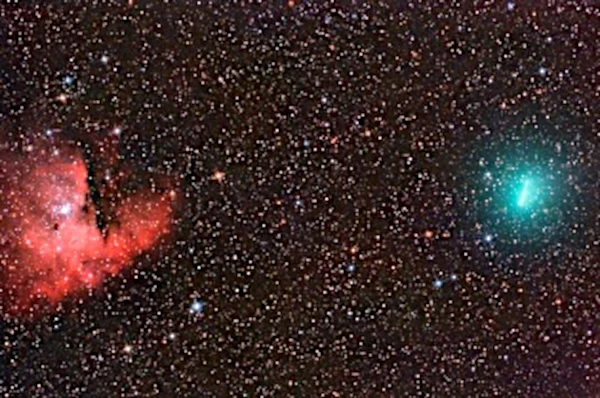
Comet Hartley 2 seen by the Deep Impact probe during its EPOXI mission.
Image source: NASA/JPL-Caltech/UMD (new window)
Scientific summary
The Astronoo article presents comet 103P/Hartley 2, a small icy body from the Jupiter family, flown by the Deep Impact probe in 2010 as part of the EPOXI mission. The observations reveal a bilobed, dumbbell-shaped nucleus about 2.2 km long, whose activity is powered by jets rich in carbon dioxide. This particular volatile composition explains intense sublimation and projects aggregates of water ice. The article also explores the implications of the water's isotopic composition for the origin of Earth's oceans and places Hartley 2 in the history of cometary flybys.
What makes comet Hartley 2 so special for the study of comets and the origin of Earth's water?
This article is devoted to comet 103P/Hartley 2, a periodic object from the Jupiter family discovered in 1986. But what makes this comet so special? First, its nucleus has an exceptional bilobed shape, resembling a peanut, which probably reflects the gentle merging of two icy bodies. Then, during the close flyby of the Deep Impact probe in November 2010, the cameras revealed particularly active jets of carbon dioxide, capable of projecting grains of water ice. This activity, powered by internal CO\(_2\) reservoirs, differs from that of water-dominated comets. Finally, the isotopic composition of Hartley 2's water proves compatible with that of Earth's oceans, which strengthens the hypothesis that Jupiter Family Comets may have contributed to the delivery of water to the young Earth. The article thus details the discovery, orbit, structure and scientific lessons of this historic flyby.
Also worth exploring
Continue your exploration of the Universe with these topics:
An icy rendezvous in space
A close flyby of the comet
On November 4, 2010, the Deep Impact probe, reassigned to the EPOXI mission, flew past comet 103P/Hartley 2 at a distance of only 700 km. This small celestial body, about 2.2 km long and 0.4 km wide, offered an unexpected spectacle: a dumbbell-shaped nucleus, from which jets of gas and dust escape. Hartley 2, although modest in size, reveals surprisingly intense activity.
Structure and composition of the nucleus
A bilobed nucleus rich in ices
The high-resolution images show a nucleus with two dense lobes connected by a narrower and less massive central region. This configuration suggests a bilobed structure, potentially formed by the gentle accretion of two distinct objects. The comet contains a high proportion of CO\(_2\) ice, volatile at low temperature, which explains persistent activity even far from the Sun.
Unexpected jets of carbon dioxide
Jets of CO\(_2\) and water ice
Unlike typical comets that release water as they approach the Sun, Hartley 2 massively releases CO\(_2\) from its extremities. These jets are capable of projecting centimeter-sized aggregates of water ice at high speed. This behavior reveals a deep degassing mechanism, where solar heat reactivates internal pockets of CO\(_2\) ice, stimulating sublimation and erosion processes.
A mission with multiple objectives
EPOXI and cometary exploration
The EPOXI mission combined two objectives: the study of exoplanets (Epoxi) and the exploration of comets (DIXI). Hartley 2 was thus the fifth comet to be closely flown by a space probe, after Halley, Borrelly, Wild 2 and Tempel 1. The detailed analysis of its surface and dynamics allows a better understanding of the first materials of the Solar System, preserved in the cometary nucleus.
Implication for the origin of Earth's water
An isotopic signature close to that of the oceans
The isotopic composition of Hartley 2's water, measured indirectly, is compatible with that of the Earth's oceans (\(D/H \sim 1.61 \times 10^{-4}\)), which fuels the hypothesis that comets of the Jupiter Family Comets (JFC) type may have played a major role in delivering water to Earth.
Main characteristics of comet Hartley 2
Orbital and physical data
The table below gathers the main orbital and physical characteristics of comet Hartley 2.
| Parameter | Value | Unit | Remarks |
|---|---|---|---|
| Official name | 103P/Hartley | – | Jupiter-family periodic comet |
| Orbital period | 6.47 | years | Strongly influenced by Jupiter |
| Nucleus dimensions | 2.2 × 0.4 | km | Elongated bilobed shape |
| Perihelion distance | 1.05 | AU | Just beyond Earth's orbit |
| Volatile composition | CO\(_2\), H\(_2\)O | – | CO\(_2\)-rich jets |
| Flyby date | November 4, 2010 | – | 700 km from the nucleus |
References
FAQ: Everything you need to know about comet Hartley 2
What is comet Hartley 2?
Comet Hartley 2, officially designated 103P/Hartley 2, is a periodic comet from the Jupiter family. It was discovered in 1986 by astronomer Malcolm Hartley. Its nucleus measures about 2.2 km long and orbits the Sun in 6.47 years.
Why is comet Hartley 2 famous?
It is famous for the close flyby of the Deep Impact probe in November 2010, as part of the EPOXI mission. The images obtained revealed a bilobed nucleus and particularly active carbon dioxide jets, offering an unprecedented glimpse of cometary activity.
What is the shape of its nucleus?
Its nucleus has an elongated bilobed shape, often compared to a peanut or a dumbbell. It consists of two dense lobes connected by a narrower central region, suggesting a possible accretion of two distinct bodies.
What did the EPOXI mission discover during the 2010 flyby?
The EPOXI mission discovered that Hartley 2 massively releases CO\(_2\) from its extremities, unlike water-dominated comets. These jets project aggregates of water ice and reveal a deep degassing mechanism.
Can comet Hartley 2 explain the origin of Earth's water?
The isotopic composition of Hartley 2's water is compatible with that of Earth's oceans. This strengthens the hypothesis that comets of the Jupiter Family Comets type may have contributed to the delivery of water to the young Earth, without however being the sole source.
How can one observe or obtain data on Hartley 2?
As Hartley 2 is a periodic comet, it becomes observable again during its passages near the Sun. The scientific data from the flyby are archived by NASA and JPL. Images and results are available via the public databases of the EPOXI mission.
 Dwarf Planets: The Forgotten Worlds of the Solar System
  Kuiper Belt: Composition and Origins
  Haumea and its Moons: A Singularity of the Solar System
  The Enigma of the Oort Cloud: Indirect Evidence and Uncertainties
  Sedna: The Mysterious Remnant at the Edge of the Solar System
  Quaoar: The Dwarf Planet That Defies the Roche Limit with Its Two Rings
  What is Dust? Between the Dust on Our Shelves and the Dust that Builds Planets
  Ceres: Boundary Between Asteroid and Dwarf Planet
  Pluto and its Moons: Charon, Nix, Hydra, Styx, and Kerberos
  Eris: The Dwarf Planet at the Edge of the Solar System
  Gonggong: An Eccentric Witness to Distant Perturbations
  Meteor Showers: Perseids, Leonids, Geminids...
  Interstellar Comets: When the Universe Sends its Messengers
  The Asteroid Bennu: The Building Blocks of Life
  Formation of Asteroids: From Cosmic Dust to Small Rocky Bodies
  Yarkovsky Effect: Orbit and Rotation of Asteroids
  Arrokoth: Unique Witness to the Primordial Solar Nebula
  The Kirkwood Gaps in the Main Asteroid Belt
  Asteroid Belt: Dark, Bright, or Red
  The Great Comet of 1577 Shattered the Crystal Spheres
  The Invisible Threat of Asteroids: From Pebbles to Flying Mountains
  Meteorites: Messengers from Space and Witnesses of the Solar System
  Comet Hartley 2: The Icy Heart Scrutinized by Deep Impact
  When Two Asteroids Collide: The Strange Case of P/2010 A2
  2005 YU55: The 400 m Asteroid that Grazed Earth
  Asteroid Apophis: The Perfect Candidate for a Global Impact?
  Vesta: The Colossus of the Asteroid Belt
  From Asteroids to Planets
  Comet Ison C/2012: between the promise of brilliance and disillusionment
  Giants of the Asteroid Belt: Classification by Size
  Impact Craters on Earth: Between Destruction and Mineral Resources
  Online Simulator: Orbits of Asteroids
  Online Simulator: Orbits of Near-Earth Asteroids
  Rosetta has a date with a comet
  Near-Earth Asteroids: An Underestimated Threat?
  Asteroid 2009 DD45: A Reminder of Planetary Vulnerability to Asteroids
  Strange Resemblance Between Comet Hartley 2 and Asteroid Itokawa
  Earth Trojan Asteroids: The Companions Sharing our Orbit
  Torino Scale: a classification system for impact risks
  The Nice Model: Towards an Explanation of the Late Heavy Bombardment
  NEO Monitoring: The Case of Asteroid 2012 LZ1
  Comet Lemmon C/2012 F6: The green visitor of the southern hemisphere
  Asteroid 2012 DA14 passed on February 15, 2013
  Near-Earth Asteroid 2012 BX34: A Record Close Approach to Our Planet
  Didymos and Dimorphos: The First Asteroid Moon Moved by Humanity
  Chariklo and its rings: a surprising centaur asteroid
  Rosetta and Philae: A Feat 500 Million Kilometers from Earth
  The Passage of Comets: Eccentric Orbits at the Heart of the Solar System
  Vesta and its Curiosities: The Enigma of the Torn South Pole
  Meeting the Asteroids: The Main Belt
  Orbits of Near-Earth Asteroids: When Asteroids Brush Past Earth
  Comets: Streaks of Light, Promises of Life, and Cosmic Threats
  Asteroid Pallas: A Giant of the Main Belt
  Asteroid Juno: an unknown giant of the solar system
  Ganymed (1036): Near-Earth and Mars-crosser
  Earth's quasi-satellite: 2016 HO3