


Asteroid Bennu: A Rubble Pile Containing Organic Compounds
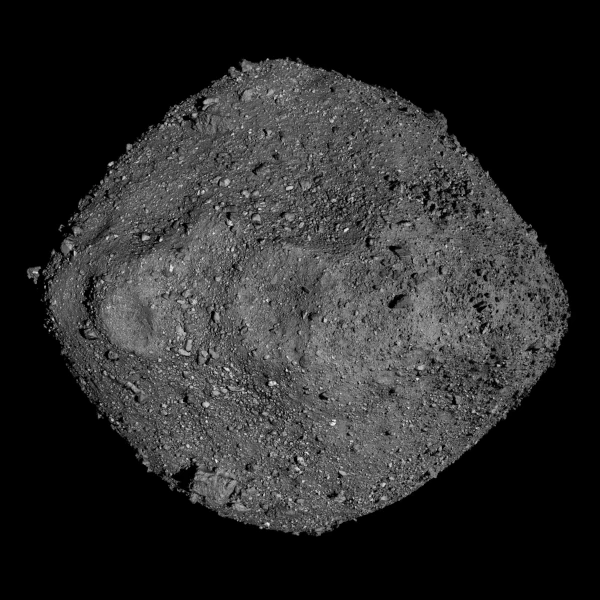
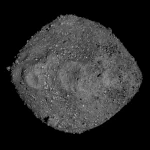
This mosaic of asteroid Bennu is composed of 12 PolyCam images collected on December 2, 2018 by the OSIRIS-REx spacecraft from a distance of about 24 km.
Detailed view of Bennu's surface showing its rubble-pile structure and numerous cracks on the surface rocks rich in carbonaceous material.
Image source: NASA/Goddard/University of Arizona (new window)
Scientific abstract
Astronoo's article presents asteroid Bennu (~492 meters) as a natural laboratory preserving the chemical state of the early Solar System. Samples returned by the OSIRIS-REx mission reveal the presence of hydrated phyllosilicates, over thirty amino acids (including 14 of the 20 used by terrestrial biology), all five nucleobases of DNA and RNA, an exceptionally abundant ammonia and, since 2025, bio-essential sugars such as ribose and glucose. These discoveries demonstrate that liquid water and organic chemistry were active as early as 4.5 billion years ago, even forming a genuine evaporated brine on Bennu's parent body. The three major families of life's building blocks — nitrogenous bases, sugars and amino acids — were thus assembled in the early Solar System, long before Earth's formation, opening major perspectives on the mechanisms of life's emergence in the Universe.
Why is asteroid Bennu so crucial for understanding the origin of life?
This article is dedicated to asteroid Bennu, a carbonaceous B-type body from the earliest moments of the Solar System. But why is this asteroid so crucial for astrobiologists? The answer lies in its exceptional composition: Bennu contains complex organic molecules, dozens of amino acids, all five nucleobases of DNA and RNA, an unusually abundant ammonia and bound water in its minerals, direct evidence of active prebiotic chemistry 4.5 billion years ago. Unlike Earth, whose surface has been profoundly reshaped by plate tectonics and erosion, Bennu is a virtually unchanged remnant of the protoplanetary disk. Its study therefore allows us to travel back in time and observe the ingredients that preceded the emergence of life on our planet. Analyses published in 2025 confirm that these chemical building blocks were not only present, but that they interacted with a genuine liquid brine, now frozen as evaporated salts, promoting their complexification. More recently still, the detection of sugars like ribose completes the inventory of the three ingredients essential for RNA: a nucleobase, a sugar and a phosphate. Thus, Bennu does not merely deliver fossil clues: it offers us a direct window onto the processes that made life possible, providing an increasingly precise answer to the hypothesis of a cosmic origin for biological precursors.
Also worth exploring
Continue your exploration of the Universe with these topics:
A relic of the early Solar System
A preserved witness of the first billion years
Asteroid Bennu is a carbonaceous asteroid (carbon-rich asteroid containing primitive organic compounds) of type B, originating from the first millions of years of Solar System formation. Its age is estimated at about 4.5 billion years, making it a virtually unchanged witness of the physico-chemical conditions prevailing in the solar nebula. Bennu itself is a second-generation rubble pile, formed less than 65 million years ago from the debris of an older parent body, now gone, which experienced most of the aqueous alteration described in this article.
With an average diameter of about 490 m, Bennu has a so-called "rubble pile" structure, where self-gravity is weak, on the order of \( g \approx 10^{-5} \, \text{m·s}^{-2} \). This low gravity allows the preservation of fragile materials, including hydrated minerals and volatile organic compounds.
The OSIRIS-REx mission
A direct sampling at the heart of the asteroid
NASA's OSIRIS-REx spacecraft, launched in 2016, enabled the direct sampling of Bennu, returned to Earth on September 24, 2023, in the Utah desert. Approximately 121.6 g of regolith were recovered and then curated under high-purity nitrogen at NASA's Johnson Space Center. This mission continues the exploration work aimed at linking cosmic chemistry to the origin of life, under the leadership of principal investigator Dante S. Lauretta of the University of Arizona.
Spectroscopic and isotopic analysis of the samples revealed a carbon content of 4.54% by mass (of which about 90% in organic form) and a nitrogen content of 0.23 to 0.25% by mass: values higher than those measured on samples from asteroid Ryugu or most known carbonaceous meteorites.
Organic molecules and primitive water
Phyllosilicates that tell the story of water
Bennu contains hydrated phyllosilicates (minerals that have incorporated water into their crystal structure) (about 80% by volume of the sample), evidence that its parent body interacted with liquid water very early in Solar System history. This water is not free, but chemically bound, indicating reactions at low temperature.
More than 16,000 distinct molecular formulas, composed of carbon, hydrogen, nitrogen, oxygen, sulfur and magnesium, were identified in the samples. Among them, about thirty amino acids were detected, including 14 of the 20 proteinogenic amino acids used by terrestrial biology, with glycine being the most abundant. All five canonical nucleobases of DNA and RNA (adenine, guanine, cytosine, thymine and uracil) were also identified, alongside about ten other related nitrogenous heterocyclic compounds.
N.B.:
Remarkably, the chiral amino acids detected in the Bennu samples occur in nearly equal proportions between their left- and right-handed forms (racemic), in contrast to the strong left-handed excess characteristic of terrestrial biochemistry. This absence of chiral bias confirms that these are indeed abiotic molecules, not contaminated by Earth's biosphere, and raises the open question of the origin of life's homochirality on Earth.
A saline parent world: the discovery of an ancient evaporated brine
A complete salt sequence revealed in 2025
In January 2025, two independent studies published in Nature and Nature Astronomy transformed our understanding of Bennu's parent body. The team led by Timothy J. McCoy (Smithsonian) and Sara S. Russell (Natural History Museum, London) identified, in the sample grains, a genuine evaporite sequence: sodium phosphates, hydrated sodium carbonates (trona, gaylussite/pirssonite), sodium sulfate (thenardite), halite and sylvite (NaCl and KCl), as well as sodium fluoride. This mineral suite, comparable to that of Searles Lake in California, attests to the progressive evaporation of an alkaline brine on the surface or in the fractures of the parent body, with evaporation degrees estimated between 45 and 70%.
These sodium salts, extremely fragile and sensitive to atmospheric humidity, would not have survived prolonged exposure to terrestrial air: their preservation was only possible thanks to the sample return under a controlled nitrogen atmosphere, illustrating the irreplaceable contribution of sample-return missions compared to the study of meteorites that naturally fall to Earth. Similar brines are suspected to persist today in the subsurface of Ceres and Enceladus, making Bennu a valuable analogue for the study of these ocean worlds.
Exceptionally abundant ammonia
The same analysis campaign, led by Daniel P. Glavin and Jason P. Dworkin (NASA Goddard), revealed exceptionally high ammonium concentrations (approximately 13.6 µmol per gram in a hot water extract), well above those of classic carbonaceous meteorites. This ammonia, associated with formaldehyde also detected in the sample, is a key precursor for the synthesis of amino acids and nitrogenous heterocyclic compounds via Strecker-type reactions, occurring directly in the parent body's brine.
2025-2026: bio-essential sugars complete the RNA inventory
Ribose, glucose and the third pillar of prebiotic chemistry
A nucleobase, a sugar and a phosphate group: these are the three components required to form a nucleotide, the elementary building block of RNA and DNA. While nucleobases and phosphates had already been identified in Bennu, the third pillar was missing. This has now been remedied by a study published on December 2, 2025 in Nature Geoscience by a Japanese-American team led by Yoshihiro Furukawa (Tohoku University).
Unequivocal detection of ribose and glucose by mass spectrometry
By analyzing an acidic and aqueous extract of the Bennu sample by gas chromatography coupled with tandem mass spectrometry, the researchers detected four aldopentoses — including ribose, the constituent sugar of RNA — as well as two aldohexoses, including glucose, the main energy source of cellular metabolism on Earth. Neither biological contamination nor analytical artifact can explain these detections: the racemic nature of the associated amino acids and the absence of sugars in the procedure blanks confirm an authentic extraterrestrial origin.
The formose reaction: a prebiotic synthesis in alkaline medium
The total abundance of these sugars remains low, on the order of 1% of that of amino acids, and their distribution — larger sugars (hexoses) being more abundant than smaller ones (tetroses) — is explained by a so-called "formose" reaction, where formaldehyde progressively condenses into increasingly complex sugars within the alkaline brines of the parent body, catalyzed by calcium and magnesium ions present in the carbonates. The pH measured in the Bennu extract (8.23), clearly alkaline, is consistent with this chemistry and with the presence of the evaporites described above.
N.B.:
Deoxyribose, the constituent sugar of DNA, was not detected in this sample, probably due to its much higher chemical reactivity than ribose. This difference suggests that ribose, and therefore an RNA-world-type chemistry, would have been more available than DNA in the primitive organic matter of the Solar System.
Bennu and the primordial building blocks of the Solar System
A generalized organic chemistry from the first millions of years
The study of Bennu suggests that life's chemical building blocks were already present very early during the formation of the Solar System, well before Earth's appearance itself. These organic compounds and hydrated minerals formed directly in the solar nebula (cloud of gas and dust that gave birth to the Solar System), under the effect of low-temperature physico-chemical processes involving ultraviolet radiation, grain shocks and catalysis on mineral surfaces, before being reworked within the parent body's brines.
Bennu, a fossil reservoir of the protoplanetary disk
In this context, Bennu is not a late vector of biological matter, but a fossil reservoir preserving the initial chemical state of the protoplanetary disk. The amino acids, nucleobases, sugars, ammonia and bound water observed today bear witness to a generalized organic chemistry, active from the first millions of years, at a time when the terrestrial planets were still only accreting embryos.
Mild energy conditions favorable to preservation
From an energy standpoint, these reactions do not require violent impacts. They are compatible with weakly heated environments, where energy comes from short-lived radioactive decay, local thermal gradients and surface reactions, allowing a progressive complexification of matter without destruction of fragile molecules.
A simultaneous delivery of life's building blocks to early Earth
Given that fragments of carbonaceous asteroids similar to Bennu were likely widely dispersed in the inner Solar System, these three families of life's building blocks — nitrogenous bases, sugars and amino acids — could have been delivered together to early Earth and the other terrestrial planets.
Comparative table of detected compounds
| Compound | Chemical type | Potential role | Detection method |
|---|---|---|---|
| Amorphous carbon | Elemental | Support for organic chemistry | Infrared spectroscopy |
| Phyllosilicates | Hydrated mineral | Trace of primitive water | Mineralogical analysis |
| Amino acids (33 identified, including 14 proteinogenic) | Organic molecule | Glycine (\( \mathrm{NH_2{-}CH_2{-}COOH} \)) is the most abundant; racemic distribution | Chromatography |
| Nucleobases (5 out of 5, DNA/RNA) | Nitrogenous heterocyclic compound | Precursors of genetic information | Chromatography / mass spectrometry |
| Ammonia and formaldehyde | Nitrogenous compound / aldehyde | Precursors of amino acids and sugars | Mass spectrometry |
| Ribose and glucose | Sugar (aldopentose / aldohexose) | RNA component; metabolic energy source | Gas chromatography (GC-MS/MS) |
| Evaporitic salts (phosphates, carbonates, Na/K chlorides) | Mineral salt | Trace of an ancient alkaline brine | X-ray diffraction, electron microscopy |
| Carbonates | Mineral salt | Chemical pH regulation | Mass spectrometry |
References
- NASA — Ten Things to Know About Bennu (new window)
- NASA — OSIRIS-REx Mission Page (new window)
- NASA (January 29, 2025) — NASA's Asteroid Bennu Sample Reveals Mix of Life's Ingredients (new window)
- Lauretta, D. S. & Connolly, H. C. et al. (2024). Asteroid (101955) Bennu in the laboratory: Properties of the sample collected by OSIRIS-REx. Meteoritics & Planetary Science 59, 2453–2486. doi:10.1111/maps.14227 (new window)
- Glavin, D. P. & Dworkin, J. P. et al. (2025). Abundant ammonia and nitrogen-rich soluble organic matter in samples from asteroid (101955) Bennu. Nature Astronomy 9, 199–210. doi:10.1038/s41550-024-02472-9 (new window)
- McCoy, T. J. & Russell, S. S. et al. (2025). An evaporite sequence from ancient brine recorded in Bennu samples. Nature 637, 1072–1077. doi:10.1038/s41586-024-08495-6 (new window)
- Furukawa, Y. et al. (2025/2026). Bio-essential sugars in samples from asteroid Bennu. Nature Geoscience 19, 19–24. doi:10.1038/s41561-025-01838-6 (new window)
- OSIRIS-REx Mission — Complete list of scientific publications (new window)
- NASA Planetary Data System (PDS) — Mission data archives (new window)
FAQ: Everything you need to know about asteroid Bennu and the origin of life
What is asteroid Bennu and why is it so important?
Bennu is a carbonaceous B-type asteroid, about 4.5 billion years old, which has preserved intact the matter from the early Solar System's parent body. Its importance lies in its richness in organic compounds (amino acids, nucleobases, sugars) and hydrated and evaporitic minerals, evidence of active prebiotic chemistry within an ancient brine. The samples returned by the OSIRIS-REx mission in 2023 offer a unique window onto the chemical ingredients available before Earth's formation, helping us understand how life's elementary building blocks could have emerged in space.
What are the main compounds detected on Bennu?
Analyses have revealed amorphous carbon, hydrated phyllosilicates, about thirty amino acids including 14 proteinogenic ones, all five nucleobases of DNA and RNA, exceptionally abundant ammonia, sugars such as ribose and glucose, as well as a complete sequence of evaporitic salts (phosphates, carbonates, sulfates, chlorides and fluorides of sodium). These compounds cover all three major families of life's building blocks — amino acids, sugars and nucleobases — demonstrating that the chemistry of life was already in place in the protoplanetary disk.
How were the Bennu samples collected and returned to Earth?
The OSIRIS-REx spacecraft was launched in 2016. It orbited Bennu for nearly two years to map its surface. In 2020, an approach maneuver collected about 121.6 grams of regolith using a robotic arm equipped with a Touch-And-Go Sample Acquisition Mechanism (TAGSAM). The samples were sealed in a return capsule that landed in the Utah desert on September 24, 2023, before being curated under high-purity nitrogen at the Johnson Space Center and distributed to laboratories worldwide for analysis.
What do these discoveries tell us about the origin of life on Earth?
The combined presence of amino acids, nucleobases, sugars, ammonia and an ancient brine confirms that all three major families of chemical ingredients essential for life were already available in the early Solar System, and that they could interact within a single aqueous environment. This strengthens the hypothesis of a cosmic origin for biological precursors, which could have been delivered to Earth by asteroid and comet impacts. The racemic nature of Bennu's amino acids further shows that this cosmic prebiotic chemistry does not, by itself, exhibit the homochirality bias observed in terrestrial life — a question that remains open for future research.
Where can I access the OSIRIS-REx mission data?
OSIRIS-REx scientific data are freely accessible via NASA archives, including the Planetary Data System (PDS) (new window) and the official mission website (new window), which also lists the complete scientific publications. Articles are available in journals such as Nature, Nature Astronomy and Nature Geoscience. 3D visualization tools of Bennu are also provided by the University of Arizona, a mission partner.
 Dwarf Planets: The Forgotten Worlds of the Solar System
  Kuiper Belt: Composition and Origins
  Haumea and its Moons: A Singularity of the Solar System
  The Enigma of the Oort Cloud: Indirect Evidence and Uncertainties
  Sedna: The Mysterious Remnant at the Edge of the Solar System
  Quaoar: The Dwarf Planet That Defies the Roche Limit with Its Two Rings
  What is Dust? Between the Dust on Our Shelves and the Dust that Builds Planets
  Ceres: Boundary Between Asteroid and Dwarf Planet
  Pluto and its Moons: Charon, Nix, Hydra, Styx, and Kerberos
  Eris: The Dwarf Planet at the Edge of the Solar System
  Gonggong: An Eccentric Witness to Distant Perturbations
  Meteor Showers: Perseids, Leonids, Geminids...
  Interstellar Comets: When the Universe Sends its Messengers
  The Asteroid Bennu: The Building Blocks of Life
  Formation of Asteroids: From Cosmic Dust to Small Rocky Bodies
  Yarkovsky Effect: Orbit and Rotation of Asteroids
  Arrokoth: Unique Witness to the Primordial Solar Nebula
  The Kirkwood Gaps in the Main Asteroid Belt
  Asteroid Belt: Dark, Bright, or Red
  The Great Comet of 1577 Shattered the Crystal Spheres
  The Invisible Threat of Asteroids: From Pebbles to Flying Mountains
  Meteorites: Messengers from Space and Witnesses of the Solar System
  Comet Hartley 2: The Icy Heart Scrutinized by Deep Impact
  When Two Asteroids Collide: The Strange Case of P/2010 A2
  2005 YU55: The 400 m Asteroid that Grazed Earth
  Asteroid Apophis: The Perfect Candidate for a Global Impact?
  Vesta: The Colossus of the Asteroid Belt
  From Asteroids to Planets
  Comet Ison C/2012: between the promise of brilliance and disillusionment
  Giants of the Asteroid Belt: Classification by Size
  Impact Craters on Earth: Between Destruction and Mineral Resources
  Online Simulator: Orbits of Asteroids
  Online Simulator: Orbits of Near-Earth Asteroids
  Rosetta has a date with a comet
  Near-Earth Asteroids: An Underestimated Threat?
  Asteroid 2009 DD45: A Reminder of Planetary Vulnerability to Asteroids
  Strange Resemblance Between Comet Hartley 2 and Asteroid Itokawa
  Earth Trojan Asteroids: The Companions Sharing our Orbit
  Torino Scale: a classification system for impact risks
  The Nice Model: Towards an Explanation of the Late Heavy Bombardment
  NEO Monitoring: The Case of Asteroid 2012 LZ1
  Comet Lemmon C/2012 F6: The green visitor of the southern hemisphere
  Asteroid 2012 DA14 passed on February 15, 2013
  Near-Earth Asteroid 2012 BX34: A Record Close Approach to Our Planet
  Didymos and Dimorphos: The First Asteroid Moon Moved by Humanity
  Chariklo and its rings: a surprising centaur asteroid
  Rosetta and Philae: A Feat 500 Million Kilometers from Earth
  The Passage of Comets: Eccentric Orbits at the Heart of the Solar System
  Vesta and its Curiosities: The Enigma of the Torn South Pole
  Meeting the Asteroids: The Main Belt
  Orbits of Near-Earth Asteroids: When Asteroids Brush Past Earth
  Comets: Streaks of Light, Promises of Life, and Cosmic Threats
  Asteroid Pallas: A Giant of the Main Belt
  Asteroid Juno: an unknown giant of the solar system
  Ganymed (1036): Near-Earth and Mars-crosser
  Earth's quasi-satellite: 2016 HO3