


Strange Resemblance Between Comet Hartley 2 and Asteroid Itokawa

Two bilobed geometries like giant peanuts: comet 103P/Hartley (top, EPOXI spacecraft, 2010) and asteroid (25143) Itokawa (bottom, Hayabusa spacecraft, 2005).
Image source: NASA/JPL-Caltech/UMD (new window) and ESO/JAXA (new window)
Scientific Summary
Astronoo's article presents the morphological similarities between comet 103P/Hartley 2 and asteroid (25143) Itokawa, two small bodies of the Solar System. Despite a common bilobed shape, their compositions differ radically: Hartley 2 is rich in ices and emits jets, while Itokawa is a dry silicate rock. This resemblance raises questions about accretion processes and the sometimes blurred boundary between asteroids and comets. Studying these objects helps us better understand low-velocity collision dynamics and gravitational reaccumulation, suggesting a universal pattern for the formation of contact binaries.
Why do comet Hartley 2 and asteroid Itokawa look so much alike?
This article explores the strange resemblance between comet 103P/Hartley 2 and asteroid (25143) Itokawa. Both have a bilobed morphology, resembling a peanut or a dog bone. But how can two objects of such different nature, one icy and active, the other rocky and inert, share such a distinctive shape? The answer lies in hierarchical accretion mechanisms. These two bodies are thought to have formed through the slow collision of two distinct blocks, which then aggregated under gravity. This scenario, common to many small bodies, suggests that their shape results from a universal process. Yet their thermal history and composition are radically opposed. Hartley 2, originating from the icy outskirts of the Solar System, has retained its volatiles, while Itokawa, formed closer to the Sun, has been dehydrated. This study shows that shape alone is not enough to determine the nature of a celestial object, and that morphological, dynamical and spectroscopic data must be combined to unlock their secrets.
Also worth exploring
Continue your exploration of the Universe with these topics:
Bodies with similar appearances but distinct origins
A first morphological confrontation
Comet 103P/Hartley 2, flown by in 2010 by the EPOXI spacecraft, and asteroid 25143 Itokawa, explored by the Japanese Hayabusa mission in 2005, show surprisingly similar morphology: a bilobed shape resembling a "dog bone" or a celestial peanut. Yet one is an ice-rich body, periodically active, while the other is a dry rock from the inner Solar System. This morphological similarity raises fundamental questions about the dynamic and thermal history of small celestial bodies.
Similar accretion processes?
The formation of contact binaries
These two objects share a low apparent density, indicating that they are highly porous, or even composed of two independent blocks weakly bound gravitationally: they are contact binaries. This structure likely results from low-velocity collisions in the late stages of accretion. Can this similar morphogenesis arise from a universal pattern for small bodies? It is plausible, because aggregation dynamics follow statistical laws governed by relative velocities, dissipated energy, and gravitational reaccumulation.
Transition between asteroids and comets
An increasingly blurred boundary
The Hartley 2-Itokawa case illustrates a blurred boundary between two classes once considered distinct. Observations of extinct comets in the main belt and volatile-rich asteroids (e.g. 24 Themis) suggest that material transfers may have occurred between the Oort cloud, the Kuiper belt and the asteroid belt. Processes of progressive devolatilization, internal heating or solar erosion can transform a comet into an asteroid.
A morphological continuum
Beyond binary classifications
The joint study of Hartley 2 and Itokawa helps to better define the morphological diversity of small bodies, extending the range of shapes beyond classical categories. The external similarity masks a difference in spectroscopic composition: Hartley 2 emits jets of CO2 and H2O, while Itokawa is silicate-rich (S-type). However, their shape suggests a hierarchical accretion dynamics with gravitational reconfiguration after multiple collisions.
Comparison of physical characteristics
| Parameter | Comet Hartley 2 | Asteroid Itokawa | Comments |
|---|---|---|---|
| Type | Periodic comet (103P) | S-type asteroid (silicaceous) | Hartley 2 originates from the Kuiper belt, Itokawa from the main belt. |
| Dimensions | 2.2 × 0.4 km (lobes 0.6 and 0.4 km) | 535 × 294 × 209 m | Hartley 2 is about 4 times longer than Itokawa but much narrower. |
| Mass | ~3.0 × 10¹¹ kg | ~3.5 × 10¹⁰ kg | Hartley 2's mass is nearly 10 times that of Itokawa. |
| Mean density | ~200–300 kg/m³ (0.2–0.3 g/cm³) | ~1900 kg/m³ (1.9 g/cm³) | Hartley 2 is highly porous (~80% void), Itokawa is more compact. |
| Geometric albedo | 0.028 (very dark) | 0.29 (bright) | Hartley 2 is covered in carbonaceous material, Itokawa in bright silicates. |
| Activity | Yes (CO₂ and H₂O jets) | No (inert) | Hartley 2's activity is driven by sublimation of ices during perihelion. |
| Rotation period | 18.1 hours | 12.1 hours | Both bodies have slow rotation, typical of contact binaries. |
| Spectral composition | Ices, silicates, organic compounds | Olivine, pyroxene, metals (S-type) | Hartley 2 shows absorption bands of ice and CO₂. |
A misleading morphological resemblance
The strange resemblance between Hartley 2 and Itokawa reminds us that the shape of an object is not enough to deduce its nature or history. These two worlds are the result of different processes: condensation in the cold regions of the Solar System for Hartley 2, and accretion of silicate materials for Itokawa. Yet they both embody the complexity of small bodies.
References
FAQ: Everything you need to know about comet Hartley 2 and asteroid Itokawa
What is a contact binary?
A contact binary is a small celestial body (asteroid or comet) composed of two distinct lobes that are in gravitational contact with each other. This characteristic peanut shape often results from a low-velocity collision between two objects, followed by reaccretion under gravity. Hartley 2 and Itokawa are both examples of contact binaries.
Why is comet Hartley 2 active while Itokawa is not?
Hartley 2 is a periodic comet that originates from the Kuiper belt, a cold region of the Solar System. It still contains a large amount of volatile ices (water, carbon dioxide, etc.). When it approaches the Sun, these ices sublimate and produce jets of gas and dust, forming the characteristic coma and tail. Itokawa, on the other hand, is an S-type asteroid, rich in silicates and poor in volatiles. It has been heated and dehydrated by the Sun for billions of years, making it inactive.
How did the Hayabusa spacecraft explore Itokawa?
The Japanese spacecraft Hayabusa reached asteroid Itokawa in 2005. It carried out a detailed mapping of its surface, studied its shape and spectroscopic composition, and attempted to collect samples. Hayabusa also deployed a small rover, MINERVA, which however did not successfully land. Despite technical difficulties, the spacecraft returned to Earth in 2010 with dust particles from Itokawa, enabling laboratory analyses.
What have the Itokawa samples taught us?
The grains from Itokawa brought back by Hayabusa revealed a chemical and isotopic composition close to that of ordinary chondrites (the most common stony meteorites). They also showed signs of space weathering (cosmic ray irradiation, micrometeorite impacts). These samples confirmed that Itokawa is a primitive body, originating from the asteroid belt, and that it has undergone moderate heating.
Where can I find more information about these missions?
Data and images from the EPOXI (Hartley 2) and Hayabusa (Itokawa) missions are freely available on the NASA and JAXA websites. You can consult the Planetary Data System (new window) (NASA) and the Data Archives and Transmission System (new window) (JAXA) for detailed scientific data.
 Dwarf Planets: The Forgotten Worlds of the Solar System
  Kuiper Belt: Composition and Origins
  Haumea and its Moons: A Singularity of the Solar System
  The Enigma of the Oort Cloud: Indirect Evidence and Uncertainties
  Sedna: The Mysterious Remnant at the Edge of the Solar System
  Quaoar: The Dwarf Planet That Defies the Roche Limit with Its Two Rings
  What is Dust? Between the Dust on Our Shelves and the Dust that Builds Planets
  Ceres: Boundary Between Asteroid and Dwarf Planet
  Pluto and its Moons: Charon, Nix, Hydra, Styx, and Kerberos
  Eris: The Dwarf Planet at the Edge of the Solar System
  Gonggong: An Eccentric Witness to Distant Perturbations
  Meteor Showers: Perseids, Leonids, Geminids...
  Interstellar Comets: When the Universe Sends its Messengers
  The Asteroid Bennu: The Building Blocks of Life
  Formation of Asteroids: From Cosmic Dust to Small Rocky Bodies
  Yarkovsky Effect: Orbit and Rotation of Asteroids
  Arrokoth: Unique Witness to the Primordial Solar Nebula
 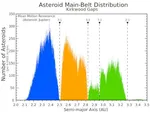 The Kirkwood Gaps in the Main Asteroid Belt
  Asteroid Belt: Dark, Bright, or Red
  The Great Comet of 1577 Shattered the Crystal Spheres
  The Invisible Threat of Asteroids: From Pebbles to Flying Mountains
  Meteorites: Messengers from Space and Witnesses of the Solar System
  Comet Hartley 2: The Icy Heart Scrutinized by Deep Impact
  When Two Asteroids Collide: The Strange Case of P/2010 A2
  2005 YU55: The 400 m Asteroid that Grazed Earth
  Asteroid Apophis: The Perfect Candidate for a Global Impact?
  Vesta: The Colossus of the Asteroid Belt
  From Asteroids to Planets
  Comet Ison C/2012: between the promise of brilliance and disillusionment
  Giants of the Asteroid Belt: Classification by Size
  Impact Craters on Earth: Between Destruction and Mineral Resources
  Online Simulator: Orbits of Asteroids
  Online Simulator: Orbits of Near-Earth Asteroids
  Rosetta has a date with a comet
 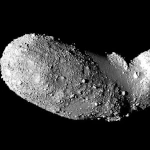 Near-Earth Asteroids: An Underestimated Threat?
  Asteroid 2009 DD45: A Reminder of Planetary Vulnerability to Asteroids
  Strange Resemblance Between Comet Hartley 2 and Asteroid Itokawa
  Earth Trojan Asteroids: The Companions Sharing our Orbit
  Torino Scale: a classification system for impact risks
  The Nice Model: Towards an Explanation of the Late Heavy Bombardment
  NEO Monitoring: The Case of Asteroid 2012 LZ1
  Comet Lemmon C/2012 F6: The green visitor of the southern hemisphere
  Asteroid 2012 DA14 passed on February 15, 2013
  Near-Earth Asteroid 2012 BX34: A Record Close Approach to Our Planet
  Didymos and Dimorphos: The First Asteroid Moon Moved by Humanity
  Chariklo and its rings: a surprising centaur asteroid
  Rosetta and Philae: A Feat 500 Million Kilometers from Earth
  The Passage of Comets: Eccentric Orbits at the Heart of the Solar System
  Vesta and its Curiosities: The Enigma of the Torn South Pole
  Meeting the Asteroids: The Main Belt
  Orbits of Near-Earth Asteroids: When Asteroids Brush Past Earth
  Comets: Streaks of Light, Promises of Life, and Cosmic Threats
  Asteroid Pallas: A Giant of the Main Belt
  Asteroid Juno: an unknown giant of the solar system
  Ganymed (1036): Near-Earth and Mars-crosser
  Earth's quasi-satellite: 2016 HO3