


Comet Ison C/2012: between the promise of brilliance and disillusionment
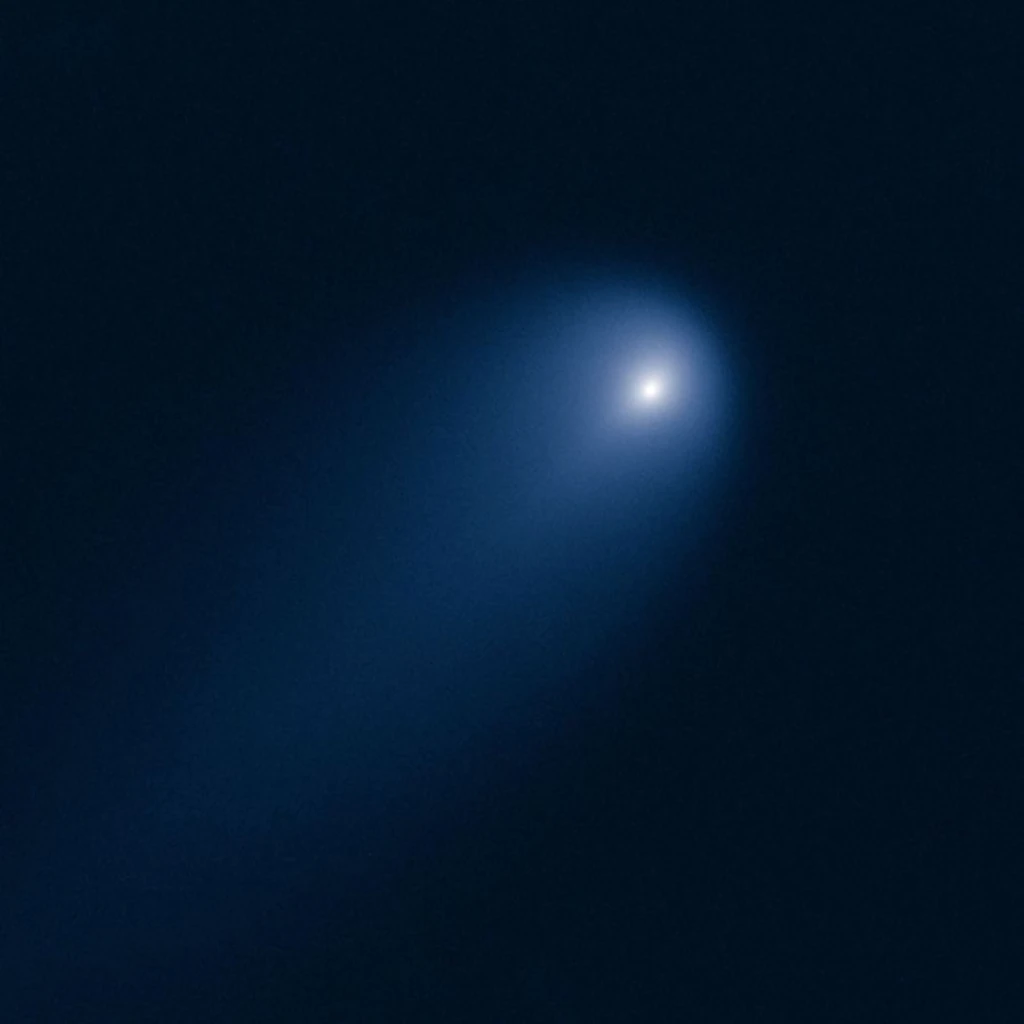
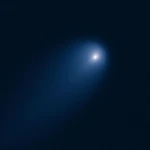
On October 18, 2013, NASA published a new image of the comet, taken on October 9 by the Hubble Space Telescope. At that date the comet was still intact.
Image source: NASA Hubble Space Telescope (new window)
Scientific summary
The Astronoo article retraces the history of comet C/2012 S1 (ISON), spotted on September 21, 2012 by two Russian and Belarusian amateur astronomers. Originating from the Oort cloud, this dynamic comet was heading toward a very tight perihelion, predicted for November 28, 2013, only 1.16 million kilometers from the solar surface. Models predicted a nucleus of 1 to 2 km and a brightness comparable to that of the full Moon. The scenario turned out quite differently: the nucleus disintegrated under the effect of heat. Observations by SOHO and STEREO nevertheless enriched our knowledge of cometary nuclei.
Did Comet ISON really deserve its nickname of “comet of the century”?
This article is devoted to comet C/2012 S1 (ISON), discovered on September 21, 2012 by two amateur astronomers, Artyom Novichonok and Vitali Nevski, from the International Scientific Optical Network observatory near Kislovodsk. Very quickly, orbital calculations revealed an object from the Oort cloud, making its first passage through the inner Solar System. Its perihelion, set for November 28, 2013, was to bring it only 1.16 million kilometers from the Sun’s surface, an extremely risky approach but also spectacular in power. Astronomers then hoped for a comet visible to the naked eye, even in daylight, as bright as the full Moon. Expectations were immense, fueled by the memory of Hale-Bopp and Ikeya-Seki. Reality was quite different: crushed by solar heat and tidal forces, ISON disintegrated at the time of its perihelion passage. It never delivered the great spectacle announced. Yet continuous observation of its death throes by SOHO, STEREO, and Hubble provided scientists with valuable data on the structure and fragility of cometary nuclei.
Also worth exploring
Continue your exploration of the Universe with these topics:
Where do comets come from?
Two reservoirs at the confines of the Solar System
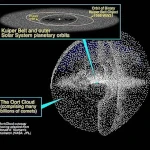
Comets come mainly from two major reservoirs located at the confines of the Solar System: the Kuiper Belt and the Oort cloud. Their origin and evolution are linked to the gravitational dynamics of the primitive Solar System and to the distribution of ices in cold regions.
The Kuiper Belt
The Kuiper Belt is a disk-shaped region located beyond Neptune’s orbit, between 30 and 50 astronomical units (AU) from the Sun. It contains billions of small icy bodies.
The Oort cloud
The Oort cloud is a hypothetical gravitational sphere surrounding the Solar System out to a distance of about 100,000 AU. It is thought to consist of several billion small icy bodies.
Comet ISON: a promising discovery
A discovery made by two amateur astronomers
On September 21, 2012, two amateur astronomers, Artyom Novichonok (Russia) and Vitali Nevski (Belarus), discovered a particularly bright object using the telescope of the International Scientific Optical Network (ISON) located near Kislovodsk. This comet, officially catalogued as C/2012 S1 (ISON), immediately aroused the interest of the scientific community: its highly elliptical trajectory suggested that it was a new dynamic comet from the Oort cloud, heading toward the Sun for the first time.
Orbital and physical characteristics of Comet ISON
A highly eccentric orbit
Comet ISON follows a highly eccentric orbit (e ≈ 1), typical of long-period comets originating in the Oort cloud. Its passage through perihelion was predicted for November 28, 2013, at a distance of about 1.16 million kilometers from the solar surface (i.e., 0.0124 AU). It was then to graze the Sun at very high speed (about 377 km/s), while undergoing extreme heating capable of vaporizing a large part of its volatile ices and releasing a potentially spectacular coma.
A nucleus 1 to 2 kilometers across
From a physical standpoint, early observations estimated that the comet’s nucleus measured between 1 and 2 km in diameter. The volatile compounds it released (water, carbon dioxide, dust) under the effect of early insolation seemed particularly abundant, which reinforced the hypothesis of a spectacular surge in brightness as it approached the Sun.
The promise of an exceptional celestial event
A “comet of the century”
From its discovery, some astronomers called ISON the “comet of the century.” Orbital projections indicated that it could become as bright as, or even brighter than, the full Moon, and even visible in daylight, an extremely rare phenomenon. Enthusiasm spread quickly, fueled by historical precedents such as Comet Ikeya-Seki (1965) or Hale-Bopp (1997).
A unique opportunity for science
Hopes were all the greater because its visibility was to extend over several weeks in autumn 2013, for observers in both the northern and southern hemispheres. For scientists, ISON also offered a unique opportunity to study the primitive composition of an object from the Oort cloud, little altered since the formation of the Solar System.
Disappointment and lessons
Disintegration at perihelion
Alas, as perihelion approached in late November 2013, Comet ISON was disintegrated by the Sun’s intense heat. Images captured by the SOHO and STEREO probes showed a progressive fading of its nucleus, leaving only a diffuse trail. The event certainly drew worldwide attention, but the visual spectacle expected from Earth never took place.
A test bed for cometary models
Despite this disintegration, Comet ISON represented a valuable opportunity to test thermal and dynamic models of cometary nuclei. It also served as a test bed for solar observation instruments and collaborations between professionals and amateurs around the globe.
References
FAQ: Everything you need to know about Comet ISON
What is a long-period comet?
A long-period comet is an icy body whose highly elongated orbit around the Sun exceeds 200 years, and which generally comes from the Oort cloud. Like C/2012 S1 (ISON), many make their first passage near the Sun, which makes them particularly unpredictable.
Why was Comet ISON nicknamed the “comet of the century”?
Because early estimates of its brightness suggested it could rival the full Moon, or even become visible in daylight. This scenario was based on its very close passage to the Sun and the apparent abundance of its volatile ices.
What is perihelion?
Perihelion is the point in a body’s orbit closest to the Sun. For ISON, it was located about 1.16 million kilometers from the solar surface, an infinitesimal distance on the astronomical scale, reached at nearly 377 km/s.
Did Comet ISON survive its passage near the Sun?
No. In November 2013, its nucleus disintegrated under the effect of heat and gravitational stresses. Images from SOHO and STEREO show a progressive fading of the nucleus, replaced by a diffuse dust trail.
Where did comets like ISON come from?
ISON came from the Oort cloud, a spherical reservoir of icy bodies located at the confines of the Solar System, up to 100,000 astronomical units from the Sun. The closer Kuiper Belt, for its part, supplies short-period comets.
Can Comet ISON still be observed today?
No, the comet has no longer existed as an active nucleus since late 2013. However, archives of images (Hubble, SOHO, STEREO) and freely accessible photometric data remain, useful for studying the fragmentation of cometary nuclei.
 Dwarf Planets: The Forgotten Worlds of the Solar System
  Kuiper Belt: Composition and Origins
  Haumea and its Moons: A Singularity of the Solar System
  The Enigma of the Oort Cloud: Indirect Evidence and Uncertainties
  Sedna: The Mysterious Remnant at the Edge of the Solar System
  Quaoar: The Dwarf Planet That Defies the Roche Limit with Its Two Rings
  What is Dust? Between the Dust on Our Shelves and the Dust that Builds Planets
  Ceres: Boundary Between Asteroid and Dwarf Planet
  Pluto and its Moons: Charon, Nix, Hydra, Styx, and Kerberos
  Eris: The Dwarf Planet at the Edge of the Solar System
  Gonggong: An Eccentric Witness to Distant Perturbations
  Meteor Showers: Perseids, Leonids, Geminids...
  Interstellar Comets: When the Universe Sends its Messengers
  The Asteroid Bennu: The Building Blocks of Life
  Formation of Asteroids: From Cosmic Dust to Small Rocky Bodies
  Yarkovsky Effect: Orbit and Rotation of Asteroids
  Arrokoth: Unique Witness to the Primordial Solar Nebula
  The Kirkwood Gaps in the Main Asteroid Belt
  Asteroid Belt: Dark, Bright, or Red
  The Great Comet of 1577 Shattered the Crystal Spheres
  The Invisible Threat of Asteroids: From Pebbles to Flying Mountains
  Meteorites: Messengers from Space and Witnesses of the Solar System
  Comet Hartley 2: The Icy Heart Scrutinized by Deep Impact
  When Two Asteroids Collide: The Strange Case of P/2010 A2
  2005 YU55: The 400 m Asteroid that Grazed Earth
  Asteroid Apophis: The Perfect Candidate for a Global Impact?
  Vesta: The Colossus of the Asteroid Belt
  From Asteroids to Planets
  Comet Ison C/2012: between the promise of brilliance and disillusionment
  Giants of the Asteroid Belt: Classification by Size
  Impact Craters on Earth: Between Destruction and Mineral Resources
  Online Simulator: Orbits of Asteroids
  Online Simulator: Orbits of Near-Earth Asteroids
  Rosetta has a date with a comet
  Near-Earth Asteroids: An Underestimated Threat?
  Asteroid 2009 DD45: A Reminder of Planetary Vulnerability to Asteroids
  Strange Resemblance Between Comet Hartley 2 and Asteroid Itokawa
  Earth Trojan Asteroids: The Companions Sharing our Orbit
  Torino Scale: a classification system for impact risks
  The Nice Model: Towards an Explanation of the Late Heavy Bombardment
  NEO Monitoring: The Case of Asteroid 2012 LZ1
  Comet Lemmon C/2012 F6: The green visitor of the southern hemisphere
  Asteroid 2012 DA14 passed on February 15, 2013
  Near-Earth Asteroid 2012 BX34: A Record Close Approach to Our Planet
 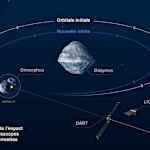 Didymos and Dimorphos: The First Asteroid Moon Moved by Humanity
  Chariklo and its rings: a surprising centaur asteroid
  Rosetta and Philae: A Feat 500 Million Kilometers from Earth
  The Passage of Comets: Eccentric Orbits at the Heart of the Solar System
  Vesta and its Curiosities: The Enigma of the Torn South Pole
  Meeting the Asteroids: The Main Belt
  Orbits of Near-Earth Asteroids: When Asteroids Brush Past Earth
  Comets: Streaks of Light, Promises of Life, and Cosmic Threats
  Asteroid Pallas: A Giant of the Main Belt
  Asteroid Juno: an unknown giant of the solar system
  Ganymed (1036): Near-Earth and Mars-crosser
  Earth's quasi-satellite: 2016 HO3