


Near-Earth Asteroid 2012 BX34: Record Close Pass by our Planet
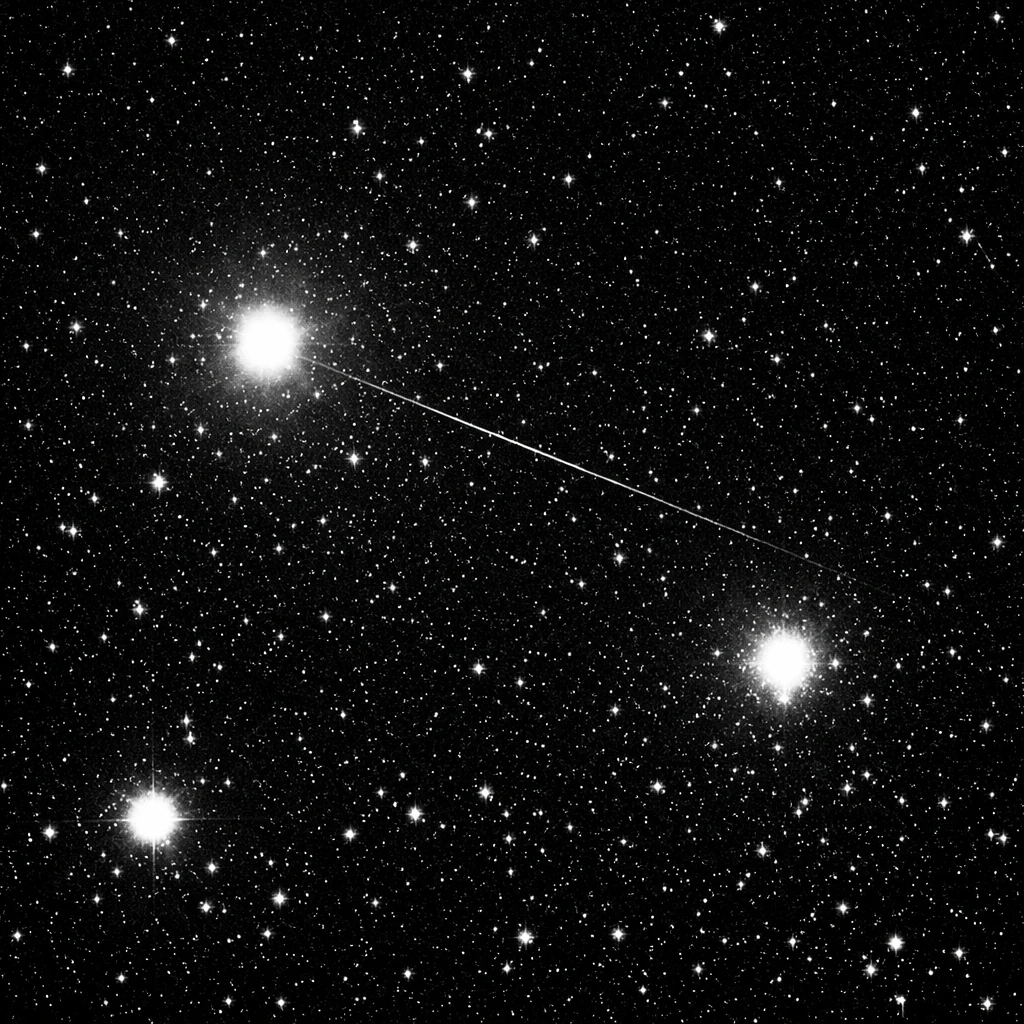
The faint light trail traces the trajectory of near-Earth object 2012 BX34 during its passage on January 27, 2012. It passed at 59,044 km from Earth, inside the geostationary orbit, located at 35,786 km altitude.
Image source: Ernesto Guido-Giovanni Sostero-Nick Howes (new window)
Scientific summary
Astronoo's article presents the near-Earth asteroid 2012 BX34, a small body of the solar system whose passage at 59,000 km from Earth on January 27, 2012 provided a unique observation opportunity. Thanks to radar and photometric data, astronomers have refined orbital models and the physical characterization of these objects. The study of its trajectory, influenced by gravitational perturbations, highlights the importance of continuous monitoring of near-Earth asteroids. This event illustrates the ability of current detection programs to track small objects, thus contributing to planetary protection and the understanding of the near-Earth object population.
What makes the passage of asteroid 2012 BX34 so remarkable for astronomers?
This article is dedicated to the near-Earth asteroid 2012 BX34, a small body about 8 to 11 meters in diameter that passed exceptionally close to Earth on January 27, 2012. But what makes this passage so special for astronomers? The answer lies in the combination of its extreme proximity — only 59,000 km, less than one-fifth of the Earth-Moon distance — and the precision of the observations it enabled. This event provided a rare opportunity to test and refine orbital prediction models, while demonstrating the effectiveness of surveillance networks such as the Catalina Sky Survey. Furthermore, the study of 2012 BX34 has helped to better understand the composition and dynamics of Apollo-type asteroids, which regularly cross Earth's orbit. This close pass, although harmless, underscores the importance of early detection of NEOs (near Earth Object) and paves the way for future planetary defense missions.
Also worth exploring
Continue your exploration of the Universe with these topics:
A remarkably precise passage
On January 27, 2012, asteroid 2012 BX34 flew past Earth at a distance of approximately 59,000 km, barely 0.15 times the Earth-Moon distance. This small object, estimated at only 8 to 11 meters in diameter, belongs to the category of NEOs (near Earth Object), and more precisely NEAs (near Earth Asteroid) of the Apollo type, whose orbit regularly crosses that of Earth.
Discovered by the Catalina Sky Survey program in Arizona, 2012 BX34 sparked great scientific interest because it passed inside the orbit of many geostationary satellites. Its relative speed at the time of the flyby reached approximately 13.4 km/s, a value consistent with the average speeds of small near-Earth objects.
N.B. :
Apollo-type asteroids belong to a class of NEOs (near Earth Object) whose semi-major axis is greater than 1 astronomical unit (AU), but whose perihelion is less than 1.017 AU. In other words, their orbit intersects that of Earth. Discovered by Karl Reinmuth (1892-1979) in 1932, the Apollo family today constitutes the most numerous population of NEAs (near Earth Asteroids), representing more than 60% of known near-Earth objects.
Physical and orbital characteristics
Composition and albedo
Radar and photometric data collected during its approach allowed an estimate of a moderate albedo, suggesting a silicaceous composition typical of S-type asteroids. The heliocentric orbit of 2012 BX34 is characterized by a sidereal period of 1.08 years and an eccentricity of 0.36. Its perihelion distance is 0.68 AU and its aphelion reaches 1.45 AU.
Hazard and model precision
Its passage near Earth posed no impact danger, the calculated probability being less than \(10^{-7}\). This type of approach nevertheless allows testing the precision of gravitational prediction models and the margins of error related to orbital perturbations (gravitational perturbations linked to the Moon and planets).
Monitoring and orbital calculations
Law of universal gravitation
Orbital calculations are based on the law of universal gravitation formulated by Isaac Newton (1643-1727), according to which the force between two masses is given by: \( F = G \frac{m_1 m_2}{r^2} \)
Numerical integration and perturbations
In the case of near-Earth asteroids, perturbations due to Earth and the Moon continuously modify orbital parameters: inclination, eccentricity and argument of perihelion. These variations are calculated by numerically integrating the equations of motion with a temporal resolution of less than one hour, in order to maintain trajectory accuracy over several years.
A record among known passages
Before 2012, only a few asteroids of comparable size had been observed so close to our planet, notably 2008 TC3 and 2011 CQ1. The latter, about 1 meter in diameter, still holds the record for the closest passage, at only 5,480 km from Earth, but it disintegrated in the atmosphere. In comparison, 2012 BX34 passed much farther, without experiencing atmospheric braking or mechanical alteration.
These observations are valuable for NEO (near Earth Object) models because they allow improving early detection strategies. NASA estimates that nearly 95% of objects larger than 1 km are now cataloged, but less than 30% of asteroids smaller than 100 meters are regularly tracked.
N.B. :
Radar and optical observations today allow tracking objects larger than 10 meters up to a distance of about 1 million kilometers. Future missions such as NEO Surveyor will strengthen this capability within the next decade.
Comparative table: Passages of small near-Earth asteroids
| Asteroid name | Passage date | Minimum distance (km) | Estimated diameter (m) | Relative velocity (km/s) | Remark |
|---|---|---|---|---|---|
| 2008 TC3 | October 7, 2008 | 0 (impact) | ≈ 4 | ≈ 12.4 | First asteroid detected before impact; disintegrated at 37 km altitude above the Nubian Desert (Sudan). Origin of Almahata Sitta meteorites. |
| 2011 CQ1 | February 4, 2011 | 5,480 | 0.8–2.6 | ≈ 9.7 | Held the record for the closest non-impacting flyby known, until 2020 QG in 2020. |
| 2012 BX34 | January 27, 2012 | 59,044 | 8–11 | ≈ 8.9 | Discovered only two days before its passage by the Catalina Sky Survey. |
| 2020 QG | August 16, 2020 | 2,950 | 3–6 | ≈ 12.3 | Closest non-impacting flyby ever recorded at the time; detected only 6 hours after its passage. |
| 2023 CX1 | February 13, 2023 | 0 (impact) | ≈ 0.72 | ≈ 17.4 | Seventh asteroid detected before impact; disintegrated over the English Channel, near the coast of Normandy (France). |
References
- https://cneos.jpl.nasa.gov/ca/ (new window)
- https://ssd.jpl.nasa.gov/tools/sbdb_lookup.html#/?sstr=2012%20BX34 (new window)
- https://www.minorplanetcenter.net/db_search/show_object?object_id=2012+BX34 (new window)
- https://ui.adsabs.harvard.edu/abs/2012CBET.3005....1G/abstract (new window)
- https://neo.ssa.esa.int/past-impactors/2008tc3 (new window)
- https://www.nasa.gov/feature/jpl/tiny-asteroid-buzzes-by-earth-the-closest-flyby-on-record/ (new window)
- https://neo.ssa.esa.int/past-impactors/2023cx1 (new window)
FAQ: Everything you need to know about asteroid 2012 BX34
What is asteroid 2012 BX34?
2012 BX34 is a small near-Earth asteroid discovered on January 25, 2012 by Alex Gibbs, astronomer and software engineer of the Catalina Sky Survey program (University of Arizona). It belongs to the class of Apollo asteroids, whose orbit crosses that of Earth. It passed near our planet two days after its discovery, on January 27, 2012 at 15:25 UT.
Why was this passage important for science?
This passage was an exceptional opportunity for astronomers to test the precision of orbital prediction models and to observe a small asteroid at very close range. The asteroid was ranked among the 20 closest approaches ever recorded. Its trajectory was tracked by NASA radars (Goldstone Deep Space Communications Complex), allowing refinement of physical and orbital parameters. Its rapid detection also demonstrated the effectiveness of surveillance programs such as the Catalina Sky Survey.
What was the size of 2012 BX34?
Its size is estimated between 8 and 11 meters in diameter, according to sources. Some initial estimates placed it between 6 and 19 meters. It is a relatively small object, comparable to the size of a bus or a small house. Its absolute magnitude (H) is 27.6.
Did it pose any danger to Earth?
No danger. The asteroid passed about 59,000 km from Earth — about 0.17 times the Earth-Moon distance — which represents about 15 times Earth's radius. Even if it had been on a collision trajectory, it would have disintegrated in the atmosphere due to its small size. NASA even tweeted: "It wouldn't make it through our atmosphere intact even if it dared to try."
How do astronomers track this type of object?
Astronomers use a network of optical telescopes and radars, such as the Catalina Sky Survey or the ATLAS system. The method consists of taking a series of images (four images spaced 10 to 12 minutes apart), then using specialized software to detect objects that move from one image to the next. The data is centralized by the Minor Planet Center (MPC) at the Smithsonian Astrophysical Observatory, then analyzed by centers such as CNEOS at NASA to calculate trajectories and assess risks.
What made the discovery of 2012 BX34 particularly unusual?
The discovery was unusual: after its initial detection on January 25, no one was able to find it the next day. Astronomer Rik Hill eventually discovered a "new" object nearby, which Alex Gibbs identified as being the same asteroid, whose brightness and apparent motion had increased considerably due to its growing proximity to Earth. Astronomers then realized it was going to pass exceptionally close to our planet.
What exact distance did 2012 BX34 pass at?
According to NASA data, the minimum distance was 36,750 miles (59,044 km) from Earth's surface. The asteroid reached an apparent magnitude of about 13.9 at its closest approach, a brightness comparable to that of Pluto. Its angular velocity in the sky was then about 729 degrees per day.
 Dwarf Planets: The Forgotten Worlds of the Solar System
  Kuiper Belt: Composition and Origins
  Haumea and its Moons: A Singularity of the Solar System
  The Enigma of the Oort Cloud: Indirect Evidence and Uncertainties
  Sedna: The Mysterious Remnant at the Edge of the Solar System
  Quaoar: The Dwarf Planet That Defies the Roche Limit with Its Two Rings
  What is Dust? Between the Dust on Our Shelves and the Dust that Builds Planets
  Ceres: Boundary Between Asteroid and Dwarf Planet
  Pluto and its Moons: Charon, Nix, Hydra, Styx, and Kerberos
  Eris: The Dwarf Planet at the Edge of the Solar System
  Gonggong: An Eccentric Witness to Distant Perturbations
  Meteor Showers: Perseids, Leonids, Geminids...
  Interstellar Comets: When the Universe Sends its Messengers
  The Asteroid Bennu: The Building Blocks of Life
  Formation of Asteroids: From Cosmic Dust to Small Rocky Bodies
  Yarkovsky Effect: Orbit and Rotation of Asteroids
  Arrokoth: Unique Witness to the Primordial Solar Nebula
 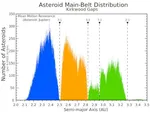 The Kirkwood Gaps in the Main Asteroid Belt
  Asteroid Belt: Dark, Bright, or Red
  The Great Comet of 1577 Shattered the Crystal Spheres
  The Invisible Threat of Asteroids: From Pebbles to Flying Mountains
  Meteorites: Messengers from Space and Witnesses of the Solar System
  Comet Hartley 2: The Icy Heart Scrutinized by Deep Impact
  When Two Asteroids Collide: The Strange Case of P/2010 A2
  2005 YU55: The 400 m Asteroid that Grazed Earth
  Asteroid Apophis: The Perfect Candidate for a Global Impact?
  Vesta: The Colossus of the Asteroid Belt
  From Asteroids to Planets
  Comet Ison C/2012: between the promise of brilliance and disillusionment
  Giants of the Asteroid Belt: Classification by Size
  Impact Craters on Earth: Between Destruction and Mineral Resources
  Online Simulator: Orbits of Asteroids
  Online Simulator: Orbits of Near-Earth Asteroids
  Rosetta has a date with a comet
  Near-Earth Asteroids: An Underestimated Threat?
  Asteroid 2009 DD45: A Reminder of Planetary Vulnerability to Asteroids
  Strange Resemblance Between Comet Hartley 2 and Asteroid Itokawa
  Earth Trojan Asteroids: The Companions Sharing our Orbit
  Torino Scale: a classification system for impact risks
  The Nice Model: Towards an Explanation of the Late Heavy Bombardment
  NEO Monitoring: The Case of Asteroid 2012 LZ1
  Comet Lemmon C/2012 F6: The green visitor of the southern hemisphere
  Asteroid 2012 DA14 passed on February 15, 2013
  Near-Earth Asteroid 2012 BX34: A Record Close Approach to Our Planet
  Didymos and Dimorphos: The First Asteroid Moon Moved by Humanity
  Chariklo and its rings: a surprising centaur asteroid
  Rosetta and Philae: A Feat 500 Million Kilometers from Earth
  The Passage of Comets: Eccentric Orbits at the Heart of the Solar System
  Vesta and its Curiosities: The Enigma of the Torn South Pole
  Meeting the Asteroids: The Main Belt
  Orbits of Near-Earth Asteroids: When Asteroids Brush Past Earth
  Comets: Streaks of Light, Promises of Life, and Cosmic Threats
  Asteroid Pallas: A Giant of the Main Belt
  Asteroid Juno: an unknown giant of the solar system
  Ganymed (1036): Near-Earth and Mars-crosser
  Earth's quasi-satellite: 2016 HO3