


When two asteroids collide: The strange case of P/2010 A2
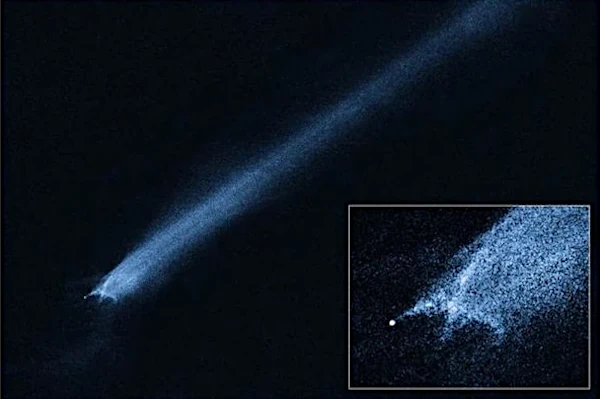
Images taken from January to May 2010 by the Hubble Space Telescope indicate that the object, called P/2010 A2, measures ∼120 m in width.
The asteroid, 50,000 km away, drags particles measuring from 1 millimeter to 2.5 centimeters.
P/2010 A2 is the residual debris of a recent collision between two small asteroids orbiting in the asteroid belt between Mars and Jupiter.
Image source: NASA/ESA/D. Jewitt (UCLA) (new window)
Scientific summary
Astronoo's article presents the asteroid P/2010 A2, a rare case of collision in the main asteroid belt. Hubble's observation reveals a tail of solid debris, distinct from cometary trails, resulting from a high-speed impact (~5 km/s). Dynamic modeling of the fragments, based on the parameter β (radiation pressure to gravity ratio), makes it possible to estimate the grain size distribution of the dust. This event confirms that collisions, although rare on a human scale (one every 20 million years), are key processes in the morphological and dynamic evolution of small bodies in the Solar System.
What makes the P/2010 A2 collision so exceptional for astronomers?
This article is dedicated to the asteroid P/2010 A2, discovered in January 2010, and to the catastrophic event that transformed it into a comet-like structure. But what makes this collision so exceptional? The answer lies in both its rarity and its visibility. In the asteroid belt, the spatial density is so low that a collision between two small bodies (a few meters versus a hundred meters) statistically occurs only once every 20 million years. Yet, in January 2010, the Hubble Space Telescope captured the image of a debris tail 50,000 km long, revealing the recent impact of a 2 to 4 meter projectile on an asteroid 120 meters in diameter. The energy released, on the order of 109 joules, pulverized the rock and ejected fragments whose dynamics are governed by the balance between solar gravity and radiation pressure. This direct observation offers a unique window onto the fragmentation and regolith processes that shape the main belt, and it confirms theoretical models of collision in the inner Solar System.
Also worth exploring
Continue your exploration of the Universe with these topics:
A rare case study of asteroid collision
Asteroid P/2010 A2, discovered in January 2010, revealed an unexpected structure, likened to a debris tail, indicating a recent collision within the main asteroid belt located between Mars and Jupiter. Unlike a classical comet, the expelled matter is mainly solid, consisting of dust and fragments resulting from a high-energy impact. This event offers a rare case study of mechanical fragmentation in an environment where relative velocities of bodies are typically on the order of a few km/s.
Collision mechanics and physical modeling
Kinetic energy and shock wave
The collision that produced P/2010 A2 involves a projectile about a few meters in diameter striking a larger target body, with an albedo of 0.15 (a typical value for a rocky asteroid) leading to an estimate of about 120 meters. The estimated impact velocity in the average asteroid belt is about 5 km/s, leading to a huge release of kinetic energy, calculable by: \( E = \frac{1}{2} m v^2 \) where \(m\) is the mass of the projectile and \(v\) the impact velocity. This energy causes catastrophic fragmentation of the rocky material through shock wave transmission. The ejected debris then follows distinct orbital trajectories influenced by local gravity and solar radiation pressure.
Optical analysis and debris dynamics
Grain trajectories under radiation pressure
Observations by the Hubble Telescope made it possible to trace the shape and evolution of the dust tail, which does not follow a classical cometary path (ionized gas), but rather that of solid grains subjected to solar radiation force (\(F_{rad}\)) and solar gravity (\(F_{grav}\)). The dynamics of the grains can be modeled by the parameter \(\beta\), defined as the force ratio: \( \beta = \frac{F_{rad}}{F_{grav}} \)
with \(\beta\) typically varying between 0.01 and 0.1 depending on particle size (the smaller the particles, the larger \(\beta\)). This analysis allows estimation of the grain size distribution of the debris.
Implications for understanding the asteroid belt
Renewal of surface material
The P/2010 A2 collision is direct evidence that small, high-energy impacts continue to shape the morphology and dynamics of bodies in the asteroid belt. It also sheds light on the processes of interplanetary dust generation and surface material renewal.
Table of physical and dynamical characteristics
| Parameter | Estimated value | Unit | Remarks |
|---|---|---|---|
| Main body diameter | 120 – 140 | m | Estimated from photometry and light curve. An albedo of 0.15 (typical for S-type rocky asteroid) leads to an estimate of about 120 m. Some studies suggest up to 140 m depending on the albedo used. |
| Projectile diameter | 2 – 4 | m | Estimated from the kinetic energy required to produce the amount of debris observed. The value depends on the assumed density of the projectile (typically 2 – 3 g/cm³ for a chondritic asteroid). |
| Average impact velocity | ~5 | km/s | Typical relative velocity in the main asteroid belt. The actual impact velocity can vary from 3 to 7 km/s depending on the orbit and eccentricity of the two bodies. |
| Impact kinetic energy | ≈ 109 | Joules (109 watts in 1 s) | Energy equivalent to about 0.24 tons of TNT. This energy, released in a fraction of a second, pulverized the surface of the main body and ejected thousands of fragments. |
| Parameter \(\beta\) of debris | 0.01 – 0.1 | Dimensionless | Ratio between solar radiation pressure and solar gravity. For 1 mm particles, \(\beta \approx 0.1\); for 1 cm grains, \(\beta \approx 0.01\). This parameter determines the trajectory of debris in the tail. |
| Visible observation duration | Several months (January – May 2010) | — | The debris tail was detected from January to May 2010, with significant morphological evolution. Hubble performed several spaced observations to track the dispersion of fragments under radiation pressure. |
| Debris tail length | ~50,000 | km | Length estimated from Hubble images. The tail consists of particles ranging from 1 mm to 2.5 cm in size, dispersed under solar radiation pressure. |
| Estimated albedo | 0.15 | Dimensionless | Typical geometric albedo of S-type (silicate) asteroids. This value allows conversion of absolute magnitude to diameter via the relation \( D = \frac{1329}{\sqrt{p_V}} \times 10^{-H/5} \), where \(p_V\) is the albedo and \(H\) the absolute magnitude. |
N.B.:
The kinetic energy value is given as an order of magnitude. Uncertainties in projectile mass (density, porosity) can vary this result by a factor of 2 to 3.
Improbability of a collision between two small objects in the asteroid belt
In an astrophysical context, the probability that a small asteroid (a few meters to a hundred meters) collides with another similar body in the main belt is extremely low, despite the large total number of objects present. This improbability is explained by the very low spatial density of bodies and the specific orbital dynamics of the belt. This means that, on average, an object of this size experiences a collision with another small object about once every 20 million years.
This is why the direct observation of a collision like the one that produced P/2010 A2 is a rare event, but physically plausible on astronomical timescales, confirming models of dynamics and evolution of the asteroid belt.
Dating the collision
Analysis of the debris and its dispersion allowed estimating that the collision that produced P/2010 A2 occurred between November 10, 2009 and January 15, 2010, most likely during the last weeks of November 2009. This range is deduced from the dynamics of the fragments observed by Hubble, combined with modeling of the orbital evolution of dust under solar radiation pressure.
The discovery of P/2010 A2 was made on January 6, 2010 by the LINEAR program (Lincoln Near-Earth Asteroid Research), which detected an object with an unusual cometary appearance. Follow-up observations by the Hubble Space Telescope, obtained between January and May 2010, confirmed the collisional nature of the event and refined the chronology.
The collision therefore occurred less than two months before its discovery, making it a remarkably recent event on the astronomical scale. This temporal proximity explains the still little-dispersed state of the debris, offering astronomers a unique observation window on fragmentation processes at work in the asteroid belt.
References
FAQ: Everything you need to know about the P/2010 A2 collision
What is P/2010 A2?
P/2010 A2 is a small main-belt asteroid discovered on January 6, 2010 by the LINEAR program (Lincoln Near-Earth Asteroid Research). It attracted attention because it displays a long debris tail, similar to a comet's, but which is actually the result of a recent collision between two asteroids. The designation "P/" indicates that it is a short-period object, although it is not an active comet.
Why is this collision rare?
The spatial density of the asteroid belt is extremely low. A collision between two small bodies (a few meters to a hundred meters) statistically occurs only once every 20 million years. Moreover, for such an event to be observed, the collision must occur at a time when sufficiently powerful telescopes are pointed in the right direction. Directly observing the aftermath of such an impact is therefore exceptional and constitutes a unique opportunity for astronomers.
How did scientists determine it is a collision and not a comet?
Several clues allow the distinction: P/2010 A2's tail is composed of dust and solid fragments, not ionized gas as for a comet. Moreover, the shape of the tail — broad and diffuse, without jet structure — and the absence of volatile material (water ice, carbon dioxide) clearly indicate a mechanical fragmentation process by impact. Finally, spectroscopic analysis revealed no gas emission characteristic of active comets.
What are the dimensions involved?
The main body is about 120 to 140 meters in diameter, with an albedo estimated at 0.15 typical of S-type rocky asteroids. The projectile that struck it was between 2 and 4 meters in diameter. The debris tail extends about 50,000 km, about four times Earth's diameter. The particles composing it range from 1 millimeter to 2.5 centimeters, allowing study under the effect of solar radiation pressure.
When exactly did the collision occur?
Analysis of the debris dispersion allowed estimating that the collision occurred between November 10, 2009 and January 15, 2010, most likely during the last weeks of November 2009. Since the discovery occurred on January 6, 2010, the collision thus occurred less than two months before its observation by Hubble. This temporal proximity explains the still little-dispersed state of the debris, offering a unique observation window on fragmentation processes.
How much energy was released during the impact?
The kinetic energy released is estimated at about 109 joules, equivalent to 0.24 tons of TNT. This energy, released in a fraction of a second, pulverized the surface of the main body and ejected thousands of fragments at speeds of a few meters per second. For comparison, the energy released is about 10 times greater than that of a lightning bolt.
What does this collision teach us about the asteroid belt?
It confirms that high-energy impacts continue to shape small bodies in the main belt, even on geological timescales. It also helps understand the production of interplanetary dust, which contributes to zodiacal light, and the renewal of asteroid surfaces, an important process for studying the evolution of the Solar System. Finally, it validates collisional dynamics models that predict the frequency and effects of these rare but significant impacts.
Can P/2010 A2 still be observed today?
The debris tail gradually dispersed under solar radiation pressure and gravitational perturbations. The main nucleus, about 120 meters across, remains in the asteroid belt, but it is too small to be observed by most amateur telescopes. Astronomers continue to track its trajectory to study the long-term evolution of residual fragments. Follow-up observations were carried out until 2012 to model the complete dispersion of the debris.
Is there a risk that P/2010 A2 will collide with Earth?
No. P/2010 A2 is located in the main asteroid belt, between the orbits of Mars and Jupiter, at an average distance of about 2.5 astronomical units (about 375 million km) from the Sun. Its orbit is stable and does not cross Earth's orbit. There is therefore no risk of collision with our planet, either now or in the foreseeable future.
 Dwarf Planets: The Forgotten Worlds of the Solar System
  Kuiper Belt: Composition and Origins
  Haumea and its Moons: A Singularity of the Solar System
  The Enigma of the Oort Cloud: Indirect Evidence and Uncertainties
  Sedna: The Mysterious Remnant at the Edge of the Solar System
  Quaoar: The Dwarf Planet That Defies the Roche Limit with Its Two Rings
  What is Dust? Between the Dust on Our Shelves and the Dust that Builds Planets
  Ceres: Boundary Between Asteroid and Dwarf Planet
  Pluto and its Moons: Charon, Nix, Hydra, Styx, and Kerberos
  Eris: The Dwarf Planet at the Edge of the Solar System
  Gonggong: An Eccentric Witness to Distant Perturbations
  Meteor Showers: Perseids, Leonids, Geminids...
  Interstellar Comets: When the Universe Sends its Messengers
  The Asteroid Bennu: The Building Blocks of Life
  Formation of Asteroids: From Cosmic Dust to Small Rocky Bodies
  Yarkovsky Effect: Orbit and Rotation of Asteroids
  Arrokoth: Unique Witness to the Primordial Solar Nebula
  The Kirkwood Gaps in the Main Asteroid Belt
  Asteroid Belt: Dark, Bright, or Red
  The Great Comet of 1577 Shattered the Crystal Spheres
  The Invisible Threat of Asteroids: From Pebbles to Flying Mountains
  Meteorites: Messengers from Space and Witnesses of the Solar System
  Comet Hartley 2: The Icy Heart Scrutinized by Deep Impact
 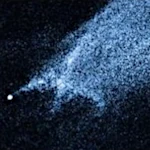 When Two Asteroids Collide: The Strange Case of P/2010 A2
  2005 YU55: The 400 m Asteroid that Grazed Earth
  Asteroid Apophis: The Perfect Candidate for a Global Impact?
  Vesta: The Colossus of the Asteroid Belt
  From Asteroids to Planets
  Comet Ison C/2012: between the promise of brilliance and disillusionment
  Giants of the Asteroid Belt: Classification by Size
  Impact Craters on Earth: Between Destruction and Mineral Resources
  Online Simulator: Orbits of Asteroids
  Online Simulator: Orbits of Near-Earth Asteroids
  Rosetta has a date with a comet
  Near-Earth Asteroids: An Underestimated Threat?
  Asteroid 2009 DD45: A Reminder of Planetary Vulnerability to Asteroids
  Strange Resemblance Between Comet Hartley 2 and Asteroid Itokawa
  Earth Trojan Asteroids: The Companions Sharing our Orbit
  Torino Scale: a classification system for impact risks
  The Nice Model: Towards an Explanation of the Late Heavy Bombardment
  NEO Monitoring: The Case of Asteroid 2012 LZ1
  Comet Lemmon C/2012 F6: The green visitor of the southern hemisphere
  Asteroid 2012 DA14 passed on February 15, 2013
  Near-Earth Asteroid 2012 BX34: A Record Close Approach to Our Planet
  Didymos and Dimorphos: The First Asteroid Moon Moved by Humanity
  Chariklo and its rings: a surprising centaur asteroid
  Rosetta and Philae: A Feat 500 Million Kilometers from Earth
  The Passage of Comets: Eccentric Orbits at the Heart of the Solar System
  Vesta and its Curiosities: The Enigma of the Torn South Pole
  Meeting the Asteroids: The Main Belt
  Orbits of Near-Earth Asteroids: When Asteroids Brush Past Earth
  Comets: Streaks of Light, Promises of Life, and Cosmic Threats
  Asteroid Pallas: A Giant of the Main Belt
  Asteroid Juno: an unknown giant of the solar system
  Ganymed (1036): Near-Earth and Mars-crosser
  Earth's quasi-satellite: 2016 HO3