


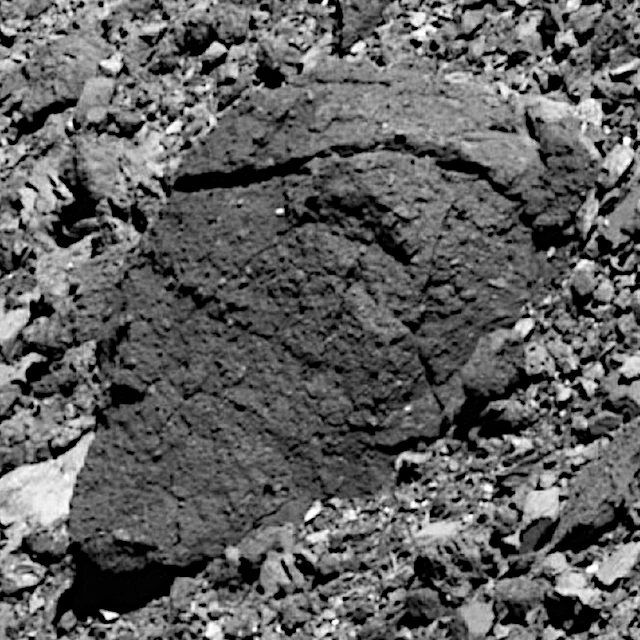
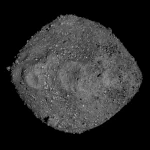
The asteroid Bennu is a carbonaceous asteroid of type B, dating back to the first few million years of the Solar System's formation. Its age is estimated at about 4.5 billion years, making it an almost unchanged witness to the physicochemical conditions in the solar nebula.
With an average diameter of about 490 meters, Bennu has a "rubble pile" structure, where self-gravity is weak, on the order of \( g \approx 10^{-5} \, \text{m·s}^{-2} \). This low gravity allows the preservation of fragile materials, including hydrated minerals and volatile organic compounds.
NASA's OSIRIS-REx probe, launched in 2016, enabled the direct sampling of Bennu, with samples returned to Earth in 2023. This mission follows the work initiated by Gerald A. Soffen (1926-2000) and other pioneers of planetary exploration, aiming to link cosmic chemistry to the origin of life.
Spectroscopic and isotopic analysis of the samples revealed the presence of carbon, nitrogen, sulfur, and hydrogen, key elements of terrestrial prebiotic chemistry.
Bennu contains hydrated phyllosilicates, evidence that its parent body interacted with liquid water very early in the history of the Solar System. This water is not free but chemically bound, indicating low-temperature reactions below 300 K.
Simple amino acids and nitrogenous bases have also been detected. These molecules are not living organisms, but they are essential precursors for the synthesis of proteins and nucleic acids.
N.B.:
The stability of these molecules in space is favored by the absence of free oxygen and very low temperatures, which limit destructive oxidation reactions.
The study of Bennu suggests that the chemical building blocks of life were already present very early during the formation of the Solar System, long before the appearance of Earth itself. These organic and hydrated mineral compounds formed directly in the solar nebula, through low-temperature physicochemical processes involving ultraviolet radiation, grain collisions, and catalysis on mineral surfaces.
In this context, Bennu is not a late vector of biological material, but a fossil reservoir preserving the initial chemical state of the protoplanetary disk. The amino acids, carbon compounds, and bound water observed today testify to widespread organic chemistry, active from the first few million years, at a time when the terrestrial planets were still accreting embryos.
From an energetic point of view, these reactions do not require violent impacts. They are compatible with weakly heated environments, where energy comes from short-lived radioactive decay, local thermal gradients, and surface reactions, allowing a progressive complexification of matter without destroying fragile molecules.
| Compound | Chemical Type | Potential Role | Detection Method |
|---|---|---|---|
| Amorphous carbon | Elemental | Support for organic chemistry | Infrared spectroscopy |
| Phyllosilicates | Hydrated mineral | Trace of primitive water | Mineralogical analysis |
| Simple amino acids | Organic molecule | Glycine (\( \mathrm{NH_2{-}CH_2{-}COOH} \)) was found in the returned samples | Chromatography |
| Carbonates | Mineral salt | Regulation of chemical pH | Mass spectrometry |
Source: NASA, OSIRIS-REx mission; Nature Astronomy, analyses 2023-2024.
 Dwarf Planets: The Forgotten Worlds of the Solar System
  Physical Composition of Trans-Neptunian Objects in the Kuiper Belt
 Haumea and its Moons: A Singularity of the Solar System
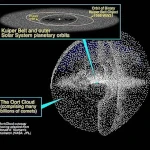 The Enigma of the Oort Cloud: Indirect Evidence and Uncertainties
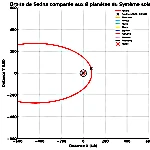 Sedna: Between the Kuiper Belt and the Oort Cloud
 Quaoar: The Dwarf Planet Defying the Roche Limit with its Rings
 The 40 largest objects in the solar system
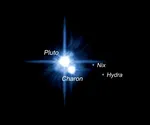 Pluto's Satellites: Strange Companions in the Dwarf Planet's Shadow
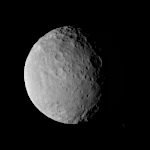 Ceres: Boundary Between Asteroid and Dwarf Planet
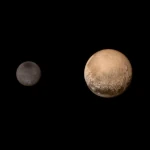 Pluto and its Moons: Charon, Nix, Hydra, Styx, and Kerberos
 Eris: The Dwarf Planet at the Edge of the Solar System
 Gonggong: An Eccentric Witness to Distant Perturbations
  Meteor Showers: Perseids, Leonids, Geminids...
  Interstellar Comets: When the Universe Sends its Messengers
  The Asteroid Bennu: The Building Blocks of Life
  Formation of Asteroids: From Cosmic Dust to Small Rocky Bodies
  The Asteroid Bennu: A Rotating Rubble Pile
  Yarkovsky Effect on Asteroids
  Arrokoth, the
red snowman
Arrokoth, the
red snowman  The Kirkwood Gaps in the Main Asteroid Belt
  What is the asteroid belt?
  The Great Comet of 1577 Shattered the Crystal Spheres
  The Invisible Threat of Asteroids: From Pebbles to Flying Mountains
  Meteorites: Messengers from Space and Witnesses of the Solar System
  Comet Hartley 2: The Icy Heart Scrutinized by Deep Impact
  When Two Asteroids Collide: The Strange Case of P/2010 A2
  2005 YU55: The 400 m Asteroid that Grazed Earth
  Asteroid Apophis: The Perfect Candidate for a Global Impact?
  Vesta: The Colossus of the Asteroid Belt
  From Asteroids to Planets
 2012 and Comet ISON: Between Promise of Brilliance and Disappointment
  Giants of the Asteroid Belt: Classification by Size
  Impact
craters on Earth
Impact
craters on Earth  Online Simulator: Orbits of Asteroids
  Online Simulator: Orbits of Near-Earth Asteroids
 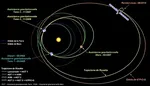 Rosetta has a date with a comet
 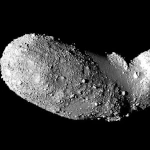 Near-Earth Asteroids: An Underestimated Threat to Our Planet?
 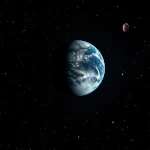 Asteroid 2009 DD45: A Reminder of Planetary Vulnerability to Asteroids
 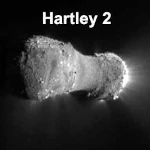 Strange Resemblance Between Comet Hartley 2 and Asteroid Itokawa
  Earth's Trojan Asteroids: Companions Sharing Our Orbit
  Turin Scale: A Classification of Impact Risks
  The Nice Model: Towards an Explanation of the Late Heavy Bombardment
  NEO Monitoring: The Case of Asteroid 2012 LZ1
 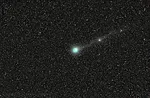 Comet Lemmon (C/2012 F6): The Southern Hemisphere's Green Visitor
 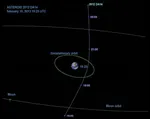 Asteroid 2012 DA14 passed on February 15, 2013
 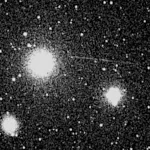 Near-Earth Asteroid 2012 BX34: A Record Close Approach to Our Planet
 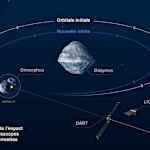 Didymos and Dimorphos: The First Asteroid Moon Moved by Humanity
 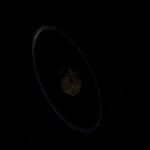 Chariklo and its rings: a surprising centaur asteroid
 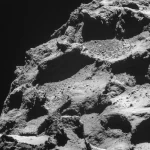 Rosetta and Philae: A Feat 500 Million Kilometers from Earth
  The Passage of Comets: Eccentric Orbits at the Heart of the Solar System
 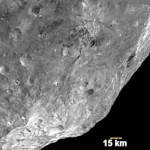 Vesta and its Curiosities: The Enigma of the Torn South Pole
 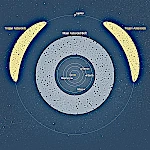 Meeting the Asteroids: The Main Belt
  Orbits of Near-Earth Asteroids: When Asteroids Brush Past Earth
  Wandering
comets
Wandering
comets  Asteroid Pallas: A Giant of the Main Belt
  Asteroid Juno: an unknown giant of the solar system
  Ganymed (1036): Near-Earth and Mars-crosser
 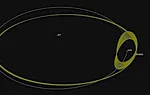 Earth's quasi-satellite: 2016 HO3