


From Black Basalt to Blue Oceans: The Changing Palette of the Earth

Our planet has undergone an incredible chromatic metamorphosis. From the dark lavas of its origins to today's multicolored landscapes, each era has left its colorful signature on the Earth's surface.
Image source: astronoo.com (new window) — AI-generated image, public domain.
Scientific Summary
This article traces the history of Earth's colors, from the Hadean (4.6 billion years ago) to the present day. The planet went from the black basalt of primitive lava oceans to the blue of liquid water oceans, passing through the orange of methane mists in the Archean, the red of rust during the Great Oxidation, the green of the plant conquest of the continents, and the dazzling white of glaciations. Each color change reflects a major transformation of the lithosphere (the solid outer layer of the Earth), the atmosphere, and the biosphere. Today, Earth is a mosaic of colors dominated by the blue of the seas, the green of forests, and the white of clouds.
How has the Earth changed colors since its birth?
Earth has not always been the "blue planet" we know today. Its color is the result of a long geological and biological evolution. 4.6 billion years ago, it was a ball of molten rock, black and red with incandescent lava. Then, cooling allowed the formation of a dark crust and the appearance of the first oceans. In the Archean, before oxygen, an atmosphere loaded with methane gave it orange hues. The arrival of oxygen rusted the continental surfaces, while the appearance of plants turned them green. Glaciations punctuated its history with white. Today, Earth is a kaleidoscope where all these colors inherited from its tumultuous past coexist.
Also worth exploring
Continue your exploration of the Universe with these topics:
The Hadean (4.6 to 4.0 billion years): primordial chaos in black and red
The eon (the largest unit of geological time, subdivided into eras, corresponding to several hundred million or billion years.) Hadean owes its name to Hades, the Greek god of the underworld, so much was the primitive Earth a hell of fire. Its surface was an ocean of molten magma, deep black and incandescent red. Intense meteoritic bombardments added yellow and white flashes to this desolate landscape. There was neither liquid water ocean nor breathable atmosphere. The dominant color was basalt black, punctuated by volcanic glows. It was in this furnace that the first minerals formed, the zircons (silicate minerals (ZrSiO₄) extremely resistant to alteration and high temperatures, used in geochronology to date the oldest rocks of the Earth, up to 4.4 billion years.), which today bear witness to this dark era.

The Hadean Earth: a sphere of molten rock, dominated by the black of basalt and the red of lavas.
Image source: astronoo.com (new window) — AI-generated image, public domain.
The Archean (4.0 to 2.5 billion years): the orange of primitive mists and the pink of nascent life
At the beginning of the Archean, before oxygen accumulated, the Earth's atmosphere was very different. It contained significant amounts of methane (CH₄) and carbon dioxide, emitted by intense volcanic activity. These gases, interacting with solar radiation, created a thick organic haze, a sort of photochemical "smog" that filtered light. This haze gave the sky and surface an orange or ochre tint, reminiscent of Titan's atmosphere, one of Saturn's moons. The oceans, still without oxygen, were loaded with dissolved iron (Fe²⁺) and appeared green or gray-green. It was only later, with the activity of cyanobacteria (photosynthetic prokaryotic microorganisms capable of producing oxygen from water and carbon dioxide. They are at the origin of the Great Oxidation and transformed the Earth's atmosphere about 2.4 billion years ago.), that life began to color the shores with pink and purple hues, thanks to bacterial pigments. Thus, the Archean saw orange, green, and pink palettes succeed one another, well before the green of plants.

At the beginning of the Archean, a methane haze colored the atmosphere orange, while the oceans, rich in dissolved iron, appeared green.
Image source: astronoo.com (new window) — AI-generated image, public domain.
The Proterozoic (2.5 to 541 million years): the era of rust and oxygen
The Proterozoic is marked by a major event: the Great Oxidation, about 2.4 billion years ago. Cyanobacteria, by producing oxygen through photosynthesis, saturated the atmosphere and oceans with this reactive gas. Oxygen reacted with dissolved iron in the oceans, precipitating it as iron oxides, that is, rust. These deposits formed immense layers of red rocks, called BIFs (Banded Iron Formations). The Earth then adorned itself with ochre, red, and yellow hues on its continents, while the oceans became clearer. This period saw the planet "rust" on a large scale, a chromatic transformation that lasted hundreds of millions of years.

Banded iron formations (BIFs) are the vestiges of the Great Oxidation, which rusted the Earth's surface.
Image source: astronoo.com (new window) — AI-generated image, public domain.
The Phanerozoic (from 541 Ma to today): when life exploded the planet was covered in green
The Phanerozoic is the era of visible life, and with it, the appearance of the colors we know best. The conquest of the continents by plants, about 450 million years ago, clothed the Earth in a green mantle. Chlorophyll became the dominant pigment of landscapes. The forests of the Carboniferous (geological period of the Paleozoic (358.9 to 298.9 million years) characterized by immense humid tropical forests that gave rise to the main coal deposits. This period saw a spectacular diversification of terrestrial plants and giant insects.) gave birth to immense green swamps. Over the eras, colors diversified with the appearance of flowers, whose yellow, red, and purple pigments attracted pollinators. The blue of the sky and oceans intensified with a clearer atmosphere. The Phanerozoic is an explosion of colors, with the emergence of multicolored landscapes that we know today.

The Phanerozoic era saw the continents covered in green forests, radically transforming the Earth's appearance.
Image source: astronoo.com (new window) — AI-generated image, public domain.
The Great Glaciations: the Earth in white and blue
Sometimes, the Earth tipped into a state of extreme glaciation, as during the Proterozoic (the Snowball Earth episode (period of global glaciation where the Earth was almost entirely covered in ice.)). The two major episodes occurred about 720 million years ago (Sturtian glaciation) and 635 million years ago (Marinoan glaciation). The entire planet, or nearly so, was covered in ice, offering a dazzling white appearance from space. These episodes had a major impact on the Earth's albedo, that is, its capacity to reflect solar light. Ice, by reflecting light, reinforced cooling, creating a feedback loop (mechanism of amplification or attenuation of a phenomenon by its own effects. In the case of ice-albedo, the melting of ice reduces albedo, which increases heat absorption and accelerates melting, creating an amplification of warming.). More recent glaciations, in the Quaternary (geological period of the Cenozoic beginning 2.58 million years ago and continuing to the present, marked by successive glacial and interglacial cycles.) (since 2.58 million years), also left their white imprint on the poles and mountains, with ice caps reaching up to 3 km thick during glacial maxima.

"Snowball Earth": a spectacle of whiteness, where ice dominated the landscape for millions of years, notably during the Sturtian (720 Ma) and Marinoan (635 Ma) glaciations.
Image source: astronoo.com (new window) — AI-generated image, public domain.
The Earth Today: a mosaic of colors and life
Today, the Earth is a patchwork of colors inherited from its entire history. The blue of the oceans, which covers 71% of the surface, dominates. The green of tropical and temperate forests covers vast expanses, while the brown and yellow of deserts recall the rusted lands of the Proterozoic. The white of clouds and ice caps contrasts with the black of the ocean depths. Human activity has added its own colors: the orange lights of cities at night, the gray patches of urbanization, and agricultural surfaces with varied hues. The current Earth is a living kaleidoscope, each nuance telling a part of its tumultuous and fascinating history.

Contemporary Earth: a mosaic of blue, green, brown, and white, reflecting its geological and biological history.
Image source: astronoo.com (new window) — AI-generated image, public domain.
Summary Table of Earth's Colors Through the Ages
| Eon / Period | Period (billion years) | Dominant colors | Key event |
|---|---|---|---|
| Hadean | 4.6 - 4.0 | Black, red, yellow | Magma ocean, meteoritic bombardments |
| Archean | 4.0 - 2.5 | Orange, green, pink, purple | Methane haze, dissolved iron, first microbes (cyanobacteria) |
| Proterozoic | 2.5 - 0.5 | Red, ochre, yellow, light blue, white (global glaciations) | Great Oxidation, banded iron formations (rust), Sturtian (720 Ma) and Marinoan (635 Ma) glaciations |
| Phanerozoic | 0.5 - today | Green, blue, white, multicolored (flowers) | Plant conquest (450 Ma), explosion of life (Cambrian), polar glaciations (Quaternary) |
| Modern Era (Quaternary) | 0.0026 - today | Blue, green, white (polar caps), brown, orange (cities) | Glaciations of the poles and high latitudes, glacial/interglacial cycles, human influence |
The Colors of the Past in Our Cells: Molecular Heritage
Our body carries within it the traces of this colorful past. At the heart of our cells, molecules essential to life are the direct descendants of the pigments that colored primitive Earth.
The Heritage of Cyanobacteria: Photosynthesis and Chlorophyll
Cyanobacteria, those microorganisms that gave their pink and purple hues to the Archean, bequeathed to our cells a fundamental tool: oxygenic photosynthesis. Their molecular machinery, based on chlorophyll, is at the origin of the oxygen we breathe today. Without these first photosynthetic pigments, the Earth's atmosphere would have remained reducing and complex life would never have seen the light of day.
Mitochondria: Respiratory Pigments Inherited from Proteobacteria
The most intimate heritage is found in our mitochondria, the powerhouses of our cells. These organelles are the descendants of ancient proteobacteria (bacteria capable of producing energy by respiration using oxygen, ancestors of current mitochondria.) that, about 1.5 billion years ago, were engulfed by a primitive cell. This symbiosis gave birth to the first eukaryotic cells, from which we descend. The pigments of these bacteria, such as cytochromes and flavins, are colored molecules (red, yellow, brown) that transport electrons in the respiratory chain. Our breath and our vital energy therefore depend on these ancestral pigments, true functional molecular fossils.
Melanin: Sun Protection Inherited from Primitive Radiation
Closer to us, melanin, the pigment that colors our skin, hair, and irises, is a protection against ultraviolet radiation from the Sun. Its production is an adaptation to light intensity, a distant echo of the evolution of Earth's colors. Populations living at sunny latitudes developed darker skin, rich in melanin, while those in less sunny regions have lighter skin, allowing better synthesis of vitamin D. This diversity of skin tones is a direct response to the history of our planet and the variable intensity of solar radiation during human migrations.
Opsins: Our Eyes, Witnesses to the Evolution of Colors
Finally, our retina is equipped with photoreceptor cells, cones and rods, which contain light-sensitive pigments: opsins. These pigments, derived from retinal (a derivative of vitamin A), allow us to perceive the colors of the world. They are the molecular heirs of the first photoreceptor systems that appeared more than 500 million years ago in the ancestors of vertebrates. Thus, our eyes are direct witnesses to the evolution of Earth's colors, an open window onto the chromatic past of our planet.
The Role of Colors in Climate Balance
The colors of the Earth are not just a question of aesthetics. They play a fundamental role in climate regulation through albedo. Albedo is the reflecting power of a surface. Light surfaces (ice, snow, clouds) reflect a large part of solar radiation (high albedo, up to 80%), while dark surfaces (oceans, forests) absorb it (low albedo, about 10%). Thus, the color of the Earth directly influences the amount of solar energy it retains. The melting of ice, by reducing albedo, accelerates global warming: this is the ice-albedo feedback. Understanding the evolution of Earth's colors is therefore essential for modeling its past and future climate.
The Colors of the Earth: an Open Book on Its Past
Each color of the Earth is an archive of its history. Red rocks tell us of an oxygenated atmosphere, pink stromatolites of the appearance of life, traces of old green forests of the expansion of plants. Scientists, such as paleontologists and geologists, use these colored clues to reconstruct past environments. The color of minerals, such as iron oxyhydroxides, can indicate the chemical and climatic conditions of the time of their formation. Thus, the Earth is an immense book whose pages are colored, and each nuance is a sentence of its history.
References
FAQ: Everything About the History of Earth's Colors
Why was the Earth orange during the Archean?
At the beginning of the Archean, before oxygen accumulated, the Earth's atmosphere contained large amounts of methane (CH₄) and carbon dioxide. These gases, under the effect of solar radiation, formed a thick photochemical haze, an organic "smog" that absorbed blue light and let through longer, red and orange wavelengths. This phenomenon is similar to what we observe on Titan, the largest moon of Saturn, whose methane-rich atmosphere gives it an orange hue. Thus, the sky and surface of primitive Earth appeared orange or ochre, a palette very different from today's blue.
Why is the Earth called the "blue planet" when it was black, orange, and red?
The Earth is nicknamed the "blue planet" because of the dominant color of its surface seen from space today: the oceans, which cover about 71% of the surface, reflect and absorb light to give this characteristic blue hue. However, this color is recent on the scale of Earth's history. During its first billion years, the planet was successively black (Hadean), orange (Archean), then red (Proterozoic) and green (Phanerozoic). The current blue is the result of the planet's cooling, the formation of liquid water oceans, and a clear atmosphere, a process that began about 4 billion years ago but only took its current hue with oxygenation and the clearing of the atmosphere.
What was the first biological color on Earth?
The first known biological color is not green, but pink or purple. Scientists have discovered in rocks 1.1 billion years old fossils of cyanobacteria containing pink pigments, close to bacteriochlorophyll. These microorganisms used this pigment for photosynthesis, before the appearance of green chlorophyll. Thus, the first visible colors of life on Earth were pinkish and purplish hues, which colored the oceans and shores for hundreds of millions of years, well before the advent of green plants.
How does the color of the Earth influence the climate?
The color of the Earth influences the climate through the phenomenon of albedo. Albedo is the fraction of solar light reflected by a surface. A light surface (such as ice or clouds) has a high albedo and reflects a large part of solar energy back into space, which has a cooling effect. A dark surface (such as an ocean or forest) has a low albedo, absorbs more heat, and contributes to warming. Changes in the Earth's color, such as the melting of ice that reduces albedo, can therefore amplify or attenuate climate change. This is called the ice-albedo feedback, a key mechanism in climate models.
Why are banded iron formations red?
Banded iron formations (BIFs) are sedimentary rocks dating from the Proterozoic, composed of alternating layers of iron ore (hematite, magnetite) and chert. Their red, yellow, or brown color is due to the presence of iron oxides, mainly hematite (Fe₂O₃). These oxides formed when oxygen produced by cyanobacteria reacted with dissolved iron in the oceans, precipitating it as rust. BIFs are therefore the geological witnesses of the Great Oxidation and colored vast regions of the globe red more than 2 billion years ago.
 From Black Basalt to Blue Oceans: Earth's Changing Palette
  Plate Tectonics: The Invisible Engine Moving the Continents
  The Number 360: The Mathematical Key to the Babylonian Sky
  Wet-Bulb Temperature: Humanity's Climate Time Bomb
  Why Doesn't Earth's Atmosphere Escape into Space?
  Origins of Earth: Magmatic Chaos and the Birth of the Solid World
  Earth's Atmosphere: The Invisible Shield Protecting Life
  The 5 Cosmic "End of the World" Scenarios (and Why They Won't Happen)
  Where does the water in the oceans come from? Three key stages
  From Carbon 14 to Uranium-Lead: The Science of Dating
  Major Natural Disasters: What Are the Most Likely Threats?
  The Boundary of Space: Where Does It Really Begin?
  536: The Year Without a Summer and the Beginning of the Late Antique Little Ice Age
  The leap second: scheduled end in 2035
  Planetary Alignments: A Fascinating but Relative Phenomenon
  All Deserts of the World
  Earth's Paleoclimates and Carbon Dioxide
  What is the effect of large lakes and water reservoirs on Earth's rotation?
  International Date Line
  Start Date of the Seasons: A Complex Celestial Mechanism
  Paleomagnetism: the magnetic memory of rocks
  3D Simulator: Revolutions of the Planets
  Geological Time and Mass Extinctions: From the Ordovician to the Cretaceous
  Earth History: Timeline Compressed into 24 Hours
  Earth's Water: An Extraterrestrial Origin?
  Reading the Sky: Understanding Declination and Right Ascension
  How is Earth's magnetic field born and why does it reverse?
  Earth's Magnetosphere: The Invisible Shield
  Fujita Scale: Classifying the Fury of Tornadoes
  Earth's Radioactivity: The Internal Energy of Our Planet
  The Deep Sea: Exploring the Deepest Ocean Trenches
  Why Are Days Getting Longer?
  The Depths of the Earth: From the Lithosphere to the Core
  Earth's Movements: How Earth Traces Its Spiral Through the Universe?
  How much is the sea level rising?
  The Life of Earth: Structure and Layers of the Earth
  The Eccentricity of Earth's Orbit: An Ellipse That Changes Everything
  Little Ice Age: The History of a Natural Climatic Cooling
  The Quest for Time: How Ancient Civilizations Used Astronomy?
  Van Allen Belt: A Rampart Against Cosmic Particles
  The Cosmos in Our Measure: When Man Invents the Universe
  What is the pendulum fixed relative to?
  Problem of longitude at sea
  World population, still gallopingin 2008
 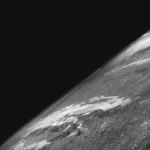 The Oldest Image of Earth from Space
 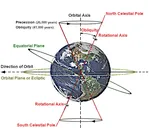 Earth's Obliquity and Variations in Its Axis of Rotation
  The Astronomical Unit Fixed: A Length, No Longer an Orbit
  Water: one molecule, three states on Earth
  Simulator, the round of near-Earth cruisers
  Satellites that measure underwater relief
  Hadean's Hell
  The First Free Flight of an Astronaut in Space
  The first measurement of the Earth-Sun distance
  La The Announced End of the World on December 21, 2012: A Millennial Prophecy
 The Equinoxes: An Astronomical Event
 Milankovitch Cycles: The Astronomical Rhythm of Earth's Climate
 Why Is Earth So Often Cloudy?